
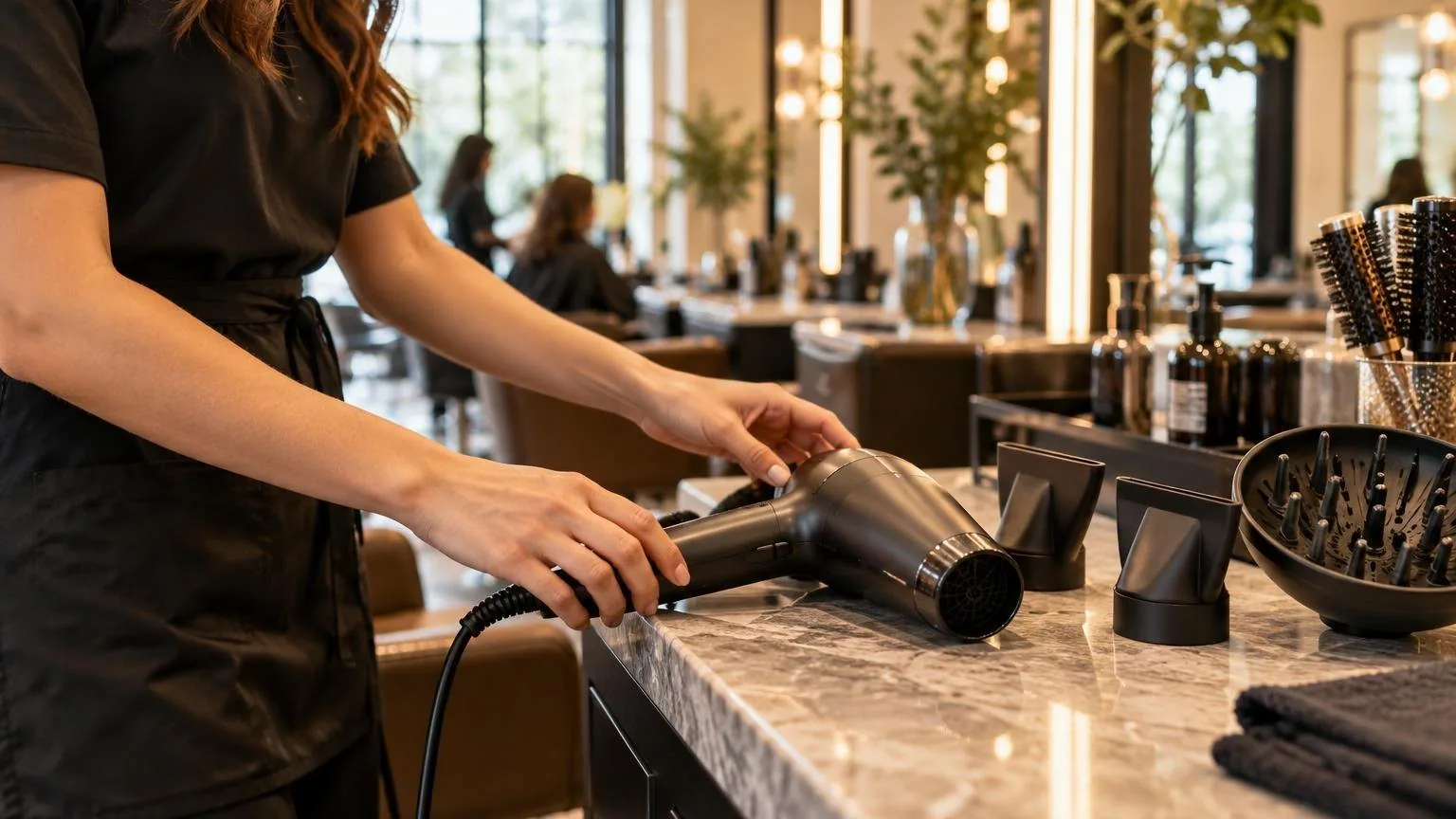
Hair dryer nozzle types explained: a concentrator directs airflow through a 10–20 mm opening for smoother, faster section-by-section styling. A diffuser spreads air across 60–90 mm fingers to preserve curl pattern while reducing force.
This guide compares concentrators, diffusers, picks, and comb attachments by outlet shape, airflow control, heat distribution, and finish.
You will see which nozzle suits sleek blowouts, defined waves, root lift, or gentle drying, then match each tool to brush size and section width.
Expect practical settings: use a 25–35 mm round brush for medium sections, keep the nozzle 2–5 cm from the hair, and angle airflow from roots to ends.
The final checklist covers attachment fit, cleaning, heat control, and technique for consistent salon-style results at home.
Match Your Nozzle to Your Hair Width
Nozzle openings range from roughly 50 mm to 120 mm wide. The wrong width wastes time or fries ends. Use the steps below to find your starting point.
- Measure a section. Take a typical working section of hair — the width you’d wrap around a round brush. For most blowout work, that sits between 50 mm and 100 mm wide.
- Compare to your nozzle opening. A concentrator nozzle should be narrower than your section width. A 75 mm nozzle paired with a 50 mm section sprays air past the hair and heats surrounding strands. Flip that: a 50 mm nozzle on a 75 mm section focuses the stream tightly within the section boundaries.
- Factor in hair density. Fine or low-density hair needs a narrower opening (50–65 mm) at a lower temperature, around 70–80 °C at the outlet. Thick, coarse, or high-density hair handles a wider nozzle (75–90 mm) at 80–95 °C because the mass absorbs heat faster.
- Check the gap width. Concentrator nozzles also vary in slot height — typically 5 mm to 12 mm. A thinner slot (5–7 mm) delivers higher-velocity air for sleek straightening. A wider slot (9–12 mm) diffuses the stream for softer, voluminous results.
Write down the nozzle dimensions printed or embossed on each attachment you own. Cross-reference them against the section widths you actually use on the three hair types you see most often in your chair.
What the Data Shows
Nozzle geometry directly controls airflow velocity, heat concentration, and drying time.
Narrower nozzle openings accelerate air speed while focusing heat onto a smaller strand section, which is why concentrator width matters more than wattage alone for a smooth, frizz-free result.
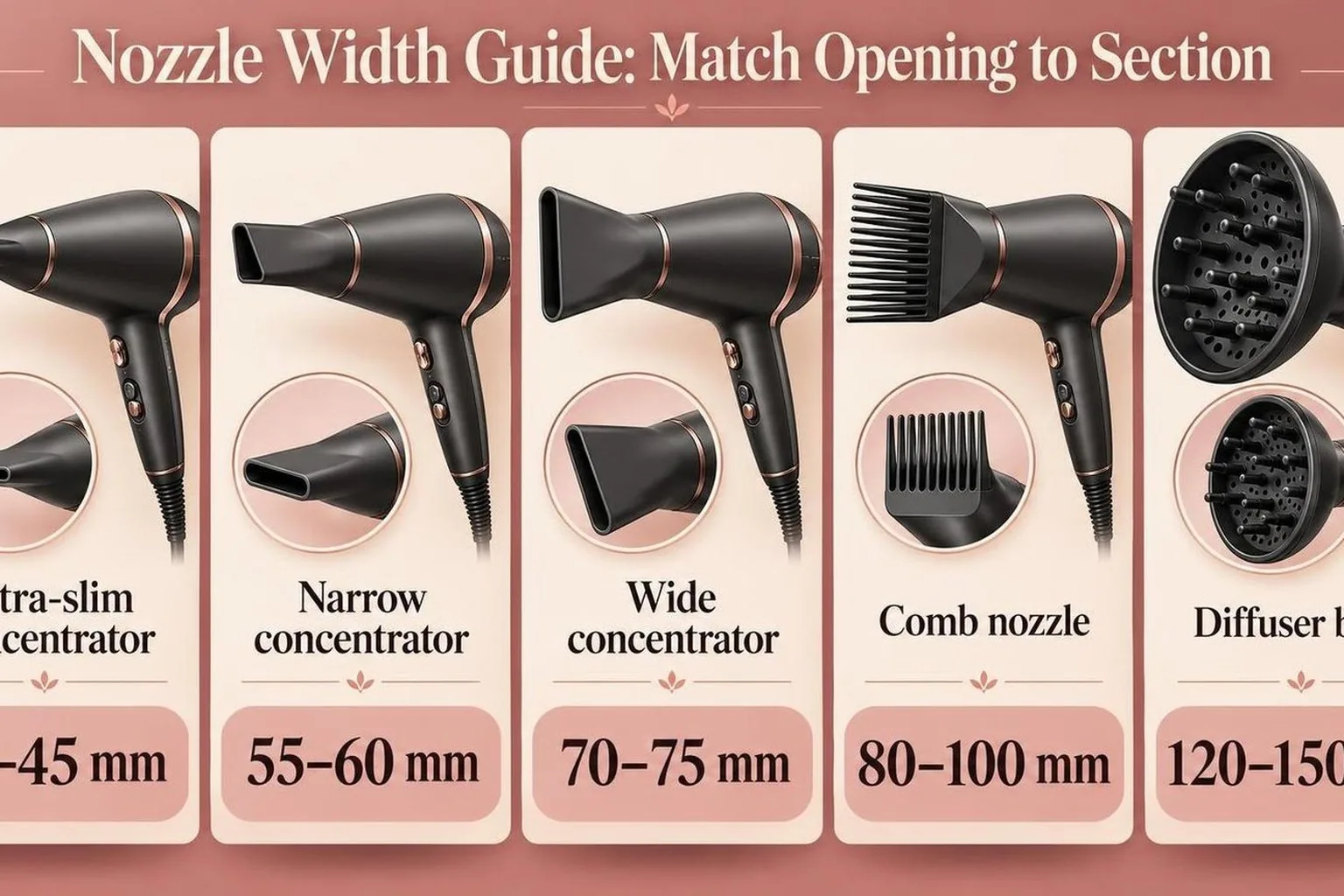
Most professional dryers ship with two concentrator nozzles. The wider one typically measures 70–75 mm across the opening; the narrower one sits around 55–60 mm. That size difference changes how air hits the cuticle.
| Nozzle Type | Typical Opening Width | Airstream Width at 15 cm | Best Use |
| Wide concentrator | 70–75 mm | ~90 mm | Rough-drying, volume work |
| Narrow concentrator | 55–60 mm | ~65 mm | Smoothing, tension styling |
| Ultra-slim concentrator | 40–45 mm | ~50 mm | Precision finishing, flyaway control |
| Diffuser (bowl type) | 120–150 mm diameter | Dispersed across full bowl | Curl definition, wave enhancement |
| Comb nozzle | 80–100 mm with tines | Dispersed through tines | Textured and coily hair detangling |
A narrow concentrator increases air velocity by roughly 15–20% compared with a wide concentrator on the same dryer and speed setting, because the same volume of air is forced through a smaller exit.
Concentrator Angle and Gap Height
Gap height — the vertical opening of the nozzle slot — typically ranges from 5 mm to 9 mm on professional models.
A thinner gap produces a flatter, more laminar airstream that presses the cuticle shut more effectively during a round-brush pass.
Angled concentrators, tilted 15–20 degrees downward, direct airflow along the hair shaft rather than perpendicular to it.
This reduces cuticle disruption and supports the direction of brushwork without fighting the stylist’s wrist position.
Diffuser Finger Length and Spacing
Standard diffuser fingers measure 30–40 mm long, spaced roughly 12–15 mm apart. Longer fingers (45–50 mm) cradle more hair per section, reducing the number of repositions needed on dense, coily textures and cutting overall dry time.
Bowl diameter also matters. A 150 mm diffuser covers approximately 175 cm² of surface area — nearly four times the coverage of a 75 mm wide concentrator. That spread drops air velocity and lowers localised heat intensity.
Practical Takeaway
- Use the wide concentrator for 70–80% of rough-drying to save time.
- Switch to the narrow or ultra-slim concentrator for finishing passes within 10 cm of the hair.
- Reserve diffusers for clients with curl patterns ranging from wavy (type 2B) through coily (type 4C).
- Replace nozzles when cracks appear — a warped concentrator leaks air sideways and defeats the purpose of directed airflow.
What Moves the Outcome
Three variables determine how a nozzle shapes the finished result: aperture width, airflow velocity at the exit point, and the angle at which heated air contacts the hair strand.
Changing any one of these shifts drying time, cuticle behavior, and final smoothness measurably.
Aperture Width and Airflow Concentration
A standard concentrator nozzle narrows outlet width to between 8 mm and 14 mm. That compression accelerates airflow and focuses heat onto a smaller band of hair, typically 2–4 inches wide per pass.
Wider nozzles — 20 mm or above — spread air across a broader section. This reduces heat intensity per square centimeter but increases drying time because energy disperses.
| Nozzle Type | Typical Aperture | Best Use |
| Slim concentrator | 8–10 mm | Sleek finishes, fine hair, precision sectioning |
| Standard concentrator | 11–14 mm | General blowouts, medium-density hair |
| Wide concentrator | 15–22 mm | Rough-drying, thick or coily textures |
| Diffuser | Full barrel diameter (70–90 mm) | Curl definition, volume at the root |
Velocity at the Exit Point
Narrowing the aperture raises exit velocity without increasing motor speed. A dryer producing 90 km/h at the open barrel can exceed 120 km/h through a slim concentrator, following basic fluid dynamics (Bernoulli’s principle).
Higher velocity pins the cuticle flat against the cortex when directed root-to-tip. This is the mechanical basis for smoothness in a tension blowout — not heat alone.
Angle of Contact
Holding the nozzle at roughly 45 degrees to the hair strand, aimed downward, encourages cuticle closure. Perpendicular airflow lifts cuticle edges, creating frizz and a matte texture.
- 45-degree downward angle: cuticle seals, maximum light reflection, smoothest finish
- 90-degree angle: cuticle disruption, added volume but reduced shine
- Upward angle (diffuser use): lifts roots, encourages curl spring without elongation
Material and Heat Transfer
Ceramic-coated nozzles distribute heat more evenly across the aperture opening. Uncoated plastic nozzles can create hot spots near the center of the airstream, raising localized temperatures by 10–15 °C above the dryer’s set level.
Tourmaline-infused nozzles generate negative ions at the surface, reducing static and shortening smoothing time by an estimated 15–20 percent compared to untreated plastic.
Matching the correct nozzle width and material to the client’s density and target finish is the single highest-leverage decision in any blowout sequence. The dryer motor matters, but the nozzle directs every watt of its output.
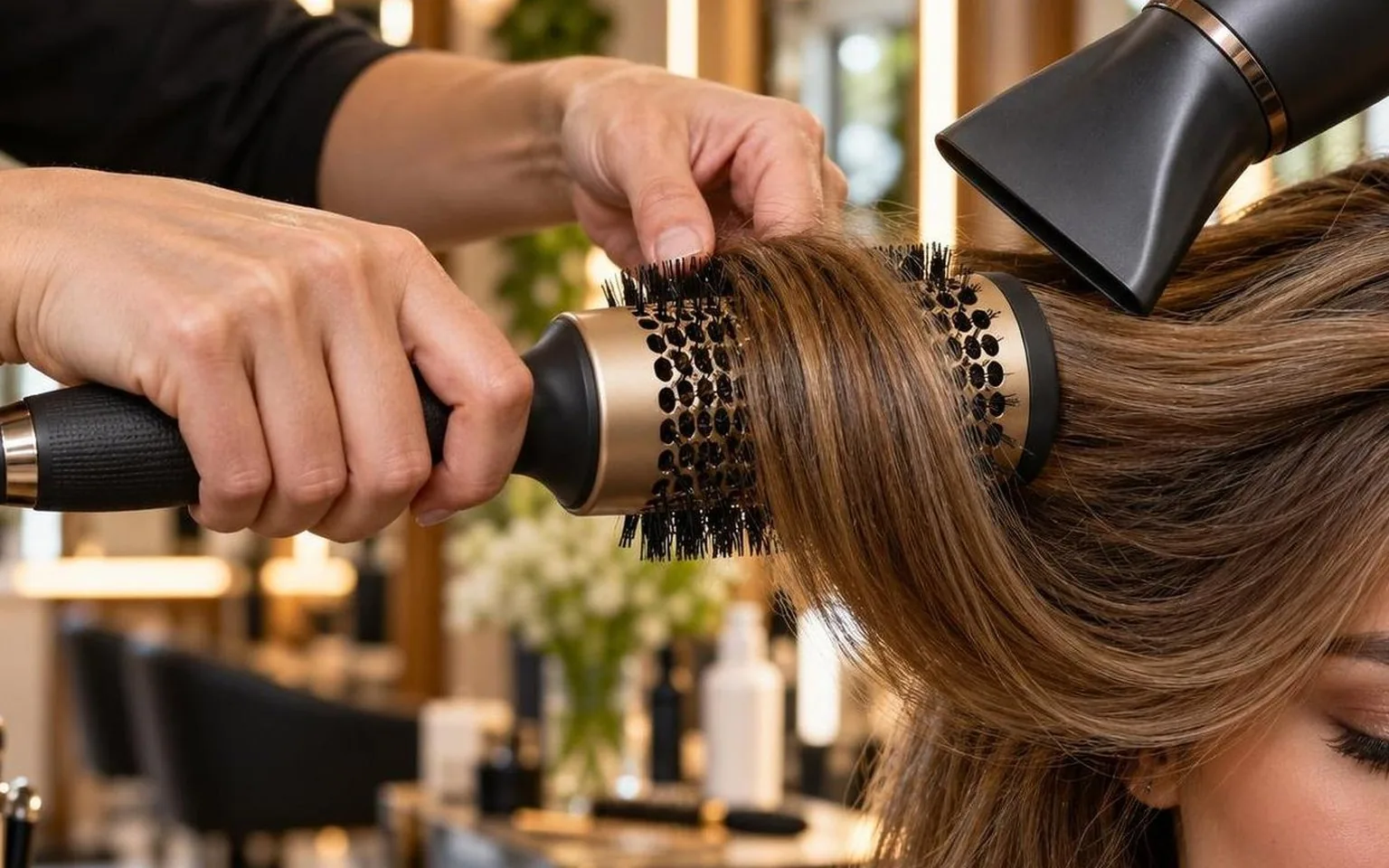
Spotting It on the Day
Identifying the right nozzle before you start drying saves time and prevents heat damage. Each attachment has a distinct shape, width, and lock-on mechanism that you can confirm visually and by touch in under five seconds.
Most professional dryers ship with two or three nozzle attachments. Recognising each one at a glance means you pick the correct tool without trial and error mid-client.
Concentrator Nozzle
This is the flat, rectangular attachment with a narrow slit opening. Typical slit widths range from 6 mm to 12 mm. The narrower the slit, the more focused the airstream and the greater the tension you can create on a section.
Run your finger across the opening. If the slit is roughly the width of a pencil (about 7 mm), you are holding a styling concentrator suited for smoothing and straightening work.
Wide Concentrator (Smoothing Nozzle)
Wider than a standard concentrator, this nozzle has a slit opening between 14 mm and 20 mm. It covers more surface area per pass, reducing total drying time on thick or long hair by distributing airflow across a broader section.
Diffuser
Unmistakable: a large, bowl-shaped disc studded with prongs or “fingers” typically 2 cm to 4 cm long. Diffuser diameters usually span 12 cm to 15 cm. It disperses airflow to minimise frizz on curly and wavy textures.
Quick-Reference Comparison
| Nozzle Type | Shape | Opening / Diameter | Best Use |
| Standard concentrator | Flat, narrow slit | 6–12 mm slit | Smoothing, sectional styling |
| Wide concentrator | Flat, broad slit | 14–20 mm slit | Faster rough-dry, thick hair |
| Diffuser | Bowl with prongs | 12–15 cm disc | Curl definition, volume |
Fit Check
Before switching on, confirm the nozzle seats firmly. Most snap or twist onto the barrel end. A loose nozzle vibrates, redirects airflow unevenly, and can detach mid-blowout.
- Twist-lock: rotate 15–20 degrees clockwise until the click.
- Friction-fit: push straight on until flush with the barrel collar.
- Magnetic mount: align and let the magnets grab — gentle tug to verify hold.
Hold the dryer barrel-down and shake once. If the nozzle shifts or rattles, reseat it. A secure attachment ensures consistent, directional airflow from root to tip throughout the service.
Labelling your nozzles with a small dot of coloured nail lacquer — one colour per type — speeds station setup when multiple stylists share equipment at the backbar.
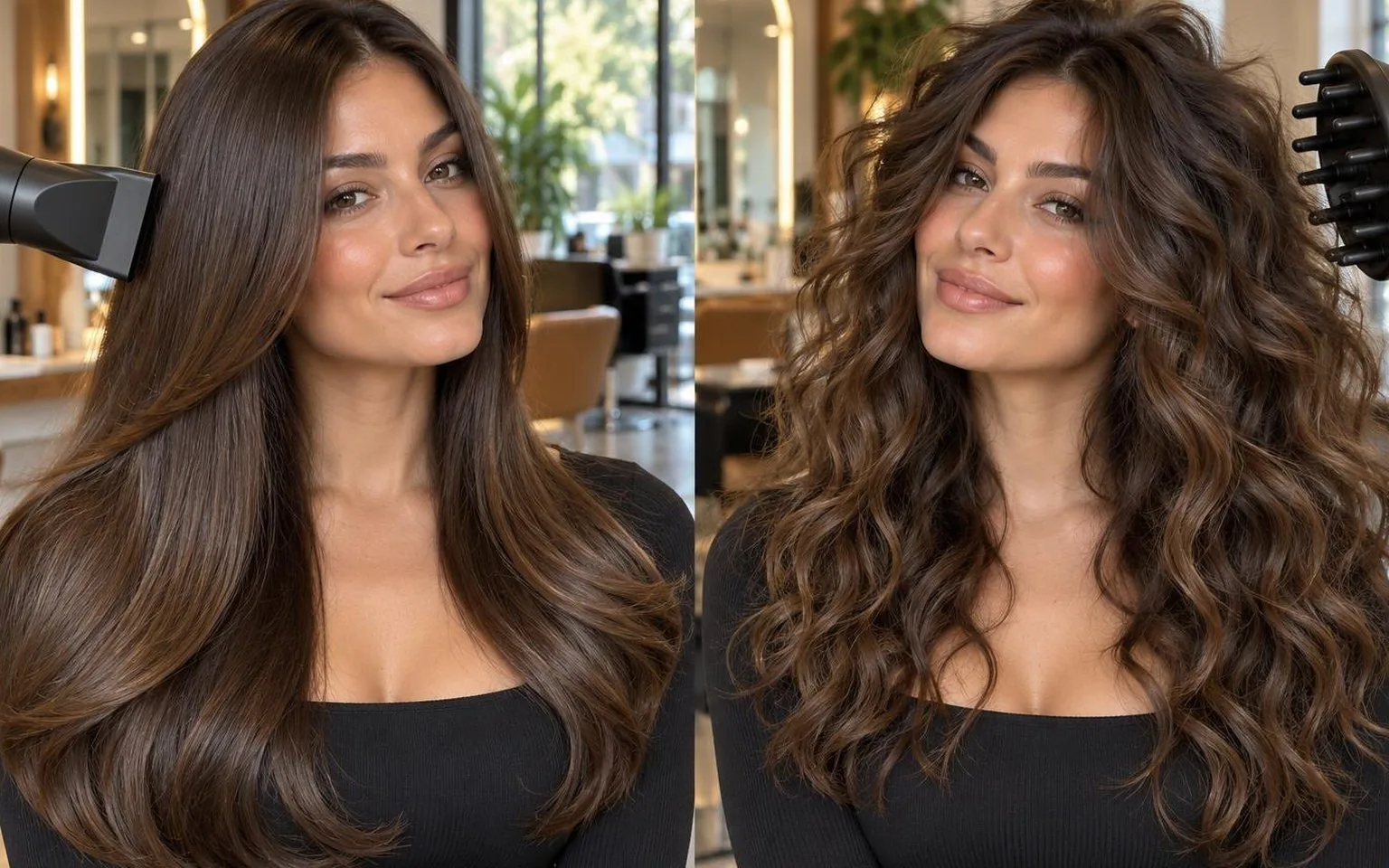
How the Choices Stack Up
Each nozzle type controls airflow width, velocity, and heat concentration differently. Matching the right attachment to the task — smoothing, diffusing, or volumising — determines finish quality and drying time.
The differences are measurable and significant.
Concentrator Nozzles
The standard concentrator (also called a styling nozzle) narrows the dryer’s airflow into a flat, directed stream. Most concentrators measure between 60 mm and 90 mm wide with an opening gap of roughly 5–10 mm.
Narrower openings increase air velocity at the exit point. This accelerates smoothing by pressing the cuticle flat along the hair shaft, reducing frizz and boosting shine.
| Nozzle Type | Typical Opening Width | Best Airflow Pattern | Primary Use |
| Wide concentrator | 8–10 mm | Broad, moderate velocity | Rough-drying, general shaping |
| Narrow concentrator | 5–7 mm | Tight, high velocity | Sleek finishing, section work |
| Diffuser | 80–120 mm diameter | Dispersed, low velocity | Curls, waves, volume at roots |
| Comb nozzle | Toothed attachment | Directed through teeth | Detangling while drying textured hair |
Diffuser Attachments
Diffusers spread concentrated airflow across a wide bowl — typically 80–120 mm in diameter — fitted with prongs ranging from 20 mm to 40 mm long. The dispersed air reduces direct force on curls.
Shorter prongs suit tighter curl patterns (type 3c–4c). Longer prongs lift and separate looser waves (type 2a–3b) without disrupting curl clumps.
Optimal diffusing temperature sits around 60 °C at the hair surface. Hold the diffuser 0–5 cm from the head and use medium speed to preserve curl definition without heat damage.
Comb Nozzles
Comb attachments channel airflow through evenly spaced teeth, combining detangling with drying in a single pass. They reduce mechanical stress compared to using a separate brush during blow-drying.
These attachments work well on coily and tightly textured hair. Teeth spacing of roughly 5–8 mm prevents snagging while still stretching the hair shaft during drying.
Choosing by Task
- Smooth blowout: Narrow concentrator, 70–80 °C, high speed, held at a 45-degree downward angle to the brush.
- Defined curls: Diffuser, 55–65 °C, medium speed, cupping sections upward toward the scalp.
- Quick rough-dry: Wide concentrator or no nozzle, high speed, constant movement to avoid hot spots.
- Textured stretch-out: Comb nozzle, medium heat, slow passes from root to mid-length.
Swapping nozzles mid-service is standard practice. Rough-dry with the wide concentrator first, then switch to the narrow concentrator for finishing — total time savings of roughly 15–20% compared to using a single attachment throughout.
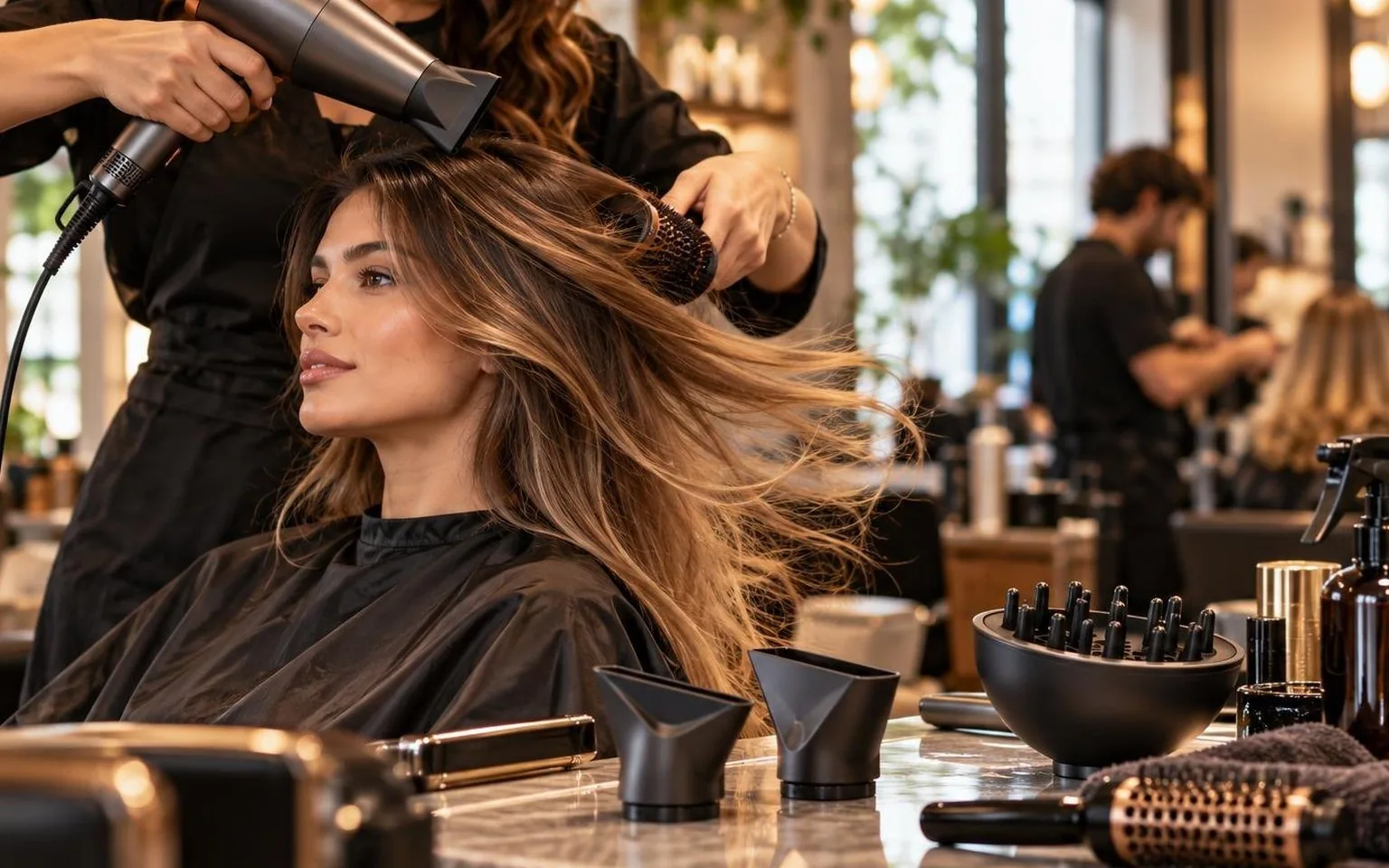
Heat Without the Cost to Hair
Nozzle choice directly controls how heat reaches the hair shaft. A concentrator nozzle narrows airflow into a focused stream, raising surface temperature at the strand but reducing overall drying time.
Shorter exposure offsets higher localised heat, preserving moisture content when technique is correct.
The physics are straightforward: compressing air through a narrower opening increases velocity while concentrating thermal energy on a smaller target area.
Nozzle Width and Airflow Dynamics
Standard concentrator nozzles ship in widths between 50 mm and 75 mm. Narrower slots produce faster, more focused airflow. Wider slots distribute heat over a broader section, lowering peak temperature at any single point on the strand.
| Nozzle Slot Width | Typical Use | Airflow Character | Relative Strand Temperature |
| 5–7 mm (slim concentrator) | Sleek finishing, smoothing flyaways | High velocity, tight stream | Higher at contact point |
| 10–14 mm (standard concentrator) | General blow-dry, round-brush work | Moderate velocity, directed | Moderate |
| No nozzle (open barrel) | Rough-drying, diffusing curls | Wide, dispersed | Lower per strand |
| Diffuser (80–120 mm diameter) | Curl definition, wave enhancement | Low velocity, spread across wide area | Lowest per strand |
Temperature and Distance
Air exiting a professional dryer at the barrel sits around 80–100 °C on a high-heat setting. At 15 cm from the nozzle tip, that drops to roughly 60–70 °C.
Holding the dryer closer than 10 cm with a slim concentrator risks pushing strand temperatures above 150 °C.
Hair protein begins to degrade at sustained temperatures above approximately 150 °C. Keeping the nozzle moving and maintaining at least 15 cm distance are non-negotiable habits for preserving cuticle integrity.
Practical Rules for Nozzle Heat Management
- Use the widest concentrator that still achieves the desired tension and smoothness.
- Angle the nozzle downward at roughly 45 degrees to direct heat along the cuticle grain rather than against it.
- Switch to a cool-shot (typically 20–25 °C output) after each section to close the cuticle before moving on.
- On fine hair below 60 µm strand diameter, drop to a medium-heat setting and add 2–3 cm of extra distance.
- Rotate between two sections while drying so no single area receives continuous heat for more than 8–10 seconds.
A diffuser attachment reduces air speed to roughly 1.2–1.8 m/s compared with 12–15 m/s through a slim concentrator.
That velocity gap is why diffused drying feels gentler — heat is present, but mechanical force on the strand is drastically lower.
Matching nozzle type to hair density and target style is the single most effective way to manage thermal exposure without sacrificing finish quality.
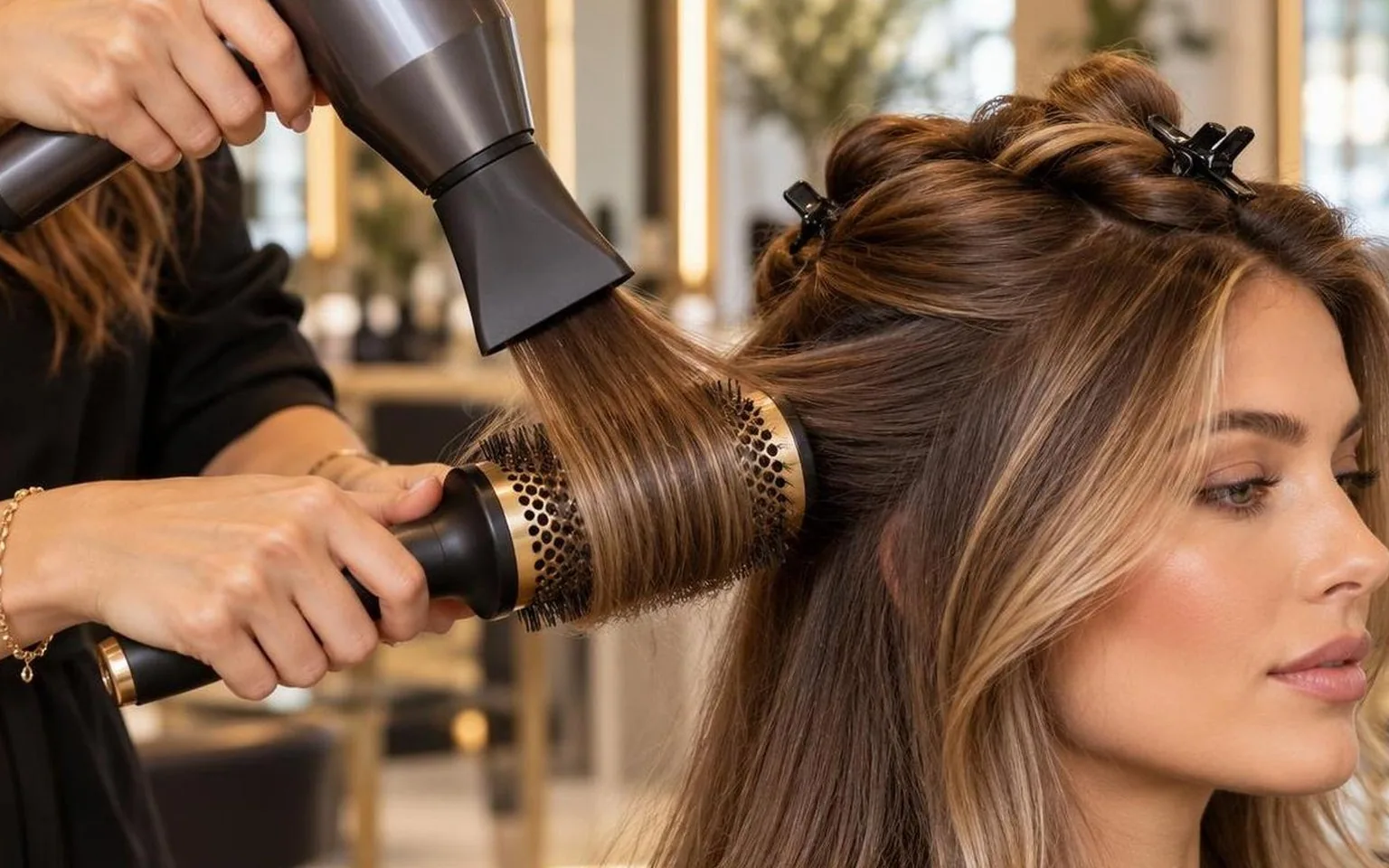
What Is Happening to the Hair
Every nozzle type manipulates three physical variables: airflow velocity, heat concentration, and the angle at which both strike the cuticle layer.
Changing any one variable alters how quickly hydrogen bonds in wet keratin break and re-form into a temporary shape. The nozzle is the control surface for all three.
Hydrogen Bonds and Heat
Water-saturated hair contains hydrogen bonds in a mobile state. Applying heat between 80°C and 130°C at the strand surface accelerates evaporation, allowing those bonds to lock into the position the brush or tension dictates.
A concentrator nozzle narrows airflow to a slot roughly 8–10 mm wide. This focuses heat onto a small section, raising strand surface temperature faster than an open-barrel dryer held at the same distance.
A diffuser spreads airflow across 80–120 cm² of surface area. Lower velocity per strand means slower evaporation, which preserves curl clump integrity instead of disrupting it with force.
Distance, Velocity, and Cuticle Behaviour
Holding a concentrator 5 cm from the hair versus 15 cm changes the surface temperature by approximately 30–40°C, according to trichological literature on convective heat transfer in salon drying.
Closer distance sets the cuticle before the root section is fully dry.
Airflow velocity through a standard concentrator slot reaches roughly 12–18 m/s depending on wattage (1,600–2,200 W). Through a diffuser’s finger vents, velocity drops to approximately 4–7 m/s.
| Nozzle Type | Slot/Opening Width | Typical Airflow Velocity | Best Use Case |
| Narrow concentrator | 8–10 mm | 14–18 m/s | Smooth blowouts, sealing cuticle flat |
| Wide concentrator | 12–18 mm | 10–14 m/s | Rough-drying, volume work |
| Diffuser (standard) | 80–120 cm² spread | 4–7 m/s | Curl definition, wave preservation |
| No attachment | Full barrel (~48 mm diameter) | 8–12 m/s | Pre-drying only |
Angle of Attack
Directing airflow at 45° downward along the strand pushes cuticle scales flat, increasing light reflection and perceived smoothness. Blowing perpendicular to the shaft lifts cuticle edges, creating a rougher texture and more grip for volume styling.
Holding a concentrator parallel to a round brush and rotating through a section in 6–8 seconds per pass allows even heat distribution.
Pausing longer than 10 seconds in one spot risks raising strand temperature above 150°C, at which point keratin protein begins to degrade irreversibly.
- Narrower nozzle opening equals faster cuticle seal but demands constant movement to avoid hotspots.
- Wider openings forgive slower hand speed but sacrifice precision on fine, straight styles.
- Diffusers trade speed for structural preservation — expect 8–15 minutes longer on medium-density hair compared to a concentrator finish.
Matching nozzle type to the desired bond-setting speed is the core technical decision. Every other variable — brush diameter, tension, product load — responds to that choice.
Frequently Asked Questions
What is a concentrator nozzle and when should you use it?
A concentrator is a flat, tapered attachment that narrows airflow to a strip roughly 10–15 mm wide. Use it for tension blowouts, smoothing sections, and directing heat precisely along the hair shaft.
It is the default nozzle for almost every professional blow dry technique.
How does a diffuser nozzle work on textured hair?
A diffuser disperses airflow across a wide circular area (typically 120–150 mm diameter) through prongs or fingers. This reduces frizz by lowering air velocity at the hair surface.
Set heat to medium (around 60–70 °C at the outlet) and scrunch sections upward into the bowl to encourage curl definition.
What is the difference between a wide and narrow concentrator nozzle?
Narrow concentrators (under 12 mm opening) focus heat tightly for pin-straight smoothing and precise styling.
Wide concentrators (20 mm or above) cover more surface area per pass, speeding up rough-drying and reducing overall blow dry time on thick or long hair.
Do comb nozzle attachments replace a round brush?
Comb nozzles combine airflow with built-in teeth, letting you detangle and direct hair simultaneously.
They work well for short cuts and quick smooth-outs but cannot replicate the tension and curl memory a 43 mm or 53 mm round brush delivers during a full blowout.
How far should the nozzle sit from the hair during styling?
Hold the concentrator 5–10 cm from the hair section. Closer than 5 cm risks heat damage, especially above 80 °C at the strand. Farther than 15 cm scatters airflow and loses directional control.
Angle the nozzle downward along the cuticle to maximise smoothness and shine.