
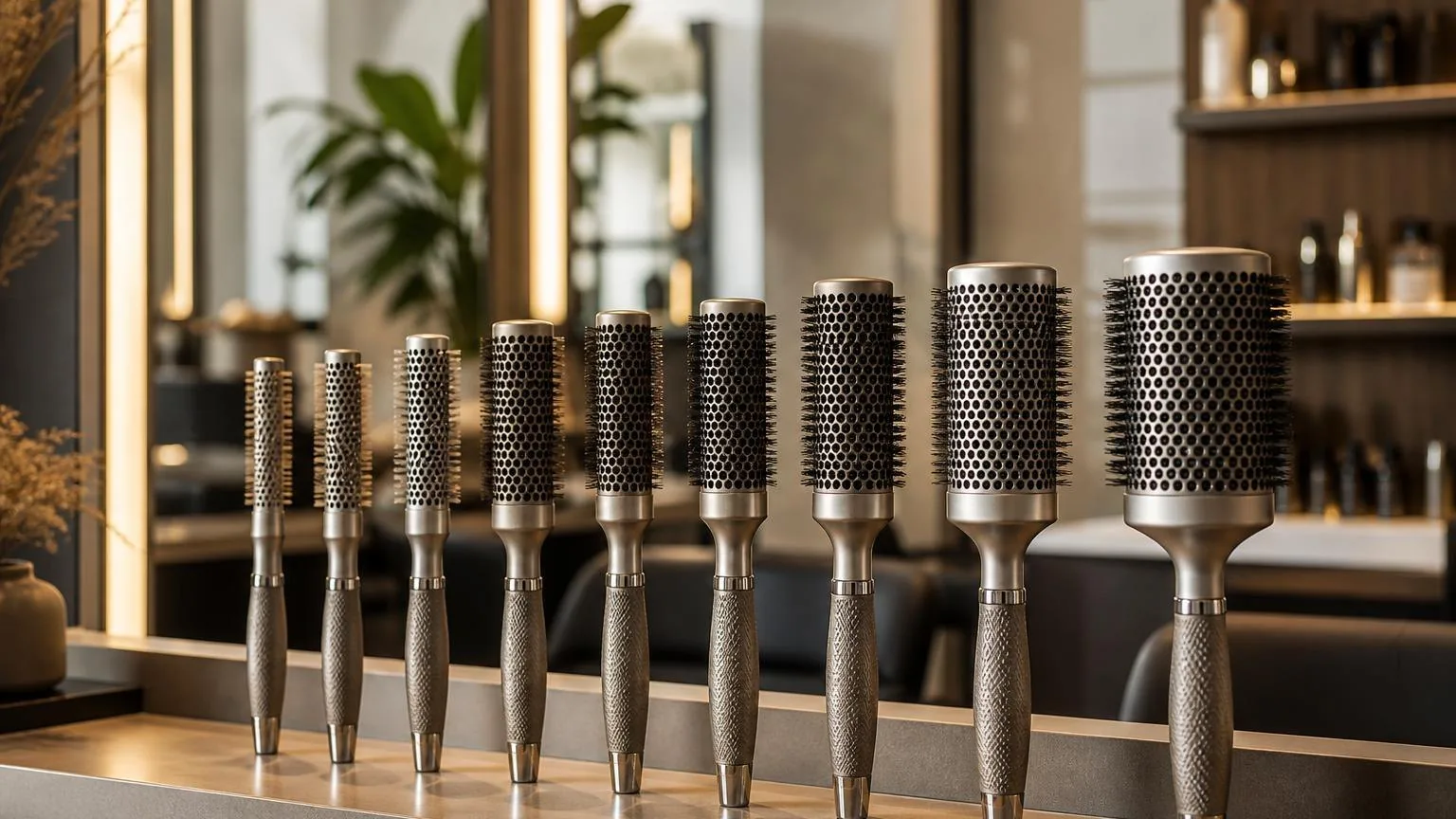
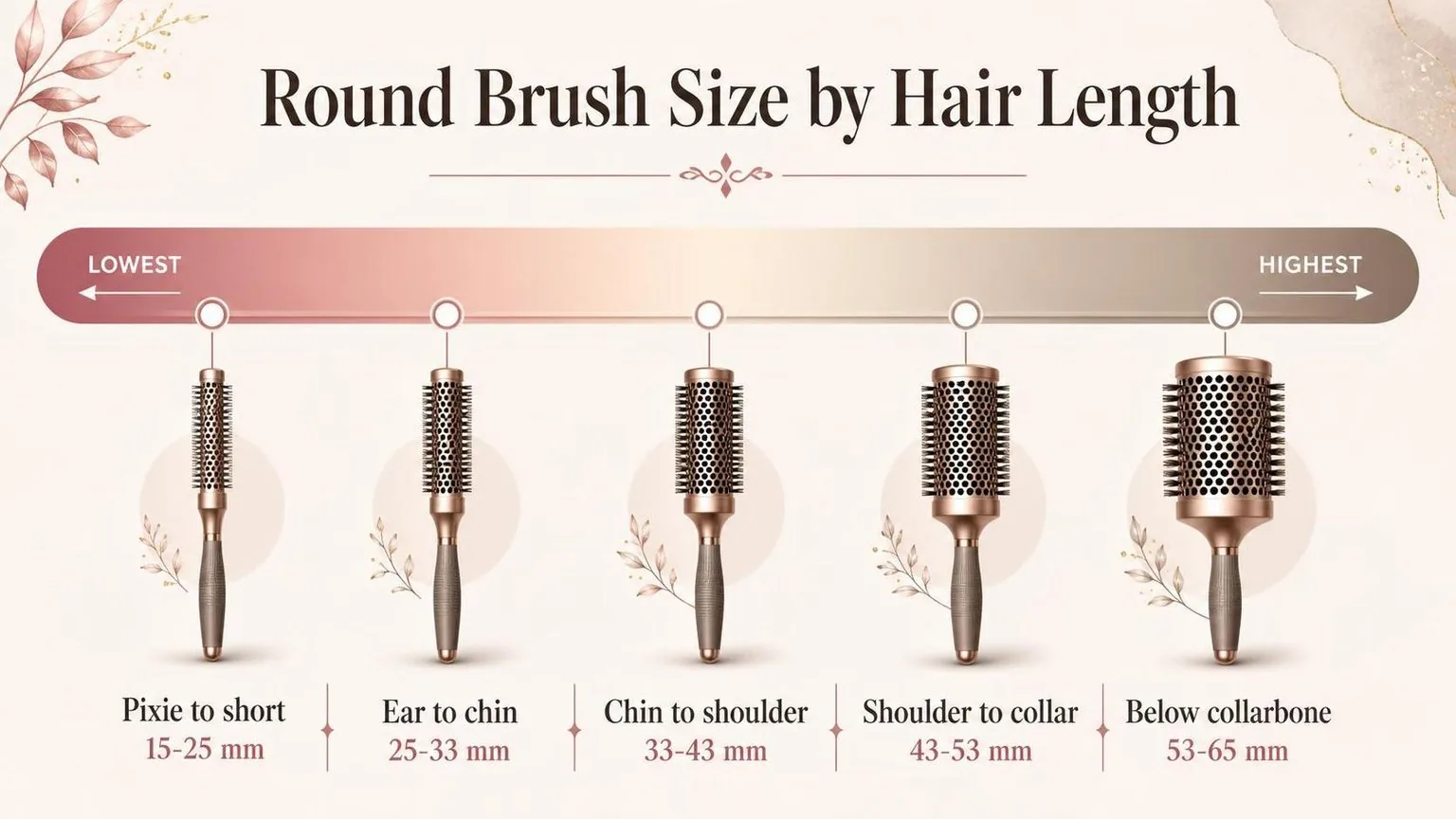
Round brush diameter, by hair length: use 25–32 mm for crops and bobs, 33–43 mm for shoulder-length hair, and 44–55 mm for long hair when you want smooth bend rather than tight curl.
The rule is simple: shorter hair needs a smaller barrel to grip the section; longer hair needs more surface area to tension, polish, and speed drying. Keep each section no wider than the brush barrel and about 2–3 cm deep.
For salon-level control, match diameter to the finish too: smaller barrels build root lift and flicks, medium barrels create bevelled ends, and larger barrels stretch lengths straighter with soft movement.
Size Your Brush Now
Use this quick floor check before you buy, book, or restock. You need your hair length, the finish you want, and the round brushes already on your station.
- Find your length band. Pixie to chin: start at 1–1.5 in or 25–32 mm. Bob to lob: start at 1.5–2 in. Shoulder length: start at 2–2.5 in or 33–43 mm. Long hair: start at 2.5–3.5 in or 44–55 mm.
- Choose the finish. For root lift, flicks, or a stronger bend, go down one size. For smooth volume and loose movement, stay in the middle. For a straighter, polished finish, go up one size.
- Check section width. Take a section no wider than the barrel. Keep depth around 2–3 cm. If hair spills past the brush edges, the barrel is too small or the section is too wide.
- Run a grip test. Wrap the mid-lengths once around the brush. If short pieces fall out, size down. If the hair wraps too many times and takes too long to dry, size up.
- Set your station pair. For most blow dry bars, keep one smaller lift brush and one larger smoothing brush ready for each client length. Example: a lob may need 32 mm at the crown and 43 mm through the ends.
The Figures Behind It
Round brush diameter is really a bend selector: small barrels create more turn, large barrels stretch hair smoother with less curve. Match the barrel to the amount of hair that can wrap around it, not just to the label on the brush.
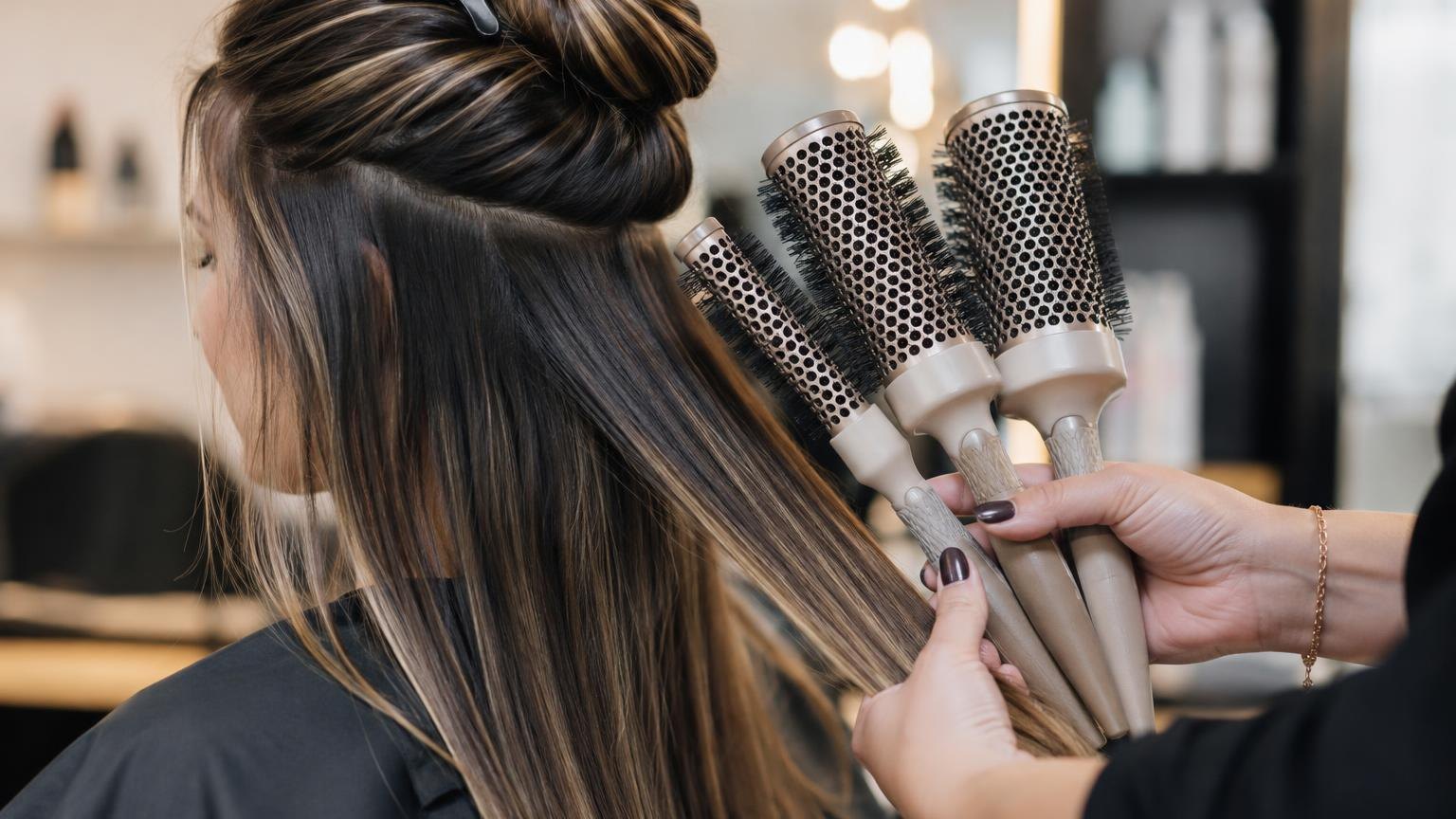
The useful measurement is the barrel diameter, excluding bristles.
Professional education from brands such as Olivia Garden and Sam Villa generally teaches the same principle: choose a smaller barrel for curl and control, a larger barrel for smoothing, lift, and a looser bevel.
| Hair length | Best working barrel diameter | What it does best |
| Pixie, fringe, nape, short layers | 15 mm to 25 mm | Root lift, tight bend, flicks, fringe control |
| Ear to chin length | 25 mm to 33 mm | Rounded bob shape, bevelled ends, controlled volume |
| Chin to shoulder length | 33 mm to 43 mm | Classic blowout curve, soft movement, smooth mids |
| Shoulder to collarbone length | 43 mm to 53 mm | Loose bend, volume, polished smoothing |
| Below collarbone or very long lengths | 53 mm to 65 mm | Big volume, stretched finish, minimal curl |
The geometry explains why a brush can feel wrong even when it looks right. One wrap around the barrel equals the barrel circumference, calculated as diameter multiplied by pi. If the hair cannot travel around the brush, it will smooth more than curl.
| Barrel diameter | Approximate hair needed for one full wrap |
| 25 mm | 79 mm |
| 33 mm | 104 mm |
| 43 mm | 135 mm |
| 53 mm | 167 mm |
| 65 mm | 204 mm |
For salon work, section size should stay smaller than the barrel width and thinner than the brush can heat evenly.
A practical section is about the same width as the brush barrel and shallow enough for air to pass through without pushing the hair off the bristles.
| Desired finish | Choose this size direction | Reason |
| More curl or flip | Go down one barrel size | Hair wraps farther around the brush |
| More smoothness | Go up one barrel size | Less rotation, more tension and stretch |
| More root lift | Use a barrel that fits the root area | The brush can sit close to the scalp and elevate the section |
| Less end bend | Use a larger barrel | The ends travel through a wider curve |
Heat matters, but airflow and tension do most of the finishing. For fine hair, many stylists work with medium heat and high airflow.
For coarse or dense hair, high heat is often paired with controlled tension, then cooled before the brush is released.
Where the Difference Comes From
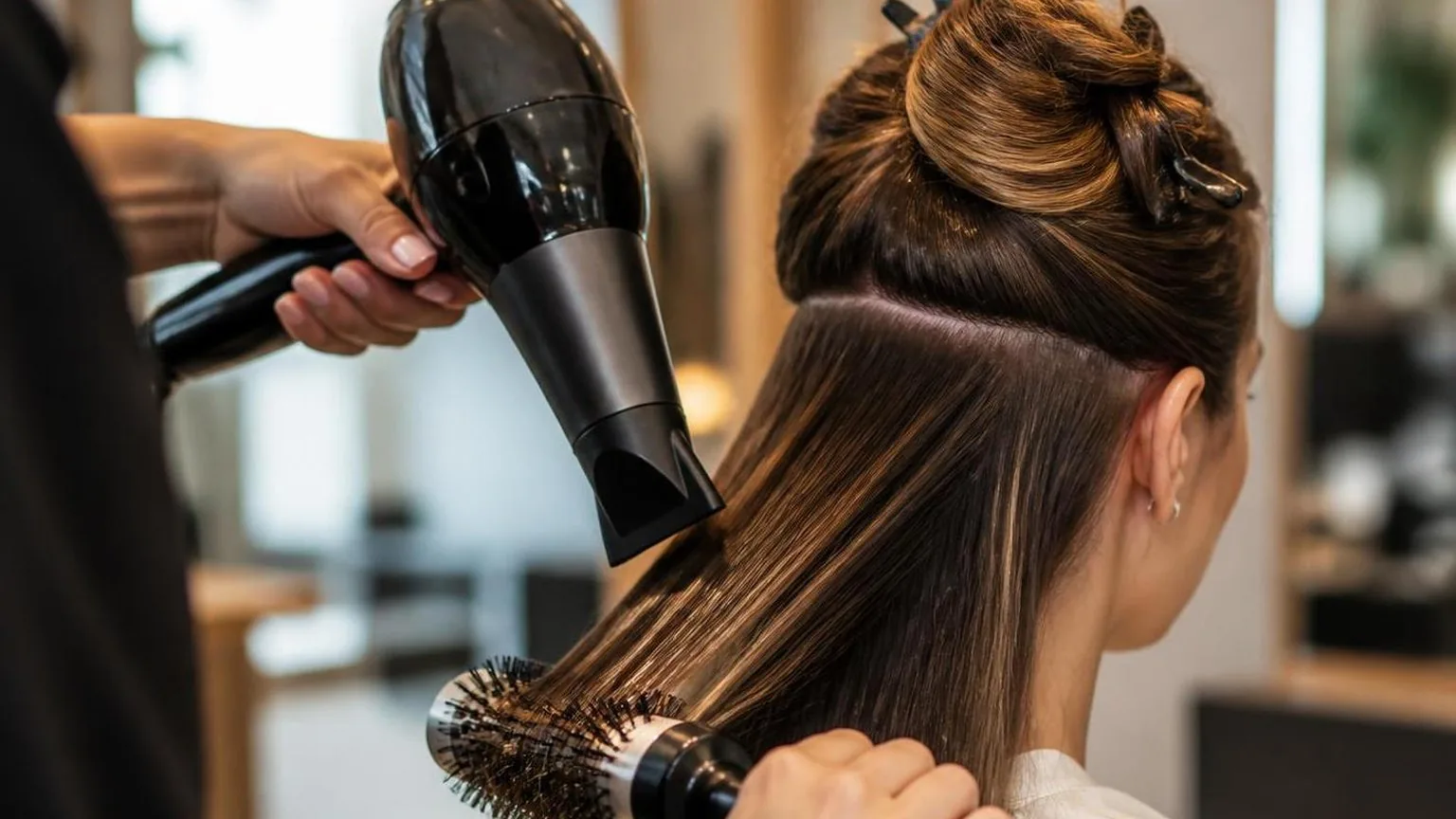
Round brush diameter changes how much bend, lift, and stretch you can build before the hair cools.
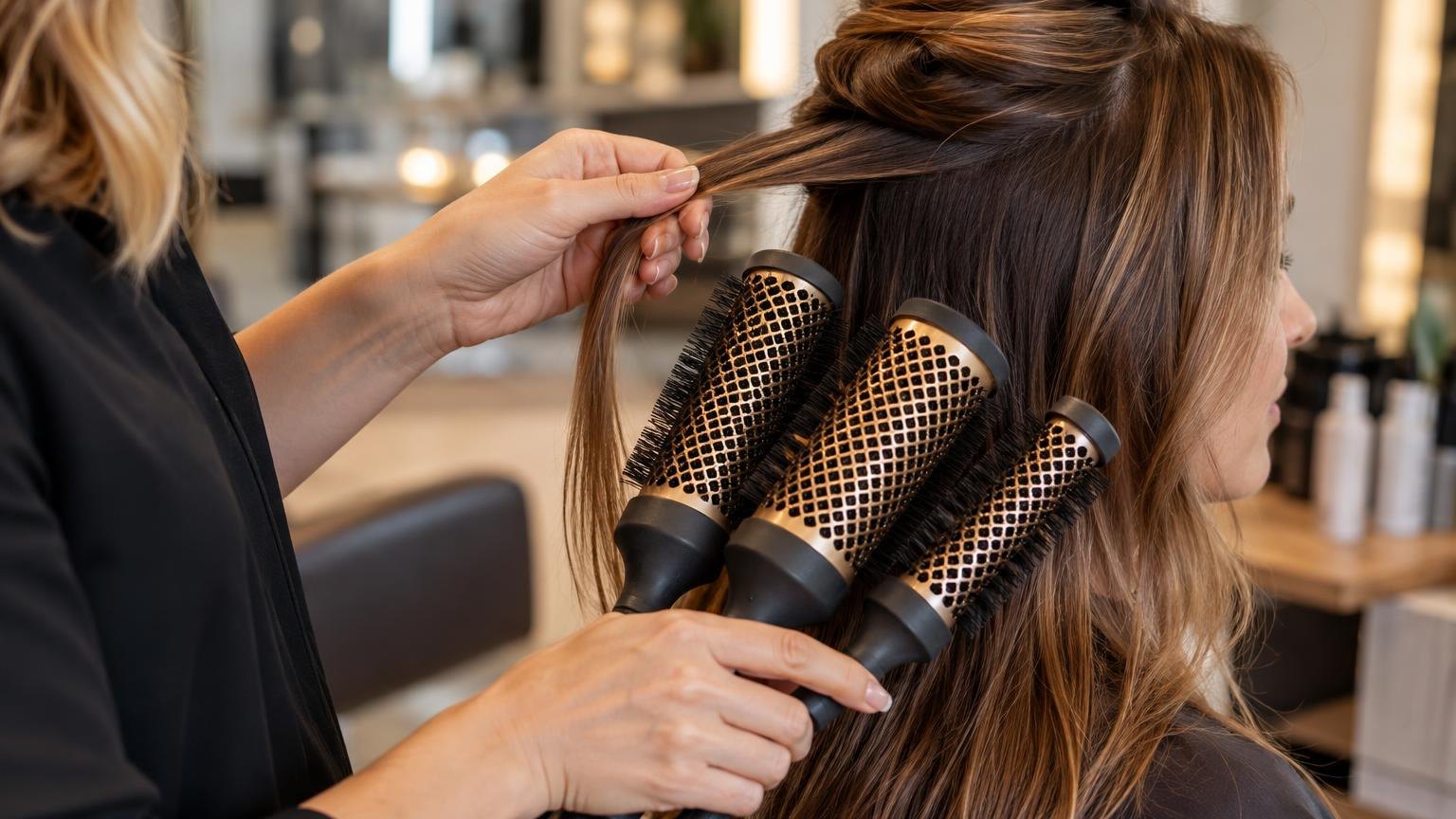
Hair length sets the maximum barrel size, but density, layer length, heat, and section size decide whether that barrel gives polish or collapses the shape.
Barrel size versus finished shape
| Hair length | Useful barrel diameter | Typical result |
| Pixie to ear length | 0.75 to 1 inch | Root lift, bevelled ends, tight bend |
| Chin to jaw length | 1 to 1.5 inches | Rounded bob shape, controlled flip under |
| Collarbone length | 1.5 to 2 inches | Soft bend, smoother mid-lengths, moderate volume |
| Chest length and longer | 2 to 3 inches | Loose movement, stretch, polished surface |
A barrel has to wrap the section far enough to create memory. In practical blow-dry work, one full wrap gives bend; less than half a wrap mainly smooths. That is why very large brushes flatten short layers instead of shaping them.
Section size controls tension
| Brush diameter | Best section width | Best section thickness |
| 0.75 to 1 inch | 1 to 1.5 inches | 0.25 to 0.5 inch |
| 1.5 to 2 inches | 2 to 3 inches | 0.5 to 0.75 inch |
| 2.5 to 3 inches | 3 to 4 inches | 0.75 to 1 inch |
For salon consistency, the section should be no wider than the bristle field. If hair spills past the brush edges, the centre dries under tension while the sides dry loose, leaving frizzed corners and uneven bevel.
Heat, airflow, and cooling
| Hair feel | Dryer setting at nozzle | Working method |
| Fine or fragile-feeling | 140 to 160°F | Medium airflow, shorter passes, cool before release |
| Medium texture | 160 to 185°F | High airflow, steady tension, cool for shape set |
| Coarse or resistant-feeling | 185 to 210°F | High airflow, smaller sections, longer cooling time |
Heat softens the styling shape; cooling fixes it. A practical chair-side rule is to keep the brush in place until the section feels neutral to the touch, usually longer on dense hair and on large barrels.
Bristle type changes grip
- Boar bristle: gives firm grip and surface polish, useful on shorter bobs and layered cuts that need control.
- Nylon bristle: detangles and penetrates dense sections more easily, especially on longer hair.
- Mixed bristle: balances tension and glide, often the most versatile choice for blow-dry bar speed.
- Vented metal or ceramic barrel: speeds drying, but needs cleaner heat control because the barrel surface warms during repeated passes.
Milady cosmetology training materials emphasize control, tension, and direction as the basis of thermal styling.
In practice, diameter only works when those three match the haircut: short layers need small tools; long, heavy lengths need wider barrels and smaller sections for lift.
How to Judge It on Real Hair
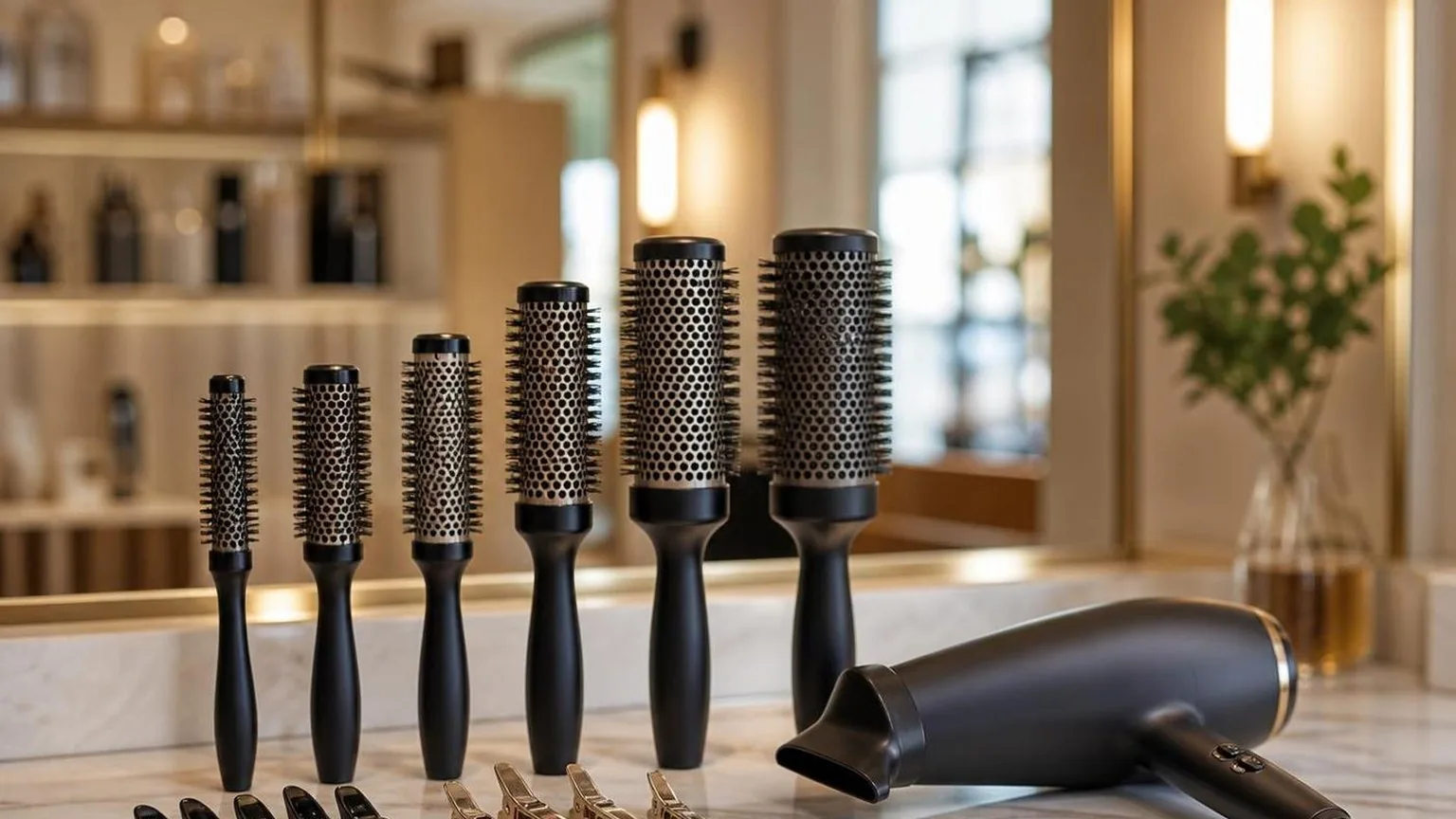
Judge round brush diameter by how much hair can wrap around the barrel with control. On real hair, the right brush gives tension at the root, one smooth rotation through the mid-lengths, and a finished end that bends without snagging.
In the chair, do not choose by haircut name alone. Check the shortest layer, the density in each section, and the finish wanted: root lift, bevel, bend, or loose movement.
| Hair length or layer | Useful barrel diameter | What it does best |
| Fringe, pixie, very short layers | 12–18 mm | Root lift, tight bevel, controlled flicks |
| Short bob to jawline layers | 20–25 mm | Rounded ends, volume at the crown |
| Chin to collarbone length | 32–43 mm | Soft bend, polished bevel, body through mids |
| Below collarbone | 43–53 mm | Smoothness, loose curve, faster surface finishing |
| Long, heavy hair | 53–65 mm | Stretch, shine, large-scale movement |
A practical test: place the brush under a dry section before styling. If the hair cannot travel at least halfway around the barrel, the brush is too large for bend. If it wraps too many times, the brush is likely too small and may overcurl the end.
| Section size | Best use | Why it matters |
| Same width as the barrel | Everyday blow-dry control | Heat and airflow reach the section evenly |
| Slightly narrower than the barrel | Dense or coarse-feeling hair | Improves tension and drying speed |
| Wider than the barrel | Only for surface smoothing | Less lift and weaker bend at the ends |
For salon work, the nozzle should follow the brush from root to end, angled down the hair shaft. Dyson, ghd, and Sam Villa education all teach controlled airflow and tension as the basis of a polished blow-dry finish.
| Hair response | What to change | Working cue |
| Ends spring too tight | Go up one barrel size | Use fewer rotations at the end |
| Ends look flat | Go down one barrel size | Let the hair wrap farther around the brush |
| Root collapses quickly | Use a smaller barrel at the root | Lift the section upward before rolling |
| Mid-lengths look puffy | Use a larger barrel through the surface | Keep airflow downward and steady |
Use moderate heat for fine hair and higher airflow rather than extreme heat. Many professional dryers run well above hand-comfort temperature, so keep the nozzle moving and finish each section only when it feels dry and cools in shape.
- Let the brush sit in the finished curve for a few seconds before releasing.
- Start with the smallest layers first; they set the limit for diameter.
- For mixed-length cuts, use two brushes rather than forcing one barrel through every section.
Where the Alternatives Win and Lose
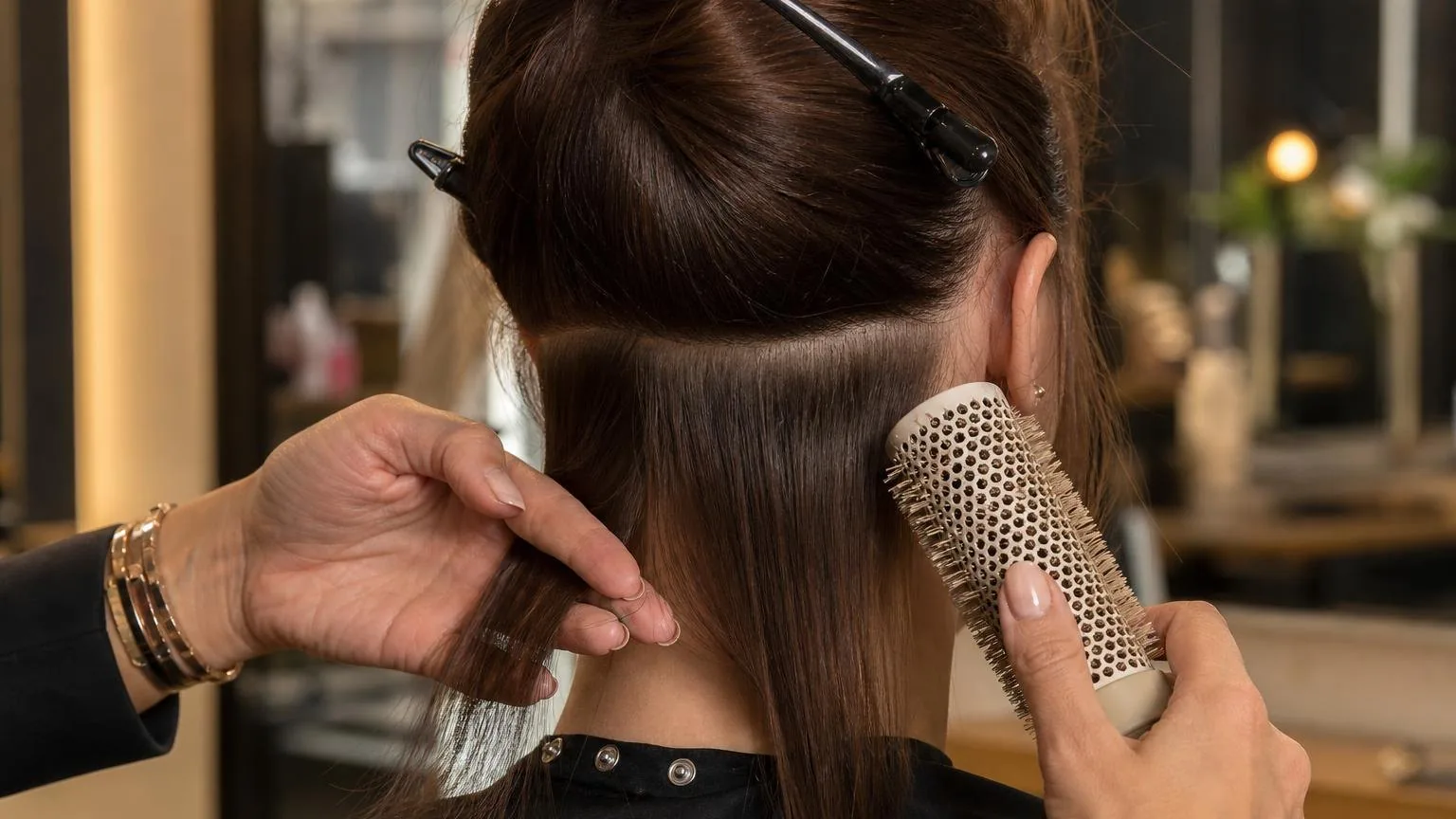
Round brush diameter is the most precise option when the goal is lift, bend, and a salon-style finish matched to hair length.
Paddle brushes, vent brushes, hot brushes, irons, and rollers can help, but they control shape less directly at the root and ends.
The key difference is geometry. A round brush creates a curved set because hair wraps around a cylinder; a paddle brush mainly stretches hair flat.
For blow-dry work, barrel diameter should be chosen before heat setting, not after the section is already wet and stretched.
| Hair length | Round brush diameter | Finish compared with alternatives |
| Pixie to jaw length | 0.75 to 1.25 in | More root lift and bevel than a paddle brush; tighter bend than a vent brush |
| Chin to collarbone | 1.5 to 2 in | Best balance of smoothness, lift, and end curve; less clamp-mark risk than irons |
| Shoulder to mid-back | 2.25 to 3 in | Smoother, looser movement than small rollers; more polish than rough-drying |
| Longer than mid-back | 3 to 4 in | Faster smoothing than small barrels; less curl definition than heated rollers |
Against a paddle brush, the round brush wins when the client wants volume at the crown or a visible bevel through the perimeter.
A paddle is faster for straight, low-tension drying, especially on long hair, but it cannot build the same base lift without over-directing sections.
Against a vent brush, the round brush gives more polish. Vent brushes move air quickly through open spacing, which helps rough-dry roots.
They are less effective for sealing the cuticle direction because they do not maintain the same wrap tension around the section.
| Tool | Best section width | Typical use |
| Round brush | Same width as barrel or up to 0.5 in wider | Lift, smoothing, bevel, soft bend |
| Paddle brush | 2 to 4 in panels | Straight stretch and fast drying |
| Vent brush | 1.5 to 3 in panels | Root drying and airy movement |
| Curling iron | 0.75 to 1.5 in subsections | Defined curl after drying |
Compared with a hot brush, a separate round brush and dryer give better control over airflow angle. In salon technique, the nozzle is usually kept about 2 to 4 in from the hair, aimed from roots toward ends to reduce frizz and improve shine.
Compared with curling irons, round brushes create softer movement because the hair is shaped while drying, not pressed between hot metal.
Irons are better for durable curl definition, but they do not replace the root control and volume built during a blow-dry.
Compared with rollers, round brushes are faster for a single appointment finish. Rollers need cooling time to set shape.
With a brush, hold the section on the barrel for about 5 to 10 seconds after drying, then release once the hair feels cool to the touch.
Heat and Tension Without the Damage
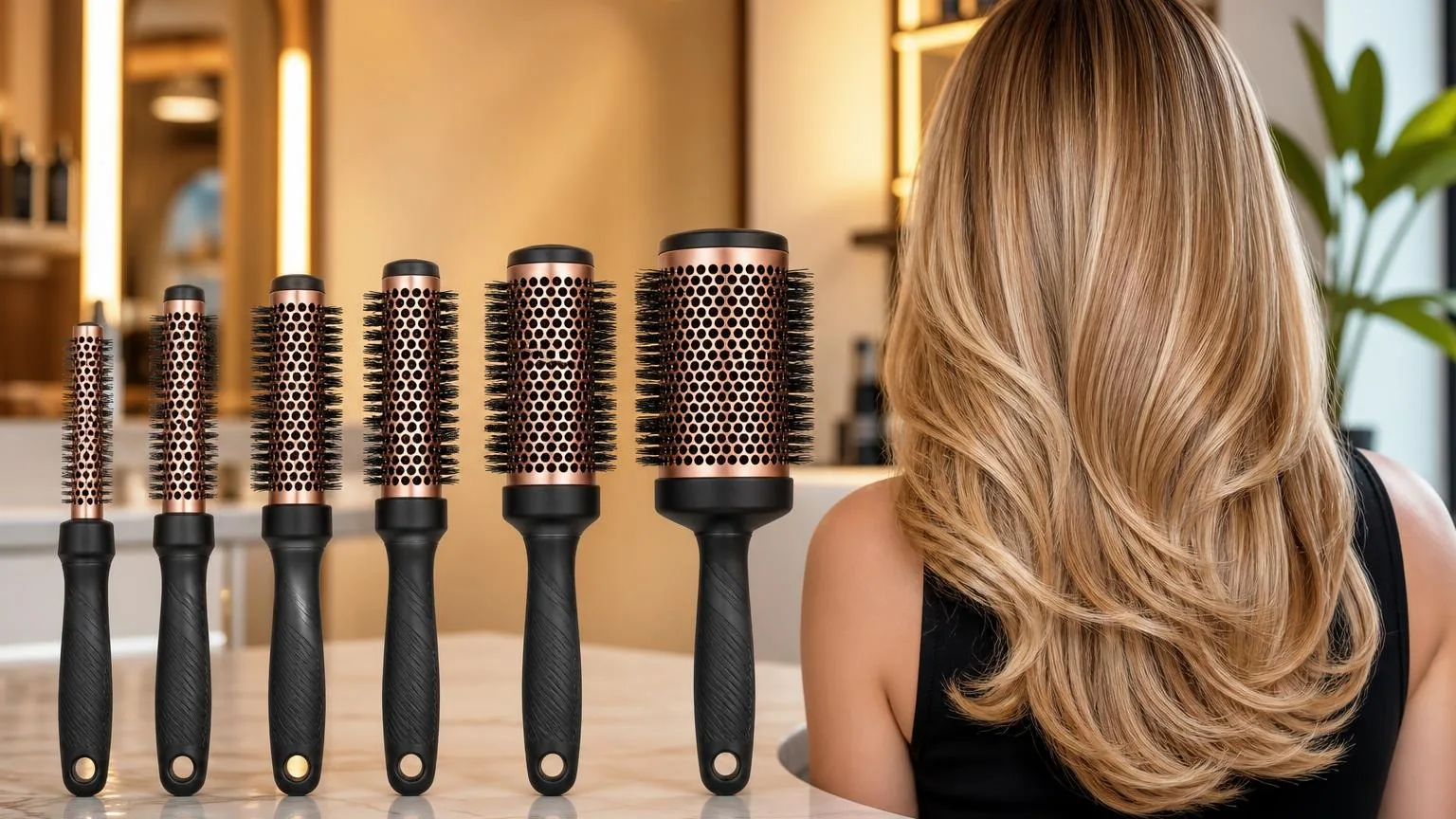
Use the largest round brush that can still wrap the hair at least halfway around the barrel, then control shape with airflow, not brute pull.
Hair is most vulnerable when wet, so rough-dry first, lower the heat as the section dries, and keep the dryer moving.
In the chair, intact ends come from three habits: smaller sections, moderate tension, and heat that is removed as soon as the strand is dry. The brush should guide the cuticle flat, not stretch the hair like elastic.
| Hair length | Typical brush diameter | Heat and tension cue |
| Pixie to ear length | 15 mm to 25 mm | Use low to medium heat; tension comes from wrist rotation, not pulling from the scalp. |
| Chin to collarbone | 25 mm to 43 mm | Use medium heat; lift at the root, then release tension through the mid-lengths. |
| Below collarbone | 43 mm to 65 mm | Use medium to high airflow; keep heat moving along the barrel, never parked on the ends. |
Start only after the hair is no longer dripping. For most blow-dry bar work, that means towel-blotting, detangling, then rough-drying before the brush is introduced. The round brush is for polishing and bending, not for removing all the water.
| Stage | Moisture feel | Tool choice | Why it protects the fibre |
| Prep dry | Wet but not dripping | Fingers or vent brush | Less traction on swollen, flexible hair. |
| Shape | Damp, not cool to the touch | Round brush | Enough moisture remains to set bend without repeated passes. |
| Finish | Dry and warm | Cool shot and light brush control | Stops further heat exposure once the shape is formed. |
Keep sections narrower than the brush barrel length, and keep depth modest. A dense section traps moisture in the middle, forcing repeated hot passes on the surface. In practice, clean subsections give faster drying and less cumulative heat.
| Brush diameter | Practical section depth | Best use |
| 15 mm to 25 mm | 1 cm to 2 cm | Short layers, fringe, root lift. |
| 25 mm to 43 mm | 2 cm to 3 cm | Bob shapes, bends, bevelled ends. |
| 43 mm to 65 mm | 3 cm to 4 cm | Long layers, smooth volume, loose movement. |
- Hold the nozzle about 2 cm to 5 cm from the hair, aimed down the strand from roots to ends.
- Keep the dryer moving every few seconds; stationary heat creates hot spots on the outer layer.
- Use firm, even tension, then soften the pull as the section becomes dry.
- Finish each section with a cool shot for 5 to 10 seconds before unwrapping the brush.
- If the ends feel dry before the roots, remove them from the barrel and heat the root area only.
For professional consistency, think in passes rather than minutes. One controlled pass to dry, one pass to polish, then cooling is usually kinder than repeatedly rewinding the same section after it is already dry.
What Is Happening to the Hair
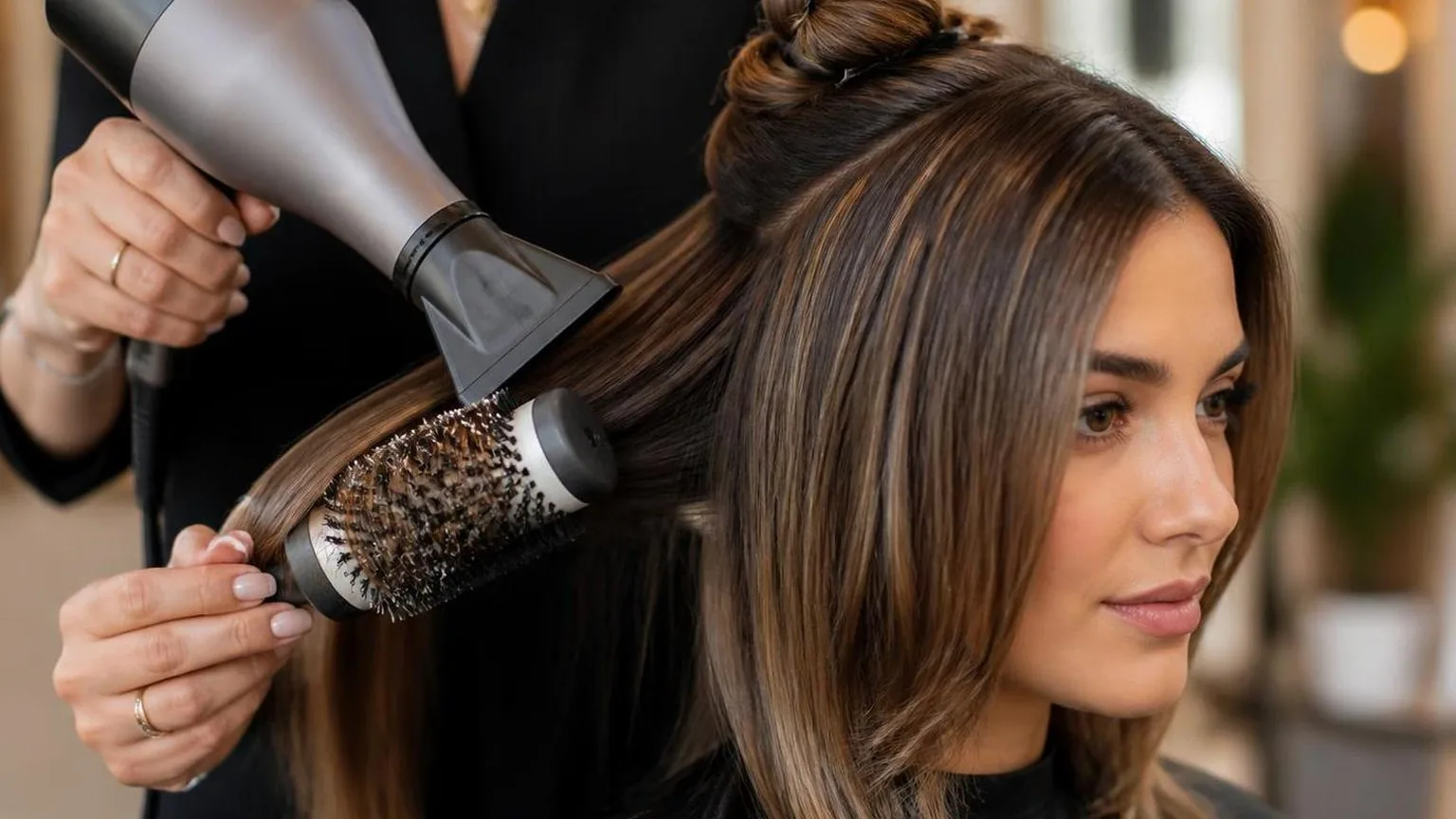
Round brush diameter matters most in the last third of the blowout. Once the root is dry, barrel size controls bend, lift, and how much the end turns under.
The standard working choice is usually the smallest barrel that can wrap the section once without crowding the bristles.
Straight, wavy, and loose-curly hair all follow the same basic geometry, from chin-length bobs to hair below the shoulder blades.
Concentrated airflow, moderate tension, and consistent sectioning make the result more predictable because heat, tension, and cooling reach the hair evenly.
| Variable | Working range |
| Section width | 1.5 in to 2 in |
| Section depth | 0.5 in to 0.75 in |
| Nozzle distance | 1 in to 2 in from hair |
| Drying passes | 3 warm passes per section |
| Cooling pass | 8 seconds to 10 seconds before release |
| Air temperature at nozzle | 150°F to 185°F |
| Repeat trials | 3 sections per brush size, per head side |
Section width and depth control how evenly air reaches the strand group. At 1.5 in to 2 in wide and 0.5 in to 0.75 in deep, the section is compact enough for heat, tension, and cooling to act consistently.
Nozzle distance changes both control and efficiency. At 1 in to 2 in from hair, airflow stays concentrated without scattering the section or forcing the stylist to chase flyaways.
Drying passes and cooling time affect memory. 3 warm passes per section shape and smooth the hair, while 8 seconds to 10 seconds before release lets the bend firm up on the brush.
Air temperature at the nozzle, 150°F to 185°F, supports controlled styling without relying on excessive heat. The craft standard is to pair moderate heat with tension, direction, and cooling rather than heat alone.
Short hair shows oversizing fastest. On bobs, a barrel can look efficient at the station but still fail because the hair cannot travel far enough around the brush to build bevel.
That creates expansion through the mid-lengths while the ends stay blunt.
| Hair length | Best working diameter | Result |
| Pixie to ear | 0.75 in to 1 in | Root lift and directional polish without losing control |
| Chin bob | 1 in to 1.25 in | Clean bevel, especially around the jawline |
| Collarbone | 1.5 in to 1.75 in | Smooth body with a soft bend at the ends |
| Past shoulders | 2 in to 2.5 in | Fast smoothing and larger movement, not curl |
| Mid-back | 2.5 in to 3 in | Best for stretch, shine, and loose swing |
A larger brush stops creating shape once the barrel becomes too wide for the hair length. It can polish the surface, but it cannot build design if the hair lacks enough wrap to change direction.
- For face frames, sizing down one barrel from the main body helps create visible bend.
- For dense hair, smaller sections matter more than a hotter dryer because airflow can reach the full section.
- For fine hair, cooling on the brush improves hold more than adding extra warm passes because the shape sets as the hair cools.
- For long hair, oversized barrels work only when the goal is smoothness, not bounce.
Practical rule: choose diameter by the shortest layer that needs shaping, not by the longest hair on the head. If the fringe, face frame, or bob perimeter cannot wrap the barrel cleanly, the brush is too large for that part of the service.
Mistakes Worth Avoiding
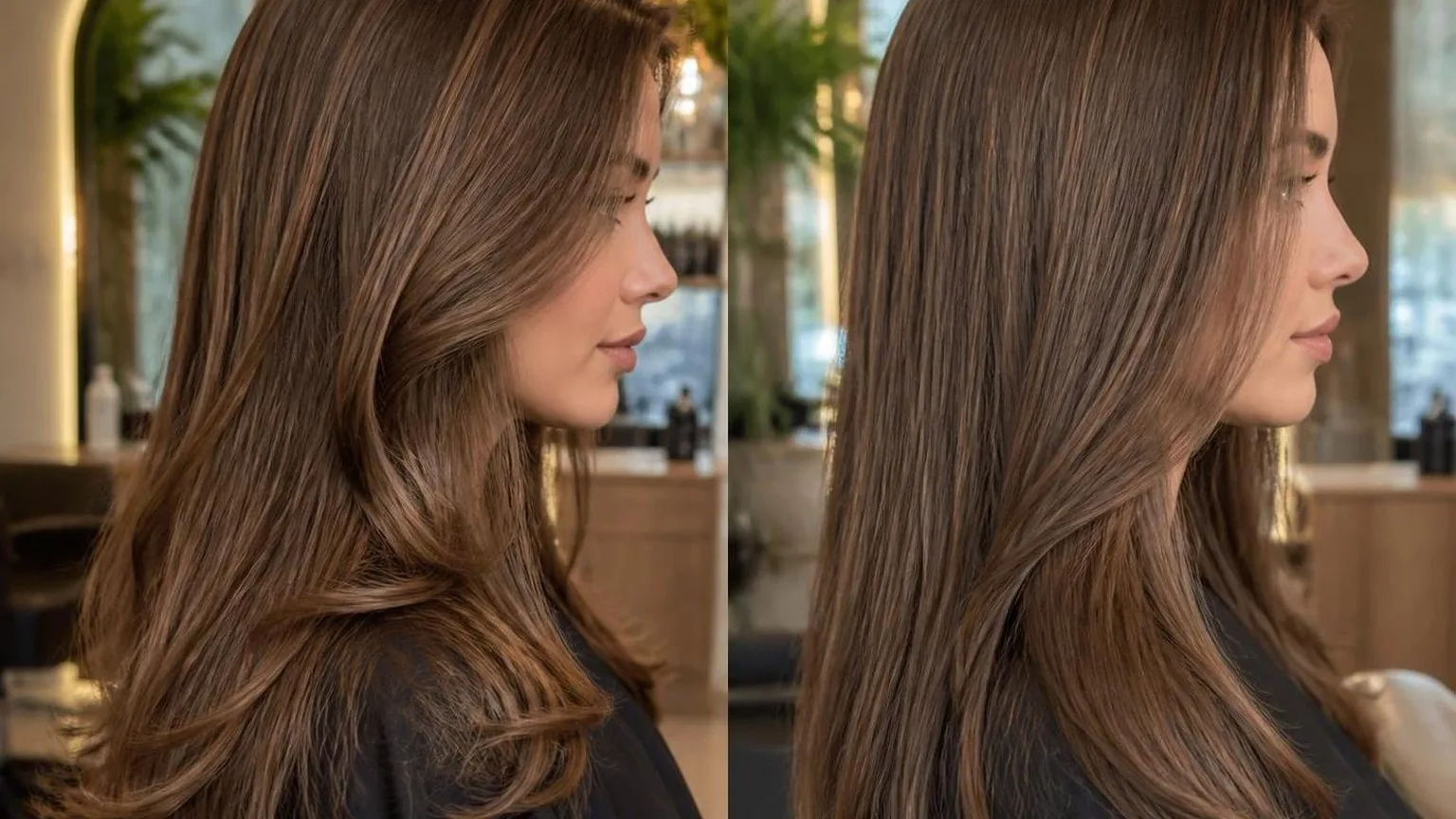
Most round-brush mistakes come from choosing the barrel you wish your hair needed, not the barrel your hair length can physically wrap around.
The right diameter lets the section travel at least most of the way around the brush while the dryer sets the curve.
A common myth is that a bigger brush always gives a smoother, more expensive finish. In blow-dry work, oversized barrels often create flat roots, unfinished ends, and too much tension because short lengths cannot bend around the tool.
Mistake: using a barrel too large for the hair length
| Hair length | Common wrong choice | Better working range | What usually happens |
| Pixie to jaw | 53 mm to 65 mm | 18 mm to 32 mm | Ends skip the curve; root lift collapses |
| Chin to shoulder | 65 mm to 75 mm | 32 mm to 45 mm | Mid-lengths smooth, ends stay straight |
| Collarbone to long | 18 mm to 25 mm | 45 mm to 65 mm | Too much curl; drying takes longer |
For short bobs, a 65 mm barrel may polish the surface, but it cannot build a beveled end if the hair cannot wrap securely. In salon terms, the brush is then acting like a flat paddle with bristles, not a shaping tool.
Mistake: ignoring section size
Diameter only works when the section is controlled. A useful rule on the floor is to keep each subsection no wider than the barrel length and no thicker than the brush can heat evenly from root to end.
| Barrel diameter | Practical section thickness | Best use |
| 18 mm to 25 mm | About 10 mm to 15 mm | Fringes, crops, tight bevels |
| 32 mm to 45 mm | About 15 mm to 25 mm | Bobs, lobs, controlled movement |
| 53 mm to 65 mm | About 25 mm to 35 mm | Long layers, volume, soft bend |
Myth: more heat fixes the wrong brush
Heat cannot compensate for poor geometry. Many professional dryers deliver air well above 80°C at close range, so distance and airflow matter. Keep the nozzle moving, keep it parallel to the hair shaft, and finish each section with a cool shot.
- Myth: A small brush is only for curls. In practice, 25 mm to 32 mm barrels are often the cleanest choice for short layers and nape work.
- Myth: Long hair always needs the largest brush. Very long, fine hair may collapse on a 65 mm barrel and hold better with a 45 mm to 53 mm brush.
- Myth: Tension means pulling hard. Proper tension is even contact, not dragging. If the brush snags, the section is too thick, too wet, or the barrel is wrong.
- Myth: A round brush should be twisted constantly. Rotate only as needed to set the bend; over-spinning roughens the finish and tangles layered ends.
Cosmetic science texts consistently describe hair shaping as a combination of moisture, heat, tension, and cooling. Diameter controls the “shape” part of that equation. If the barrel does not match the length, the set will not last.
Frequently Asked Questions
What round brush diameter works best for a chin-length bob?
Use a 1 to 1.5 inch barrel for control at the nape and bevel through the ends. A section should wrap around the brush about 1.5 times, not disappear into multiple tight coils.
What size round brush should I use on shoulder-length hair?
Choose a 1.75 to 2.25 inch barrel for bend, lift, and a polished curve at the ends. Work in sections no wider than the brush barrel and keep airflow moving downward for a smoother finish.
What round brush diameter is best for long hair?
Use a 2.5 to 3 inch barrel for long layers, soft volume, and loose movement. Larger barrels stretch the hair more efficiently, but they will not create a tight curl on lengths past the collarbone.
Can very short hair use a round brush?
Yes, but keep the barrel small: 0.75 to 1 inch gives grip near the roots and around the hairline. For pixie lengths, lift each section for 3 to 5 seconds with warm air, then cool before releasing.
When should I size down my round brush?
Size down by about 0.5 inch if the hair slips off, lacks bend, or cannot hold root lift. Finer sections and a smaller barrel give more tension, especially on face-framing pieces and shorter layers.
How do I choose a round brush size for layered hair?
Choose the brush size based on the shortest layers you want to shape, not the overall hair length. Smaller barrels give more control at the crown and face frame, while larger barrels smooth longer layers and add softer bend.
Does brush size affect curl tightness?
Yes. Smaller barrels create tighter bend and more lift, while larger barrels make softer curves and smoother volume. Match the barrel to the amount of movement you want.
What round brush size is best for bangs?
Use a small round brush for most bangs so the hair can wrap around the barrel. A larger brush can make short bangs too flat or hard to control.
Should fine hair use a smaller round brush?
Often, yes. A smaller brush can add lift at the roots and grip fine sections better. Use a larger brush only when you want a smoother, looser finish.
Related Reading
- What a blowout is, and how it differs from a blow dry
- What the cool shot button actually does
- How to blow dry your hair at home, step by step
- How long a blow dry should actually take
- How to blow dry a finish that survives humidity
- How to make a blowout last past day two
- The complete guide to blow drying technique