
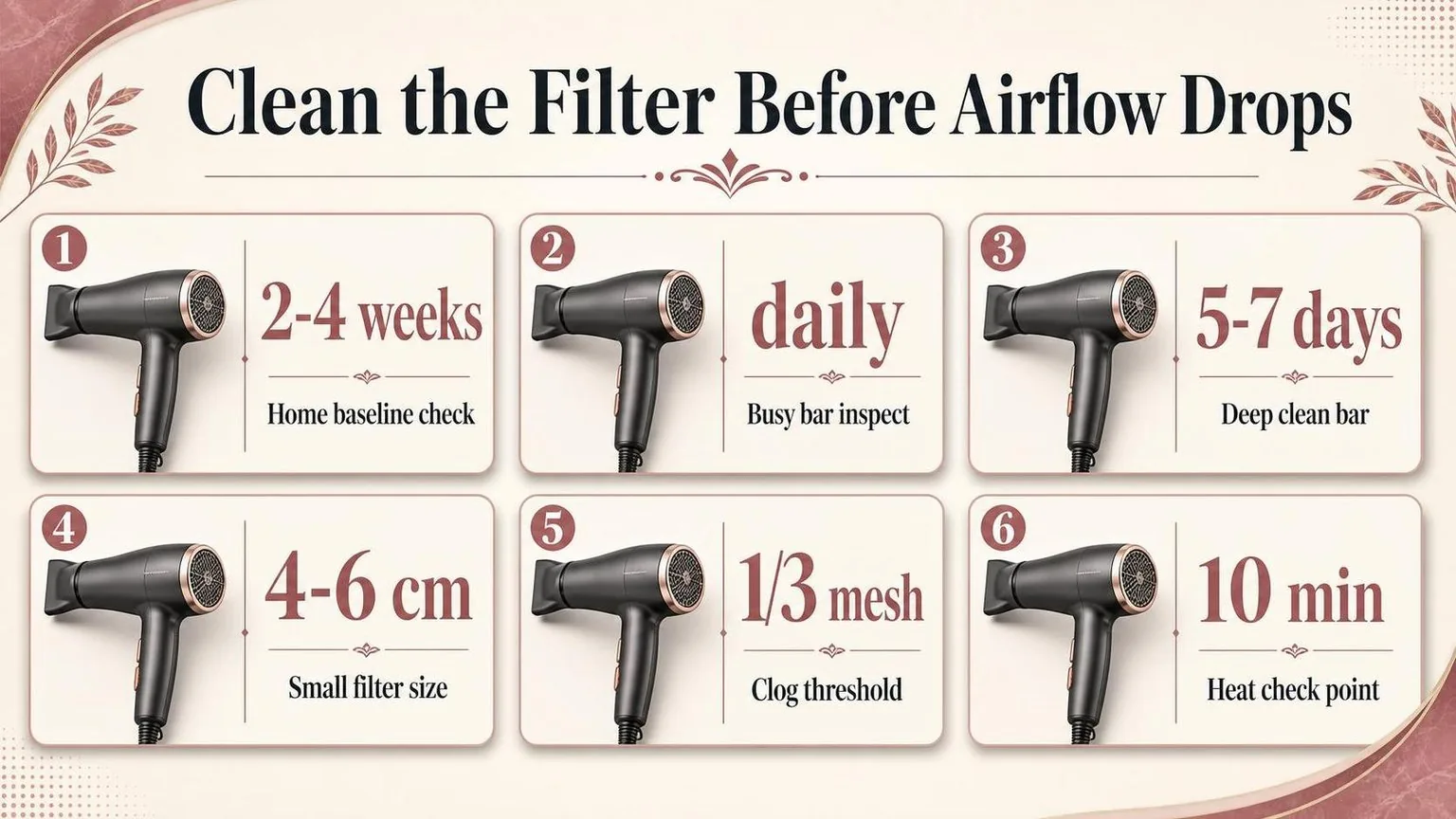
hair dryer filter cleaning frequency is every 2 to 4 weeks in salon use, or every 6 to 8 weeks at home, because lint buildup restricts airflow and makes the motor run hotter.
Check the rear intake screen weekly if you blow-dry textured, long, or product-loaded hair. A clogged filter adds drying time, weakens airflow, and can leave the finish flatter because heat replaces air movement.
Use a dry toothbrush, soft detailing brush, or vacuum nozzle on low suction. Clean only when the dryer is unplugged and fully cool, then refit the filter before the next service.
Set Your Cleaning Interval
Work from usage, not guesswork. A filter in a home kit used 10 minutes a day loads far slower than a salon dryer running 2-4 hours across back-to-back services. Your target is a repeatable interval you can put on the mirror, trolley, or station.
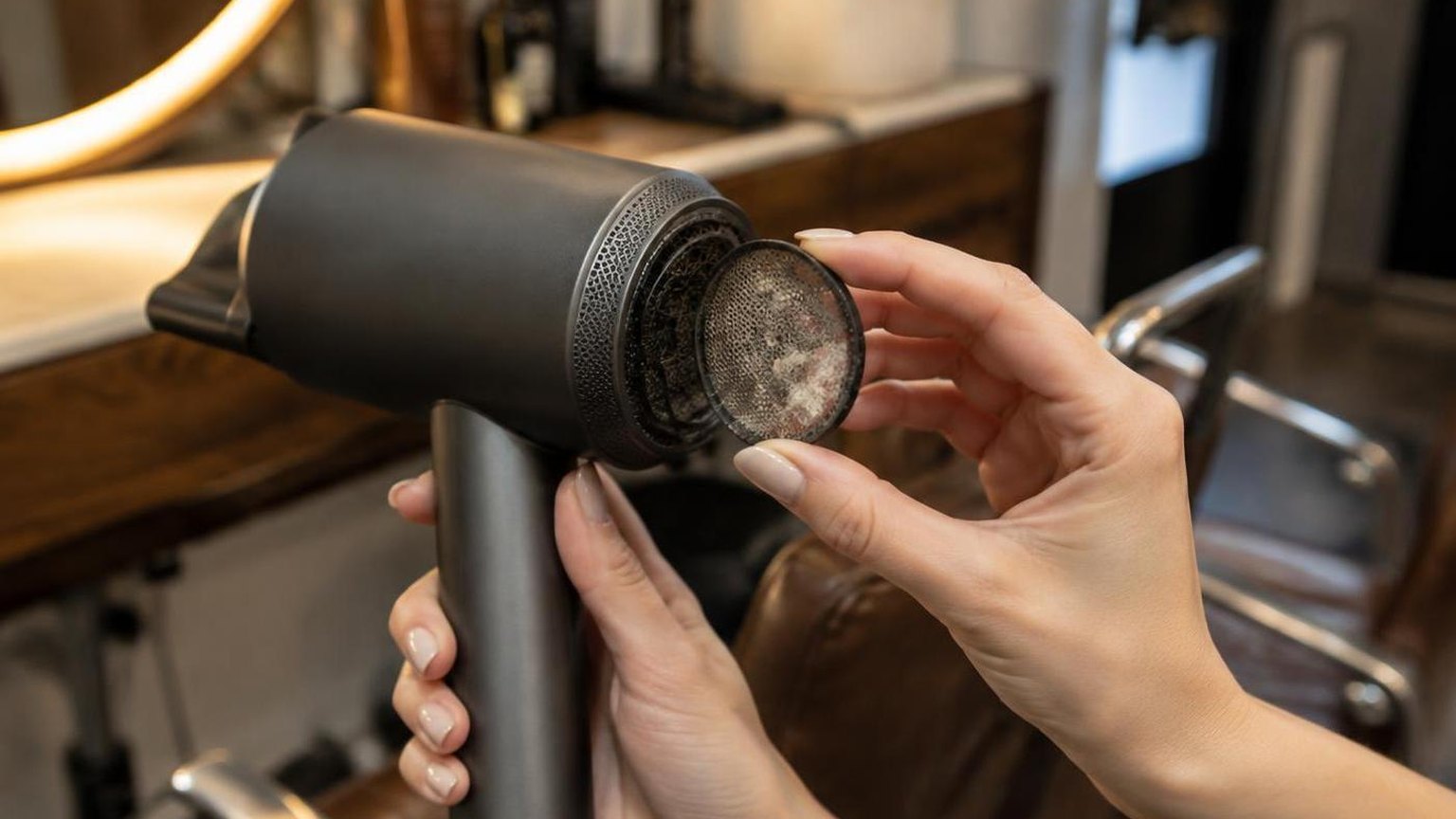
First, check the filter size and airflow path. Most dryer rear filters are about 4-6 cm across. Smaller screens clog faster because the same lint load covers more of the mesh.
If your intake sits close to styling products, towels, or loose brush-out, shorten the interval.
| Daily use | Environment | Start-point cleaning interval |
|---|---|---|
| Under 15 minutes | Low lint, low spray residue | Every 14 days |
| 15-45 minutes | Moderate brush-out and product mist | Every 7 days |
| 45-120 minutes | Busy home studio or light salon station | Every 3-4 days |
| 2-4 hours | Full salon floor, towels and aerosol nearby | Daily |
Now adjust once after inspection. Remove the filter cover and look at the mesh in bright light. If more than one-third of the visible screen is dulled by lint or dust, halve the interval.
If the mesh still looks open after two cycles, extend by 2-3 days.
Use one final check while blow-drying. If dry time on a medium-density section creeps up by 1-2 minutes, or the handle feels hotter than usual after 10 minutes, clean the filter the same day and shorten your schedule.
Reading the Numbers Properly
Clean the dryer filter more often than most users expect. In home use, checking every 2 to 4 weeks is a practical baseline. In a busy blow dry bar, a daily inspection and a deeper clean every 5 to 7 days is closer to reality.
The numbers shift with hours, dust load, and product overspray. A filter that looks acceptable at the start of the week can clog fast when the dryer runs across back-to-back appointments.
| Setting | Typical dryer use | Filter check | Full clean |
| Home, short hair | 5 to 10 minutes, 3 to 4 times weekly | Every 4 weeks | Every 4 to 8 weeks |
| Home, thick or long hair | 10 to 20 minutes, 3 to 7 times weekly | Every 2 weeks | Every 2 to 4 weeks |
| Single-stylist station | 1 to 3 hours daily | Daily | Every 7 days |
| High-volume blow dry bar | 3 to 6 or more hours daily | At opening and mid-shift | Every 3 to 5 days |
These intervals line up with how professional dryers are built. Most salon models sit around 1600 to 2200 watts. They move a lot of air, but only if the intake stays open.
Even a thin lint layer matters. When dust covers the mesh openings, airflow drops first, then drying time stretches. Stylists notice it as weaker root lift, slower rough-drying, and more heat lingering on one section.
| What to watch | What it usually means | Action |
| Visible lint across 25% of the mesh | Air intake is already restricted | Brush clean before the next service |
| Drying takes 2 to 5 minutes longer on the same head of hair | Airflow is falling | Remove cover and clean the screen fully |
| Rear filter feels dusty after 1 shift | High airborne product and salon dust | Move to daily deep cleaning |
| Client count rises above 8 to 12 blowouts per dryer | Usage has crossed home-style maintenance | Check at least twice daily |
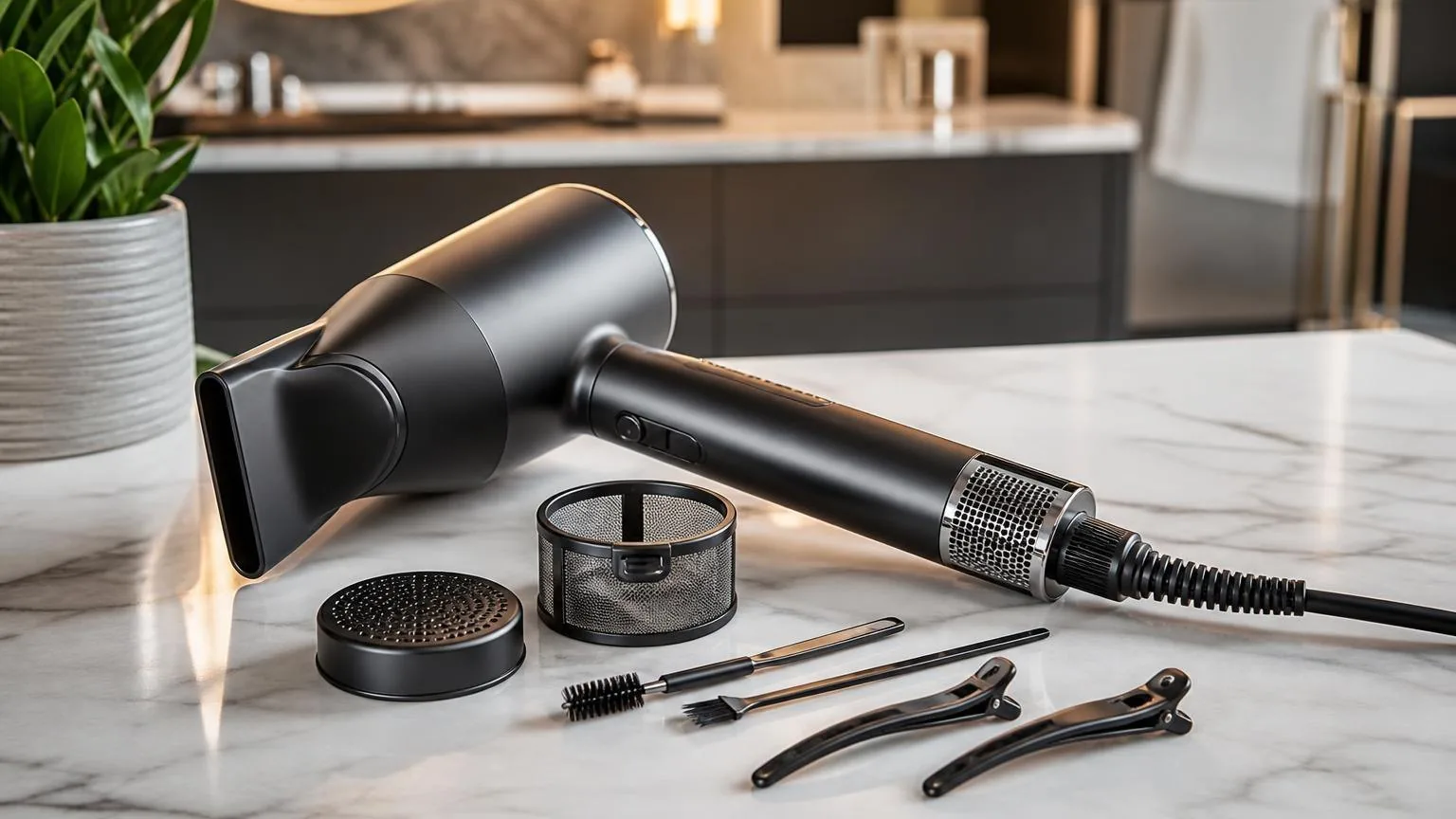
Method matters. A removable filter cap can usually be brushed out in under 60 seconds. If the manual allows rinsing, dry the part fully before refitting it. Moisture left in the screen traps fresh dust faster.
- Keep a soft brush at each station.
- Assign one dryer per stylist where possible.
- Log cleaning by shift, not by memory.
- Replace cracked or warped filter covers immediately.
The practical rule is simple. The heavier the daily runtime, the shorter the cleaning interval. For salons, think in days. For home users, think in weeks.
What Tips It One Way
Filter cleaning frequency changes with airflow load, not brand loyalty. The more hair dust, lint, and spray residue the motor pulls in, the faster the screen blocks and the hotter the dryer runs.
Usage hours, product overspray, and room lint are the main drivers.
A home dryer used 10 minutes a day can often go longer between cleans than a salon dryer running 4 to 8 hours. Fine mesh filters also clog faster than wider rear grilles because they trap smaller particles.
| Setting | Typical use | Check filter | Clean filter |
| Home, low styling product | 5 to 10 minutes per day | Every 2 weeks | About every 4 weeks |
| Home, frequent sprays or powders | 10 to 20 minutes per day | Weekly | Every 2 weeks |
| Blow dry bar, steady chair traffic | 4 to 6 hours per day | Daily | 2 to 3 times per week |
| High-volume salon floor | 6 to 8 hours per day | Daily | Daily or every 2 days |
Product choice changes the result fast. Flexible hold sprays, dry texture sprays, and powders leave airborne particles that stick to the filter. Oils and shine mists can trap dust on the mesh, turning loose lint into a tighter film.
Room conditions matter as much as styling habits. Towels, capes, velcro rollers, and backcombing all release fibers. Small salon spaces with constant sweeping usually load a filter faster than larger, better-ventilated rooms.
Tool design also shifts the interval. A rear mesh under 1 millimeter catches fine debris well but needs more frequent attention. Removable cages are easier to clean fully than fixed grilles, so maintenance is more likely to happen on time.
| Factor | Lower buildup | Higher buildup |
| Air products in use | Creams, lotions | Sprays, powders, dry texturizers |
| Textile fiber nearby | Minimal towels and capes | Heavy towel turnover, fleece, velcro tools |
| Filter type | Open grille | Fine mesh screen |
| Daily runtime | Under 30 minutes | Over 4 hours |
Heat setting does not clog a filter by itself, but blocked airflow forces hotter operation. If drying time stretches, the motor note sounds sharper, or the barrel feels unusually hot after 5 to 10 minutes, inspect the filter before the next client.
- Check faster if the dryer is used on back-to-back appointments.
- Check faster in rooms with frequent aerosol finishing work.
- Check faster after towel-heavy services or heavy round-brush sessions.
- Check slower only when runtime and airborne product are both low.
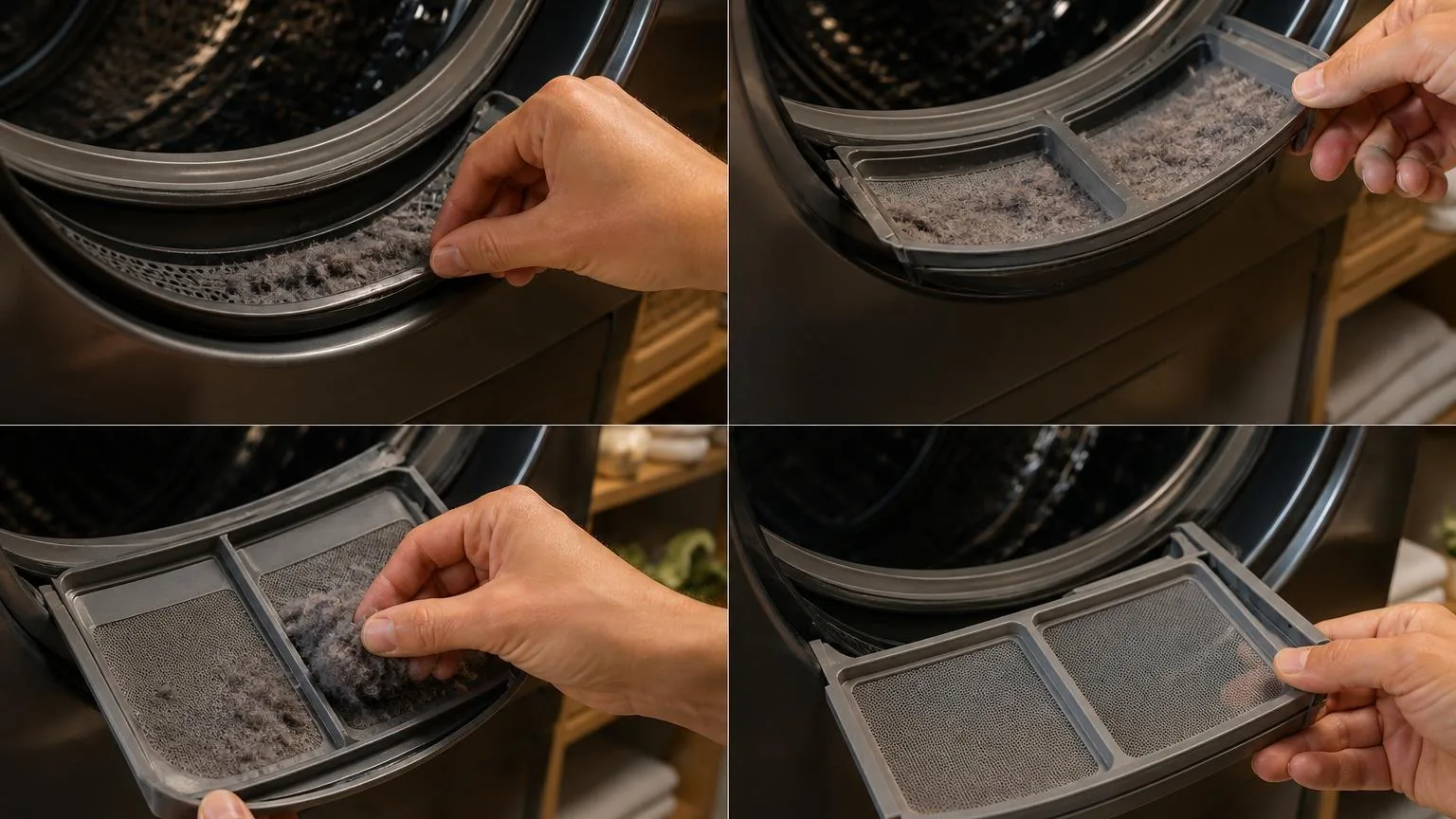
The best schedule is a fixed inspection rhythm, then adjust by what you see. If the screen shows a visible grey ring or lint mat, your current interval is too long.
Telling Good From Good Enough
Judge filter cleaning frequency by what happens on the head, not only by the calendar.
If dry time stretches by 20 to 30 percent, airflow feels weaker at the same heat setting, or the barrel runs hotter in your hand, the filter is usually carrying lint and dust.
On clean, towel-blotted hair, a healthy professional dryer should move roots within 30 to 60 seconds per section.
When the filter is restricted, roots stay damp longer, mids need extra passes, and the finish loses polish even with the same brush tension.
Start with one repeatable test. Use hair that is about 60 to 70 percent dry, sectioned to 2-inch widths, and a round brush sized 35 mm to 55 mm. Keep the nozzle attached and hold it about 1 inch from the brush.
Time one crown section and one front section. On medium-density hair, many stylists expect each 2-inch section to smooth in about 90 to 150 seconds. If the same client now needs 30 to 45 seconds longer per section, check the filter first.
| What you see on real hair | Typical clean-filter result | What a clogged filter often changes |
| Root drying speed | Roots lose visible dampness in 30 to 60 seconds | Roots stay cool and damp past 60 to 90 seconds |
| Section finishing time | 2-inch section smooths in 90 to 150 seconds | Time rises by 20 to 30 percent or more |
| Frizz at the cuticle | Surface looks tighter after 2 to 3 passes | Needs 4 to 6 passes for the same polish |
| Tool heat in hand | Handle and rear housing stay manageable | Rear housing feels noticeably hotter |
| Sound | Steady, even pitch | Higher strain sound or uneven airflow note |
Texture changes the threshold. Fine hair exposes weak airflow fast because it overdries at the surface yet stays damp at the root. Dense or coarse hair shows it through longer service times, especially at the nape and crown.
- Watch for extra heat use to compensate. If you move from medium to high heat without faster drying, airflow is the issue.
- Check nozzle behavior. A concentrated nozzle should feel forceful at 1 inch. If it feels soft, inspect the filter.
- Track service drift. An extra 5 minutes on a full blowout often points to maintenance, not technique.
For salon use, review the filter at the end of each busy day and clean when lint is visible across the mesh. For home use, inspect weekly if you blow-dry 3 or more times per week. Heavy lint, pets, or powder styling products shorten that interval.
Always compare after cleaning on the same client type, section size, brush size, and heat setting. If drying time and finish recover immediately, your filter schedule was too loose. Tighten it until performance stays consistent chair to chair.
How It Compares to the Alternatives
For most dryers, routine filter cleaning is the lowest-effort way to protect airflow and drying speed.
Compared with self-cleaning systems, removable cartridge filters, or external pre-filters, a standard rear screen usually needs attention more often but takes less than 2 minutes.
The trade-off is simple: the simpler the intake design, the more often lint and dust must be cleared by hand. In busy blow-dry service, that usually means checking the filter daily and cleaning it at least weekly.
| Filter setup | Typical check interval | Typical clean or replace interval | What changes in use |
| Standard rear mesh screen | Daily in salon use; weekly at home | Every 3 to 7 days in heavy use; every 2 to 4 weeks at home | Fast to clean, but airflow drops sooner when lint builds |
| Removable fine-screen cartridge | Daily in salon use; every 1 to 2 weeks at home | Weekly in heavy use; every 2 to 4 weeks at home | Catches finer debris, so it can load faster |
| Self-cleaning or reverse-air intake system | Weekly in salon use; monthly at home | Manual clean when residue remains after the cycle | Reduces buildup, but does not eliminate manual inspection |
| External pre-filter cover | Daily | Wash or replace every 1 to 7 days, depending on visible loading | Protects the main filter, but adds another maintenance step |
Standard mesh screens are still the baseline in salons because they are visible and easy to access. Twist off the rear cap, remove lint by hand or with a soft brush, then wipe the screen dry before the next service.
Fine cartridge filters catch smaller particles than open mesh. That can help keep the motor area cleaner, but it also means the surface blocks sooner, especially where dry shampoo, texturiser overspray, and towel lint are common.
Self-cleaning systems reduce labor, not responsibility. If a dryer uses reverse airflow for 10 to 30 seconds, inspect the intake anyway. Residue can stick to the screen frame and vents, and that residue still restricts airflow.
External pre-filters work best in high-lint settings, such as backwash areas shared with towels and capes. They are useful when cleaned often. Leave them loaded for several days, and they become the restriction point instead of the internal screen.
- Choose standard mesh if you want the quickest manual routine.
- Choose fine cartridges if your priority is trapping smaller debris.
- Choose self-cleaning systems if you want fewer deep cleans, not zero checks.
- Choose pre-filters only if staff will inspect them every shift.
In practice, cleaning frequency should follow airflow, not habit alone. If the dryer sounds hotter, takes longer to rough-dry, or the rear intake shows visible lint, clean the filter before the next client.
Where Damage Creeps In
A clean dryer filter protects hair by keeping heat and airflow predictable. When lint blocks the rear screen, many dryers run hotter, dry slower, and force stylists to add more brush tension and extra passes.
That combination raises breakage risk and roughens the cuticle.
Filter maintenance matters because blow-drying is a balance of heat, air speed, and stretch. The British Association of Dermatologists advises minimizing excessive heat on hair.
In practice, that means moderate settings, controlled section sizes, and a clean intake so the tool performs as designed.
Use the lowest heat that finishes the section within 2 to 4 passes. Keep the nozzle 2 to 4 inches from the hair shaft. Work in sections no wider than the brush barrel, usually 1.5 to 2.5 inches for smooth blowouts.
| Variable | Target range | Why it protects hair |
| Nozzle distance | 2 to 4 inches | Reduces concentrated hot spots |
| Section width | 1.5 to 2.5 inches | Needs fewer repeat passes |
| Passes per section | 2 to 4 | Lowers cumulative heat exposure |
| Brush tension | Firm, not pulling | Smooths without overstretching |
A blocked filter changes technique. Airflow drops first. The stylist compensates by increasing heat, slowing the brush, or holding the dryer closer than 2 inches.
Hair then spends longer above a safe styling window, especially at the ends where fiber wear shows fastest.
For straight or fine hair, use medium heat and high airflow before escalating heat. For dense or coarse hair, use high airflow first, then raise heat only if the section stays damp after 3 controlled passes.
Air movement dries; heat should assist, not replace airflow.
Clean the removable filter as often as product dust and lint collect. In a busy blow dry bar, check daily and deep-clean at least weekly. For home use, inspect every 1 to 2 weeks.
Always unplug first and follow the manufacturer’s cleaning method.
| Use pattern | Filter check | Deeper clean |
| High-volume salon | Daily | Weekly |
| Moderate salon station | Every 2 to 3 days | Weekly |
| Home use | Every 1 to 2 weeks | Monthly, or sooner if visibly clogged |
Finish each section with a cool shot for 5 to 10 seconds. That sets shape without more heat. If you need stronger hold, use smaller sections before raising temperature. Better sectioning reduces both tension and time under the dryer.
Why It Works the Way It Does
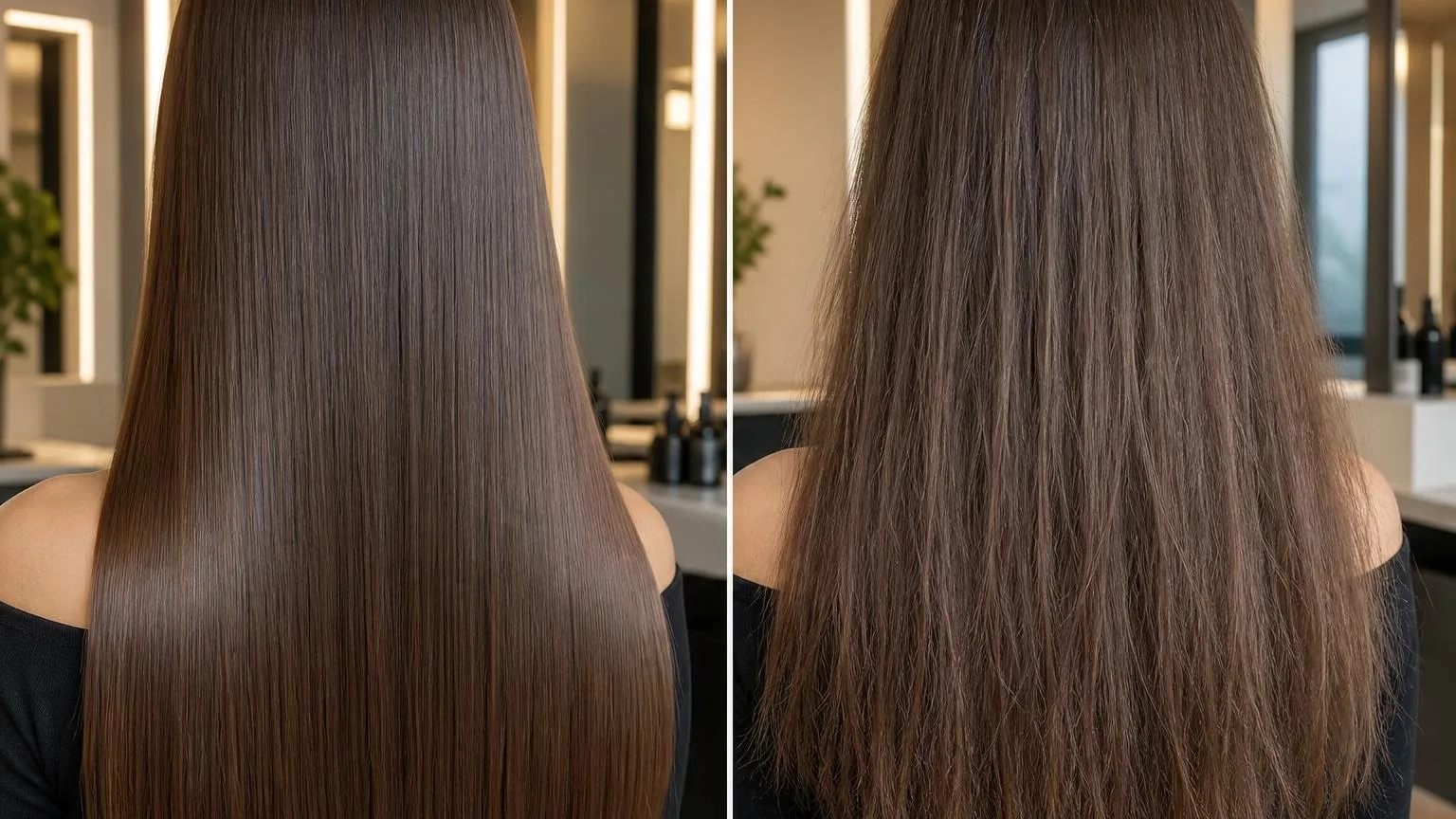
Filter cleaning changes airflow first, then heat delivery, drying time, and finish control.
A clear rear filter lets the motor pull air at its intended rate; a loaded filter restricts intake, which reduces air volume and raises internal heat around the heater assembly.
The practical result shows up at the brush. The same dryer setting can feel hotter yet move less air, so moisture leaves the surface unevenly. That shifts root lift, stretch, and how quickly a section reaches a dry, polished state.
| Variable | Cleaner filter | Loaded filter | Why the finish changes |
| Airflow at nozzle | Higher air volume | Lower air volume | More moving air removes water faster from roots through mid-lengths |
| Surface heat feel | More even | Hotter in bursts | Restricted intake can concentrate heat while reducing evaporation |
| Section dry time | Shorter | Longer | Evaporation depends on airflow and heat together, not heat alone |
| Brush tension needed | Lower | Higher | Slower drying often makes stylists overwork the same 5 cm pass |
| Finish consistency | Smoother pass to pass | Patchier | Uneven drying leaves damp roots or rough ends |
Distance changes matter more when airflow is restricted. Holding the nozzle 5 cm from the hair instead of 10 cm raises surface temperature quickly, which can set the cuticle before the root zone is fully dry.
The result is polish on top and collapse underneath.
Section size also shifts. A 5 cm wide section with moderate density dries predictably because air can pass from root to ends in one controlled pass.
An 8 cm section demands more time; with a dirty filter, the center often stays damp after the outer hair looks finished.
Timing shows the difference. A disciplined blow-dry pass usually stays around 8 to 12 seconds per brush rotation on a small section.
If the same section needs 15 to 20 seconds repeatedly, reduced intake is one likely cause, especially when the dryer body feels unusually warm.
Nozzle choice changes the effect. A concentrator around 6 to 8 cm wide directs limited airflow better than a bare barrel.
With a clogged filter, however, narrowing the stream cannot replace lost volume; it only focuses what remains, which increases spot heating risk.
- Check the rear filter daily in high-volume salon use.
- Clean when lint is visible across more than a thin surface film.
- At-home use commonly needs attention every 1 to 4 weeks, depending on dust and styling frequency.
- Recheck if dry time lengthens by one extra pass per section.
The method changes output stability, not only hygiene. Stable intake keeps temperature and airflow closer to the dryer’s intended balance, which is what sets roots, smooths lengths, and finishes ends within the same working window.
Common Mistakes and Myths
The most common mistake is waiting until airflow drops or the barrel feels unusually hot before cleaning the filter.
A salon dryer used all day often needs a check every shift and a proper clean at least weekly, while home use is often every 1 to 4 weeks.
Another mistake is treating every filter the same. Mesh screens, rear caps, and fine internal grilles trap lint at different rates, so the correct frequency depends on run time, dust, and styling products in the air.
| Myth or mistake | What is accurate | Practical action |
| “Clean it once a month, no matter what.” | Frequency should follow use hours. Heavy salon use can mean 20 to 40 drying sessions a day. | Check the filter daily in busy bars. Deep-clean weekly unless the maker states otherwise. |
| “If the dryer still sounds normal, the filter is fine.” | Lint buildup can restrict airflow before noise changes are obvious. | Remove visible dust when buildup covers roughly one-third of the mesh surface. |
| “A quick wipe of the outside is enough.” | Dust often sits in the mesh openings, not only on the cap. | Use a soft brush first. Then wipe the cover. Make sure the dryer is unplugged and cool. |
| “Compressed air always fixes it.” | Blasting debris inward can push lint deeper on some designs. | Follow the manual. Clean from the outside of the screen unless the filter is designed to detach. |
| “Heat setting causes most overheating, not the filter.” | Blocked intake reduces cooling air to the motor and heater assembly. | Pair filter checks with cord and vent checks every 5 to 7 working days. |
A frequent salon error is ignoring product-heavy environments. Hairspray, dry texture spray, and powder create sticky dust that clings faster than ordinary lint. In a station using sprays on most clients, a filter can look loaded after 2 to 3 days.
Home users often make the opposite mistake and over-clean aggressively. Metal pins, hard brushes, and wet cloths on a plugged-in or warm dryer can damage the screen or housing. Use a dry microfiber cloth and a soft brush about 1 to 2 cm wide.
Another myth is that a removable rear cap means the inside should be washed under a tap. Some caps are washable only when fully detached and fully dried. If any moisture remains, wait until every part is dry before reassembly and use.
One more mistake is skipping a schedule. Put filter cleaning beside your tool sanitation routine. For salons, a 30-second visual check at open and close prevents the longer downtime that comes with a visibly packed intake.
Frequently Asked Questions
How often should you clean a hair dryer filter?
For salon use, clean the filter every 1 to 3 days. For home use, clean it every 1 to 2 weeks. Heavy product spray, linty towels, and long appointments load the mesh faster, so shorten the interval.
What are the signs that the filter needs cleaning sooner?
Check airflow first. If dry time stretches by 2 to 5 minutes, the handle feels hotter than usual, or the motor sounds higher pitched, the filter is likely restricted. Clean it before the next service to reduce heat buildup.
How do you clean a removable dryer filter correctly?
Switch off the dryer, unplug it, and let it cool for 10 to 15 minutes. Twist off the rear cap, lift away lint with a soft brush, and wipe the mesh dry.
Avoid running water unless the manufacturer permits it, because trapped moisture can damage the motor.
Do high-speed digital dryers need a different cleaning schedule?
Yes. High-speed models often use finer mesh, so check the filter daily in a busy bar. If the dryer runs 20 to 40 blowouts a week, a quick brush-out after every shift keeps airflow closer to factory performance.
Can a dirty filter affect blow-dry finish and tool life?
Yes. Restricted intake cuts airflow, which can flatten root lift and slow brush tension work, especially with 33 mm to 53 mm round brushes.
The motor and heating element also run under more strain, so routine cleaning supports more consistent results and longer service life.
Should you clean the hair dryer filter more often in a salon?
Yes. A salon dryer usually pulls in more hair, dust, and product residue because it is used throughout the day. Check the filter daily and clean it whenever buildup is visible.
What products can build up on a hair dryer filter?
Hairspray, mousse, dry shampoo, heat protectant, and fine styling powders can collect on the filter over time. This buildup can restrict airflow, especially when mixed with lint and shed hair.
Can you use a hair dryer without its filter cover?
No. The filter cover helps keep hair, lint, and debris away from the motor and internal parts. Using the dryer without it can increase the risk of blockage, overheating, or damage.
Related Reading
- Choosing a professional dryer: what actually matters
- Ceramic or tourmaline: what changes inside the barrel
- How long a hair dryer lasts, and what shortens it
- Safe heat settings for a blow dry, by hair type
- Paddle or round: which brush does which job
- What a paddle brush is actually for
- The complete guide to blow dry tools
- Occupational Safety and Health Administration
- PubMed
- National Institute of Standards and Technology Fire Research Division
- U.S. Small Business Administration
- Milady
- Professional Beauty Association
- National Hair & Beauty Federation
- Electrical Safety First
- EPA — Safer Choice
- NCBI Bookshelf
- MedlinePlus — Hair Problems