
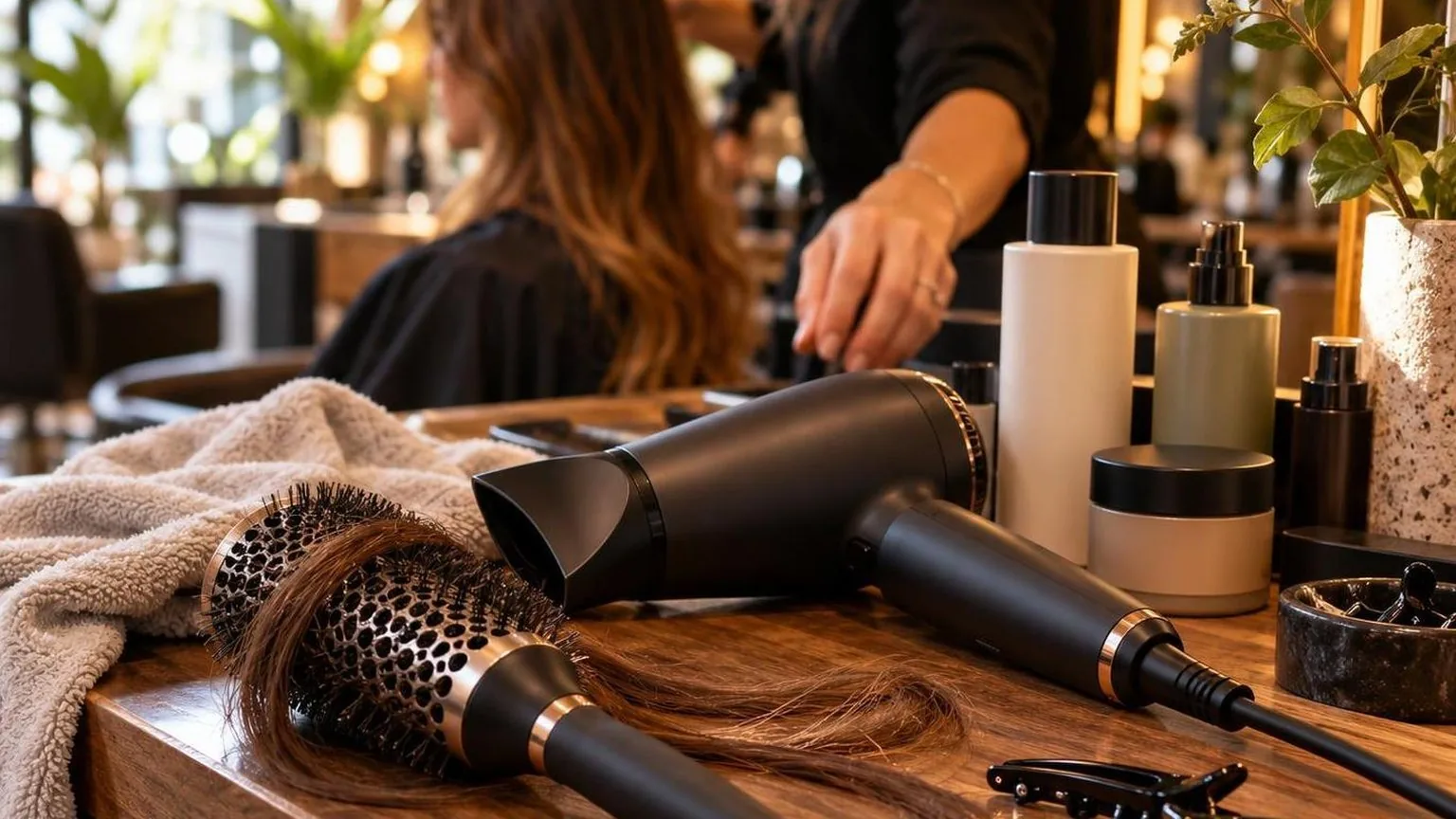
Why does hair go frizzy after blow drying? Excess water, rough towel drying, high heat and airflow that lifts the cuticle leave strands uneven, so humidity enters and expands them.
Direct the dryer downward at 45 degrees, keep it 15 centimetres from the hair, and finish each section with cool air.
Frizz also increases when hair is dried inconsistently: damp roots, over-dried ends and brushing against the natural growth direction create different textures.
Use a nozzle narrower than 4 centimetres, work in 3-centimetre sections and keep the brush moving. Choose medium heat for fine hair and high heat only for dense sections, then stop when each section feels dry rather than hot.
A lightweight smoothing product can reduce friction when applied from mid-lengths to ends. Avoid adding product to wet roots, which slows drying and encourages repeated passes.
The result depends on controlled tension, consistent airflow and complete drying, not simply higher temperature.
Diagnose Your Frizz Trigger in 60 Seconds
Frizz after a blowout has a specific cause. Pinpointing yours determines every product and technique choice that follows. Grab a single strand from your brush and run through these steps.
- Measure your strand diameter. Hold a shed hair against a standard sewing thread (roughly 0.4 mm). If thinner, you have fine hair — it loses moisture fast and frizzes from over-drying at temperatures above 150 °C. If thicker, coarse hair is more likely frizzing from under-drying, where the cuticle never fully sealed.
- Check your porosity. Drop a clean, product-free strand into a glass of room-temperature water. If it sinks within 10 seconds, you have high porosity — humidity re-enters the cortex almost immediately after styling. If it floats past 2 minutes, low porosity means surface moisture sits on the cuticle and disrupts smoothness.
- Audit your nozzle gap. Measure the distance you hold your concentrator nozzle from the hair section. Under 3 cm scorches fine strands and roughens the cuticle. Over 8 cm disperses airflow too wide, leaving sections partially damp inside — a guaranteed frizz source within 20 minutes.
- Time your cool shot. After finishing a section with heat, count how many seconds of cool air you apply. Fewer than 5 seconds per section leaves the cuticle partially open.
Record your answers: strand width, sink time, nozzle distance, cool-shot duration. These four readings dictate every adjustment covered below.
Reading the Numbers Properly
Frizz after blow drying almost always traces back to misreading or ignoring heat settings. Most dryers display wattage, not temperature, leaving stylists guessing at actual airstream heat.
Understanding the relationship between wattage, temperature, and distance prevents the cuticle disruption that causes frizz.
A dryer’s wattage rating measures motor power, not heat output. A 2200 W dryer produces stronger airflow than a 1600 W unit, but both can reach similar temperatures at the nozzle if the lower-watt model compensates with hotter elements.
Airstream Temperature by Setting
Infrared thermometer readings taken at the nozzle tip show significant variation across typical consumer and professional dryers.
| Setting | Nozzle Temperature Range | Frizz Risk |
| Cool / Cold shot | 25–35 °C (77–95 °F) | Low |
| Low heat | 50–70 °C (122–158 °F) | Low to moderate |
| Medium heat | 70–90 °C (158–194 °F) | Moderate |
| High heat | 90–120 °C (194–248 °F) | High |
These ranges shift depending on nozzle attachment and distance from the hair. A concentrator nozzle (typically 70–75 mm wide) focuses airflow, raising effective temperature at the strand by roughly 10–15 °C compared to an open barrel.
Distance Changes Everything
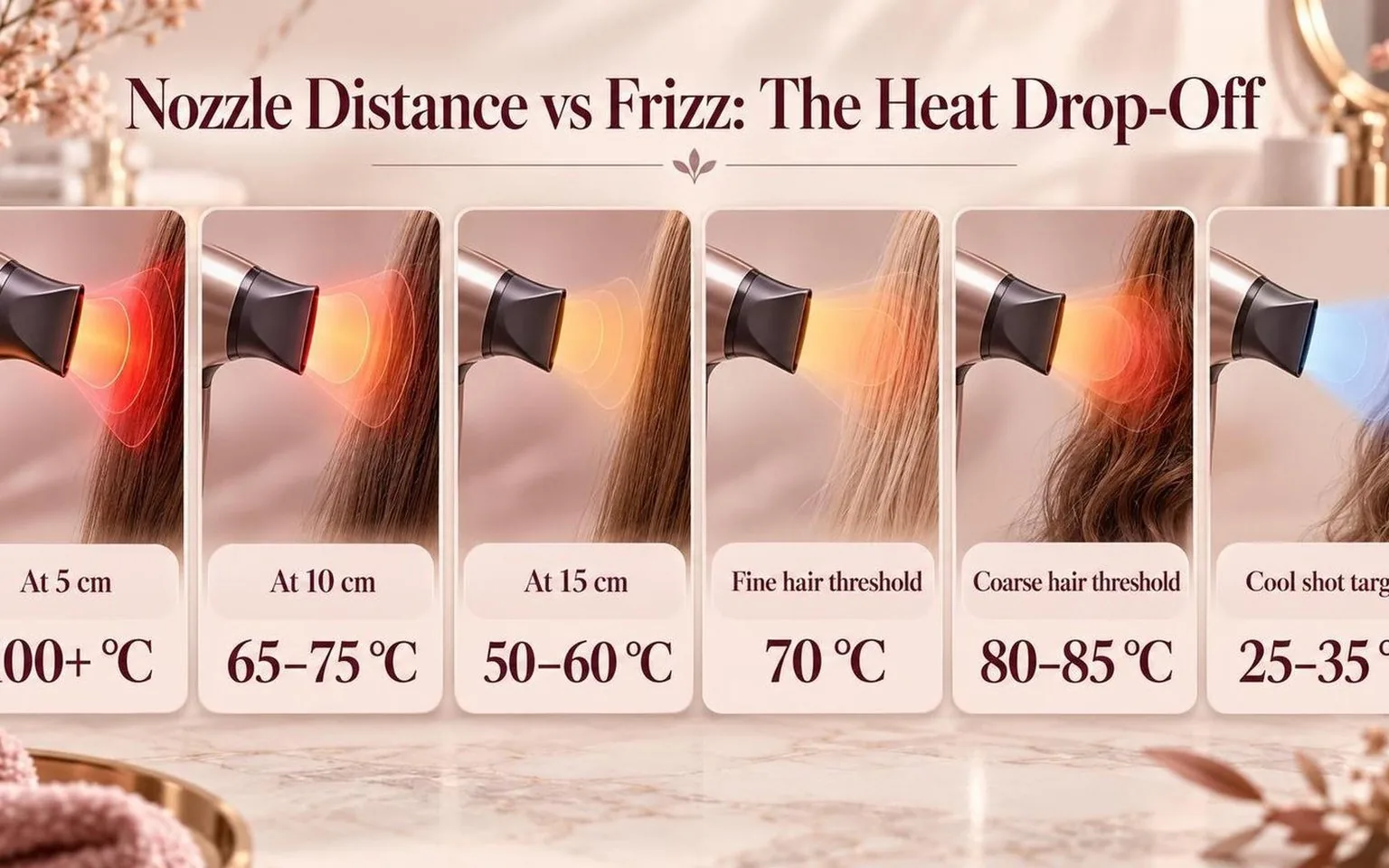
Temperature drops sharply as distance increases between the nozzle and the hair surface. Holding the dryer 15 cm (6 in) away reduces heat reaching the strand by approximately 30–40% compared to holding it at 5 cm (2 in).
- At 5 cm: hair surface can reach 100+ °C on high, enough to flash-boil residual moisture and lift cuticle scales
- At 10 cm: effective temperature drops to roughly 65–75 °C on high, within a safer working range
- At 15 cm: temperature falls further to approximately 50–60 °C, reducing frizz risk significantly but extending drying time
What the Numbers Mean in Practice
Fine hair begins showing heat damage indicators at lower thresholds than coarse hair. Fine strands respond to temperatures above 70 °C with cuticle lifting, while coarser textures tolerate up to 80–85 °C before the same effect appears.
The practical takeaway: pair a high-wattage dryer (1800–2200 W) with a medium heat setting and 10–15 cm of distance.
This combination delivers enough airflow to move water from the strand efficiently while keeping surface temperature below the cuticle-disruption threshold for most hair types.
The Variables That Matter
Three variables dictate whether a blowout stays smooth or reverts to frizz: the moisture level inside the cortex when you finish, the heat setting relative to hair porosity, and the diameter and material of the brush you use.
Get any one wrong and the hydrogen bonds reset unevenly.
Heat Setting and Porosity
High-porosity hair absorbs and releases moisture rapidly, making it the most frizz-prone type. Lower temperatures held longer seal the cuticle more reliably than a quick blast of high heat.
| Porosity Level | Recommended Dryer Temp | Approximate Drying Time per Section |
| Low porosity | 80–90 °C (176–194 °F) | 20–30 seconds |
| Medium porosity | 70–80 °C (158–176 °F) | 25–35 seconds |
| High porosity | 60–70 °C (140–158 °F) | 30–45 seconds |
Exceeding 150 °C at the hair surface causes bubble damage inside the cortex. This weakens the cuticle layer permanently, leaving hair structurally unable to resist ambient humidity.
Brush Diameter and Material
A larger barrel creates greater tension per pass, which stretches hydrogen bonds straighter before they cool and lock. Boar-bristle brushes grip the cuticle tightly; nylon-pin brushes move faster but apply less smoothing force.
- 25 mm barrel — short hair up to 15 cm; tight tension, faster overheating risk
- 33 mm barrel — medium lengths 15–25 cm; balanced tension and volume
- 43 mm barrel — long hair 25 cm and above; maximum smoothing, requires a stronger wrist angle
- Ceramic barrels — distribute heat evenly across the section, reducing hot spots by roughly 30% compared to aluminium
The Cool-Shot Lock
Hydrogen bonds solidify as hair drops below approximately 60 °C. Finishing each section with 5–8 seconds of cool air before releasing the brush locks the shape.
Skipping this step is the single most common reason salon-quality smoothness collapses within an hour.
Ambient humidity above 65% relative humidity will begin to disrupt even well-set bonds.
Working in a cooler, drier room — or applying a lightweight silicone serum before drying — gives the cuticle a hydrophobic barrier that extends the result.

Reading the Result at the Chair
Post-blowout frizz becomes visible within the first 30–60 seconds after the dryer stops.
Trained stylists assess the finished section under salon lighting at arm’s length, checking for halo frizz, flyaways along the part line, and uneven surface texture before moving to the next panel.
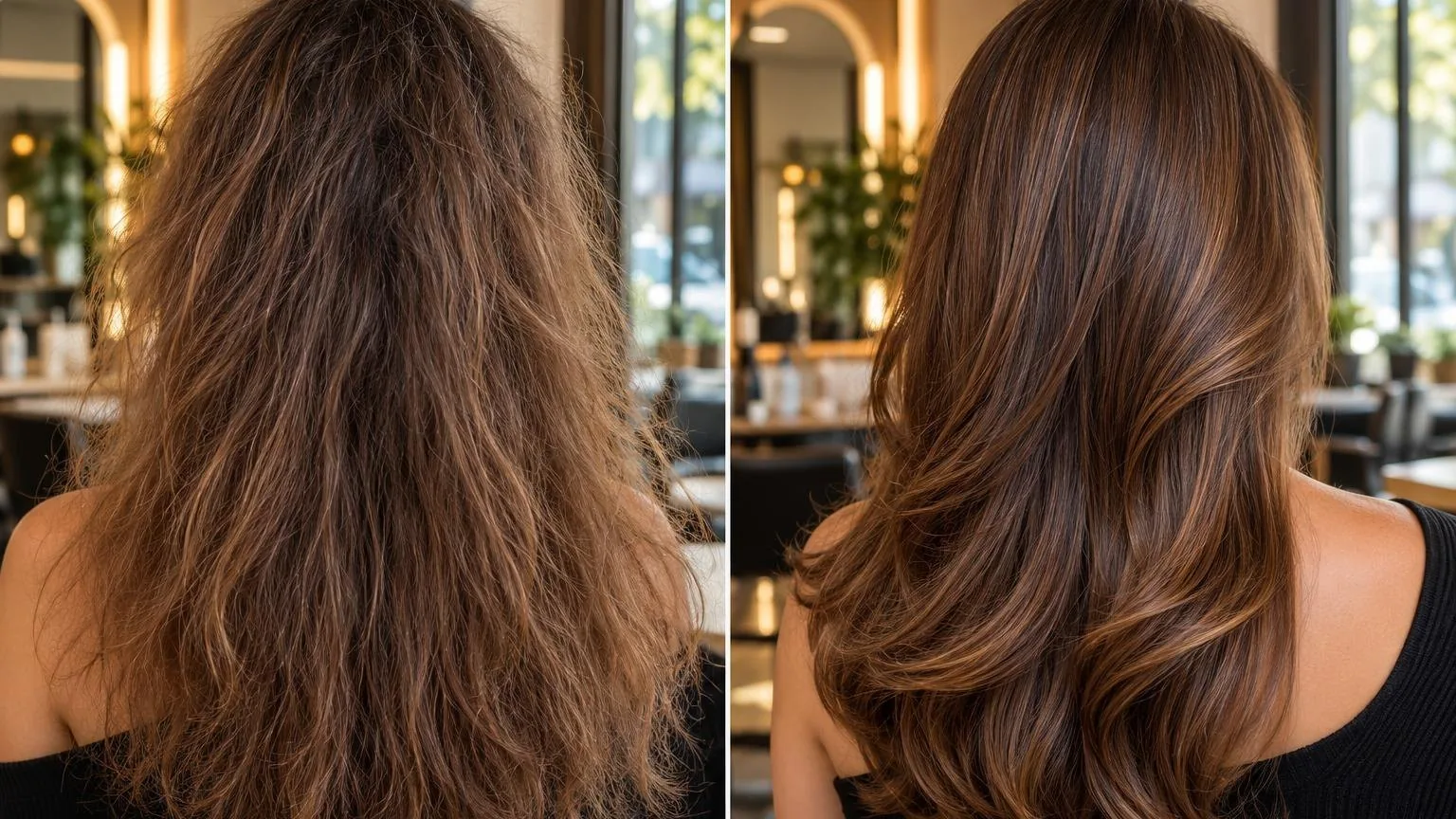
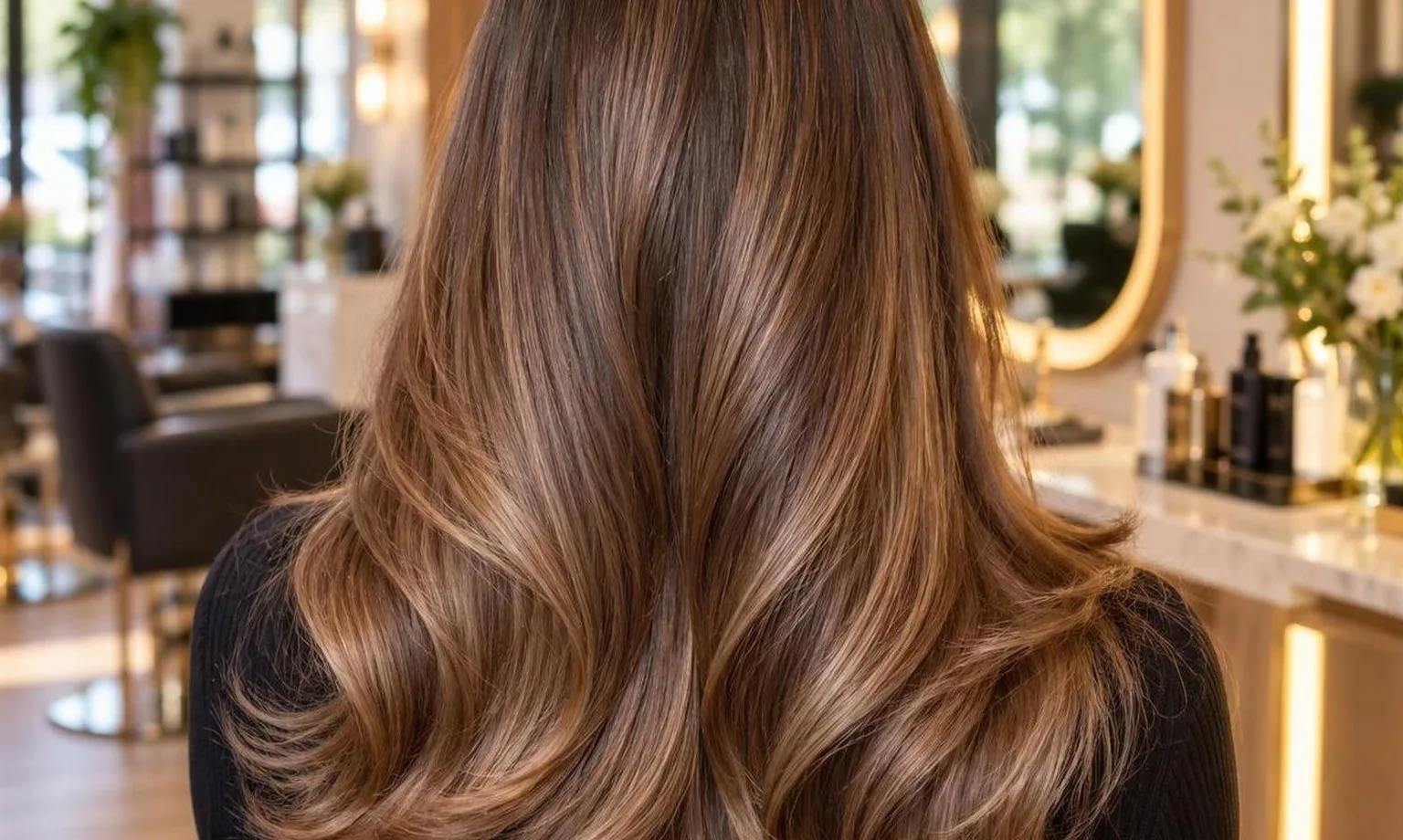
The cuticle tells the story. Smooth, closed cuticle layers reflect light uniformly, producing a visible shine band along the hair shaft. Raised or disrupted cuticles scatter light, creating the matte, fuzzy appearance clients describe as frizz.
Visual and Tactile Checkpoints
| Checkpoint | Smooth Result | Frizz Present |
| Shine band visibility | Continuous, mirror-like reflection | Broken or absent reflection |
| Surface feel (pinch-slide test) | Silky, no snag from root to end | Rough texture, catches at mid-shaft |
| Halo at crown | Fewer than 5 stray strands per cm | Visible cloud of short, lifted hairs |
| Section weight and movement | Panels swing together as a unit | Individual strands separate and lift |
| Cool-shot hold | Shape locks within 3–5 seconds | Section springs open or puffs immediately |
The Pinch-Slide Test
Pinch a finished section between thumb and forefinger at the root. Slide slowly to the ends. A properly sealed cuticle feels glassy.
Any gritty or catching sensation at the mid-shaft signals incomplete smoothing or heat damage from exceeding 210 °C on fine hair.
Humidity Response Window
Frizz often intensifies 2–4 minutes after the blowout as ambient moisture re-enters the cortex.
In salons running above 55% relative humidity, stylists report noticeably faster frizz rebound compared to environments held at 40–45% relative humidity.
- Check each section twice: once immediately after the cool shot, once after a 90-second rest.
- Use a handheld mirror to inspect the occipital zone, where undertension during drying causes the most frizz.
- Note the client’s natural porosity — high-porosity hair absorbs ambient moisture faster, accelerating the frizz timeline.
Documenting these observations on a client card allows stylists to adjust nozzle angle, tension, and product layering at the next appointment, targeting the specific failure points rather than repeating a generic technique.
Trade-Offs Against the Alternatives
Blow drying trades moisture retention for speed and volume. Air drying preserves more surface-level hydration but exposes hair to prolonged swelling from absorbed water.
Each method inflicts damage through a different mechanism, and the frizz outcome depends on hair porosity, humidity, and technique.
Blow Drying vs. Air Drying
A study published in the Annals of Dermatology found that blow drying at 15 cm distance caused less damage to the hair cortex than air drying, which allowed extended water-induced swelling of the cell membrane complex.
However, holding a dryer closer than 10 cm or using temperatures above 150 °C reversed that advantage, causing surface cracking and cuticle lift that directly produces frizz.
| Method | Primary Damage Mechanism | Frizz Risk in Humidity Above 60% | Typical Drying Time (Medium-Density Hair) |
| Blow dry (80–95 °C, 15 cm distance) | Heat-induced cuticle lifting | Moderate — controlled with tension | 12–18 minutes |
| Air dry | Hygral fatigue from prolonged water absorption | High — no cuticle sealing | 45–120 minutes |
| Hooded dryer (60–70 °C) | Low-grade thermal stress | Low — even, indirect heat | 25–40 minutes |
| Diffuser attachment (low speed) | Minimal mechanical disruption | Low to moderate | 20–35 minutes |
Where Blow Drying Wins
- Directional airflow at 70–80 mph smooths cuticles flat, reducing light scatter and frizz visibility.
- A round brush under tension physically stretches hydrogen bonds into a straight configuration before they re-set.
- A cool-shot burst at 20–25 °C locks those bonds, adding up to 48 hours of hold in moderate humidity.
Where Blow Drying Loses
- Repeated sessions above 150 °C degrade the F-layer, the hair’s outermost lipid barrier roughly 0.9 nm thick.
- High-speed airflow without a nozzle ruffles cuticles in random directions, worsening frizz rather than preventing it.
- Curly and coily textures (Type 3B–4C) lose definition under concentrated airflow unless a diffuser is used.
The safest frizz-prevention approach combines a concentrator nozzle, medium heat around 80 °C, and consistent 15 cm distance. That combination outperforms air drying for smoothness without crossing into damaging territory.
Heat and Tension Without the Damage
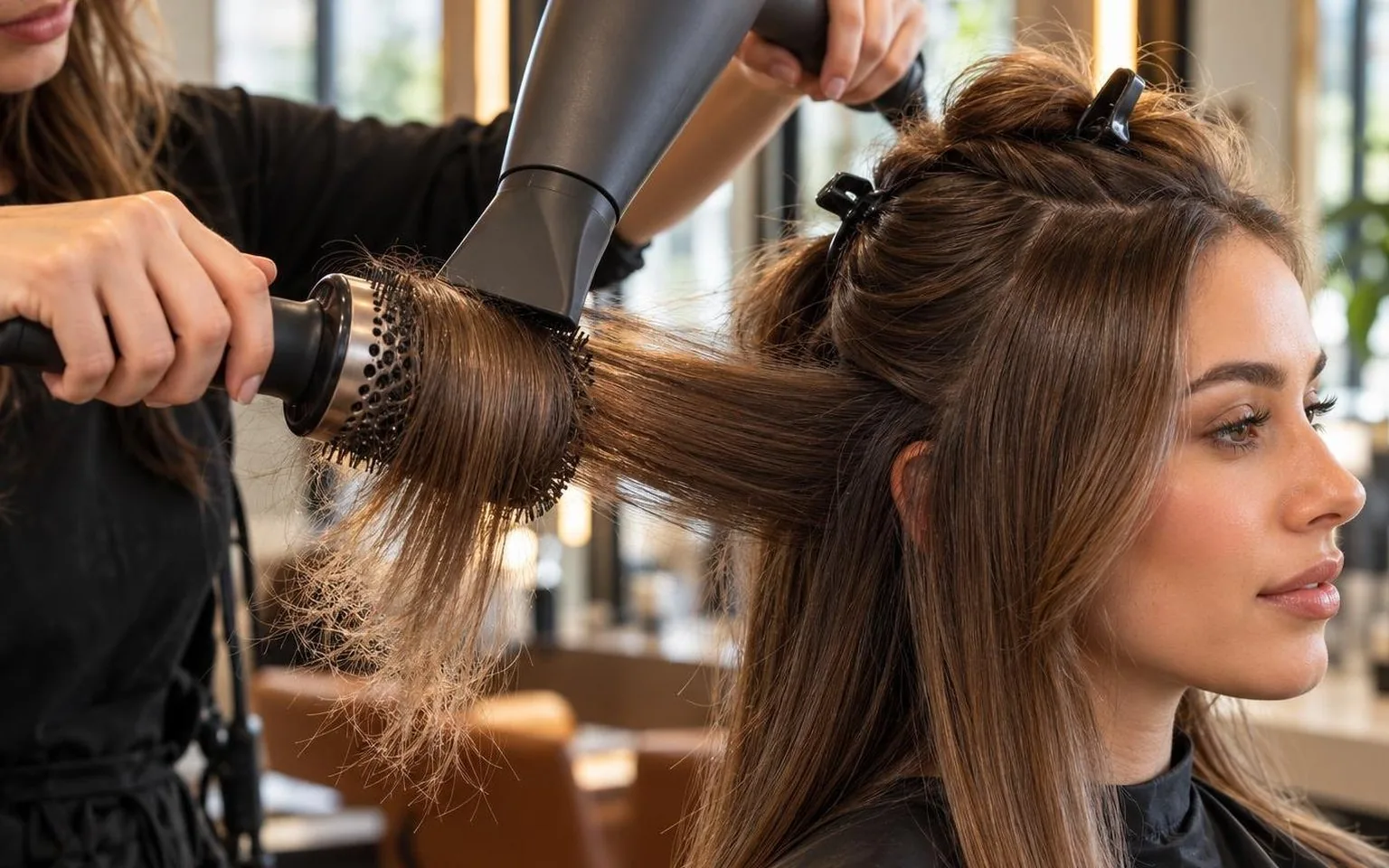
Controlled heat and mechanical tension are the two forces that reshape hydrogen bonds during a blowout.
The goal is applying enough of both to set the cuticle flat without exceeding the threshold where thermal damage begins — roughly 150 °C (302 °F) for fine hair and 180 °C (356 °F) for coarse hair.
Dryer distance matters more than most stylists realize. Holding the nozzle 15 cm (6 inches) from the hair strand keeps surface temperature approximately 30–40 °C lower than holding it at 5 cm.
A concentrator nozzle narrows airflow to a strip roughly 8–10 mm wide.
That focused stream does two things: it directs heat along the hair shaft in one direction, and it compresses the cuticle layers flat against each other, reducing light scatter that reads as frizz.
Temperature Guidelines by Hair Texture
| Hair Texture | Recommended Dryer Temp | Max Contact Temp at Strand |
| Fine / colour-treated | Low–medium setting | 130–150 °C |
| Medium / virgin | Medium setting | 150–170 °C |
| Coarse / resistant | Medium–high setting | 170–185 °C |
Tension Technique
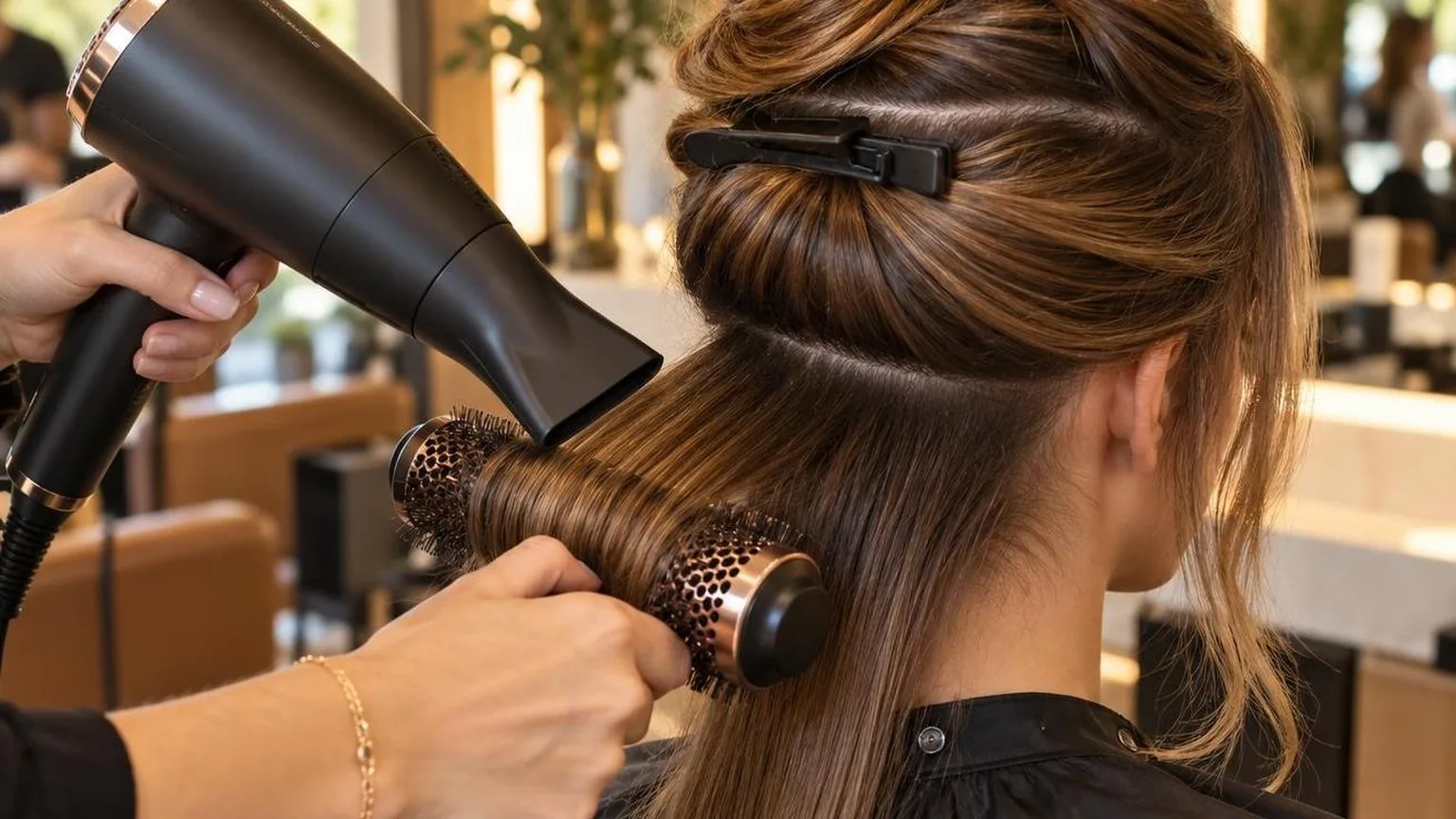
Tension from the brush is what smooths each section. A 43 mm round brush on medium-length hair provides enough wrap surface to hold strands taut while the cuticle sets in place.
- Take sections no wider than the brush barrel — roughly 5 cm for a 43 mm brush
- Maintain consistent pull from root to end, rotating slowly at roughly 3–4 seconds per pass
- Follow the brush with the nozzle at a downward 45-degree angle to seal cuticle edges
- Finish each section with a 5–10 second blast of cool air to lock the hydrogen bonds in their new position
Skipping the cool shot is one of the most common causes of post-blowout frizz. Heat opens bonds and reshapes them; cold air sets them. Without that final step, bonds remain partially mobile and revert as ambient humidity enters the strand.
Overdrying is the other frequent mistake. Hair that feels hot to the touch has likely exceeded safe thermal limits. A strand should feel warm, never uncomfortable when pressed between your fingers immediately after a pass.
Step by Step Through the Change
Frizz after blow drying traces a repeatable sequence: hydrogen bonds in wet hair break, reform unevenly as moisture escapes at different rates, and cuticle scales lift where heat exposure is inconsistent.
Each step in the drying process either locks smoothness or introduces disorder.
Stage 1: Saturation to 60 % Moisture
Freshly washed hair holds roughly its own weight in water. During the first 2–3 minutes of rough drying at medium heat (around 70 °C airflow at 15 cm distance), bulk water evaporates without significant cuticle change.
Skipping this stage and applying high heat immediately forces surface water to steam. That rapid expansion lifts cuticle edges, creating the micro-roughness that scatters light and reads as frizz.
Stage 2: 60 % Down to 20 % Moisture
This is the critical reshaping window. Hydrogen bonds begin re-forming as internal moisture drops. Tension from a round brush combined with directed airflow at 80–90 °C sets the cortex into a new configuration.
Holding the nozzle 5 cm closer raises surface temperature by approximately 15–20 °C, which sets the cuticle before the mid-shaft is dry.
The result is a sealed exterior trapping residual moisture that later migrates outward and disrupts the style.
| Nozzle distance | Approx. hair surface temp | Cuticle behaviour |
| 15 cm | 80–90 °C | Gradual lay-flat, bonds set evenly |
| 10 cm | 100–110 °C | Rapid seal, uneven internal drying |
| 5 cm | 130–140 °C | Cuticle buckling, immediate frizz risk |
Stage 3: 20 % to Fully Dry
Below 20 % moisture, switching to a cool shot (below 30 °C) closes cuticle layers that heat opened. Each 10-second burst of cool air per section contracts the outer cuticle by enough to flatten lifted edges.
Omitting the cool shot leaves cuticle scales in their heat-expanded state.
Ambient humidity then penetrates through those gaps within 15–30 minutes, re-breaking hydrogen bonds asymmetrically and producing the halo of frizz stylists call “reversion.”.
- Rough dry at medium heat, 15 cm distance, for 2–3 minutes per quadrant
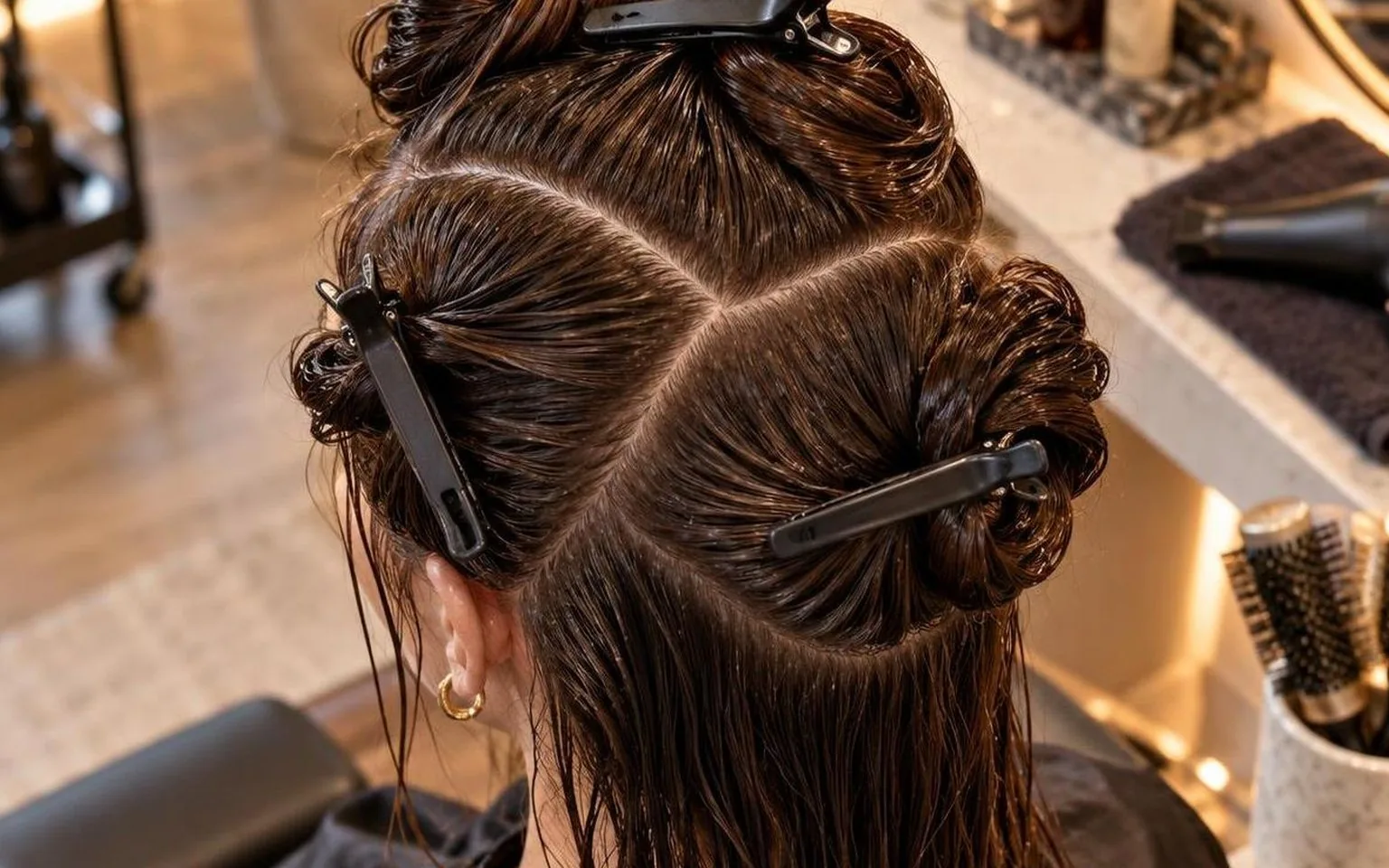
- Section hair into panels no wider than 5 cm for controlled tension drying
- Maintain nozzle-to-hair distance of 12–15 cm during the reshaping window
- Finish every section with a 10-second cool shot before releasing from the brush
Frizz is not random. It is the visible record of moisture leaving hair unevenly, cuticle scales lifting at different rates, and hydrogen bonds locking into disordered positions.
Controlling distance, temperature and timing at each stage prevents that disorder from forming.
Where Advice Goes Astray
Most post-blowout frizz advice fixates on products while ignoring technique errors that no serum can fix.
The biggest missteps involve heat settings, timing, and finishing — areas where conventional wisdom often contradicts what the hair’s hydrogen bonds actually need.
The “Highest Heat = Fastest Dry” Myth
Cranking a dryer to its maximum — often 230 °F (110 °C) at the nozzle — does not proportionally speed drying.
It superheats the outer cuticle before the cortex releases moisture, creating buckled cuticle layers that scatter light and grab humidity.
A medium setting around 160–180 °F (71–82 °C) with consistent airflow closes cuticles more uniformly. The total dry time difference on medium-density hair is typically under 3 minutes.
Skipping the Cool Shot
Roughly 8–10 seconds of cool air per section locks hydrogen bonds into the shape you just set. Without it, bonds remain pliable for 30–60 seconds after heat removal, allowing ambient humidity to re-swell the strand.
Common Advice vs. What Actually Works
| Common Advice | Problem | Better Practice |
| Rough-dry with no nozzle | Turbulent air lifts cuticles in every direction | Use a concentrator nozzle (narrow opening under 15 mm) from roots to ends |
| Apply oil before blow drying | Oil heats rapidly, can cause steam damage inside the strand | Apply oil after drying on cooled hair |
| Blast roots upside-down for volume | Inverted airflow roughs up mid-lengths and ends | Lift sections with clips; direct nozzle downward along the shaft |
| Towel-dry vigorously | Friction raises cuticle edges on wet, vulnerable hair | Blot with a microfibre towel; 40% less surface friction than terry cloth |
Over-Reliance on Anti-Frizz Products
Silicone-heavy serums mask frizz temporarily but do not address cuticle damage caused by poor technique.
Layering multiple smoothing products adds weight — typically 2–4 g per application — which flattens root lift and accelerates oil buildup at the scalp.
Fix the airflow angle, temperature, and cool-shot discipline first. Products should refine an already sound technique, not compensate for a broken one.
Frequently Asked Questions
Why does hair frizz immediately after blow drying?
The cuticle layer lifts when exposed to turbulent, unfocused airflow above 150 °C, allowing ambient moisture to penetrate the cortex unevenly. A concentrator nozzle narrows airflow to roughly 1–2 cm, pressing cuticles flat.
Without one, hot air hits the strand from multiple angles and roughens the surface.
Does drying technique matter more than the dryer itself?
Directing airflow downward from root to tip at a 45° angle smooths the cuticle in its natural direction. Pointing the nozzle upward or perpendicular to the strand forces cuticle scales open.
Keeping the dryer 15–20 cm from the hair also reduces thermal damage that triggers frizz.
Can over-drying hair cause frizz?
Continuing to apply heat after moisture has fully evaporated strips residual bound water from the cortex, making strands brittle and static-prone. Hair is optimally set at around 5–15 % moisture content.
Switching to a cool shot for the final 30–60 seconds locks the cuticle closed and preserves that balance.
How does humidity cause frizz after a blow dry?
Hydrogen bonds reformed during drying break again when they absorb atmospheric water vapour, especially above 60 % relative humidity. Each water molecule wedges between keratin chains, causing the strand to swell unevenly.
A lightweight silicone-based finishing serum coats the cuticle and acts as a moisture barrier for several hours.
Does sectioning hair during blow drying reduce frizz?
Working in 2.5–5 cm horizontal sections ensures consistent heat exposure and tension across every strand. Unsectioned drying leaves inner layers damp while outer layers overheat, creating a mix of open and closed cuticles.
Using sectioning clips and drying methodically from nape to crown produces a uniform, smooth result.
Related Reading
- Blow drying short hair without losing the shape
- How to make a blowout last past day two
- Diffusing curls without breaking the pattern
- Blow dry or air dry: what each does to hair
- How to blow dry your hair at home, step by step
- Round brush diameter, by hair length
- The complete guide to blow drying technique
- National Institutes of Health – PubMed
- U.S. Small Business Administration
- MIT Department of Chemical Engineering
- International Journal of Trichology (PMC)
- Cosmetic Ingredient Review
- Journal of Cosmetic Science (Society of Cosmetic Chemists)
- International Journal of Trichology
- Journal of the Society of Cosmetic Chemists of Japan