Employment practices liability insurance salon coverage addresses claims involving hiring, firing, discrimination, harassment, retaliation, and workplace policy disputes.
Salon owners need it because employment decisions affect stylists, assistants, receptionists, contractors, and managers, while standard business insurance may exclude employment-related allegations.
Review policy definitions before comparing premiums. Check whether coverage includes defense costs, legal representation, third-party claims, wage-and-hour exclusions, and claims involving independent contractors.
Confirm whether the insurer requires approved counsel, internal reporting procedures, or written employment policies.
Build stronger protection by documenting interviews, disciplinary action, scheduling changes, complaints, and termination decisions. Train managers to apply policies consistently and escalate complaints promptly.
This guide explains the coverage structure, common exclusions, documentation practices, and questions salon owners should ask brokers.
What the Figures Add Up To
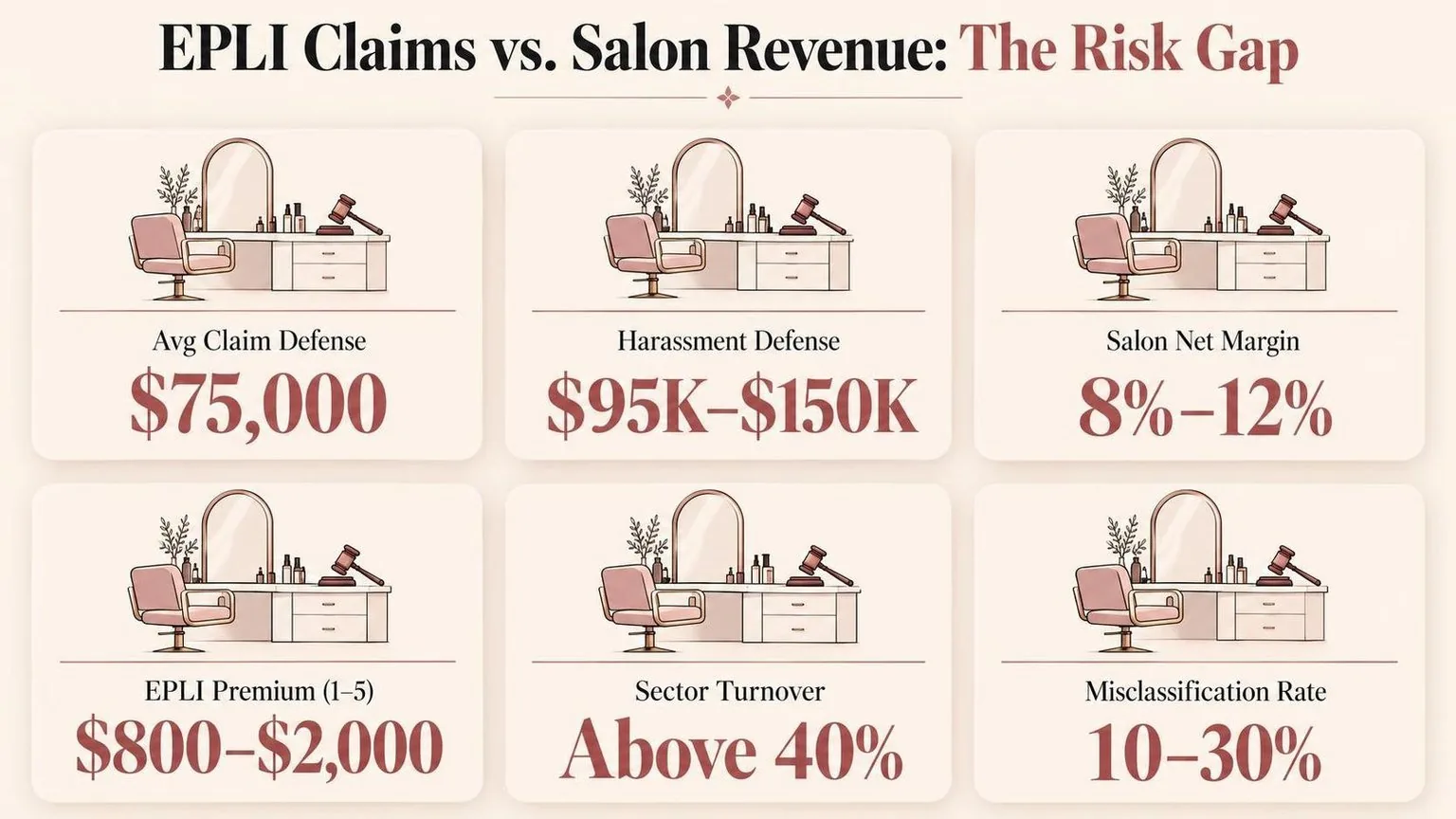
Employment practices liability insurance (EPLI) claims cost U.S. small businesses an average of $75,000 to defend, even when the employer wins.
Salons face heightened exposure because of high staff turnover, tip-pooling disputes, and frequent independent-contractor misclassification. The numbers below frame the actual risk.
Average EPLI Claim Costs by Allegation Type
| Allegation | Average Defense Cost | Average Settlement |
| Wrongful termination | $45,000–$85,000 | $40,000–$100,000 |
| Discrimination | $75,000–$125,000 | $30,000–$150,000 |
| Sexual harassment | $95,000–$150,000 | $50,000–$175,000 |
| Wage and hour violation | $10,000–$50,000 | $20,000–$80,000 |
| Retaliation | $50,000–$100,000 | $50,000–$125,000 |
Defense costs alone can exceed the settlement itself. A single harassment claim against a three-chair salon could wipe out an entire quarter of gross revenue.
Premium Ranges for Salons
EPLI premiums scale with headcount, claims history, and state jurisdiction. Salons with fewer than 10 employees typically pay the lowest bracket.
| Number of Employees | Typical Annual Premium |
| 1–5 | $800–$2,000 |
| 6–15 | $2,000–$5,000 |
| 16–50 | $5,000–$9,000 |
Deductibles commonly range from $2,500 to $25,000. Choosing a higher deductible can reduce annual premiums by 15–25 percent.
Key Risk Factors Specific to Blow Dry Bars
- Contractor vs. employee classification: The IRS estimates misclassification affects roughly 10–30 percent of employers. Booth-rental models in salons sit squarely in this gray zone.
- High turnover: The salon and spa sector averages annual turnover above 40 percent, generating more termination-related claim opportunities.
- Tip disputes: Pooled tipping arrangements trigger wage-and-hour complaints under the Fair Labor Standards Act when back-of-house staff are included improperly.
- Informal HR practices: Salons with fewer than 15 staff rarely employ a dedicated HR manager, leaving documentation gaps that weaken defense cases.
What Policies Typically Cover
Standard EPLI policies cover legal defense fees, settlements, and judgments arising from covered employment claims.
They do not cover criminal fines, punitive damages in many states, or claims from pre-existing disputes known before the policy inception date.
Carriers generally require a written employee handbook and documented complaint procedures before binding coverage. Salons without these face premium surcharges of 10–20 percent or outright declination.

Which Factors Carry Weight
The difference comes from three converging factors: salons carry higher per-employee exposure than most small businesses, the cost of defending a single claim dwarfs typical salon profit margins.
And standard general liability policies explicitly exclude employment-related allegations.
General liability and business owner policies (BOPs) cover slip-and-fall incidents and property damage. They do not cover wrongful termination, discrimination, sexual harassment, or retaliation claims brought by employees or former employees.
Average Defense Costs vs. Salon Revenue
Even claims that never reach a courtroom generate significant legal fees. The gap between defense costs and what a typical salon earns makes a single uninsured claim potentially fatal to the business.
| Metric | Typical Range |
| Median EPLI claim defense cost (no trial) | $75,000–$125,000 |
| Median EPLI claim settlement | $40,000–$175,000 |
| Average annual revenue, single-location salon (4–8 chairs) | $250,000–$580,000 |
| Average net profit margin, salon industry | 8%–12% |
A salon netting 10% on $400,000 in revenue keeps $40,000. One mid-range settlement without coverage consumes multiple years of profit.
Why Salons Face Elevated Exposure
Salon employment structures create friction points that other small businesses encounter less frequently.
- Worker classification disputes: The booth-renter vs. employee distinction triggers misclassification claims, wage-and-hour complaints, and benefits disputes across multiple jurisdictions.
- High turnover: Industry turnover rates run between 40% and 60% annually, multiplying the number of separation events where wrongful termination allegations arise.
- Tip pooling and commission structures: Complex pay arrangements invite wage theft claims, especially when documentation is informal or inconsistent.
- Close physical working environment: Stylists work in sustained close contact with colleagues and clients, increasing the surface area for harassment allegations.
- Minimal HR infrastructure: Most salons under 15 employees operate without a dedicated HR professional, meaning terminations and disciplinary actions often lack proper documentation.
The Coverage Gap in Practice
Standard BOPs and general liability policies contain employment-practices exclusions. Workers’ compensation covers on-the-job injuries only. Professional liability covers service-related claims against clients, not internal employment disputes.
EPLI fills the specific gap between what these policies exclude and what employment law exposes. Without it, the salon owner personally absorbs every dollar of defense and settlement costs.
Standalone EPLI policies typically carry per-claim deductibles ranging from $1,000 to $10,000 for small salons. Premiums scale with headcount, claims history, and whether the salon maintains written employee handbooks and documented HR procedures.

What a Good Result Looks Like
A good result means your salon carries an EPLI policy that covers the specific risks blow dry bars face — wrongful termination, discrimination, and wage-and-hour claims — without gaps that leave you exposed.
The policy pays defense costs from dollar one, separate from the liability limit.
Defense costs alone for a single employment claim average between $75,000 and $125,000, according to the Hartford. A strong EPLI policy prevents that figure from closing your doors.
Coverage Benchmarks for a Typical Blow Dry Bar
| Policy Element | Minimum Target | Recommended Target |
| Per-claim limit | $250,000 | $500,000–$1,000,000 |
| Aggregate annual limit | $500,000 | $1,000,000 |
| Deductible/retention | $2,500 | $5,000–$10,000 |
| Staff count covered | All W-2 employees | W-2 employees + 1099 contractors |
| Third-party coverage | Not included | Included (client claims) |
Salons with 6–15 stylists typically pay annual EPLI premiums between $800 and $3,500, depending on claims history, state, and whether coverage is standalone or bundled into a Business Owner’s Policy.
Signs Your Policy Is Working
- The insurer assigns defense counsel within 48 hours of a reported claim
- Wage-and-hour disputes are explicitly covered, not excluded in the fine print
- The policy covers claims arising from booth-renter misclassification — a leading risk for blow dry bars
- Prior-acts coverage (a retroactive date) protects against incidents that occurred before the policy inception
- The carrier provides access to an employment practices hotline for pre-claim guidance
Worker misclassification is the single largest EPLI trigger in the salon industry. The IRS and state labor boards routinely audit businesses that use both W-2 employees and 1099 booth renters under the same roof.
A good outcome also includes risk-reduction resources bundled with the policy. Many carriers offer employee handbook templates, anti-harassment training modules, and HR helplines at no additional cost.
Review your EPLI policy at each renewal. Staff count changes, new locations, and shifts in your employment model — such as moving from booth rental to commission — alter your exposure profile significantly.
Red Flags That Signal a Poor Result
- Defense costs erode the liability limit rather than sitting outside it
- The policy excludes wage-and-hour claims entirely
- No coverage for regulatory proceedings or administrative agency actions such as EEOC charges
- A retroactive date that leaves a gap between your business start and coverage inception
Measure success by three criteria: the policy responds to the claim types blow dry bars actually face, defense costs do not reduce available limits, and the premium stays below 1% of gross annual revenue.
Trade-Offs Against the Alternatives
Employment practices liability insurance (EPLI) sits alongside general liability (GL), professional liability, and business owner’s policies (BOPs) in a salon’s coverage stack. Each addresses a different risk vector.
EPLI alone covers claims from employees — not clients, not property damage.
Salon owners frequently confuse GL coverage with EPLI. General liability responds to client slip-and-fall incidents or property damage. It will not pay for a wrongful termination claim brought by a former stylist.
A BOP bundles GL with commercial property insurance, often at a lower combined premium than purchasing each separately. BOPs typically exclude employment-related claims entirely.
Professional liability (sometimes called malpractice or errors-and-omissions coverage) protects against claims of negligent service delivery — a chemical burn from a keratin treatment, for example.
It does not address hiring, firing, or workplace discrimination disputes.
Coverage Comparison
| Policy Type | Covers Employee Claims | Covers Client Injury | Typical Salon Premium Range |
| EPLI | Yes — discrimination, harassment, wrongful termination, retaliation | No | $800–$3,000 per year for 1–15 employees |
| General Liability | No | Yes — bodily injury, property damage | $300–$1,000 per year |
| BOP | No | Yes — GL + property combined | $500–$1,500 per year |
| Professional Liability | No | Yes — negligent service only | $200–$600 per year |
EPLI premiums scale with headcount. A salon with 5 W-2 employees and no prior claims typically falls at the lower end. Adding 1099 booth renters can complicate classification and raise premiums by 10–25%.
Workers’ compensation is another policy salon owners sometimes assume overlaps with EPLI. Workers’ comp covers on-the-job injuries and is mandatory in most US states. It does not cover discrimination lawsuits or wage-and-hour disputes.
Key Gaps to Note
- GL and BOPs contain employment-related exclusions in standard ISO forms.
- EPLI typically excludes claims covered by workers’ comp, and vice versa.
- Defense costs under EPLI can erode policy limits — most salon EPLI policies are written on a “duty to defend, costs within limits” basis.
- Retroactive dates matter: switching carriers without confirming the retroactive date can leave prior-act claims uncovered.
The average EEOC charge resolution costs $40,000 in combined legal fees and settlement, according to EEOC mediation data. Even a single claim can exceed a small salon’s annual revenue margin.
Stacking EPLI alongside GL and workers’ comp — rather than substituting one for another — closes the three most common lawsuit entry points a salon with W-2 employees faces.
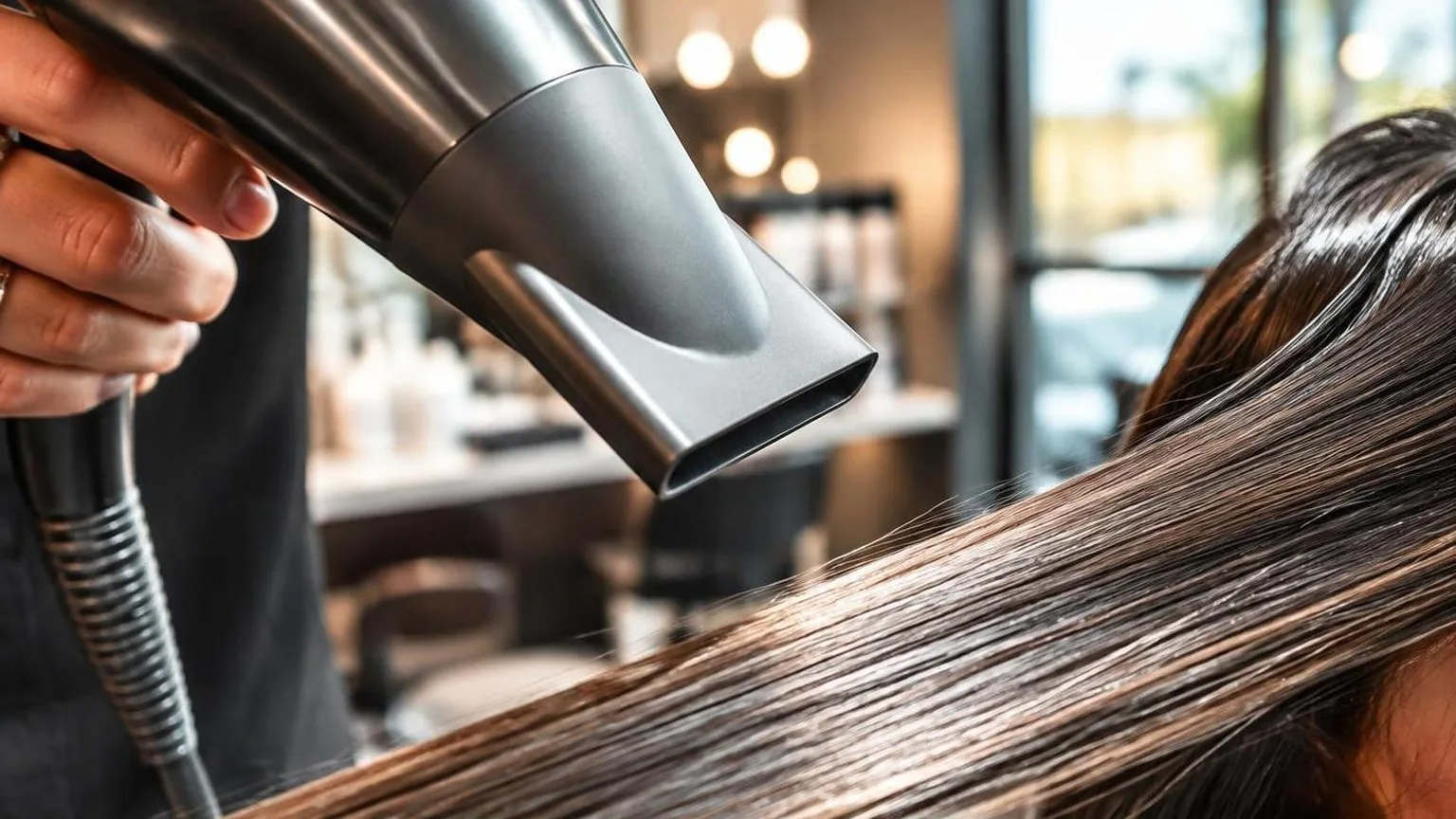
Heat, Tension and Keeping Hair Intact
Thermal and mechanical damage during blow-dry services is the single fastest route to an employment practices liability insurance claim involving client injury allegations.
Documented temperature protocols and tension standards protect both the hair and the business from costly disputes.
EPLI policies typically cover claims from employees, but salon owners increasingly face adjacent liability when staff cause client harm through improper technique.
Insurers evaluate training records and written protocols when assessing coverage and premiums.
Temperature Thresholds That Matter
Fine hair begins to suffer structural protein degradation above 150 °C (300 °F). Medium-density hair tolerates up to 185 °C (365 °F).
Coarse or highly textured hair can withstand up to 210 °C (410 °F), though sustained contact beyond 7 seconds at any setting risks cuticle lifting.
| Hair Type | Max Recommended Temp | Max Contact Time Per Section |
| Fine / colour-treated | 150 °C (300 °F) | 4–5 seconds |
| Medium / virgin | 185 °C (365 °F) | 5–7 seconds |
| Coarse / highly textured | 210 °C (410 °F) | 6–8 seconds |
Tension Control During Styling
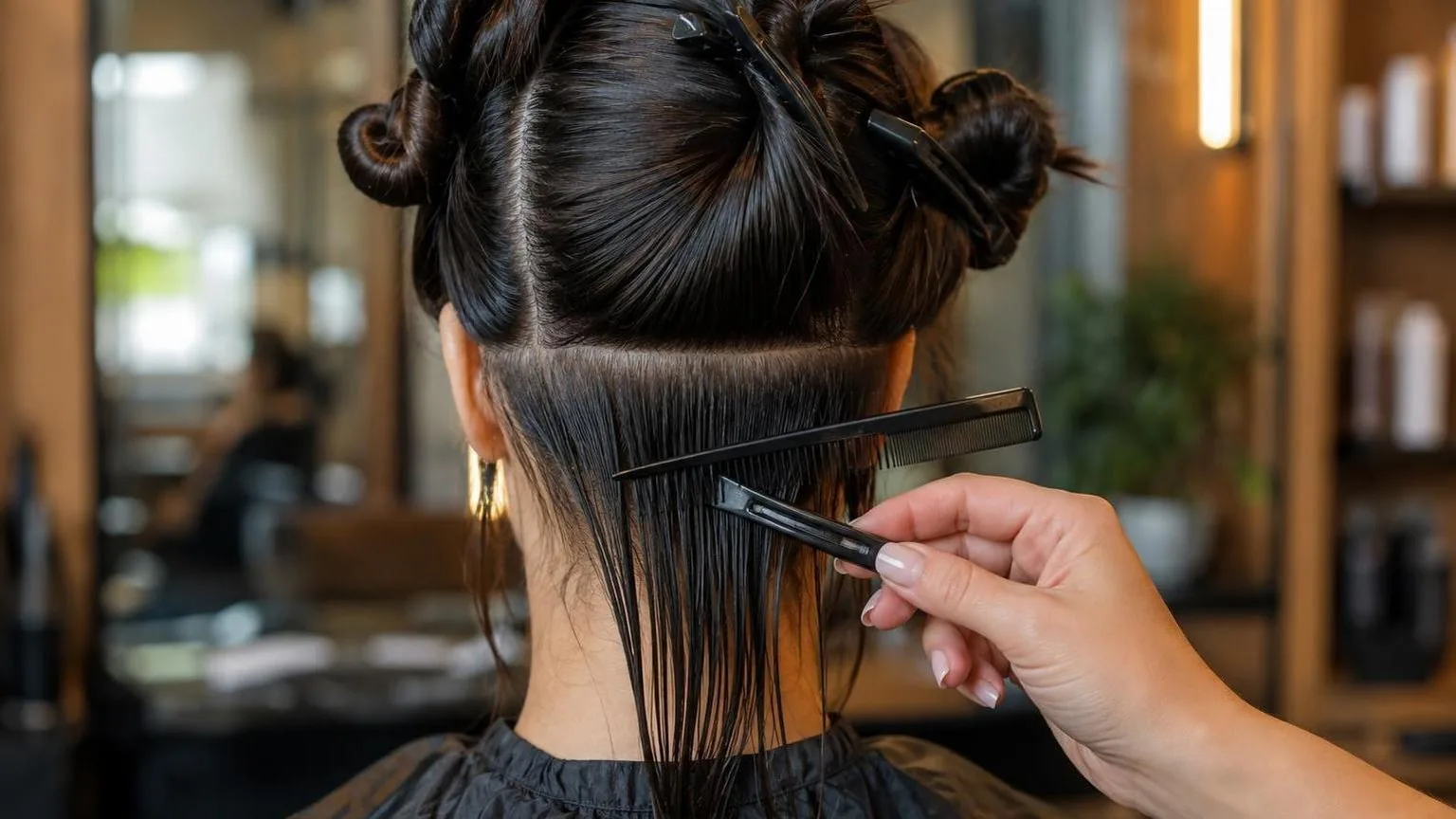
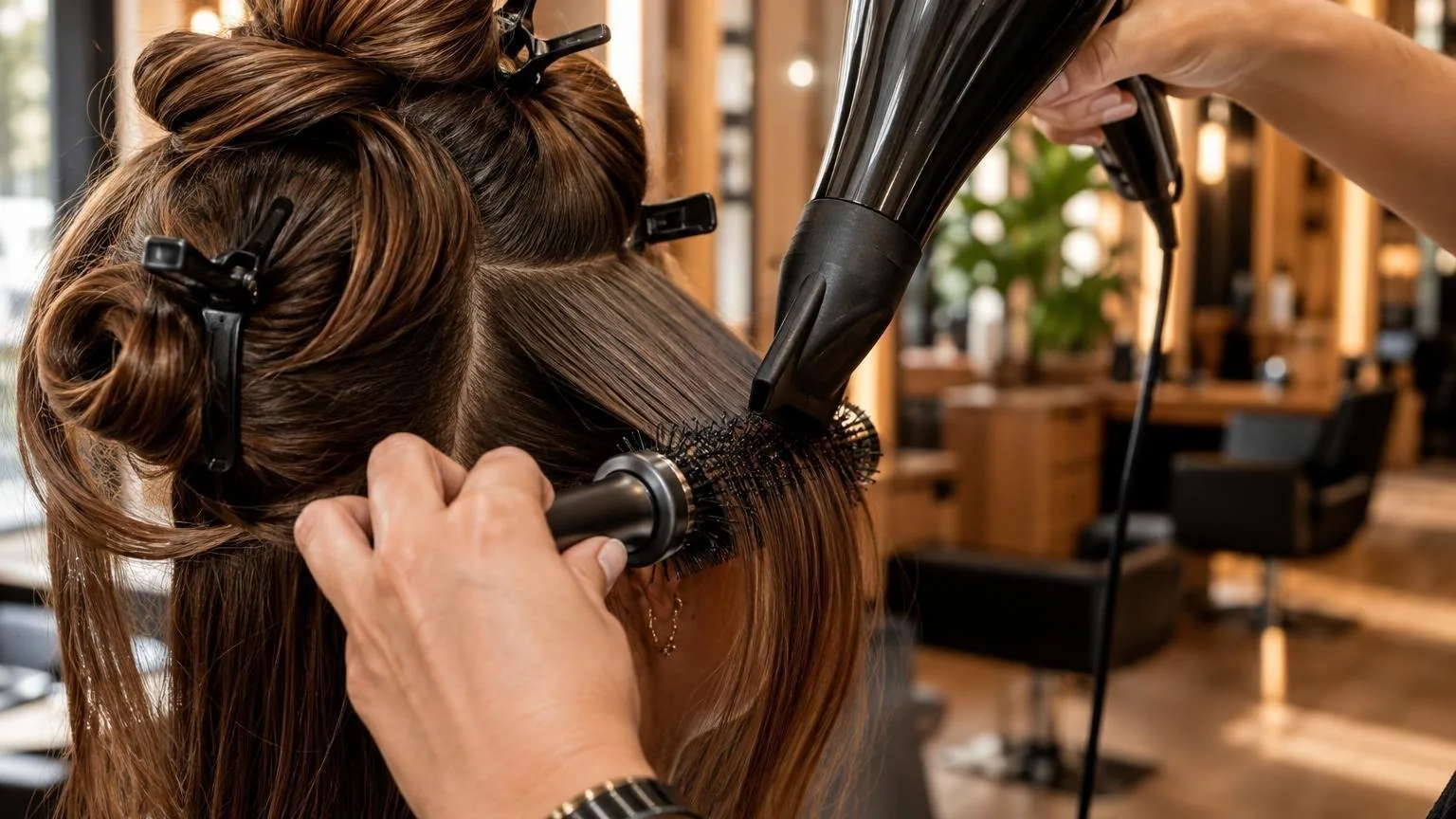
Excessive pulling during round-brush blowouts is a common client complaint. Traction should never cause visible blanching at the root. Sections wider than 2.5 cm (1 in) on a 43 mm barrel increase the risk of tangling and breakage.
Train stylists to keep the dryer nozzle 10–15 cm (4–6 in) from the scalp. Direct airflow along the hair shaft, never against the cuticle. Both practices reduce thermal complaints and breakage incidents.
Documentation That Supports Your EPLI Policy
- Written temperature protocols posted at each station
- Signed training acknowledgements from every stylist, updated after each refresher session
- Client intake forms noting hair type, prior damage, and service preferences
- Incident logs completed within 24 hours of any complaint
- Calibrated tool checks — infrared thermometer readings on dryers and irons quarterly
Insurers reviewing EPLI claims look for evidence of reasonable workplace standards. Salons without written protocols face higher deductibles and, in some cases, claim denial. The documentation itself becomes the defence.
Premiums for salon EPLI coverage vary by staff count, claims history, and state jurisdiction. Consistent protocol adherence is the most controllable factor in keeping those premiums manageable over successive policy periods.
Why It Works the Way It Does
Employment practices liability insurance (EPLI) works for salons because it transfers the financial risk of workforce-related claims — wrongful termination, discrimination, harassment — away from the business owner.
The average employment claim defense costs between $75,000 and $125,000 before any settlement, according to the Hartford.
Blow dry bars carry specific vulnerability. High staff turnover, tip-pooling disputes, and the independent-contractor-versus-employee classification question create fertile ground for claims.
Common Claims EPLI Covers in Salon Settings
- Wrongful termination or constructive dismissal
- Sexual harassment allegations between staff or involving clients
- Wage and hour disputes, including overtime and tip misallocation
- Discrimination based on race, gender, age, or pregnancy
- Retaliation claims after an internal complaint
- Failure to promote or negligent hiring practices
The Equal Employment Opportunity Commission (EEOC) receives roughly 67,000 workplace discrimination charges per fiscal cycle. Small businesses with fewer than 100 employees account for a significant share of these filings.
Cost Versus Exposure
EPLI premiums scale with headcount, claims history, and revenue. A salon with 10 to 15 employees typically pays between $800 and $3,000 annually for $1 million in aggregate coverage, depending on the carrier and deductible selected.
| Salon Size (Employees) | Typical Annual Premium Range | Common Aggregate Limit |
| 1–5 | $500–$1,200 | $500,000 |
| 6–15 | $800–$3,000 | $1,000,000 |
| 16–30 | $2,500–$5,000 | $1,000,000–$2,000,000 |
Compare those premiums against the median out-of-court employment settlement of $40,000, as reported by Hiscox. A single claim can exceed five to ten years of premium payments.
Why It Matters More for Blow Dry Bars
The booth-rental and commission-based pay structures common in this sector invite misclassification audits. The IRS and state labor boards actively investigate salons for worker misclassification under the ABC test framework used in many states.
EPLI policies typically include access to employment-law hotlines and HR resource portals. These tools help owners draft compliant handbooks, termination procedures, and anti-harassment policies before a claim ever surfaces.
Carriers also frequently offer reduced premiums — often 5% to 10% — for salons that implement documented anti-harassment training programs and maintain signed employee acknowledgment forms.
The mechanism is straightforward: shifting unpredictable, potentially catastrophic legal costs into a fixed, budgetable annual expense. For a business running on 8% to 12% net margins, one uninsured claim can mean closure.
Frequently Asked Questions
What does employment practices liability insurance cover for a salon?
EPLI covers claims from employees alleging wrongful termination, discrimination, sexual harassment, or retaliation.
For salons — where staff often include booth renters, W-2 stylists, and front-desk employees — policies typically cover legal defence costs and settlements regardless of whether the claim has merit.
Why are blow dry bars particularly exposed to EPLI claims?
High staff turnover, tip-pooling disputes, and the misclassification of stylists as independent contractors rather than employees create frequent friction points.
The close physical working environment also increases the statistical likelihood of harassment allegations compared to office-based businesses.
How does worker misclassification trigger an EPLI claim in a salon?
If a booth renter is reclassified as an employee by a state labour board, the salon may face back-pay claims for overtime, benefits, and tax withholding.
EPLI can cover the defence costs arising from the resulting employment dispute, though tax penalties themselves are typically excluded.
What is the typical EPLI deductible range for a small salon?
Deductibles for salons with fewer than 15 employees generally start around $2,500 and can reach $10,000 or more depending on the insurer and claims history.
Higher deductibles reduce premiums but increase out-of-pocket exposure on smaller nuisance claims.
Does general liability insurance already include EPLI coverage?
No. Standard general liability and business owner policies (BOPs) exclude employment-related claims. EPLI must be purchased as a standalone policy or added as an endorsement.
Some insurers bundle it into a management liability package alongside directors and officers coverage.
What factors affect EPLI premium costs for a salon?
Insurers evaluate total employee count, annual payroll, turnover rate, prior claims history, and whether the salon maintains a written employee handbook.
Salons operating in states with stronger employee-protection statutes — such as California or New York — typically face higher premiums.
Can EPLI protect a salon owner against a wage-and-hour lawsuit?
Standard EPLI policies exclude wage-and-hour claims, which are common in salons disputing overtime or commission structures.
Some carriers offer wage-and-hour defence-cost-only endorsements that cover legal fees but not the settlement or judgment itself. Owners should confirm this endorsement is available before binding.
What steps reduce EPLI risk and premiums for salon owners?
Maintain a signed employee handbook covering anti-harassment policies, document all disciplinary actions, and use written booth-rental agreements that pass IRS independent-contractor tests.
Many insurers offer 5–10% premium discounts for salons that implement annual anti-harassment training and a formal complaint procedure.
Related Reading
- What a booth renter actually takes home
- What a blow dry bar is, and how the model works
- The blow dry bar business model, explained
- The types of salon insurance, and what each covers
- How blow dry stylists are paid: the three structures
- Pricing a blowout: the four inputs that set the number
- The complete guide to the blow dry bar business
- U.S. Equal Employment Opportunity Commission
- U.S. Small Business Administration – Employer Resources
- Cornell Law Institute – Title VII Overview
- Professional Beauty Association
- Insurance Information Institute
- Society for Human Resource Management
- Americans with Disabilities Act – ADA.gov
- U.S. Department of Justice – Civil Rights Division