

booth renter take home pay typically lands at 40% to 65% of service revenue after chair rent, color supplies, booking fees, taxes, insurance, card fees, towels, backbar, and education are paid.
A stylist grossing $2,000 weekly with $350 rent and $300 operating costs keeps $1,350 before tax.
Owners and renters should track pay by service block, not monthly vibes. A 45-minute blowout, a 90-minute styling package, and a 2-hour bridal trial carry different supply use, cleanup time, and rebooking value.
This guide breaks down the math salon professionals use: weekly rent, realistic capacity, average ticket, rebooking rate, retail commission, tip handling, and tax set-asides.
Use it to price services, negotiate booth terms, and protect actual take-home income.
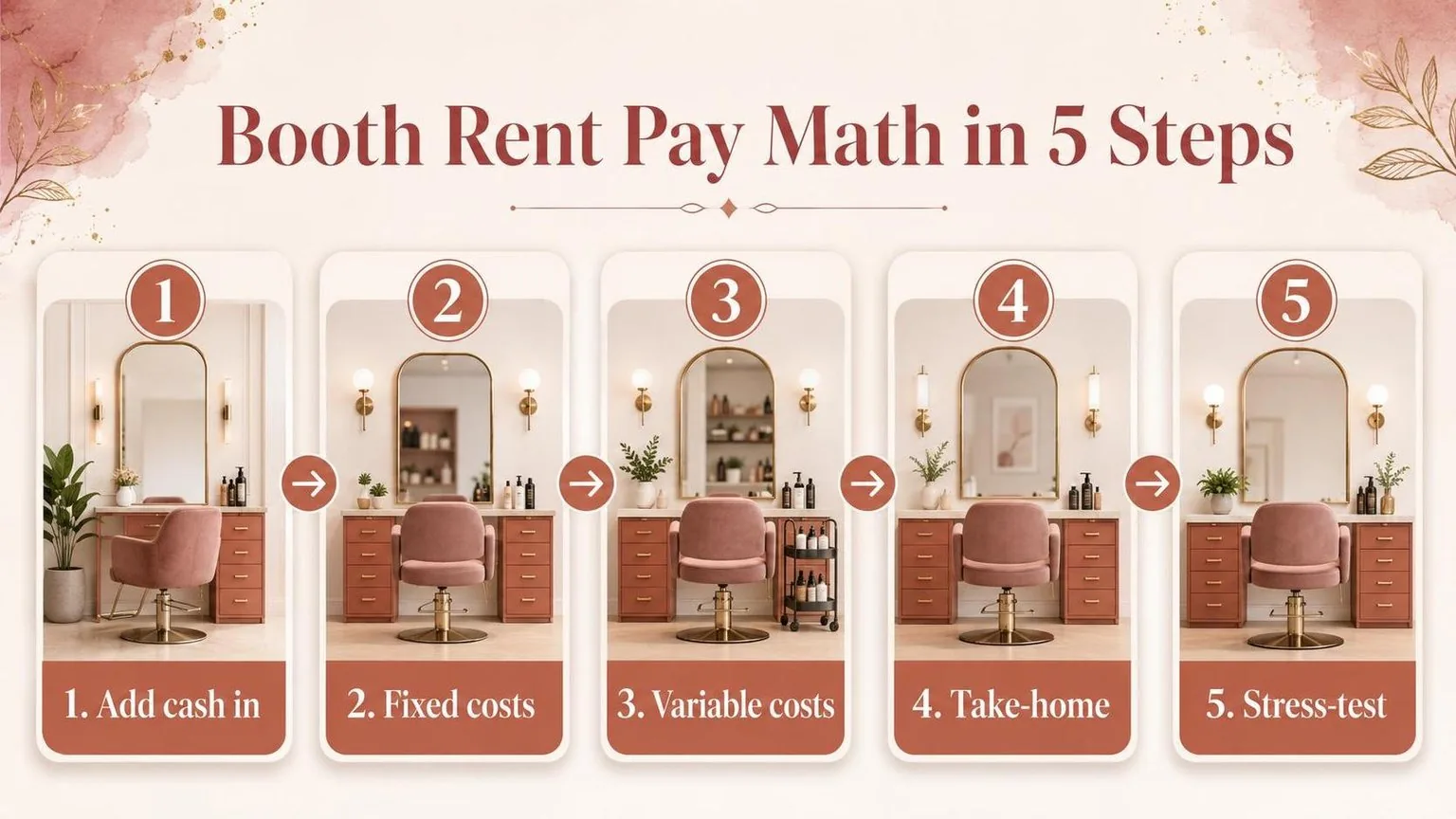
Run Your Booth Math
Work from one week, not a month. Pull your booking total, retail total, tips kept, rent, card fees, backbar spend, laundry, and tool replacement. Use actual numbers from the last 7 days. Then convert everything to a per-service figure you can trust.
If your per-client take-home lands below your target, raise service price, increase retail attachment, or cut a cost line. Start with the line item that moves at least $10 to $15 per week.

The Measured Picture
Booth renter take-home pay is not service sales minus rent. Read it as sales minus every operating cost, then minus taxes you set aside yourself. The useful number is net pay per week, per client hour, and per booked day.
Start with gross service revenue and retail profit. Then strip out fixed costs, variable costs, payment processing, and a tax reserve. What remains is the money available for your household pay.
Fixed costs are due even in a slow week. Variable costs rise with every client. Keep them separate, or a busy week can look more profitable than it is.
| Category | Typical items | How to track |
| Fixed | Booth rent, booking app, insurance, music, phone | Monthly total divided by 4.33 for weekly planning |
| Variable | Backbar, styling products, towels, card fees, retail bags | Per service ticket or as a percent of sales |
| Owner reserve | Taxes, education, tool replacement, sick days | Percent of net revenue |
Use a weekly model first. Monthly numbers hide gaps in demand. Weekly tracking shows whether one full Saturday is covering three weak midweek shifts.
| Weekly example | Amount |
| Service sales | $1,800 |
| Retail sales | $240 |
| Cost of retail goods | $120 |
| Booth rent | $300 |
| Backbar and styling supplies | $90 |
| Card processing at 2.6% + $0.10 on 30 tickets averaging $68 | $56.10 |
| Laundry and cleaning | $35 |
| Booking software and phone | $28 |
| Net before tax reserve | $1,410.90 |
| Tax reserve at 25% | $352.73 |
| Estimated take-home pay | $1,058.17 |
Now test it against hours, not only dollars. A strong top line can still mean weak pay if the chair is occupied for too many low-ticket hours.
| Efficiency check | Amount |
| Booked client hours | 24 |
| Net before tax reserve | $1,410.90 |
| Net per booked hour | $58.79 |
| Take-home per booked hour | $44.09 |
Include unpaid salon time. If those 24 booked hours required 34 on site, the practical take-home drops to $31.12 per working hour. That is the number to compare with a commission role.
Watch percentage traps. Rent that looks low at 17% of a strong week becomes 30% when sales soften. The same booth can feel profitable in one month and tight in the next.
- Track gross sales, retail profit, and tips separately.
- Convert monthly bills to weekly using 4.33 weeks.
- Record product cost per service, not one bulk order total.
- Reserve tax money before paying yourself.
- Judge performance by take-home per booked hour and per on-site hour.
Read the numbers this way and booth rent becomes clear. You are not buying freedom with gross sales. You are buying margin, and margin only counts after every predictable dollar is removed.
The Levers You Control
Booth renter take-home pay comes down to four numbers: service revenue, rent, operating costs, and taxes. The strongest swing factors are booked hours, average ticket, rebooking rate, and how tightly you control supplies, card fees, and empty time.
A renter can gross more than a commission stylist and still net less. Fixed booth rent keeps running whether the chair is full or empty, so utilization matters as much as pricing.
Start with booked revenue per week, then subtract every cost tied to delivering that work. The cleanest way is to separate fixed costs from variable costs and measure both per service and per week.
| Variable | What to track | Why it changes take-home pay |
| Average ticket | Service total per client | A $10 lift across 25 clients adds $250 gross before costs |
| Utilization | Booked hours divided by available hours | Low occupancy makes fixed rent heavier per service |
| Booth rent | Weekly or monthly fixed amount | Rent is due even in slow weeks |
| Retail mix | Units sold and margin | Retail can raise revenue without adding chair time |
| Product cost | Cost per service | Overuse cuts margin on every appointment |
| Payment fees | Card processing percentage and tips paid by card | Fees rise directly with revenue |
| Taxes | Set-aside percentage on profit | Under-saving distorts what looks like take-home pay |
Utilization is the first lever. If you offer 35 bookable hours and fill 28, that is 80% occupancy. At 20 booked hours, the same rent is spread across fewer clients, so net per service falls fast.
Average ticket is the second lever. A blowout at $55, versus $70 with add-ons or retail, changes weekly gross materially without increasing rent. Small menu changes beat random discounting.
| Example weekly model | Lower volume | Higher volume |
| Clients | 20 | 28 |
| Average ticket | $60 | $70 |
| Gross revenue | $1,200 | $1,960 |
| Booth rent | $300 | $300 |
| Supplies at $3 per service | $60 | $84 |
| Card fees at 3% | $36 | $58.80 |
| Pre-tax remainder | $804 | $1,517.20 |
Supplies are smaller individually but constant. If your product, disposables, and laundry average $3 to $6 per service, every extra ounce, towel load, or remake chips away at margin.
Time leakage matters too. A 45-minute service block with a 15-minute reset caps you at one client per hour. Tighten turnover to 10 minutes, and a full day can fit one or two more bookings.
Taxes are the line many renters miss. In the US, self-employment tax is 15.3% before income tax. Many operators set aside 25% to 30% of profit so “take-home” means money left after obligations, not before.
- Track gross sales, tips, retail, and rebooks separately.
- Measure product cost per service monthly, not by guesswork.
- Know your booked-hours percentage every week.
- Review card fees, laundry, and no-show gaps as margin leaks.
Judging It in Practice
Booth renter take-home pay is strong only when booked revenue stays well ahead of fixed weekly overhead and your own tax reserve.
In practice, judge it by service dollars kept after rent, card fees, supplies, laundry, retail cost, and self-funded payroll taxes, not by gross sales.
The fastest check is a weekly cash-flow view. Fixed rent matters most on slower weeks because it does not fall when cancellations rise.
Variable costs matter more on packed weeks because towels, products, processing time, and card fees climb with every client.
| Measure | What to track | Why it matters |
| Gross service sales | Total client ticket before expenses | Starting point only |
| Booth rent | Weekly or monthly fixed amount | Paid whether booked or not |
| Card processing | Percentage plus transaction fee charged by processor | Cuts every card sale |
| Backbar and disposables | Shampoo, conditioner, styling product, gloves, clips, neck strips | Rises with client count |
| Laundry and cleaning | Towels, capes, detergent, sanitation | Often underestimated |
| Tax reserve | Separate savings from net income | Protects take-home cash |
Then test occupancy, not hope. A renter with a high average ticket can still under-earn if the book has too many empty hours. A lower ticket with tight rebooking and add-ons can produce better take-home because the chair turns more consistently.
| Weekly scenario | Booked service revenue | Fixed booth rent share | Resulting pressure on take-home |
| Light week | $800 | If rent is $250, rent absorbs 31.25% of gross | High pressure |
| Steady week | $1,500 | If rent is $250, rent absorbs 16.67% of gross | Manageable |
| Busy week | $2,200 | If rent is $250, rent absorbs 11.36% of gross | Healthier margin |
Look at timing too. If a blowout slot runs longer than planned, the lost capacity lowers daily gross without lowering fixed rent.
For a salon owner reviewing renters, this is why speed standards, realistic booking buffers, and retail discipline change real earnings more than headline chair rent.
| Practical benchmark | Check | Interpretation |
| Rent load | Keep booth rent as a modest share of average weekly gross | Lower fixed-cost strain |
| Expense control | Track product use per service and towel turns per day | Stops margin leakage |
| Tax discipline | Move a set share of net to a separate account each payout | Prevents false take-home |
| Booking quality | Watch rebooking rate, no-shows, and add-on capture | Shows whether gross is repeatable |
Judge booth renter pay on repeatable net income across slow and busy weeks. If take-home works only when every slot is full, the model is fragile. If it still works after fixed rent, variable cost, and tax reserve on an average week, it is viable.

Where the Alternatives Win and Lose
Booth rent wins when a stylist keeps a high book, controls pricing, and can hold operating costs below roughly 35% to 45% of service sales.
It loses when weekly demand swings, retail is weak, or fixed rent keeps running during slow weeks, holidays, and cancellations.
Commission wins on stability. A stylist gives up margin, but payroll tax handling, front desk support, laundry, backbar, and walk-in traffic can protect take-home pay when booked hours fall below about 25 to 30 a week.
| Model | Typical fixed cost to stylist | Typical split or fee | Best fit | Main weakness |
| Booth rent | Weekly rent due whether booked or not | Stylist keeps service revenue after rent, color, tools, processing fees, and taxes | High repeat rate and strong prebooking | Income volatility and self-funded overhead |
| Commission employee | Low direct overhead | Often 40% to 60% of service revenue to stylist | Growing books and salon traffic support | Lower upside on full books |
| Salon suite | Higher weekly rent than booth rent in many markets | Stylist keeps remaining revenue after all expenses | Established clientele wanting privacy | Highest fixed-cost pressure |
Take-home math decides the winner. If a booth renter sells $1,500 in a week, a 40% cost load leaves $900 before personal tax.
If the same stylist is on 50% commission, take-home before tax is $750, but with fewer direct bills and less administrative time.
The crossover point is utilization. Once a stylist can consistently fill 70% to 80% of available appointment slots, booth rent usually outperforms commission.
Below that range, fixed rent can eat margin fast, especially if no-show gaps are not filled.
| Weekly service sales | Booth renter at 40% total operating cost | Commission at 50% | Difference before personal tax |
| $1,000 | $600 | $500 | Booth +$100 |
| $1,500 | $900 | $750 | Booth +$150 |
| $2,000 | $1,200 | $1,000 | Booth +$200 |
Salon suites can beat both models on ticket control. A private operator can set longer appointments, bundle add-ons, and retail freely. The tradeoff is occupancy risk.
One dark day still costs the same, and utility, booking, cleaning, and merchant fees sit on top.
Employees gain hidden value that owners often overlook. Payroll withholding simplifies cash flow. Reception can save 15 to 30 minutes a day.
Shared assistants, backbar, and laundry remove small costs that can total 5% to 10% of weekly sales in an independent setup.
- Booth rent wins on upside when demand is steady and pricing discipline is strong.
- Commission wins on consistency when the book is still growing.
- Suites win on control and branding, but punish empty hours hardest.
- The strongest model is the one with the highest booked-hour percentage after all weekly costs are counted.

Heat, Tension and Keeping Hair Intact
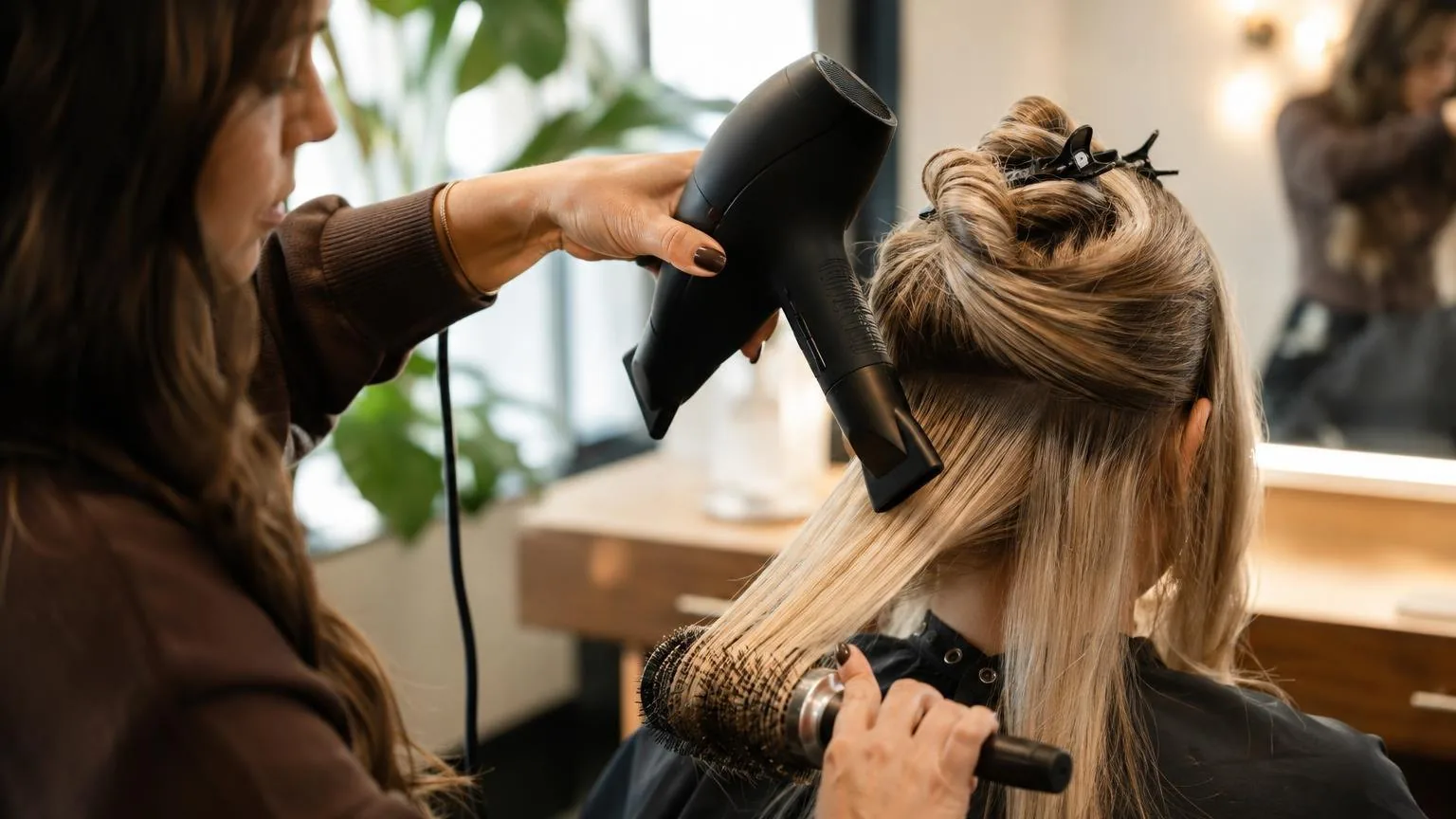
Keep hair intact by pairing moderate dryer heat with even tension and constant airflow. The goal is shape, not scorch: stretch the section just enough to smooth the cuticle, keep the nozzle moving, and let the brush do the control.
Most breakage during a blowout comes from repeated passes on damp hair, a nozzle held too close, or a brush that overloads the section. Reduce all three. Dry to the right moisture level first, then refine with fewer, cleaner passes.
Start with rough drying until the hair is mostly dry. A nozzle concentrates air, but it also raises risk when the section is too wet or the brush is locked in one spot. Work from roots to ends and keep the airflow aligned down the hair shaft.
| Control point | Working range | Why it protects hair |
| Hair dryness before brush work | About 80% to 90% dry | Reduces the time heat sits on one section |
| Nozzle distance from hair | About 1 to 2 inches | Keeps airflow directed without concentrating heat on one spot |
| Section width | About 2 inches | Lets air pass through the full section evenly |
| Brush rotation speed | Slow, continuous movement | Prevents hot spots and snagging |
Tension should feel firm, not aggressive. If the client feels pulling at the hairline or you hear snapping on the brush, the section is too large or the brush diameter is wrong for the length and density.
| Hair length or goal | Brush size | Best use |
| Short lengths, root lift, fringe | 25 mm to 35 mm | Creates bend close to the base with less over-wrapping |
| Bob to collarbone | 35 mm to 45 mm | Smooths efficiently while keeping tension manageable |
| Long hair, softer finish | 45 mm to 55 mm | Spreads tension across more hair and reduces repeated passes |
Heat setting matters less than consistency. Fine or fragile-feeling hair usually needs low to medium heat and medium airflow. Medium to coarse hair can take medium to high heat, but only when the section is moving and nearly dry.
| Tool habit | Safer target | Avoid |
| Passes per section | 2 to 4 controlled passes | Grinding the same section repeatedly |
| Cool shot timing | 5 to 10 seconds after shaping | Dropping the section while still warm |
| Nozzle angle | Down the shaft | Blasting across the cuticle |
For home users, the simplest protection rule is this: smaller sections, lower heat, more airflow, fewer repeats. For salon teams, train eyes and hands together.
Watch the section’s moisture, feel the brush tension, then cool-set before release so the shape holds without extra heat.

Why the Technique Works
The technique works because booth renter pay is not a commission check. It is gross service revenue minus fixed overhead, variable service costs, payment fees, and tax set-asides.
When each bucket is separated, take-home pay becomes measurable, repeatable, and easier to protect.
That matters in a rental model because rent is due whether one client sits in the chair or eight do. A stylist who tracks pay by service ticket alone can overestimate income fast.
A stylist who tracks pay by category sees the true margin on every booked hour.
The first reason is fixed-cost visibility. Booth rent behaves like a hard floor under every week. If rent is $250 weekly, that cost does not change with ticket size, so it must be covered before any amount feels like pay.
The second reason is variable-cost control. Blowout work uses lower color inventory than many salon services, but it still carries product, brushes, clips, hot tool wear, laundering, and booking platform costs.
Small per-client costs become large when multiplied across 20 to 40 appointments.
| Cost bucket | How it behaves | Why it matters to take-home pay |
| Booth rent | Fixed weekly or monthly | Must be covered before income feels spendable |
| Supplies and backbar | Variable per client | Reduces margin on each appointment |
| Card processing | Percentage plus transaction fee | Takes more from higher tickets and tip payments |
| Taxes | Percentage set-aside | Prevents gross revenue being mistaken for pay |
The third reason is hourly truth. Booth renters do not keep every dollar from a full book.
A 45-minute service sold at $65 looks strong, but only the net amount after costs tells you whether that slot beats a 30-minute express finish or an add-on styling service.
| Example service | Gross ticket | Supplies | Card fees at 3% | Net before rent and tax |
| 45-minute blowout | $65.00 | $4.00 | $1.95 | $59.05 |
| 30-minute express style | $45.00 | $2.50 | $1.35 | $41.15 |
| 60-minute long-hair finish | $85.00 | $5.50 | $2.55 | $76.95 |
Those numbers show why the technique improves decisions. The highest ticket may not produce the best hourly return once timing is included.
Net before rent and tax divided by booked minutes exposes which services carry the strongest earning power per chair hour.
It also works psychologically. Separating a tax reserve, often as a fixed percentage of each deposit, keeps operating cash from being confused with personal pay.
That reduces the common booth-renter mistake of spending gross receipts that still need to cover obligations.
- Use weekly rent, not monthly estimates, when checking break-even.
- Track product cost per service in ounces or pumps, then assign a dollar amount.
- Include card fees on tips if your processor deducts them from the total ticket.
- Review take-home pay by booked hour, not only by total sales.
In practice, the technique works because it converts a freelance salon model into a simple margin system. Gross tells you demand. Net tells you pay. The gap between them is where booth renters either protect profit or leak it.
Frequently Asked Questions
How do booth renters calculate take-home pay?
Start with service sales and retail profit. Subtract booth rent, color and backbar you buy, card processing, booking software, laundry, towels, tools, insurance, and self-employment taxes. The remainder is take-home pay, not gross sales.
What percentage of sales should a booth renter expect to keep?
Many renters aim to keep 45% to 60% after core operating costs, then set aside taxes separately. The exact number shifts with rent level, product usage per client, and ticket average.
The Professional Beauty Association recommends tracking every expense weekly, not monthly.
How much should booth rent be compared with weekly sales?
A practical benchmark is 10% to 20% of weekly service sales. If rent is $300 a week, a renter usually needs about $1,500 to $3,000 in weekly sales before the rent feels proportionate.
Higher rent can work if pricing, demand, and schedule density support it.
Why can two booth renters with the same sales have different take-home pay?
One may spend 8% on supplies and 3% on processing, while another spends 15% and 5%. Rebooking rate, no-show control, and service timing also change profit.
A stylist finishing a blowout in 45 minutes can fit more revenue into one shift than one taking 75 minutes.
How much should booth renters set aside for taxes?
Many independent beauty pros reserve 25% to 30% of net income in a separate account, then adjust with an accountant. The IRS treats booth renters as self-employed when they control pricing, schedule, and supplies.
Set the transfer after each payout so cash flow stays clean.
Do add-on services meaningfully raise booth renter take-home pay?
Yes, if the add-on uses little time and low product cost. A 10-minute glossing, bonding, or scalp massage add-on can lift average ticket faster than adding another full appointment block.
Higher average ticket spreads fixed costs like rent and software across more revenue.
What is a simple target for booth renters who want more take-home pay?
Track four numbers every week: service sales, retail profit, rebooking rate, and expense percentage. Many renters improve take-home pay fastest by lifting average ticket 10% and trimming supply waste 2% to 3%.
That raises net income without adding more chair hours.
Related Reading
- What it costs to open a blow dry bar
- The licences a blow dry bar needs, and who issues them
- How salon memberships work, and when they backfire
- How booth rental works, and who it suits
- The types of salon insurance, and what each covers
- How blow dry stylists are paid: the three structures
- The blow dry bar business model, explained
- What a blow dry bar is, and how the model works
- Insuring a stylist's hands: what cover exists
- The complete guide to the blow dry bar business
- U.S. Small Business Administration
- Internal Revenue Service Self-Employed Individuals Tax Center
- National Center for Biotechnology Information PubMed
- California Board of Barbering and Cosmetology
- Texas Department of Licensing and Regulation Cosmetologists
- National Fire Protection Association Electrical Safety
- American Academy of Dermatology Hair Care
- U.S. Small Business Administration