
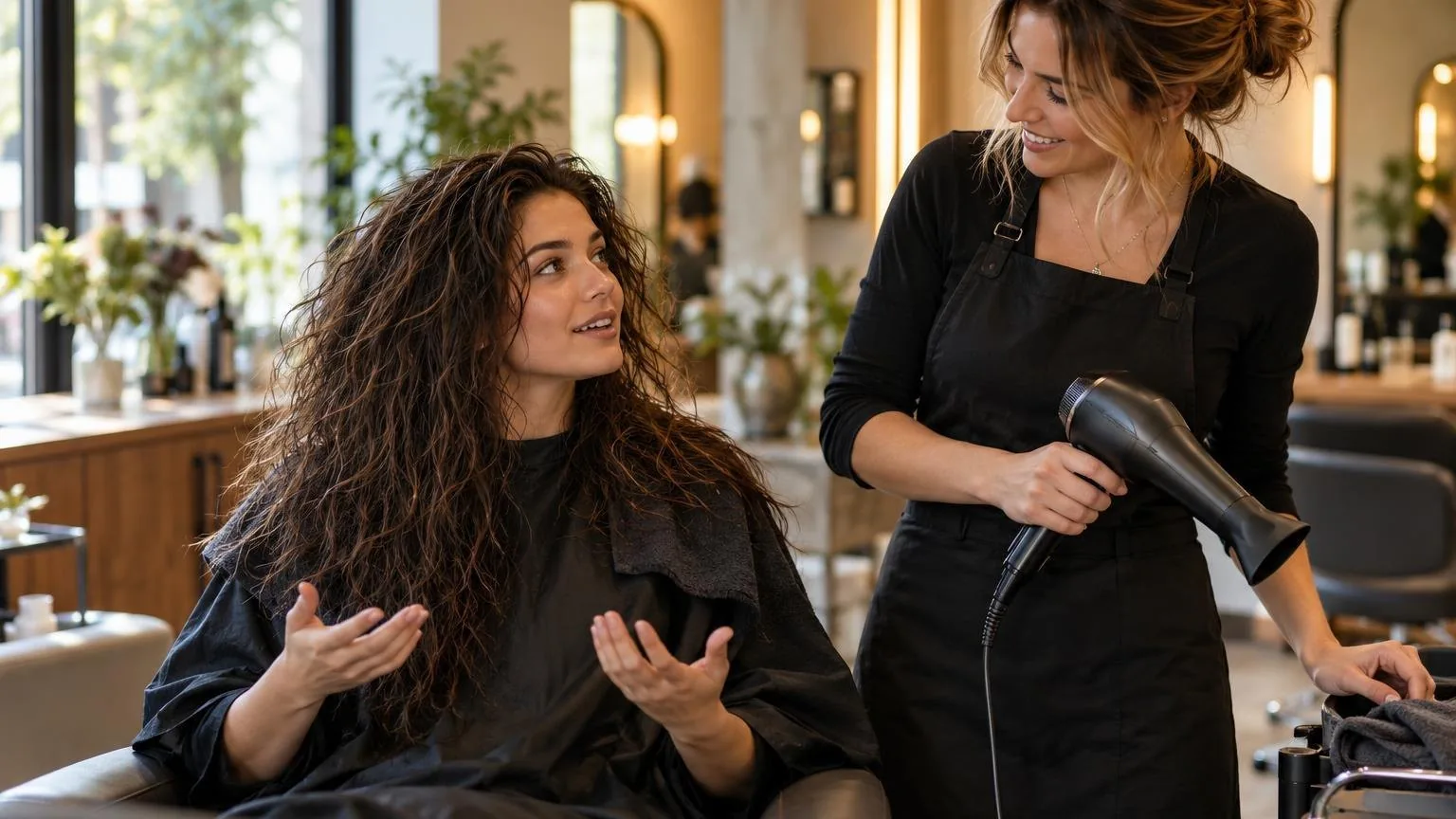
How to blow dry thick hair faster: remove excess water with a microfibre towel, then rough-dry roots to 80% using a 1,800–2,000-watt dryer before sectioning. This cuts brush time because the dryer handles most moisture before shaping begins.
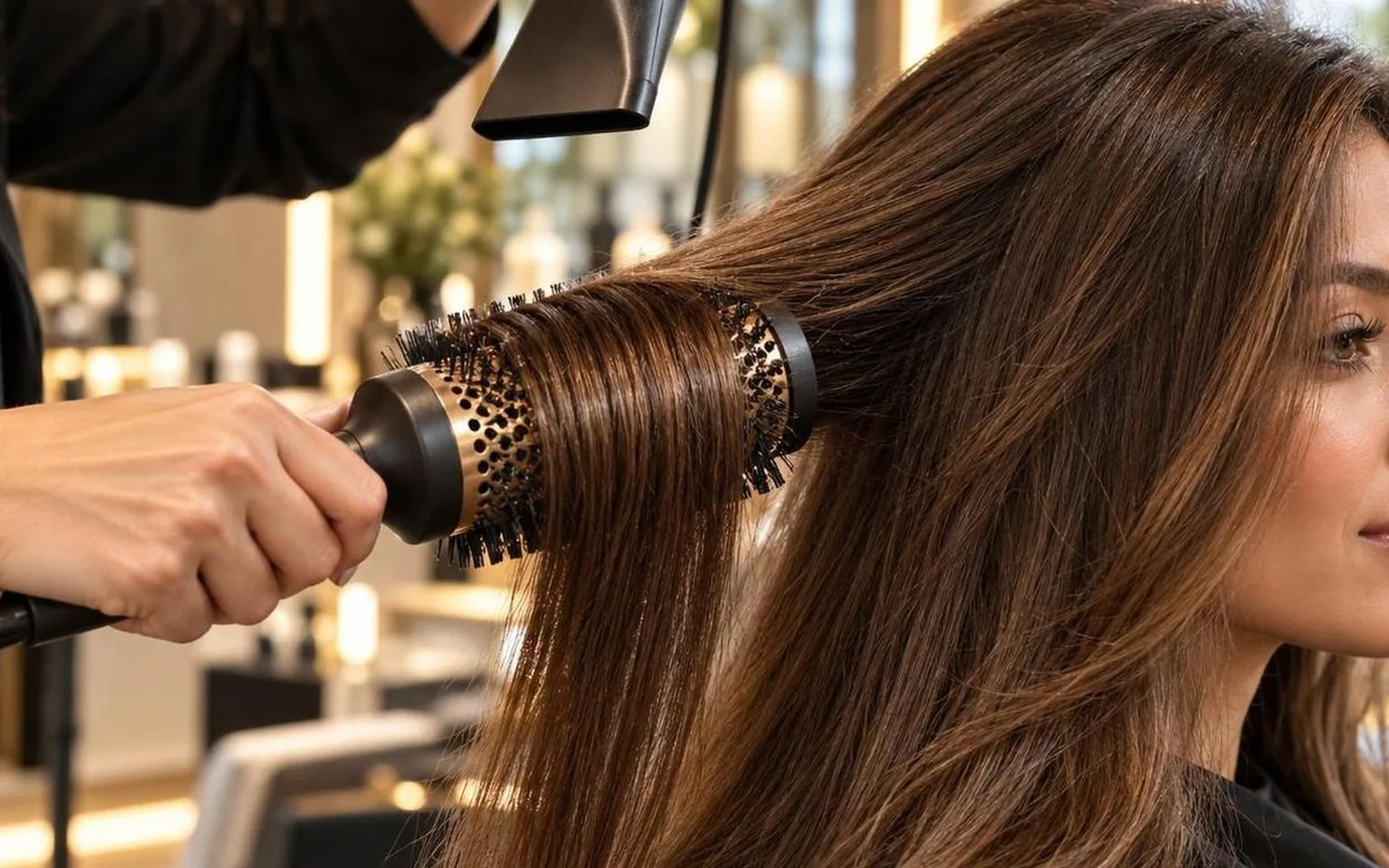
Divide hair into four sections, each no wider than 5 centimetres. Use a concentrator nozzle and direct airflow from roots to ends while working with a 43–53-millimetre round brush.
Keep the dryer moving and hold it 5–8 centimetres from the hair.
Start at the nape, where dense hair retains moisture longest, then move upward. Finish each section with 10–15 seconds of cooler airflow to set the shape.
The method creates a smoother finish while preventing repeated passes over already-dry lengths.
Map Your Drying Load First
Thick hair varies wildly. A chin-length bob at 80 g of water weight dries in a different universe from hip-length hair holding 230 g. Before changing technique, quantify what your dryer actually has to evaporate.
- Weigh the water load. Towel-blot hair to the point it stops dripping. Step on a scale holding dry towels, then again holding the damp towels. The difference is your starting water weight. Hair classified as “thick” typically holds between 90 g and 250 g depending on length and density.
- Count your working sections. Clip hair into 5 cm-wide horizontal rows from nape to crown. Most thick-haired clients need 6–10 sections. If you hit 10 or more, your per-section drying time must stay under 90 seconds each to finish a full blowout in 25 minutes.
- Check your wattage-to-load ratio. Divide your dryer’s wattage by your water weight in grams. A 2200 W dryer on 150 g of water gives a ratio of roughly 14.7. Ratios below 10 signal the motor cannot keep pace — expect blowouts running past 35 minutes unless you reduce the water load before you pick up the dryer.
Write these three numbers on a sticky note at your station. They tell you whether slow blowouts are a technique problem or a physics problem — and which section below to read first.
What the Data Shows
Thick hair holds roughly 12–18% more water by weight than fine hair after towel-drying, according to textile-fibre absorption research applied to human hair.
That additional moisture is the single biggest variable increasing total blow-dry time from an average of 15 minutes to 25–40 minutes.
Hair diameter drives drying speed. Thick strands typically measure 80–120 micrometres across, versus 50–70 micrometres for fine hair.
Greater diameter means a longer path for heat to penetrate and evaporate internal water. The relationship is not linear — doubling diameter can nearly triple drying time per strand.
Airflow vs. Heat: Which Matters More
Industry testing by dryer manufacturers consistently shows that airflow velocity reduces drying time more effectively than temperature alone.
| Variable | Low Setting | High Setting | Time Reduction on Thick Hair |
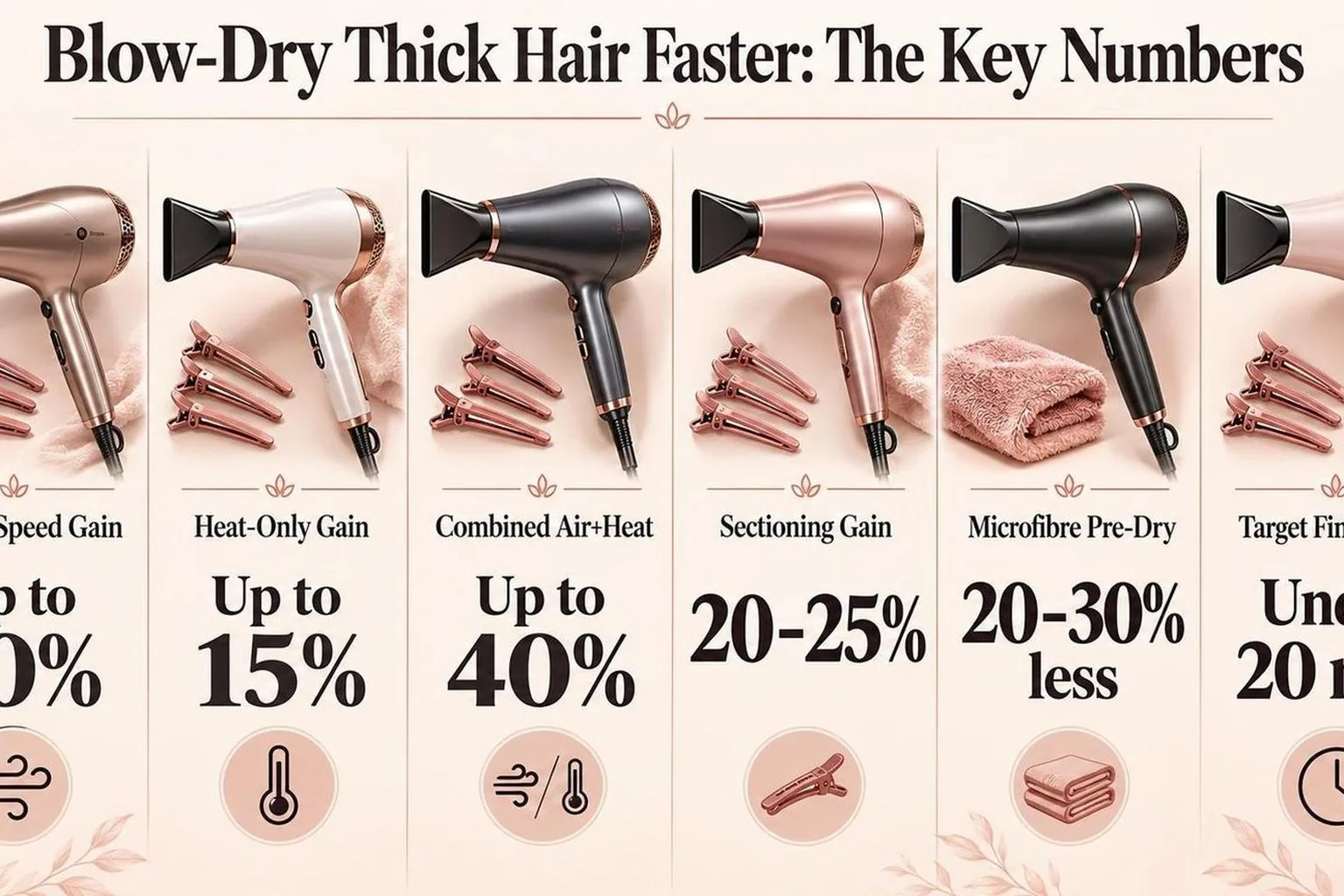
| Airflow (m/s) | 12 m/s | 22 m/s | Up to 30% |
| Heat (°C) | 57 °C | 95 °C | Up to 15% |
| Combined high airflow + moderate heat | — | 22 m/s at 70 °C | Up to 40% |
Pushing temperature above 95 °C on thick hair does not proportionally cut time. It does measurably increase cuticle lifting and moisture-barrier damage.
Sectioning Reduces Total Time
Controlled salon timing tests show that dividing thick hair into six to eight horizontal sections — each roughly 2.5 cm deep — reduces overall blow-dry time by approximately 20–25% compared to working through unsectioned bulk.
The reason is simple: thinner subsections allow heated airflow to contact more surface area per pass, evaporating water faster.
Pre-Drying Makes a Measurable Difference
- Microfibre towels absorb up to 7 times their weight in water, removing 20–30% more moisture than cotton terry before the dryer is switched on.
- Rough-drying roots-to-ends at high speed with no brush for 3–5 minutes removes approximately 50% of remaining moisture, leaving only the finishing work for the round brush.
Combining a microfibre towel pre-dry with a high-airflow dryer set to 70 °C and proper sectioning can bring a thick-hair blow-dry under 20 minutes consistently.
What Moves the Outcome
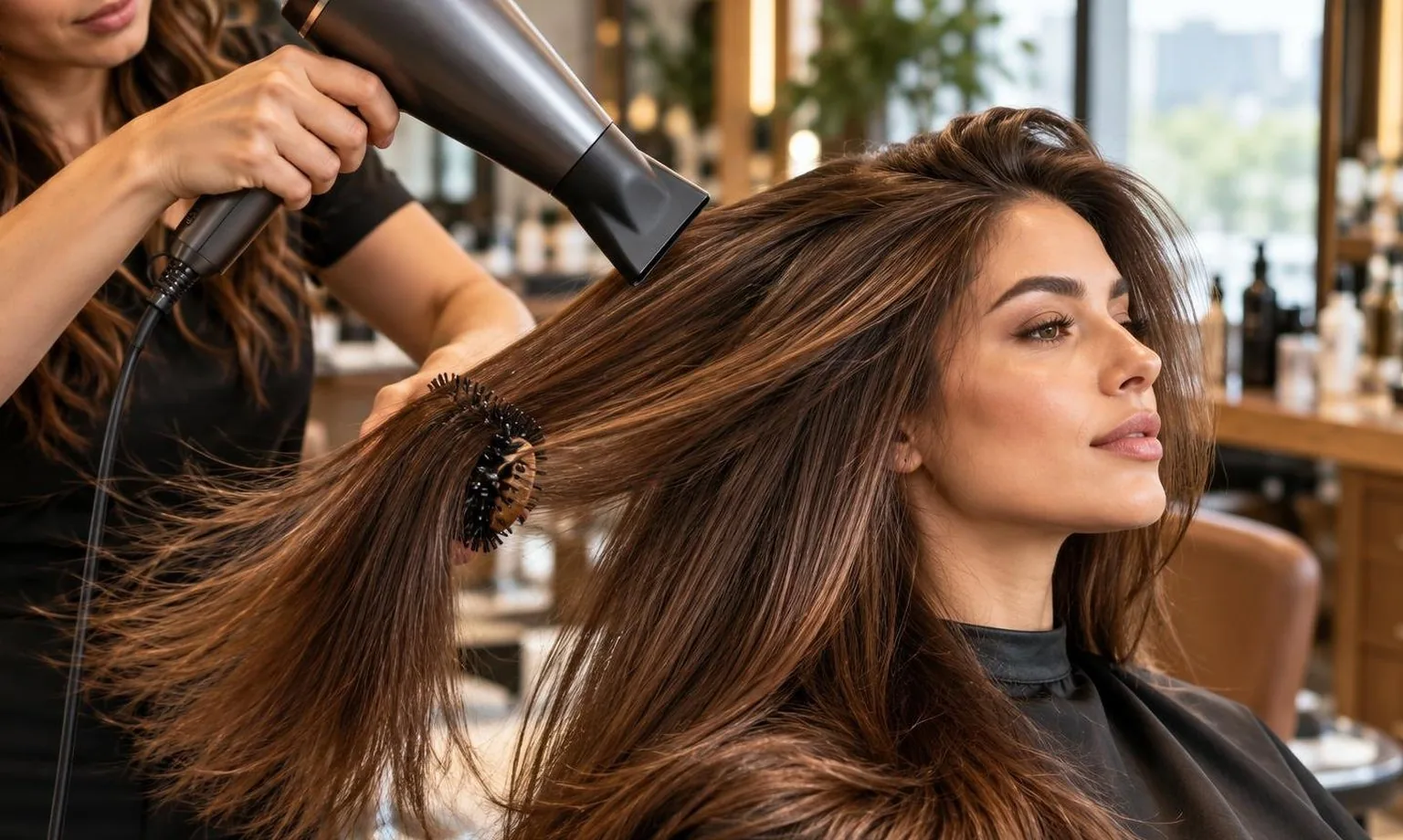
Three variables control drying speed on thick hair: airflow velocity, sectioning strategy, and moisture removal before the dryer touches the strand.
Manipulating all three together cuts total blow-dry time by roughly 30–40 percent compared to working with heat alone.
Airflow Over Heat
A dryer producing 70+ mph airflow displaces water faster than one relying on high temperature at lower velocity. Wattage alone misleads; a 1,875W motor with poor fan engineering moves less air than a well-designed 1,600W unit.
Concentrator nozzle width matters. A narrow nozzle (around 65–75 mm) compresses airflow, increasing velocity at the strand surface. Wide nozzles diffuse the stream and slow evaporation on dense sections.
Sectioning Density
Thick hair demands thinner subsections than most stylists default to. Working in sections no wider than 1–1.5 inches ensures hot air penetrates the full strand depth rather than drying only the outermost layer.
| Section Thickness | Approximate Passes Needed | Surface Temp Risk |
| 2.5 inches | 8–10 per section | Higher (outer layer overheats) |
| 1.5 inches | 4–5 per section | Moderate |
| 1 inch | 2–3 per section | Lower |
Fewer passes per section means less cumulative heat exposure and a faster total service, even though you clip more sections.
Pre-Dry Moisture Removal
Microfibre towels absorb up to seven times their weight in water, pulling significantly more moisture than standard cotton terry before the dryer starts.
Squeezing — not rubbing — with a microfibre wrap for 3–5 minutes reduces initial water content substantially.
Applying a blow-dry accelerator spray after towel-drying adds a further efficiency layer. These sprays typically contain lightweight volatile silicones or isopropyl alcohol blends that evaporate faster than water, carrying moisture with them.
Putting It Together
- Towel-press with microfibre for 3–5 minutes
- Apply accelerator spray root to mid-shaft
- Rough-dry at medium heat, high speed until 70–80 percent dry
- Section into 1–1.5 inch clips
- Finish each section with a round brush, concentrator nozzle on, at 210°F / 100°C max
Executed consistently, this sequence brings a thick-hair blow-dry from 35–45 minutes down to the 20–28 minute range without sacrificing smoothness or longevity of the style.
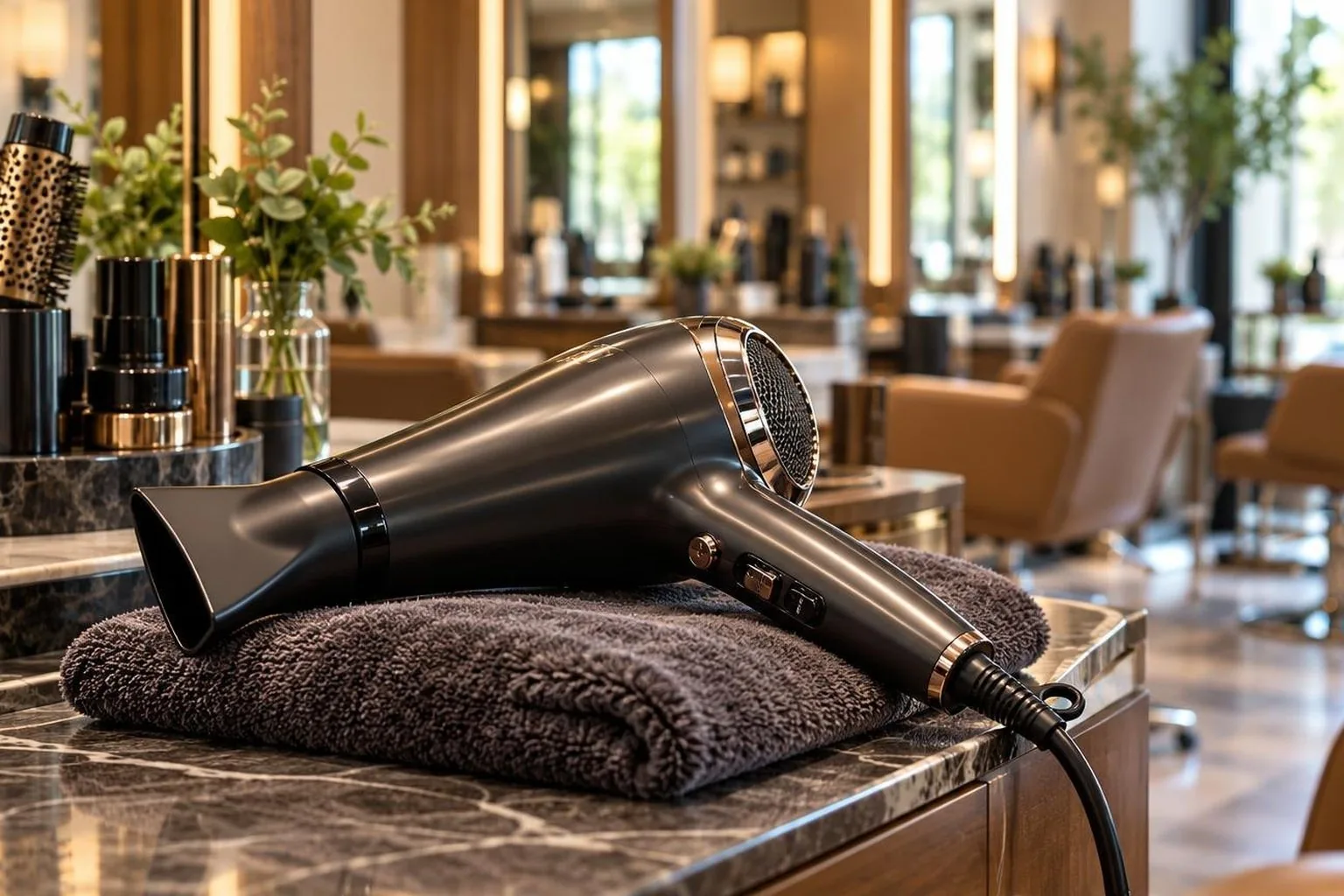
Reading the Result at the Chair
Reading the result means checking whether the hair is genuinely dry through its full density, not just surface-dry. Thick hair holds moisture in the mid-lengths and underlayers long after the outer canopy feels finished.
A systematic check prevents callbacks and restyle requests.
Run a fine-tooth comb through a finished section from root to tip. Truly dry hair produces zero drag and no cooling sensation against the back of the hand. Any resistance or coolness signals retained moisture inside the cortex.
Section-by-Section Temperature Check
Use the cool-shot button on your dryer for 3–4 seconds per section. Dry hair holds its shape and feels room temperature. Damp hair drops or deflates within seconds and feels distinctly cooler against the skin.
| Check Point | Fully Dry Indicator | Still Damp Indicator |
| Nape underlay | Smooth, no coolness on touch | Cool to touch, slight frizz return |
| Crown mid-lengths | Holds tension wrap shape | Section drops flat within 5 seconds |
| Perimeter hairline | No darkened roots visible | Translucent or darker strand bases |
| Behind ears | Strands separate cleanly | Strands clump or feel tacky |
Common Trouble Spots on Thick Hair
- The occipital bone area, where density is typically highest and airflow from the dryer is most obstructed by the stylist’s own hand position.
- Interior layers taken in sections wider than 2 inches, which trap steam between the brush barrel and the scalp.
- The area directly behind each ear, where hair often measures 20–30% thicker in strand count per square centimetre than the temporal zone.
Clip each completed section up and away before moving on. This prevents already-dry hair from reabsorbing ambient moisture released by neighbouring wet sections still under heat.
On hair exceeding 10 cm in length, budget roughly 8–12 minutes of active drying per quadrant when working with sections no wider than 1.5 inches. Thicker densities push toward the upper end of that range.
A final full-head cool shot lasting 15–20 seconds locks the cuticle flat and confirms the blowout is set. If any section moves or loses volume during this pass, return to it with the round brush and medium heat before releasing the client.
Where the Alternatives Win and Lose
Every shortcut for drying thick hair trades one advantage for a specific drawback. High-wattage dryers cut time but risk heat damage. Microfiber towels reduce active drying minutes but add a passive waiting step.
Knowing the tradeoffs lets you stack methods intelligently.
Method-by-Method Comparison
| Method | Time Saved vs. Standard 1875W Dryer | Key Win | Key Loss |
| 2200W+ professional dryer | Up to 30% | Faster airflow (up to 90 mph on some models) | Higher heat exposure; heavier motor (often 600–700 g) |
| Microfiber towel pre-dry (10 min wrap) | 15–20% | Removes moisture without heat; lightweight | Adds passive time; no styling progress |
| Sectioning with clips (4–6 sections) | 10–15% | Directs airflow precisely; improves smoothness | Requires setup time; needs clip inventory |
| Blow-dry spray or accelerator product | 10–20% (varies by formula) | Reduces water’s surface tension on the strand | Product buildup over consecutive uses |
| Hooded dryer sit-under | Comparable total time | Hands-free; even heat distribution | No tension styling; limited smoothing effect |
Where Stacking Works
Combining a microfiber pre-dry with a 2200W dryer and four-section clips is the fastest reliable workflow. Each method targets a different bottleneck: surface water, airflow power, and heat efficiency.
Where Stacking Backfires
- Pairing an accelerator spray with maximum heat (230°C / 450°F nozzle temperature) can push cuticle stress beyond what a heat protectant offsets.
- Using a hooded dryer before a handheld blow-dry adds total session time rather than cutting it, because the hooded phase delivers no directional tension.
- Over-sectioning (more than six clips on mid-length hair) creates sections too narrow for a 70–90 mm round brush to grip effectively.
The Practical Ceiling
Thick hair at shoulder length or beyond holds roughly 150–200 ml of water after a shampoo. No single method eliminates all of it instantly.
The realistic floor for a full blow-dry on dense, coarse hair is around 15–20 minutes with optimised stacking.
Choose alternatives that address your specific slowdown — excess surface water, weak airflow, or poor section control — rather than layering every option at once.
Holding Condition While You Work
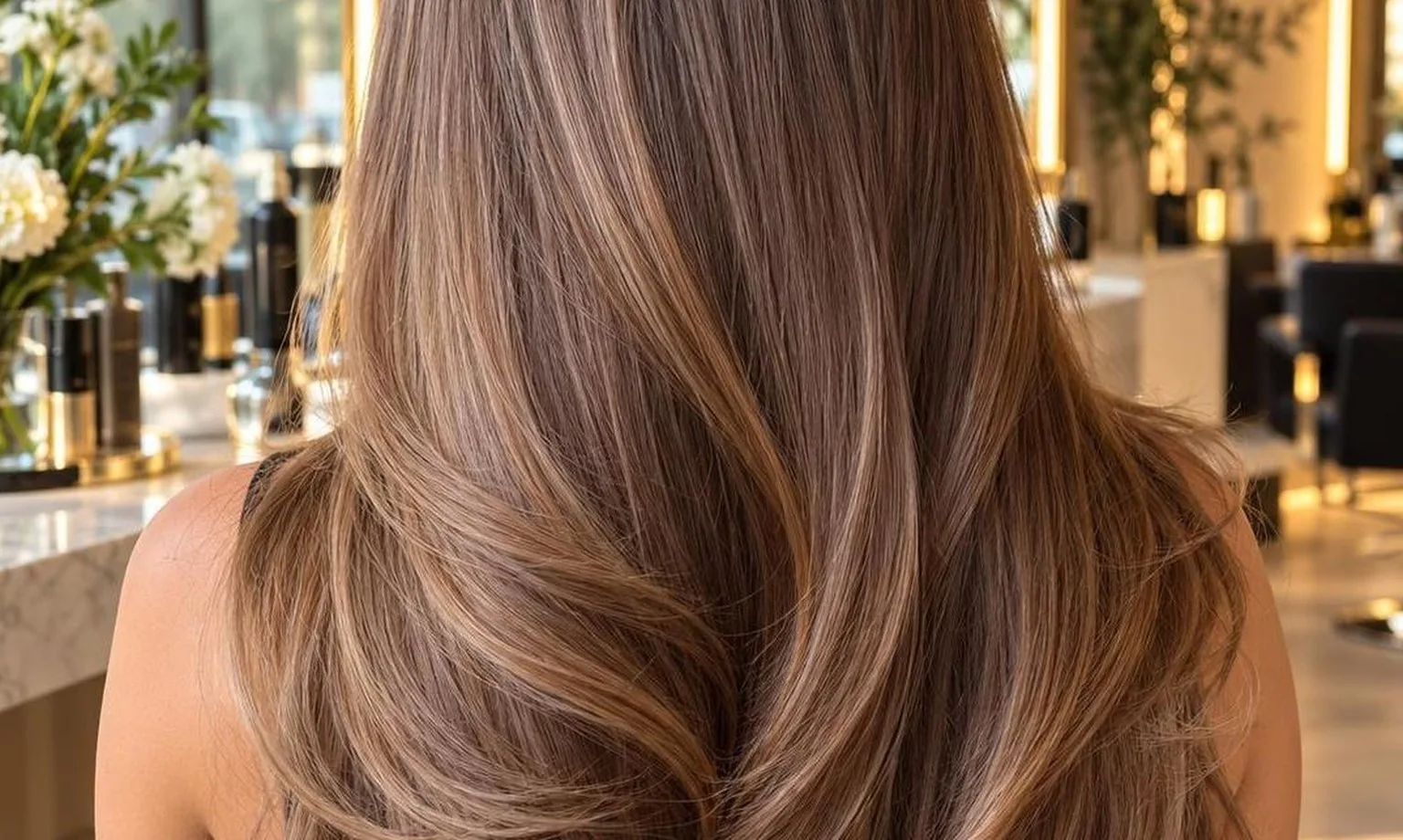
Thick hair loses tension and shape between sections if left unmanaged.
Pinning each dried section into a barrel curl and allowing it to cool completely locks the cuticle in its smoothed position, cutting restyle time and extending the blowout by up to 72 hours.
Use duckbill clips or pin-curl clips rated for heavy hair — standard single-prong clips slip under the weight of dense sections. Double-prong duckbill clips (approximately 8–9 cm long) grip without crimping.
Cool-Down Timing by Section Size
| Section Width | Barrel Diameter | Minimum Cool Time |
| 2.5 cm (1 in) | 33 mm round brush | 45–60 seconds |
| 2.5 cm (1 in) | 43 mm round brush | 60–75 seconds |
| 5 cm (2 in) | 53 mm round brush | 90–120 seconds |
Wider sections wrapped on larger barrels hold more residual heat and need longer to set. Removing clips before full cool-down causes the cuticle to reopen, reintroducing frizz.
Sequence for Holding Each Section
- Finish drying the section until zero moisture remains — hair should feel hot, not warm.
- Keep the section wrapped on the brush and hit it with the dryer’s cool-shot button for 8–10 seconds.
- Slide the brush out without unwinding; let the curl drop into your palm.
- Pin the barrel curl flat against the head using a duckbill clip positioned at the root.
- Move to the next section immediately — do not unpin any curls until the full head is complete.
The cool-shot step is non-negotiable. It drops surface temperature from roughly 80–90 °C down to around 30–35 °C within seconds, accelerating hydrogen-bond reformation inside the cortex.
Once every section is pinned, wait a minimum of five minutes before removing all clips at once. For thick, coarse textures, extend that hold to ten minutes.
Unpin from the bottom layers upward. Finger-rake through each curl rather than brushing, which disrupts the set and generates static in dense hair.
A light mist of flexible-hold hairspray on each layer before unclipping adds another 12–24 hours of hold without stiffness.
What Is Happening to the Hair
Thick hair holds more water per strand because each fibre has a wider cortex and, typically, a denser cuticle layer of 8–12 scales deep compared with 5–7 on fine hair. Removing that extra water is the central bottleneck in drying time.
A single thick strand can measure 80–120 μm in diameter versus 50–70 μm for fine hair. Greater diameter means a longer path for moisture to travel from the cortex outward to the cuticle surface, where heat can finally evaporate it.
Water Load by Hair Type
| Hair type | Approx. diameter | Cuticle layers | Water absorption (% of dry weight) |
| Fine | 50–70 μm | 5–7 | Up to 30% |
| Medium | 70–90 μm | 7–9 | Up to 35% |
| Thick / coarse | 80–120 μm | 8–12 | Up to 40% |
Those differences compound across a full head. A dense, thick-haired client may carry 150–200 g of water after towelling compared with roughly 80–100 g on fine hair — nearly double the mass to evaporate.
Why Each Variable Matters
Holding the nozzle 5 cm closer raises surface temperature, which sets the cuticle before the root section is fully dry. That traps moisture inside the cortex, leading to frizz reversion within minutes of cooling.
Increasing airflow speed from approximately 15 m/s to 22 m/s moves saturated air away from the strand surface faster. This restores the vapour-pressure gradient that drives evaporation, which stalls when humid air sits against the cuticle.
Working in sections narrower than 5 cm ensures each strand receives direct airflow. A 7 cm section folds over itself on the brush, burying inner strands where temperature may drop 20–30 °C below the outer layer.
Reducing initial water load with a microfibre towel for 3–5 minutes before switching the dryer on can cut blow-dry time by roughly 25–30%.
The towel’s split fibres create capillary action that pulls water from the cortex without roughing the cuticle.
- Thicker cuticle resists heat penetration, requiring sustained airflow rather than higher temperature.
- Each additional cuticle layer adds a barrier that slows outward moisture migration.
- Strand density per square centimetre — often 100–150 follicles on thick-haired scalps — multiplies total water volume and drying workload.
Understanding these mechanics prevents the two most common time-wasting errors: over-heating the surface while the interior stays damp, and taking sections too large for the dryer’s airflow to penetrate.
Mistakes Worth Avoiding
Three errors consistently add 10–15 minutes to thick-hair blowouts: skipping rough-drying, using the wrong nozzle width, and holding the dryer too close. Each stalls evaporation, increases repeat passes, and raises the risk of heat damage.
Skipping the Rough-Dry Phase
Jumping straight to a round brush on soaking hair is the single biggest time thief. Hair holds roughly 30% of its weight in water when towel-dried.
A 3–5 minute rough-dry with fingers at medium heat removes the bulk of that moisture before precision styling begins.
Wrong Nozzle for the Job
Concentrator nozzle width directly affects airflow speed and coverage. Using the wrong size wastes passes.
| Nozzle Width | Best Use on Thick Hair | Common Mistake |
| Narrow (roughly 7 mm) | Final smoothing, finishing small sections | Using it for the entire blowout — too slow |
| Wide (roughly 15 mm) | Rough-drying and mid-stage drying | Skipping it entirely |
Start with the wider nozzle for 70–80% of the drying process, then switch to the narrow concentrator for tension passes and smoothing.
Dryer Held Too Close
Holding a dryer closer than 15 cm (6 in) from the hair shaft concentrates heat without improving airflow efficiency. The moisture has nowhere to disperse. Maintain 15–20 cm distance to let steam escape and avoid surface overheating.
Sections Too Large
- Sections wider than 5 cm (2 in) or deeper than 1 cm trap moisture in the interior layers, forcing repeat passes over already-heated cuticle.
- Clip remaining hair up firmly — loose sections falling into your working area add confusion and drying time.
- Work from the nape upward so upper layers never block airflow to lower ones.
Ignoring Airspeed Settings
Many stylists default to maximum heat but medium speed. For thick hair, high airspeed matters more than high temperature.
A dryer pushing air at 130–145 km/h on a high-speed setting displaces water faster than a 230 °C setting on low speed ever will.
Frequently Asked Questions
What nozzle size works best for thick hair?
Use a concentrator nozzle at least 75 mm wide. The wider opening covers more surface area per pass, reducing total drying time on dense hair by spreading airflow across a broader section.
Narrow nozzles under 60 mm force too many passes and add unnecessary minutes.
How large should each section be when blow drying thick hair?
Clip hair into sections no thicker than 2.5 cm (roughly one inch). Thicker sections trap moisture in the interior layers, forcing repeated passes.
Working in controlled sub-sections lets hot air penetrate evenly and cuts overall drying time significantly.
Does towel-drying technique affect blow dry speed on thick hair?
Squeeze hair in a microfibre towel for 5–10 minutes before picking up a dryer. Microfibre absorbs roughly 7 times its weight in water compared to cotton terry.
Removing excess moisture at this stage can shave 8–12 minutes off active blow drying time for thick, dense hair.
What wattage dryer is recommended for thick hair?
Choose a dryer rated at 1800–2200 watts. Lower-wattage motors lack the airflow velocity to push through dense hair efficiently.
Pair high wattage with variable heat settings so you can run maximum airspeed at medium heat (around 70 °C) without thermal damage.
Should I use a round brush or paddle brush to speed up drying thick hair?
Start with a large paddle brush during the rough-dry phase to move maximum volume of hair through the airstream quickly. Switch to a 45 mm round brush only for finishing and smoothing individual sections once hair reaches about 80 percent dry.
Does applying a blow dry accelerator spray actually reduce drying time on thick hair?
Heat-activated accelerator sprays contain lightweight alcohols and silicone polymers that help water evaporate faster from the hair shaft.
Applied to damp hair before drying, these sprays can reduce blow dry time by roughly 30 percent on thick hair, depending on porosity and density.
Related Reading
- How to blow dry your hair at home, step by step
- What the cool shot button actually does
- Blow drying short hair without losing the shape
- Blow drying curly hair straight without wrecking it
- How to make a blowout last past day two
- Sectioning: the step most people skip
- The complete guide to blow drying technique
- National Institutes of Health – PubMed
- U.S. Small Business Administration
- MIT Department of Chemical Engineering
- Underwriters Laboratories
- Professional Beauty Association
- Society of Cosmetic Chemists
- International Electrotechnical Commission
- International Journal of Trichology (open-access, peer-reviewed)