
A blow dry bar staffing ratio of one stylist per two active chairs is a practical starting point for steady service, provided each stylist can complete a 30- to 45-minute blowout without assistance.
Adjust the ratio when demand, service mix, or prep time changes.
This guide shows how to calculate coverage from booked appointments, chair capacity, opening hours, and realistic utilization rather than headcount alone.
It separates floor stylists from front-desk coverage, identifies peak-period gaps, and gives managers a repeatable method for scheduling breaks without slowing turnover.
You will also compare solo and team-based deployment, test a 1:2 chair model against your booking data, and set review triggers.
Track wait time, appointment completion, rebooking, and idle minutes each trading day to refine staffing without overloading the floor.
Calculate Your Chair-to-Stylist Ratio
Staffing a blow dry bar hinges on one number: services per stylist per hour. Work out yours before hiring or cutting staff.
- Time your average blowout. Track 20 consecutive appointments. Most bars land between 30 and 45 minutes per client. A 35-minute average means each stylist can complete roughly 1.7 services per hour.
- Count your peak-hour bookings. Pull the busiest single hour from each of the last four weeks. Add those four numbers and divide by four. That figure is your peak demand. Example: 9 + 11 + 10 + 8 = 38 ÷ 4 = 9.5 clients in your peak hour.
- Divide peak demand by services per stylist per hour. Using the numbers above: 9.5 ÷ 1.7 = 5.6. Round up. You need 6 stylists on the floor during peak.
- Add a buffer for no-shows and walk-ins. Industry scheduling data from Phorest and Boulevard suggest blow dry bars see 12–18% no-show rates but absorb 5–10% walk-in traffic. Subtract walk-ins from no-shows. If the net gap is above 8%, you can safely staff one fewer stylist during peak.
- Set your off-peak floor. Take 40% of your peak stylist count. That is your minimum staffing level. For the example above: 6 × 0.4 = 2.4, rounded to 3 stylists.
Revisit this calculation every quarter. Seasonal shifts in demand — particularly around formal event seasons — can swing peak-hour bookings by 20–30%.
The Numbers That Matter Here
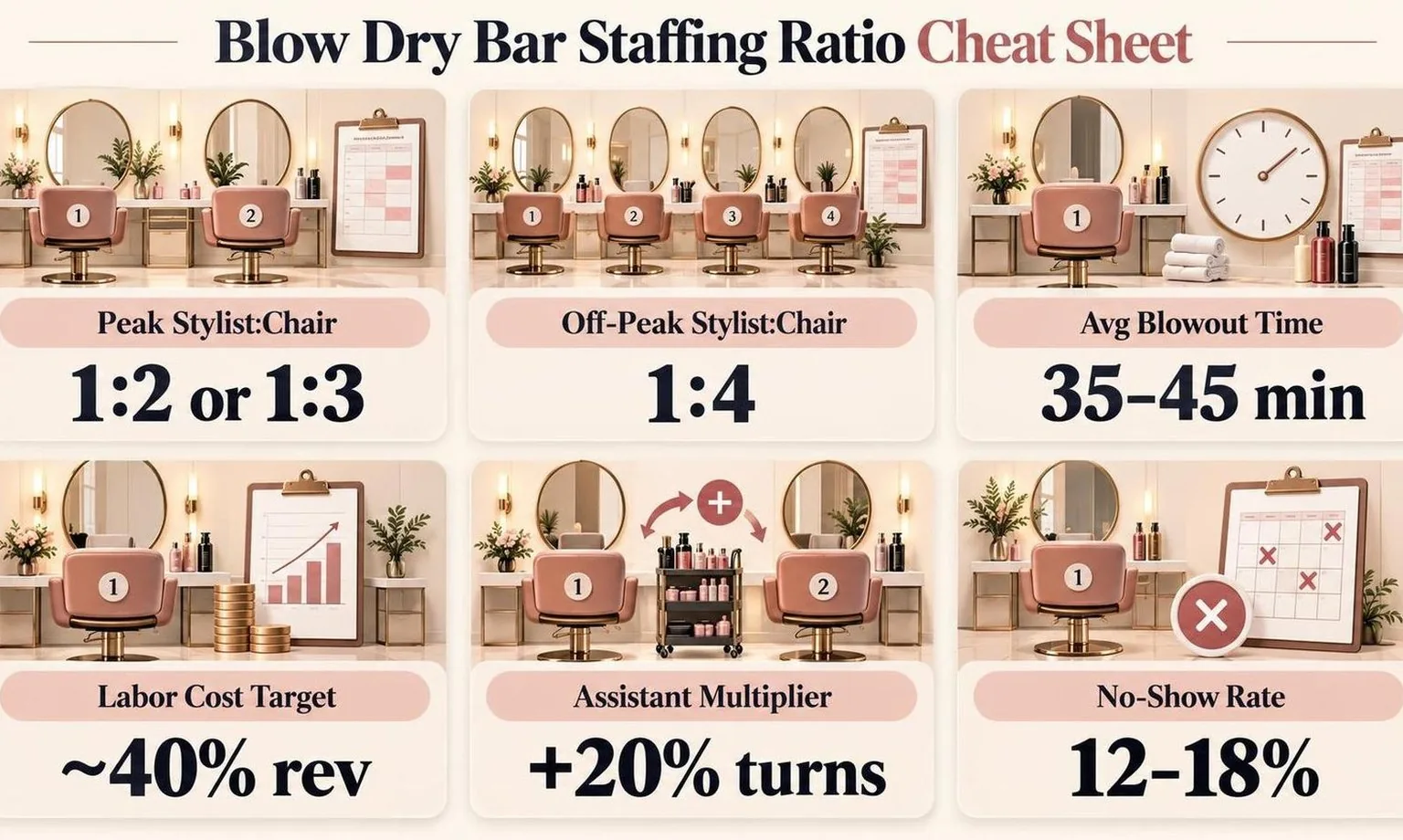
The core staffing ratio for a blow dry bar is one stylist per two to three chairs during peak hours. Off-peak, one stylist per four chairs is workable. These ratios assume a standard blowout appointment length of 30 to 45 minutes.
Staffing math starts with chair turnover rate. A single styling chair can generate four to six appointments in a peak four-hour window if each blowout averages 40 minutes including check-in and cool-down.
| Metric | Peak Hours | Off-Peak Hours |
| Stylist-to-chair ratio | 1:2 or 1:3 | 1:4 |
| Avg blowout duration | 35–45 min | 35–45 min |
| Blowouts per chair per hour | 1.3–1.7 | 0.8–1.0 |
| Front desk staff needed | 1 per 4–6 stylists | 1 per 6–8 stylists |
| Assistants/shampoo techs | 1 per 3 stylists | 1 per 5 stylists |
Why the Ratio Shifts by Day-Part
Peak windows — typically weekday mornings between 7:00 and 10:00 AM, and Thursdays through Saturdays from 3:00 to 7:00 PM — demand tighter ratios because walk-in pressure compresses wait times below the 10-minute threshold clients will tolerate.
Off-peak staffing can run leaner. A six-chair bar operating on a Tuesday afternoon may need only two stylists and one shampoo assistant to maintain a sub-15-minute wait time without labor cost overrun.
Labor Cost as a Percentage of Revenue
Industry benchmarks for salon-format businesses place total labor cost between 40% and 50% of gross revenue.
Blow dry bars that rely on volume rather than high-ticket color services should target the lower end — closer to 40% — to remain viable.
| Staff Role | Typical % of Labor Budget |
| Lead stylists | 55–60% |
| Junior stylists / assistants | 20–25% |
| Front desk / reception | 10–12% |
| Management | 8–10% |
The Support Staff Calculation
Shampoo assistants are the multiplier. One trained assistant prepping and pre-detangling for three stylists can shave 8 to 12 minutes off each appointment, effectively increasing chair turnover by roughly 20% without adding another full stylist wage.
Reception coverage is non-negotiable during peak hours. A single front desk person can manage check-in, checkout, and rebooking for up to six stylists simultaneously before service bottlenecks appear at the point of sale.
Scaling Benchmarks
- 4-chair bar: minimum 2 stylists, 1 assistant, 1 receptionist during peak
- 8-chair bar: minimum 4 stylists, 2 assistants, 1 receptionist during peak
- 12-chair bar: minimum 5–6 stylists, 3 assistants, 2 receptionists during peak
Track your blowouts-per-labor-hour metric weekly. A healthy blow dry bar produces 1.5 to 2.0 completed blowouts per paid labor hour across all staff. Dropping below 1.2 signals overstaffing or booking inefficiency that needs immediate correction.
Cross-training front desk staff in basic finishing tasks — applying serum, removing clips.
Presenting the mirror — can recover 3 to 5 minutes per appointment during surges without violating licensing requirements in most US states and UK jurisdictions.
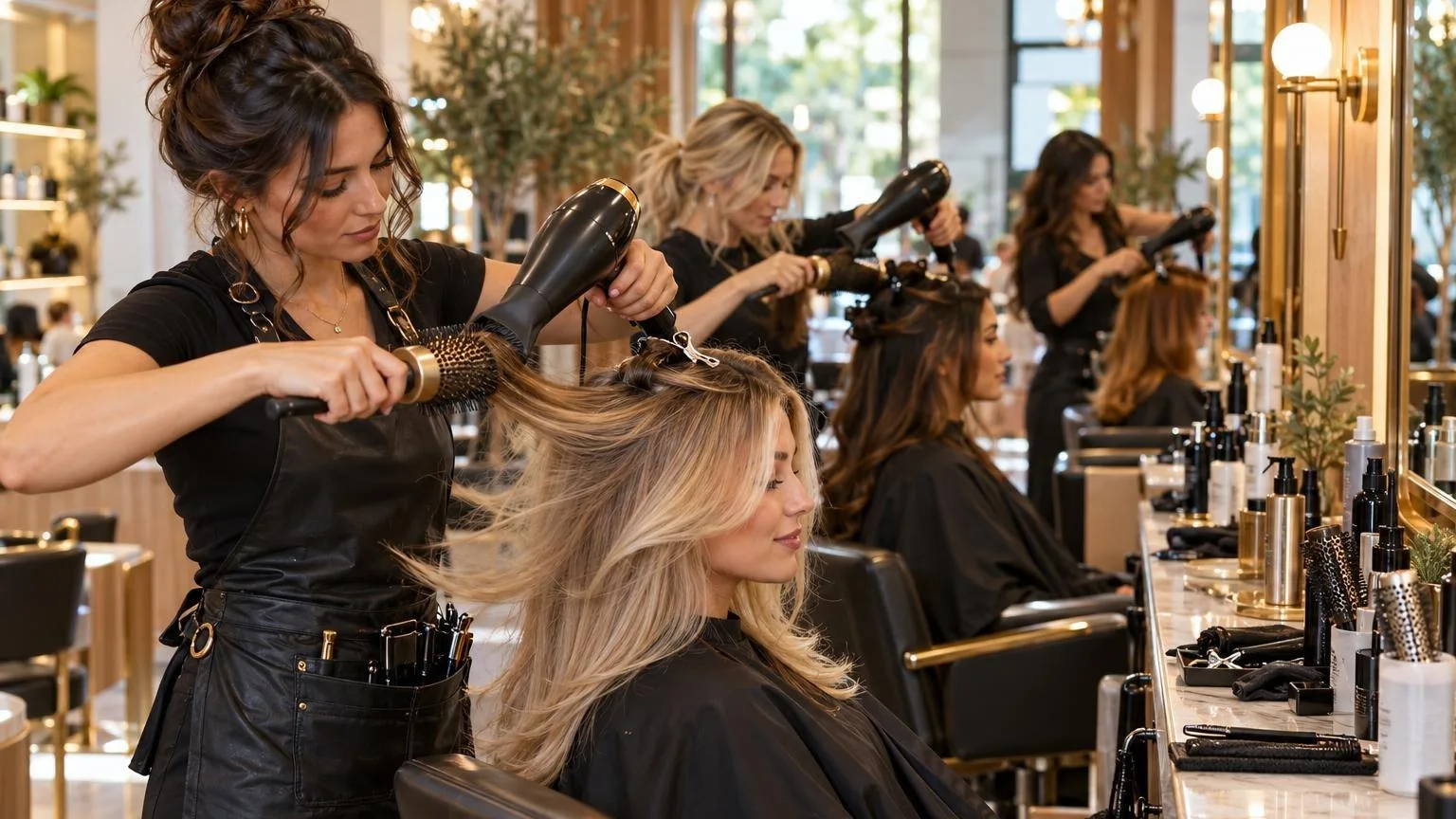
The Variables That Matter
Staffing ratios in blow dry bars hinge on three core variables: average service time per client, peak-hour volume, and the mix of services offered. Getting any one of these wrong cascades into either idle chairs or unacceptable wait times.
Service duration is the foundational metric. A standard blowout on medium-density, shoulder-length hair takes a skilled stylist 35–45 minutes from shampoo to finish. Longer, thicker hair pushes that to 50–60 minutes.
Add-on services shift the math further.
| Service | Avg. Duration | Stylist Occupied |
| Classic blowout (shoulder length) | 35–45 min | 1 stylist full time |
| Blowout (long/thick hair) | 50–60 min | 1 stylist full time |
| Blowout + braid or updo finish | 55–75 min | 1 stylist full time |
| Express blowout (bob or above) | 20–30 min | 1 stylist full time |
When 40% or more of bookings include add-on styling, effective throughput per stylist drops by roughly one client per shift compared to a blowout-only menu.
Peak-Hour Demand
Most blow dry bars see two distinct peaks: a morning window (7:00–9:30 a.m. on weekdays) and a late-afternoon surge (4:00–7:00 p.m., especially Thursday through Saturday).
Weekend mornings before weddings and events compress demand further.
A 6-chair bar averaging 8 peak-hour clients needs a minimum of 4 stylists working simultaneously, assuming a 40-minute average service.
Dropping to 3 stylists pushes average wait time past 15 minutes — the threshold where walk-in conversion falls sharply.
Support Staff Ratio
Assistants who handle shampoo, prep, and staging can increase stylist throughput by 15–20%. One trained assistant supporting every 2–3 stylists is the standard ratio in high-volume bars.
Without assistants, stylists lose 8–12 minutes per client on non-blowout tasks.
- Front desk: 1 receptionist per 6–8 chairs handles check-in, booking, and payment without bottlenecks
- Shampoo assistant: 1 per 2–3 stylists keeps the rotation moving and chairs occupied
- Floor manager: bars with 8+ chairs benefit from a dedicated floor manager to redirect walk-ins and manage flow
Chair Count vs. Staffing
Not every chair needs a dedicated stylist at all hours. Off-peak periods (typically 10:00 a.m.–3:00 p.m. midweek) rarely exceed 50% chair utilisation. Staggered shifts prevent both overstaffing and coverage gaps.
| Chair Count | Peak Stylists | Off-Peak Stylists | Assistants |
| 4 chairs | 3–4 | 2 | 1 |
| 6 chairs | 4–5 | 2–3 | 2 |
| 8 chairs | 6–7 | 3–4 | 2–3 |
| 10+ chairs | 7–9 | 4–5 | 3–4 |
Square footage matters too. Each styling station needs roughly 50–65 square feet of working space, including client movement room. Cramming in chairs without matching staff creates congestion that slows everyone down.
Booking mix is the final lever. Bars running 70%+ pre-booked appointments can forecast labour needs with tighter precision. Walk-in-heavy bars (50%+ walk-ins) must staff closer to peak capacity for longer windows to capture spontaneous revenue.
Track these variables weekly. Small shifts in service mix or peak timing compound quickly, turning a profitable staffing model into one bleeding labour costs within a single quarter.
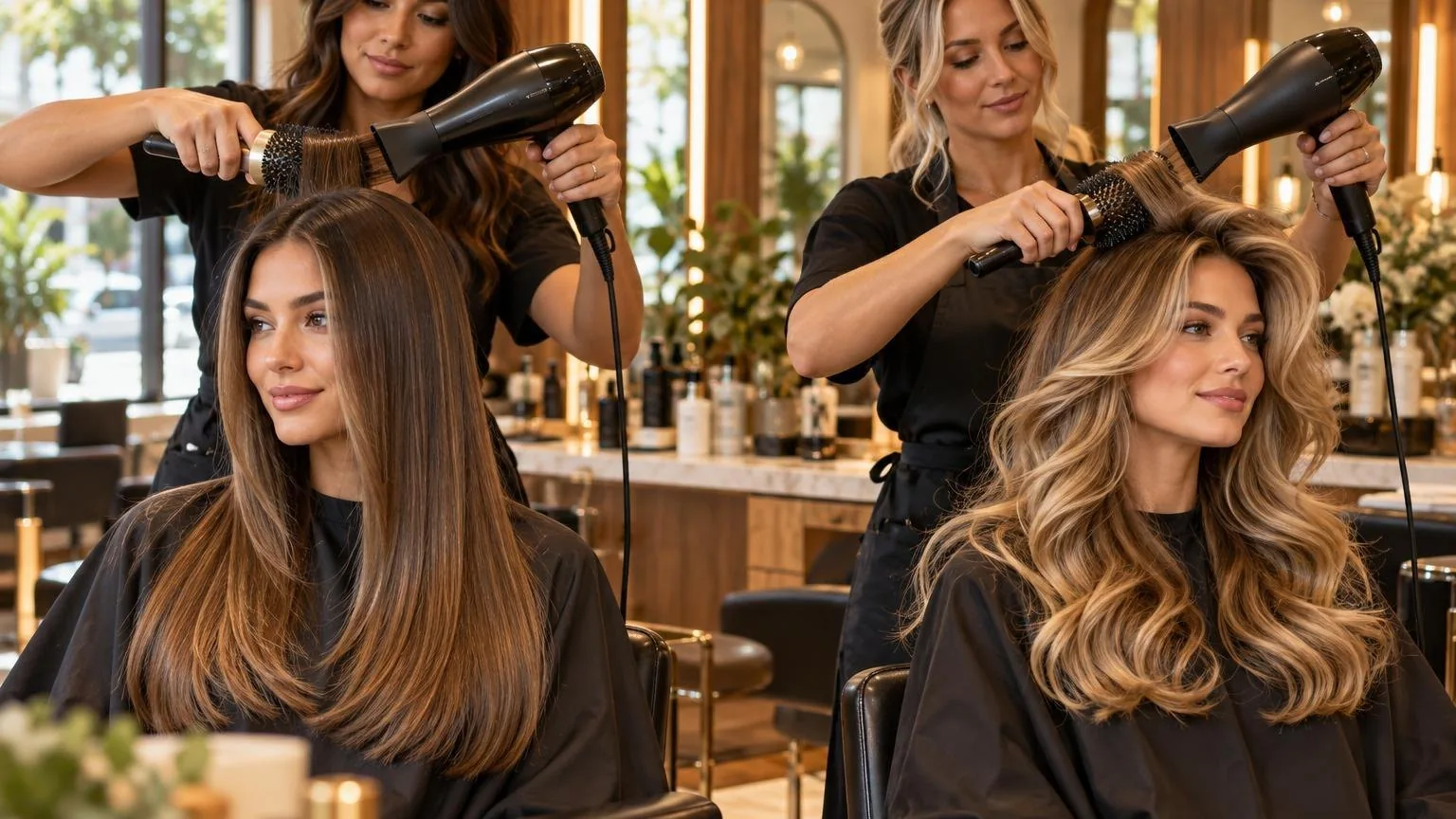
Checking It at the Chair
Staffing ratio performance shows up in three measurable signals at the chair: client wait time, stylist idle time, and service duration consistency.
Tracking these weekly reveals whether your ratio is too lean, too heavy, or correctly tuned to demand.
The standard blowout appointment blocks 45 minutes in most POS systems. When stylists consistently finish in 35 minutes but the next client is not checked in, you have excess capacity.
When clients wait more than 10 minutes past their booking time, you are understaffed for that daypart.
Core Metrics to Track Weekly
- Chair utilisation rate: minutes of active service divided by total staffed minutes per chair, targeting 75–85%
- Client wait-to-seat time: measured from check-in to cape-on, targeting under 5 minutes for appointments and under 12 minutes for walk-ins
- Stylist idle windows: gaps of 15 minutes or longer between services, counted per shift
- Rebooking rate: percentage of clients who book their next visit before leaving, which drops when wait times exceed 8 minutes
Ratio Benchmarks by Volume Tier
These ratios reflect front-of-house stylists to operating chairs during a single shift. A separate front-desk staff member is assumed for every 4–6 active chairs.
| Daily clients per shift | Chairs | Stylists on floor | Ratio (stylist:chair) |
| 15–20 | 4 | 3 | 1:1.3 |
| 21–30 | 5–6 | 4–5 | 1:1.2 |
| 31–45 | 7–8 | 6–7 | 1:1.15 |
| 46+ | 9–10 | 8–9 | 1:1.1 |
Higher-volume locations push the ratio closer to 1:1 because every empty chair minute costs more when rent per square foot is elevated. Lower-volume bars keep a slight cushion to absorb walk-in surges without overtime.
The 15-Minute Audit Method
Pick three shifts per week — one slow, one average, one peak. Every 15 minutes, a manager records how many chairs are active, how many stylists are between clients, and how many clients are waiting. Run this for two consecutive weeks.
Plot the results on a simple grid. Patterns emerge fast. If Tuesday mornings show two stylists idle for four consecutive 15-minute checks, that shift is overstaffed by one.
If Saturday 2 p.m. shows three or more clients waiting across multiple checks, you need an additional stylist from 1 p.m. to close.
Adjusting Without Overspending
- Stagger start times in 90-minute intervals rather than starting the full team at open
- Cross-train one front-desk team member to handle shampoo and prep, freeing stylists to stay at chairs
- Use a split-shift model on weekends: early team from open to 2 p.m., late team from 1 p.m. to close, with a one-hour overlap at peak
Revisit staffing ratios every time you add or remove a chair, change your appointment duration in the booking system, or see walk-in volume shift by more than 20%. The ratio is not fixed — it follows demand.
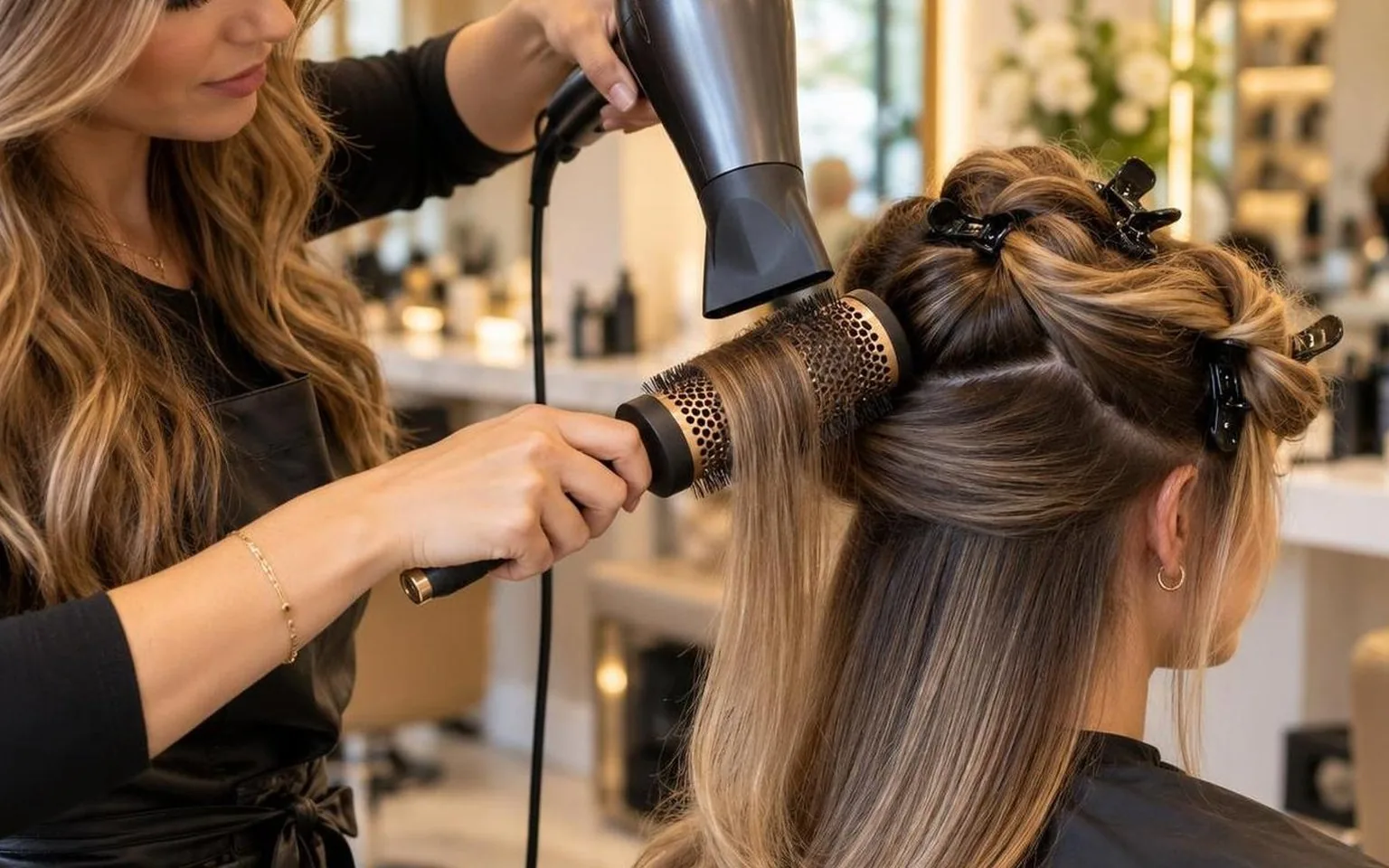
Trade-Offs Against the Alternatives
Every staffing ratio model carries a cost. The core trade-off is between labour cost per client and average ticket speed — optimising one typically degrades the other.
Understanding these trade-offs prevents owners from chasing a single metric while bleeding margin elsewhere.
Model Comparison: Lean vs. Standard vs. Premium Staffing
| Model | Stylist-to-Chair Ratio | Avg. Client Throughput per Stylist per Hour | Labour Cost as % of Revenue | Avg. Client Wait Time |
| Lean | 1:3 | 1.8–2.2 | 35–40% | 12–18 min |
| Standard | 1:2 | 1.4–1.7 | 42–48% | 5–10 min |
| Premium | 1:1 | 1.0–1.2 | 50–58% | 0–3 min |
The lean model squeezes maximum output per stylist but inflates wait times. That 12–18 minute queue window is where walk-out risk concentrates — industry benchmarks suggest roughly 30% of walk-in clients leave after a 15-minute wait.
Assistants vs. Additional Stylists
Hiring a blow dry assistant at a lower hourly rate is the most common alternative to adding a fully qualified stylist. The financial gap between the two paths is significant.
| Role | Typical Hourly Rate (US) | Tasks Covered | Impact on Throughput |
| Junior Assistant | $12–$16 | Shampooing, prep, sectioning, product application | +25–30% per stylist |
| Licensed Stylist | $18–$28 | Full blowout service independently | +100% (additional chair) |
An assistant boosts an existing stylist’s speed by roughly 25–30% because prep and rinse steps — typically 8–12 minutes of a 35–45 minute blowout — are offloaded.
But the assistant cannot independently serve a chair.
A second licensed stylist doubles capacity yet nearly doubles labour cost per hour.
The break-even point depends on seat utilisation: if chairs sit empty more than 40% of operating hours, the second stylist erodes margin faster than an assistant would.
Fixed Schedule vs. Flex/On-Call Staffing
- Fixed schedule: Predictable labour cost, easier team culture, but overstaffed during slow weekday mornings (typically 9–11 a.m.) and understaffed during peak windows (Thursday–Saturday, 3–7 p.m.).
- Flex/on-call pool: Labour cost tracks demand more closely, reducing idle payroll by an estimated 15–20%. Trade-off: higher turnover, inconsistent service quality, and scheduling software costs averaging $50–$150 per month per location.
- Hybrid model: A core team of 2–3 full-time stylists supplemented by 1–2 flex stylists during peak hours. This balances coverage and cost but requires robust booking data to forecast demand accurately.
Front-Desk Receptionist vs. Self-Service Booking
Eliminating a dedicated receptionist saves $2,200–$3,000 per month in wages. Digital check-in kiosks or app-based booking absorb most intake tasks.
The trade-off is reduced upsell opportunity — receptionists typically drive 10–15% of add-on service revenue through in-person recommendations.
No single ratio suits every bar. A 600-square-foot, four-chair location in a high-footfall urban setting will justify tighter lean staffing because volume compensates for churn.
A six-chair suburban bar relying on appointments needs the standard or hybrid model to protect rebooking rates, which directly feed lifetime client value.
Map your peak-to-trough client count across a full trading week before committing to a model. The staffing ratio that looks best on a spreadsheet only holds if seat utilisation data supports it.
Where Damage Creeps In
Damage creeps in when stylists are stretched across too many clients simultaneously. Understaffing forces corners to be cut: higher heat settings to speed drying, skipped heat protectant application, and rough detangling under time pressure.
The client’s hair pays the price for a scheduling problem.
The widely cited safe staffing benchmark for blow dry bars is one stylist per two chairs at any given time. When that ratio slides to 1:3 or worse, average service time per client compresses from 45 minutes to under 30.
Heat Escalation Under Time Pressure
A stylist running behind will reach for the temperature dial. Medium heat for a round brush blowout sits around 150–175 °C (300–350 °F).
Under pressure, that climbs to 200–230 °C (400–450 °F) — the range where cuticle lifting and moisture loss accelerate sharply.
Fine hair begins sustaining structural damage above 150 °C. Coarse or thick hair tolerates up to roughly 190 °C before significant cuticle compromise. Neither threshold leaves room for the 210 °C+ settings rushed stylists default to.
| Hair Type | Recommended Max Temp | Common “Rushed” Temp | Risk |
| Fine / colour-treated | 150 °C (300 °F) | 200 °C (400 °F) | Cuticle fracture, colour fade |
| Medium density | 175 °C (350 °F) | 210 °C (410 °F) | Moisture loss, split ends |
| Coarse / thick | 190 °C (375 °F) | 230 °C (450 °F) | Protein degradation, breakage |
Skipped Steps That Compound
Heat protectant application takes approximately 60–90 seconds per client. When a stylist juggles three or four clients in rotation, that 90 seconds feels expendable.
Over a six-hour shift at full capacity, skipping protectant across 8–10 clients saves roughly 12–15 minutes.
Those 12–15 minutes of recovered time come at a direct cost to hair integrity. Silicone- and polymer-based protectants reduce thermal transfer by up to 50%, according to manufacturer testing data from major professional product lines.
Mechanical Damage From Rushing
- Aggressive detangling on wet hair — tensile strength of wet hair drops roughly 20–30% compared to dry hair, making it far more vulnerable to snapping
- Yanking through sections with a round brush rather than controlled tension passes
- Using a 53 mm barrel brush on fine hair that needs a 33 mm barrel for proper control and sectioning
- Overlapping dryer passes on the same section because the stylist lost track mid-rotation
The Staffing Link
A bar running 12 chairs on a Saturday with four stylists is operating at a 1:3 ratio. Each stylist manages three simultaneous blowouts in rotation. Drying overlap becomes inevitable, and total heat exposure per client head can double.
Raising the ratio to 1:2 — six stylists for those same 12 chairs — adds payroll cost but cuts average heat exposure time per section from 8–10 minutes down to 4–5 minutes.
That difference determines whether cuticles stay sealed.
Salon owners tracking damage complaints should audit their staffing ratio before blaming product or tools.
The correlation between peak-hour understaffing and client complaints about dryness, frizz, and breakage is consistent across operations of every size.
Frequently Asked Questions
What is the ideal stylist-to-chair ratio for a blow dry bar?
Most profitable blow dry bars operate at a 1:1 stylist-to-chair ratio during peak hours and drop to one stylist per two chairs during off-peak windows.
Overstaffing chairs without bookings burns labour cost; understaffing creates walkaways that erode lifetime client value.
How many front-desk staff does a blow dry bar need?
One receptionist can manage check-in, checkout and phone bookings for up to eight active chairs. Beyond eight chairs, add a second front-desk person or shift to a self-check-in kiosk to keep average greet-to-seat time under 90 seconds.
What percentage of revenue should a blow dry bar spend on staffing?
Labour costs for blow dry bars typically fall between 35% and 45% of gross revenue, including wages, commissions and payroll taxes.
Bars consistently above 48% usually have idle midweek shifts that need trimming or consolidating into fewer, fuller service blocks.
How many blowouts per hour should one stylist complete?
An experienced stylist averages 1.5 to 2 standard blowouts per hour on medium-density hair, factoring in a 30–45 minute service time.
Scheduling in 45-minute slots with a built-in 5-minute buffer prevents cascading delays across the appointment column.
Should blow dry bars use commission or hourly pay for stylists?
A hybrid model works best: a base hourly rate that meets local minimum wage plus a per-service commission of 15%–25% on each blowout.
This keeps fixed costs predictable during slow periods while incentivising speed and rebooking during peak traffic.
When should a blow dry bar hire an assistant or apprentice?
Add an assistant when your average stylist spends more than 10 minutes per client on non-styling tasks like shampooing, mixing products and sanitising tools.
One trained assistant supporting three stylists can recover 1.5–2 extra blowout slots per stylist per shift.
How do you staff a blow dry bar for weekend peak demand?
Pull booking data from your last 8–12 weekends and identify the two- to three-hour window with the highest ticket count.
Staff that window at full chair capacity, then stagger start times so stylists overlap only during the confirmed surge rather than covering the entire day.
Related Reading
- The blow dry bar business model, explained
- When a salon needs an alcohol licence
- EPLI for salons: when it starts to matter
- Insuring a stylist's hands: what cover exists
- The licences a blow dry bar needs, and who issues them
- How booth rental works, and who it suits
- The complete guide to the blow dry bar business
- OSHA Salon Safety – Hair Care Industry
- U.S. Small Business Administration – Starting a Business
- National Institutes of Health – PubMed Central
- Cornell University ILR School – Workplace Studies
- Professional Beauty Association
- Associated Hair Professionals
- U.S. Census Bureau – Service Industry Statistics
- MIT Living Wage Calculator