1 licence question decides service scope: do salons need an alcohol licence yes, if you sell alcohol or include it in a paid package; no, if clients bring their own and you do not charge corkage.
The trigger is supply linked to payment, not glass size.
For blow dry bars, this affects prosecco upgrades, bridal prep menus, VIP evenings, and “complimentary” drinks bundled into ticketed services.
A 125 ml glass poured during a paid blowout can still count as alcohol supply if it supports the transaction.
Before adding drinks, map exactly who buys, stores, pours, and records alcohol. Then check local licensing rules, staff authorisation, age checks, and event limits. Build the service menu after compliance, not after the first booking.
Check Your Service Plan
Work from your actual offer, not assumptions. List every drink you hand to clients, who pays, and when it is poured. Your answer usually turns on three points: alcohol type, payment link, and where clients drink it.
| If this matches your salon | Your next check |
| Only tea, coffee, water, soft drinks, or 0.0% options | Usually no alcohol licence issue. Check labels. “Alcohol-free” products can still vary, so confirm ABV on the bottle. |
| Beer, wine, prosecco, spirits, or cocktails are offered free with a blow dry, package, membership, or event ticket | Check whether alcohol is treated as part of a paid service. If the drink is tied to payment, licence rules may apply. |
| Clients can buy a glass, mini bottle, or drink upgrade separately | This is a stronger trigger for licensing checks. Review local premises and retail alcohol rules before serving. |
| You host launches, client nights, or wedding mornings for 6 to 20 guests with alcohol on site | Check event-specific permissions, staff age checks, and where open containers are allowed. |
Now audit your setup in 10 minutes. Count how many alcoholic SKUs you store. Note bottle sizes such as 187 ml minis, 750 ml wine, or 1 litre spirits. Measure where clients drink: styling chair, waiting area, or pavement seating.
If any paid service includes alcohol, or any drink is sold separately, stop guessing. Pull your local authority guidance and compare your exact setup line by line before the article’s broader detail.
What the Data Shows
If a salon sells alcohol, it usually needs a licence or specific authorisation. If the drink is genuinely free, the answer changes by jurisdiction, but the risk rises fast once alcohol is tied to a package, booking fee, membership, or minimum spend.
In the UK, the legal trigger is usually the “sale by retail” of alcohol. In the US, there is no single national salon exemption across all 50 states, so owners must check state, county, and city rules before pouring.
For salon operators, the practical numbers matter more than the marketing language. One “complimentary” flute can still look like a sale if its cost is built into a blowout package or VIP upgrade.
| Jurisdiction | What usually triggers authorisation | Useful number |
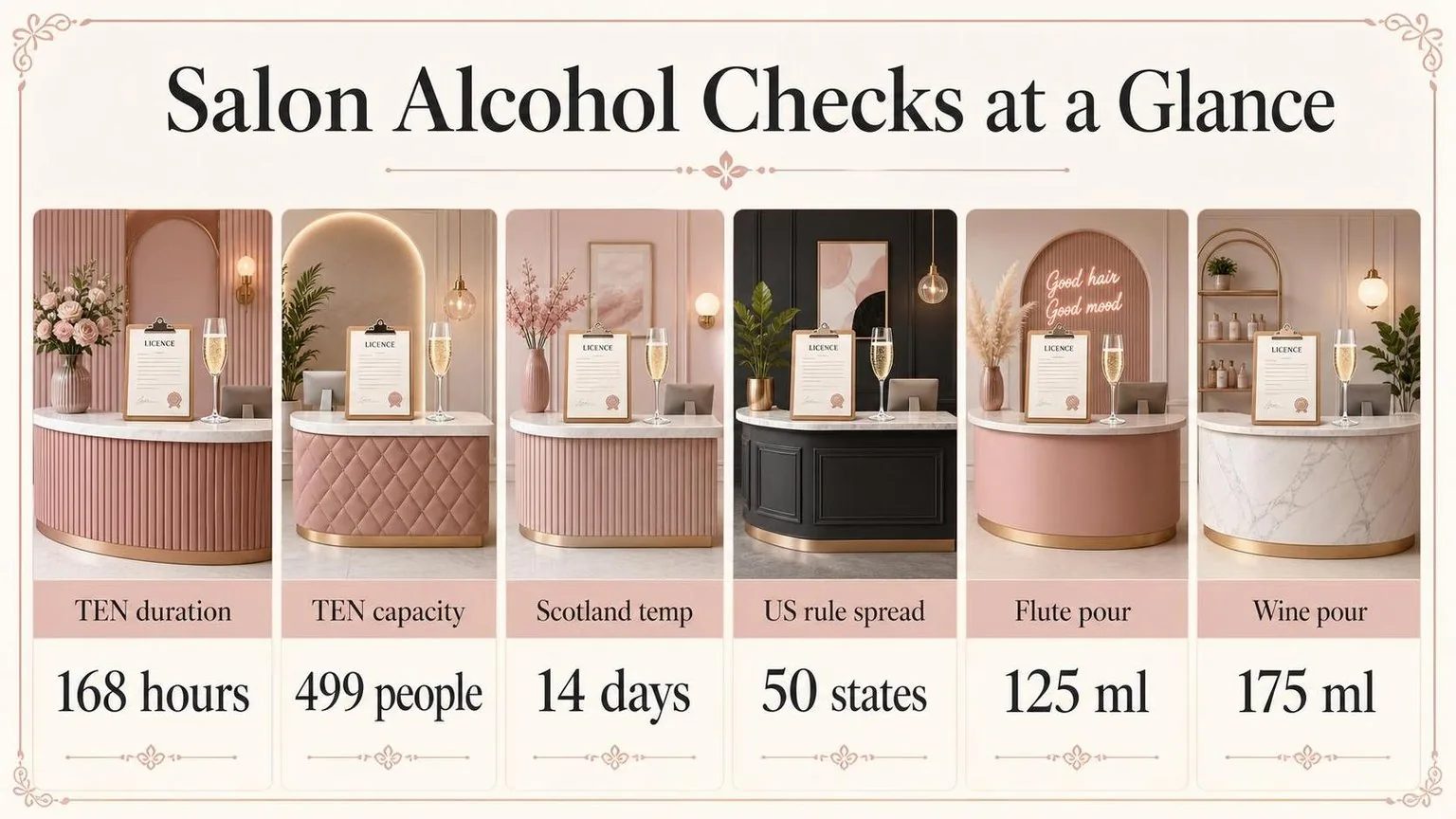
| England and Wales | Sale by retail of alcohol on the premises | Temporary Event Notice: up to 168 hours, up to 499 people including staff |
| Scotland | Sale of alcohol from premises or under an occasional licence | Occasional licence: up to 14 days |
| United States | State and local alcohol service rules, often including “free” service | 50 states, no single salon-wide rule |
The compliance maths also becomes obvious when you look at serving sizes. A standard 750 ml bottle does not stretch far in a busy Saturday salon, which is why repeated service can look commercial rather than incidental.
| Drink format | Common measure | Serves from 750 ml bottle |
| Champagne or sparkling wine flute | 125 ml | 6 serves |
| Wine glass | 175 ml | 4 serves |
| Large wine glass | 250 ml | 3 serves |
Those numbers matter because regulators look at substance over wording. If a salon serves 12 clients from 2 bottles during a 4-hour promotion, that is structured alcohol service, not an isolated hospitality gesture.
In England and Wales, a one-off event can sometimes be covered by a Temporary Event Notice. Regular Friday pours, weekly prosecco packages, or permanent menu listings usually point toward full licensing instead.
- Charge separately for alcohol, and a licence question starts immediately.
- Bundle alcohol into a service price, and it can still count as a sale.
- Offer it free with no purchase condition, and the answer depends on local law.
The safe reading is simple. Occasional, truly free hospitality may be allowed in some places. Repeated, promoted, or paid-for alcohol service usually needs formal approval before the first glass is poured.
The Variables That Matter
The result changes with one question: are you selling alcohol, or only offering it free within tight limits.
A salon that charges, bundles, promotes, or serves regularly can move from “no licence needed” to “licence needed” fast.
Jurisdiction changes the answer next. In England and Wales, the key issue is usually whether alcohol is “sold by retail” under the Licensing Act. In many US states, even free service can trigger a permit if it supports the business.
| Factor | Why it matters | Typical effect |
| Customer pays directly for wine, beer, or cocktails | That is a sale of alcohol | Licence or permit usually required |
| Drink is included in a service package | Alcohol can still be treated as part of a paid transaction | Licence often required |
| One complimentary glass with no separate charge | May fall outside “sale” in some places | Sometimes no licence, but local rules still apply |
| Regular service from a menu or drinks list | Looks like a hospitality offer, not incidental refreshment | Higher licensing risk |
| Private event, launch party, or late opening | Temporary permissions may apply | Short-term authorisation may be needed |
| Spirits served instead of beer or wine | Higher scrutiny in some jurisdictions | Extra permit conditions possible |
Packaging matters. “Free prosecco with every blowout” is riskier than quietly offering water, tea, coffee, or a modest complimentary drink.
The stronger the promotion, the easier it is for a regulator to argue the alcohol helps drive the sale.
Volume matters too. Serving 125 ml glasses of wine is easier to control than pouring 175 ml or 250 ml measures. Clear portion control reduces over-service risk and helps staff track how much each client receives during a 45 to 90 minute appointment.
Who serves the drink changes the result. In some places, a receptionist opening a single bottle for occasional complimentary service is treated differently from a staffed bar area, cocktail station, or dedicated beverage menu.
- Check if “complimentary” alcohol is still considered part of a paid service.
- Check on-premises versus off-premises permissions.
- Check age-verification rules for staff at front desk and floor level.
- Check hours. Local rules can differ between daytime service and evening events.
- Check building, lease, and insurer conditions before serving.
For salon owners, the practical test is simple.
If alcohol is advertised, repeated, measured like a service feature, or linked to the ticket price, assume the licensing question is active and verify it with the local authority or state alcohol regulator.
What a Good Result Looks Like
Judge it by what happens in the chair, not by the menu wording.
If clients are drinking while receiving a blowout, trim, or styling service, the licensing question turns on whether alcohol is sold, included in a package, or given away under a local exemption.
Start with the transaction. If a client pays separately for wine, prosecco, beer, or a cocktail, that is usually the clearest trigger for an alcohol licence or permit.
If the drink is “free,” check whether it is tied to a paid service, membership, event ticket, or minimum spend.
Then test the setting. Ask who drinks, where they drink, and who serves. A glass handed to a seated client inside the salon is treated differently from a private staff celebration after closing or a sealed retail bottle taken off site.
| Real-world salon scenario | Licensing risk | Why it matters |
| Wine added as a line item on the bill | High | Direct sale of alcohol is usually regulated |
| “Complimentary” prosecco bundled with a blowout package | High | Alcohol can still be part of a paid transaction |
| Free drink at a client event with paid tickets | High | Ticket revenue can make the alcohol part of the sale |
| Free drink with no charge and no condition | Medium | Some areas exempt this, others still regulate service |
| Sealed bottle sold to take away | High | Off-sales are separately regulated in many places |
Check the local rulebook next. In England and Wales, alcohol sales from premises usually require a premises licence, and the sale of alcohol is a licensable activity under the Licensing Act.
In many US states, the state alcohol control board decides whether salons can serve or sell alcohol.
Age control is the practical stress test. If your reception team cannot reliably challenge and verify age, your model is not ready. Staff also need a rule for refusing service to intoxicated guests and for recording incidents.
| Operational point to test | What to verify on the floor | Source to check |
| Sale versus gift | Whether any payment, package, or ticket covers the drink | Local licensing authority or state ABC board |
| On-site versus take-away | Whether alcohol is opened and consumed in salon | Licence conditions or state permit class |
| Age verification | Whether staff challenge anyone who could be under 25 | House policy and local law |
| Serving measure | Whether staff pour a standard single serve only | Local weights, measures, and licence rules |
For a blow dry bar, the safest reading is simple. If alcohol supports the client offer, assume it needs checking before launch. Read the licensing authority guidance, call the regulator, and get the answer for your exact service model in writing.
Where the Alternatives Win and Lose
If a salon wants to serve alcoholic drinks as part of normal trading, that is usually the highest-risk option.
In many jurisdictions, it adds licensing, age-checking, insurance and premises-control duties that soft drinks, tea, coffee and true 0.0% products do not.
The practical alternative is simple hospitality without alcohol. That keeps the client experience polished while removing the parts of alcohol law that trigger inspections, trained supervisors or event limits.
| Option | Typical legal position | Key numbers | Operational impact |
| Tea, coffee, water, soft drinks | No alcohol licence needed | 0% ABV | Lowest compliance burden |
| True 0.0% beer or sparkling alternative | Usually treated as non-alcoholic, but check label and local law | 0.0% ABV | Low burden if stock is genuinely 0.0% |
| Complimentary wine, beer or prosecco during services | Often regulated if alcohol is supplied in the course of business | Age checks apply where alcohol law applies | Higher burden: training, refusals, stock control |
| One-off salon event with alcohol | May be possible under temporary event rules in some places | England and Wales: up to 168 hours, up to 499 people including staff under a TEN | Good for launches, not daily service |
| BYOB | May avoid retail sale by the salon, but building, local and insurer rules still matter | 0 salon alcohol stock | Lower stock risk, still needs clear policy |
In England and Wales, permanent alcohol sales usually need a premises licence. Retail sales also require a designated premises supervisor, and that person must hold a personal licence.
That is a bigger step than many salons expect for a single glass at a blowout station.
A Temporary Event Notice is lighter, but it is narrow. It covers a maximum of 168 hours, and the event cap is 499 people including staff. That suits a launch night or client appreciation event, not routine Saturday service.
In the United States, the comparison is less uniform. Some states and cities allow limited complimentary service; others regulate any on-premises alcohol supply.
The safer operational assumption is that alcohol rules change by state, county and city, not only by country.
- Soft drinks and 0.0% stock are easiest to standardise across locations.
- Alcohol service needs refusal procedures, ID checks and staff training.
- BYOB reduces inventory handling, but can still create liability questions.
- Temporary permissions work best for short, ticketed or invite-only events.
For most salons, the cleanest comparison is this: alcohol can elevate perceived luxury, but it adds more than one compliance layer. Premium non-alcoholic service delivers most of the hospitality effect with fewer legal moving parts.
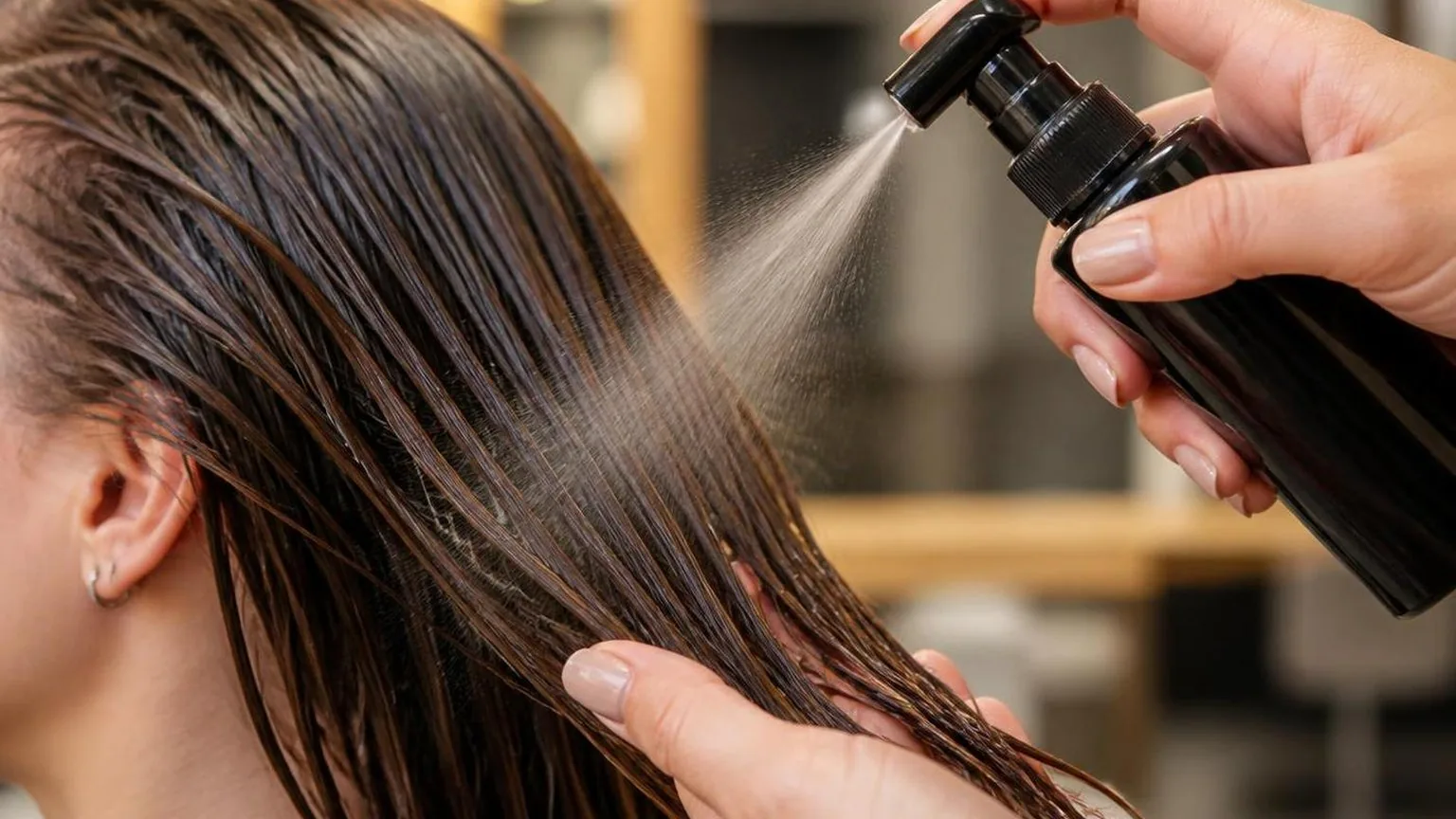
Keeping Condition Through the Dry
Keeping hair intact during a blow-dry comes down to controlled heat, measured tension and constant airflow.
Use the lowest setting that dries efficiently, keep the dryer moving, and match brush size to section size so you smooth the cuticle without over-stretching the fibre.
Most salon-quality dryers run with multiple heat and speed settings. For fine, fragile or highly porous hair, start on low to medium heat. For medium to coarse hair, use medium to high heat only until the section is about 80 to 90 percent dry.
Distance matters. Hold the nozzle about 10 to 15 cm from the hair. Closer than that concentrates heat too sharply on one point. Farther away slows drying, which can tempt the stylist to add more heat or hold tension longer than necessary.
Tension should feel firm, not aggressive. The brush should guide the section taut enough to smooth, but not so hard that the hairline or mid-lengths visibly strain. If the section bows around the brush, tension is too high for that hair density.
| Hair type | Suggested heat | Nozzle distance | Section size |
| Fine or low density | Low to medium | 12 to 15 cm | 2.5 to 4 cm wide |
| Medium density | Medium | 10 to 12 cm | 4 to 5 cm wide |
| Coarse or high density | Medium to high | 10 to 12 cm | 5 to 7.5 cm wide |
Section control protects the hair. Smaller sections dry faster and need fewer passes. A section that is too thick traps moisture in the centre, so the outer layer gets repeated heat while the inner hair is still damp.
Brush diameter changes the stress on the fibre. Smaller barrels create more bend and more pull at the ends. Larger barrels spread tension across a wider curve, which is usually safer for longer lengths and faster for smooth, polished finishes.
| Brush diameter | Best use | Effect on tension |
| 25 to 32 mm | Short hair, fringe, strong bend | Higher at ends |
| 43 to 53 mm | Bobs, lobs, medium lengths | Balanced control |
| 63 mm and above | Long hair, smooth finish, volume | Lower concentrated pull |
- Pre-dry to roughly 70 percent before using a round brush. This cuts total heat exposure.
- Use the concentrator nozzle. Directed airflow smooths faster than bare airflow.
- Finish each section with a cool shot for 3 to 5 seconds. This helps set shape without more heat.
- Limit repeated passes. Two to three controlled passes per section beat six rushed ones.
If hair smells hot, catches on the brush, or needs constant reworking, reset the technique. Lower the heat, reduce section size, and increase airflow before adding more tension. Intact hair responds to precision, not force.
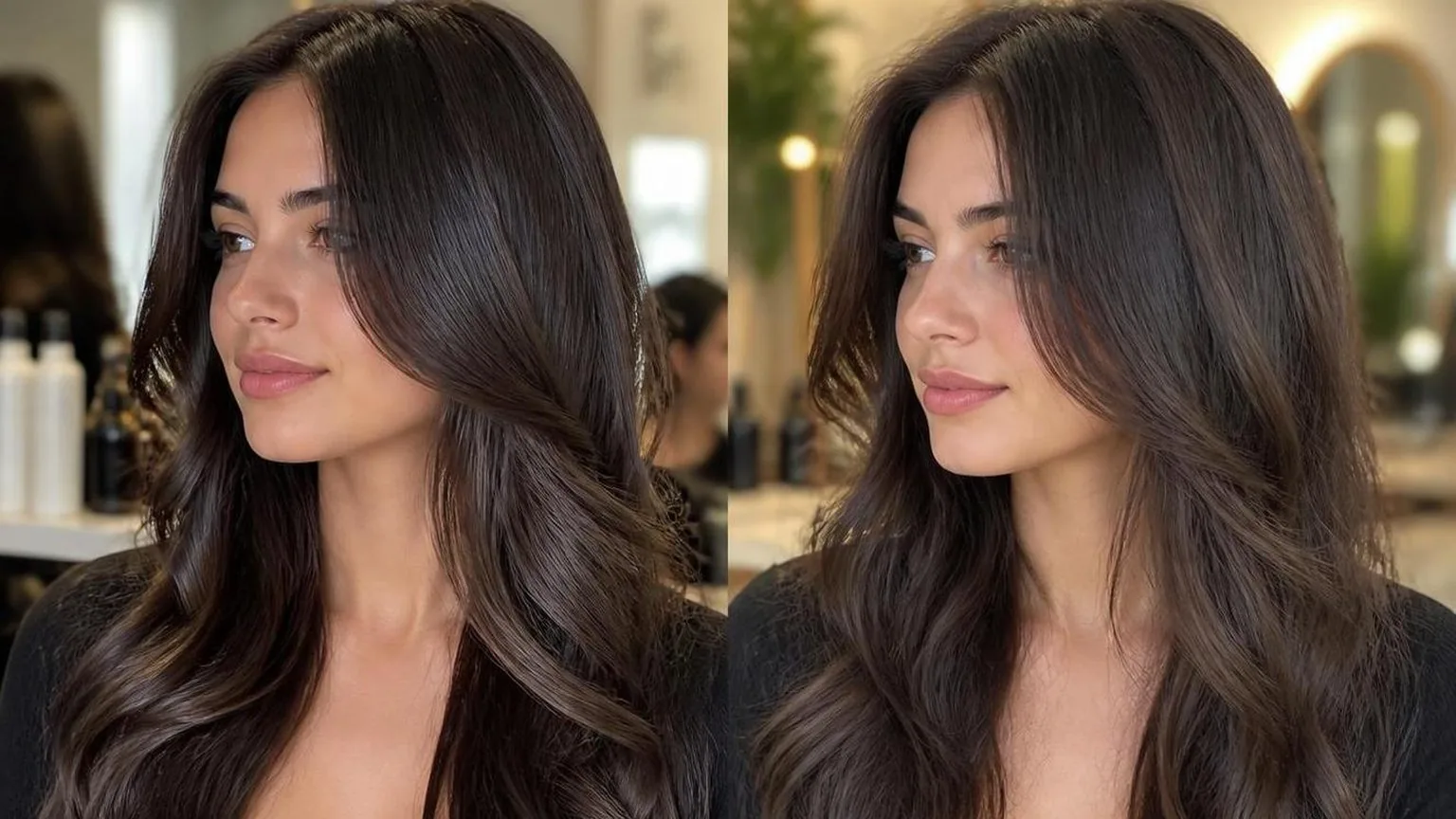
The Mechanism, Step by Step
The method changes the legal classification first, then the staffing and record burden. Charging for a glass, bundling it into a treatment price, or pouring it free can move the same 125 ml serve from low-risk hospitality to licensed activity.
The operational method changes risk exposure too. Beer or wine only, one drink during a service, and no takeaway usually narrows the compliance load. Spirits, open public access, and late trading widen it quickly.
| Variable | Change in method | Why the outcome changes |
| Payment | Separate charge for a 125 ml wine or 330 ml beer | A direct sale is usually licensable in the UK and commonly licensable in US states because money changes hands for alcohol. |
| Bundling | “Prosecco with every blowout” built into a higher service price | “Free” stops being free when alcohol is included in the consideration. Regulators can treat it as a sale by another route. |
| True no-charge service | One drink offered with no price link | In the UK, genuine free supply is not automatically a sale. In the US, many states still regulate complimentary service. |
| Drink type | Beer or wine only, no spirits | Some US salon exceptions are limited to beer and wine. Spirits usually trigger a full on-premises alcohol framework. |
| Where consumed | Consumed only in the salon chair area | On-premises consumption is easier to supervise. Takeaway or sealed containers can trigger extra retail rules. |
| Hours and event size | Single event, capped duration and attendance | In England and Wales, a Temporary Event Notice can cover up to 168 hours and up to 499 people, including staff. |
In England and Wales, the legal hinge is “sale by retail of alcohol.” A salon charging for alcohol normally needs authority under a premises licence, or a Temporary Event Notice for a short event.
A designated premises supervisor is typically required where alcohol is sold under a premises licence.
Method also changes training needs. Table service to booked clients is easier to control than a self-serve station. One staffed pour point limits over-service, keeps unopened stock secure, and supports age checks at the moment of service.
Layout matters. A fridge behind the reception desk changes access compared with an open cooler in the waiting area. Restricting stock to staff-only zones reduces casual pouring and makes stock reconciliation possible at the end of each shift.
Menu wording matters because regulators look at substance, not styling. “Complimentary” next to a service that rises by £5 or $10 is more likely to be treated as part of the sale than a genuinely optional no-charge pour.
- Use a fixed serve size, such as 125 ml wine or 330 ml beer, to control stock and service consistency.
- Limit service to clients during appointments, not walk-ins or companions, because the audience affects how “private” the offering looks.
- Check state, county, and city rules in the US. Salon alcohol exceptions, where they exist, are narrow and highly local.
Mistakes Worth Avoiding
No, salons do not automatically need an alcohol licence. The answer depends on where the salon operates, whether alcohol is sold or supplied, and whether it is included in a paid service, ticket, or package.
The biggest mistake is treating a “free” glass of fizz as legally risk-free. In many licensing systems, alcohol can still count as a sale or regulated supply if the cost is built into the appointment price.
Myth one: one small glass never matters. Volume does not usually decide the licensing question. A 125 ml glass, a 175 ml pour, or a single 330 ml beer can all trigger the same issue if alcohol is sold, included, or regularly supplied to clients.
Myth two: tipping avoids the rules. It usually does not. If clients are expected to pay extra, even indirectly, or the drink is linked to a booking, upgrade, membership, or event ticket, regulators may view that as licensable activity.
Myth three: staff can serve anything because it is a salon, not a bar. Premises type is less important than the activity. A blow dry bar, colour lounge, nail salon, or spa reception can all face the same licensing test.
| Scenario | Typical risk level | Why |
| Water, tea, coffee | Low | Non-alcoholic drinks are usually outside alcohol licensing rules. |
| One complimentary 125 ml glass, no charge, genuinely occasional | Medium | May still need review if used to promote services or bundled into price. |
| Fizz included with every blowout package | High | Regular inclusion suggests alcohol is part of the paid offer. |
| Wine at launch nights, client events, or ticketed masterclasses | High | Events often create a clearer link between payment, admission, and supply. |
Myth four: a private event is exempt. Often it is not. If a salon hosts 20 to 50 guests, serves prosecco, and promotes the event publicly or through ticketing, licensing rules can become stricter, not looser.
Myth five: delivery apps or retail rules are the same as in-salon service. They are not. Off-sales, on-premises drinking, and takeaway alcohol can sit under different permissions, hours, age-check duties, and display requirements.
- Check whether alcohol is sold, bundled, or simply offered with no payment link.
- Check local authority or state rules before serving a single alcoholic drink.
- Check permitted hours, age verification, and staff training expectations.
- Keep soft drinks prominent so hospitality does not depend on alcohol.
The practical rule is simple. If alcohol helps sell the service, package, or event, stop and verify the licence position first. That is cheaper than correcting a breach after trading has started.
Frequently Asked Questions
Do salons need an alcohol licence to serve wine or prosecco?
Often yes, but the rule depends on where the salon operates.
In many areas, selling alcohol or including it in a paid service package requires a premises or retail licence, while some places allow limited complimentary service under separate exemptions.
Is a licence still needed if the drink is free?
Sometimes. If alcohol is genuinely complimentary and not built into the service price, some local authorities treat it differently from a sale.
If the drink is advertised as part of a blowout, bridal package, or members’ event, regulators may view that as a licensable supply.
Who regulates alcohol service in a salon?
Usually a local licensing authority, city agency, council, or state alcohol control board oversees the rules.
The salon should check premises use, service hours, staff age requirements, and whether on-site consumption is permitted in a personal care business.
Can a salon owner use a restaurant or bar licence from next door?
No, not usually. Alcohol licences are commonly tied to a specific premises, operator, and approved activity. If drinks are served inside the salon footprint, the salon often needs its own approval or a formal extension covering that exact area.
What should salons check before offering drinks to clients?
Check local licensing rules, lease terms, business insurance, and any health department guidance on open beverages near workstations.
Then confirm whether staff can pour sealed single-serve drinks only, whether consumption must stay in reception, and whether private events change the licence requirement.
Can clients bring their own alcohol to a salon?
Allowing clients to bring alcohol can still create legal and insurance issues. Salons should check local licensing rules, lease terms, and public liability cover before permitting BYOB.
Do salons need permission for one-off events with alcohol?
A special launch, late opening, or private event may need a temporary alcohol permission. The salon should confirm requirements with the local licensing authority before advertising or serving drinks.
Can salon staff drink alcohol while serving clients?
Salon policies should make this clear. Staff who are working with clients or tools should usually avoid alcohol for safety and professionalism.
Do salons need insurance if they serve alcohol?
They should check their business insurance first. Some policies may exclude alcohol-related incidents unless the insurer has agreed to cover them.
Related Reading
- How blow dry stylists are paid: the three structures
- How booth rental works, and who it suits
- The types of salon insurance, and what each covers
- The blow dry bar business model, explained
- How salon memberships work, and when they backfire
- Insuring a stylist’s hands: what cover exists
- The complete guide to the blow dry bar business