
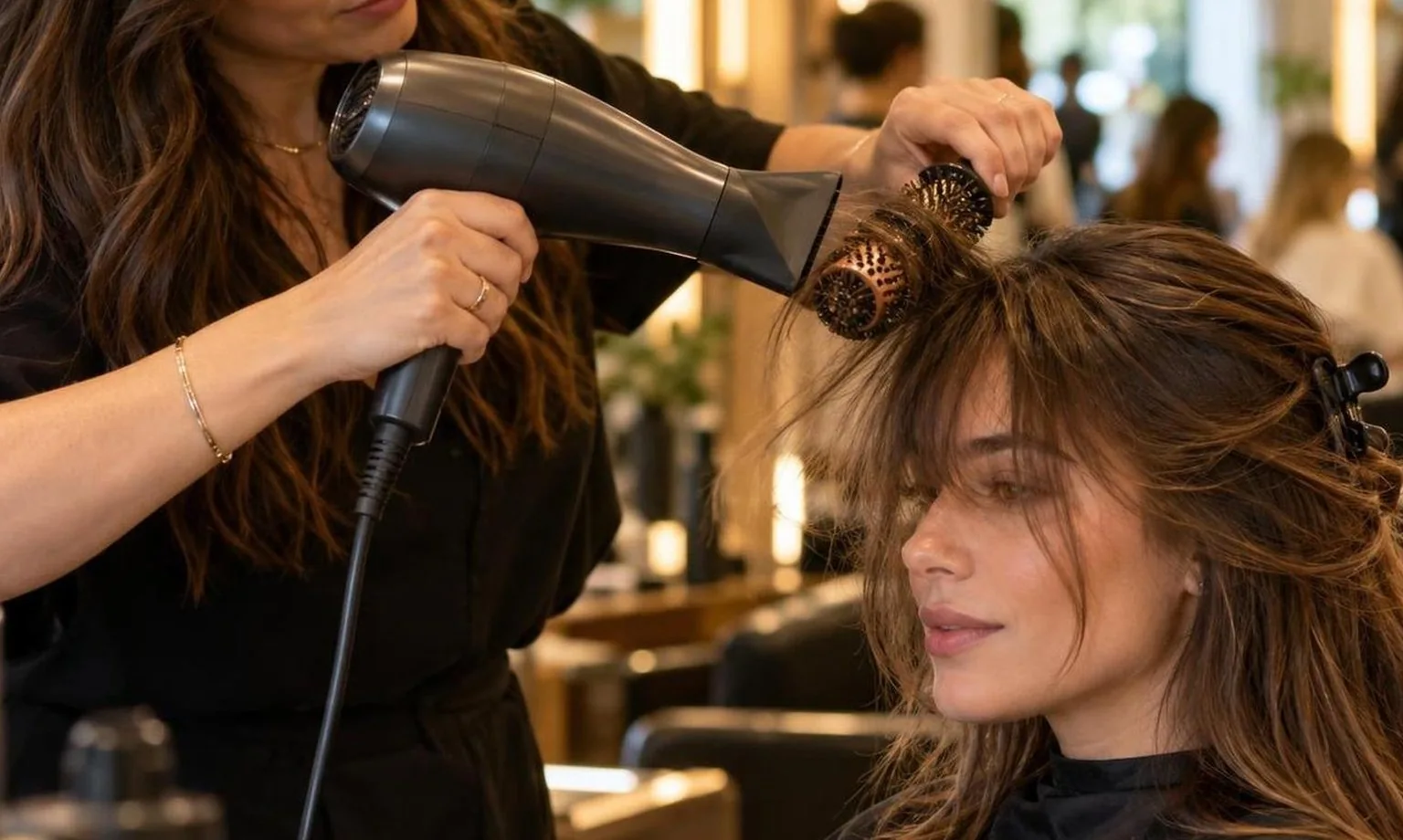
Brush damp fringe left, then right under downward airflow: that is how to blow dry bangs with a smooth finish and controlled volume.
Start with your bangs before drying the lengths, so the roots do not set into an awkward bend while you work elsewhere.
Use medium heat, a concentrator nozzle and a small paddle brush, keeping the dryer moving about 6 inches from your hair. Once the roots lie neatly, shape the ends to suit your cut.
This guide covers blunt, curtain and side-swept bangs, including finishing without excessive puffiness.
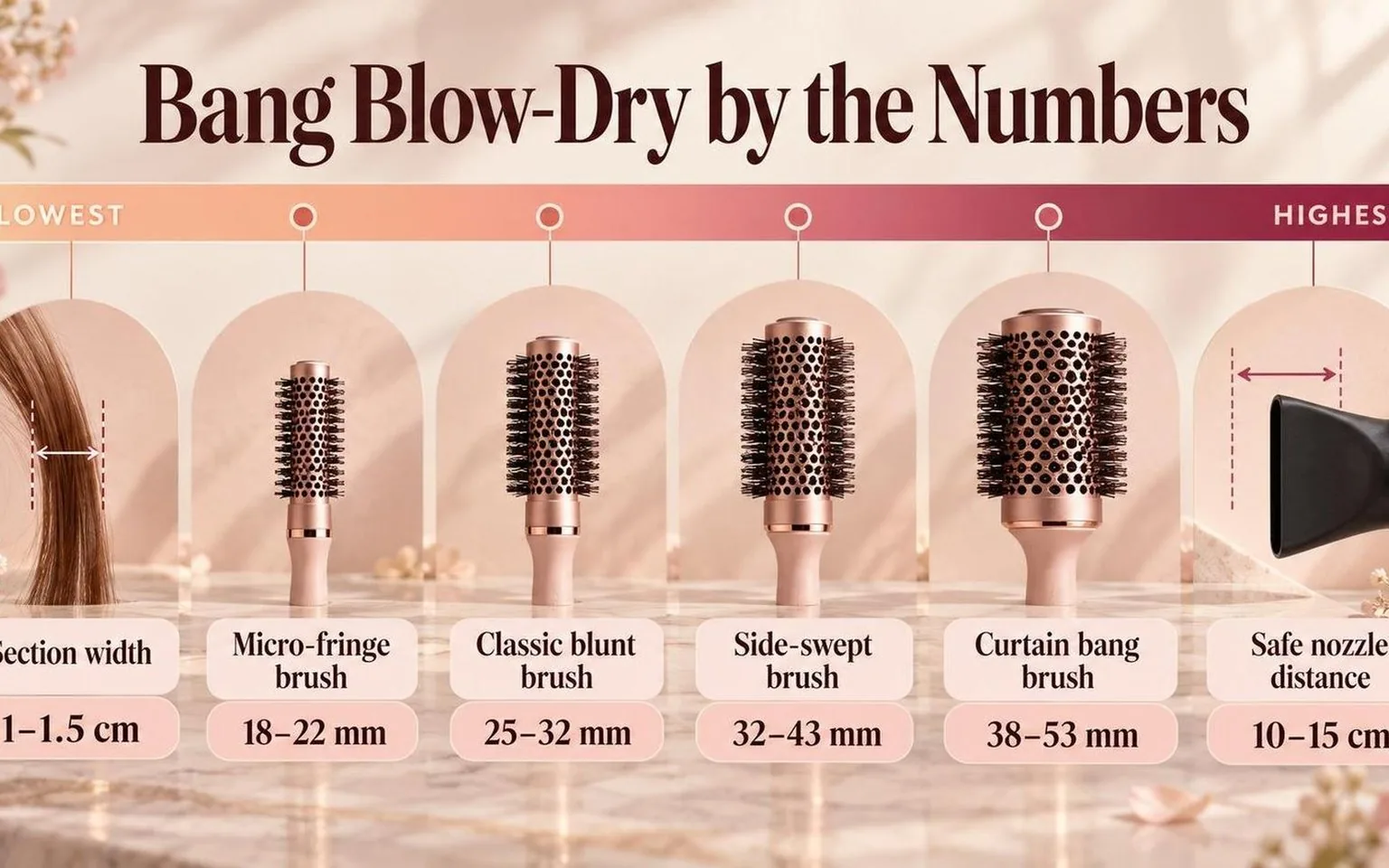
Map Your Bang Type to a Brush Size
The brush diameter you reach for determines whether bangs curl under, fly apart, or sit flat. Grab a ruler and your fringe before you plug in the dryer.
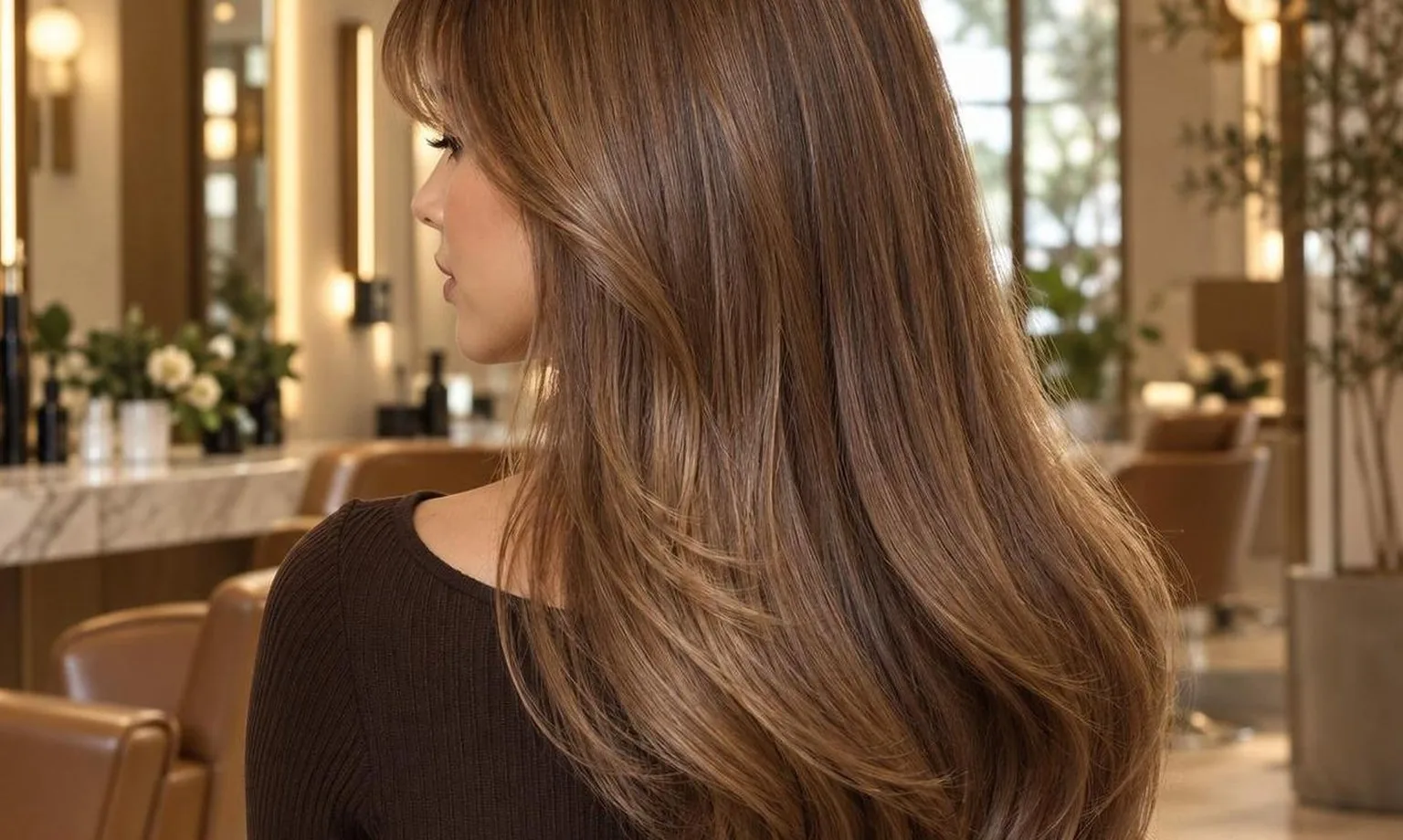
- Measure your bang length. Pull one centre section straight down from the root. Bangs shorter than 7 cm (roughly eyebrow-skimming) need a 25 mm round brush. Bangs between 7–12 cm (cheekbone length) work best on a 32 mm barrel. Curtain bangs longer than 12 cm call for a 43 mm brush to avoid over-curling.
- Check your bang density. Part your fringe from the rest of your hair and hold it between two fingers at the mid-shaft. If the gathered section is thinner than a pencil, you have fine-density bangs — use a boar-bristle brush for grip. If it matches or exceeds pencil width, switch to a mixed boar-and-nylon brush that moves through thicker hair without snagging.
- Identify your parting width. Measure the triangular section at the hairline that forms your fringe. A narrow triangle (under 5 cm at the forehead) produces a wispy bang that dries in roughly 90 seconds per pass. A wide triangle (5–8 cm) creates a full, blunt bang needing two or three directed passes at 80 °C on medium airflow.
Write down all three results — length, density, parting width — and keep them visible while you follow the steps below.
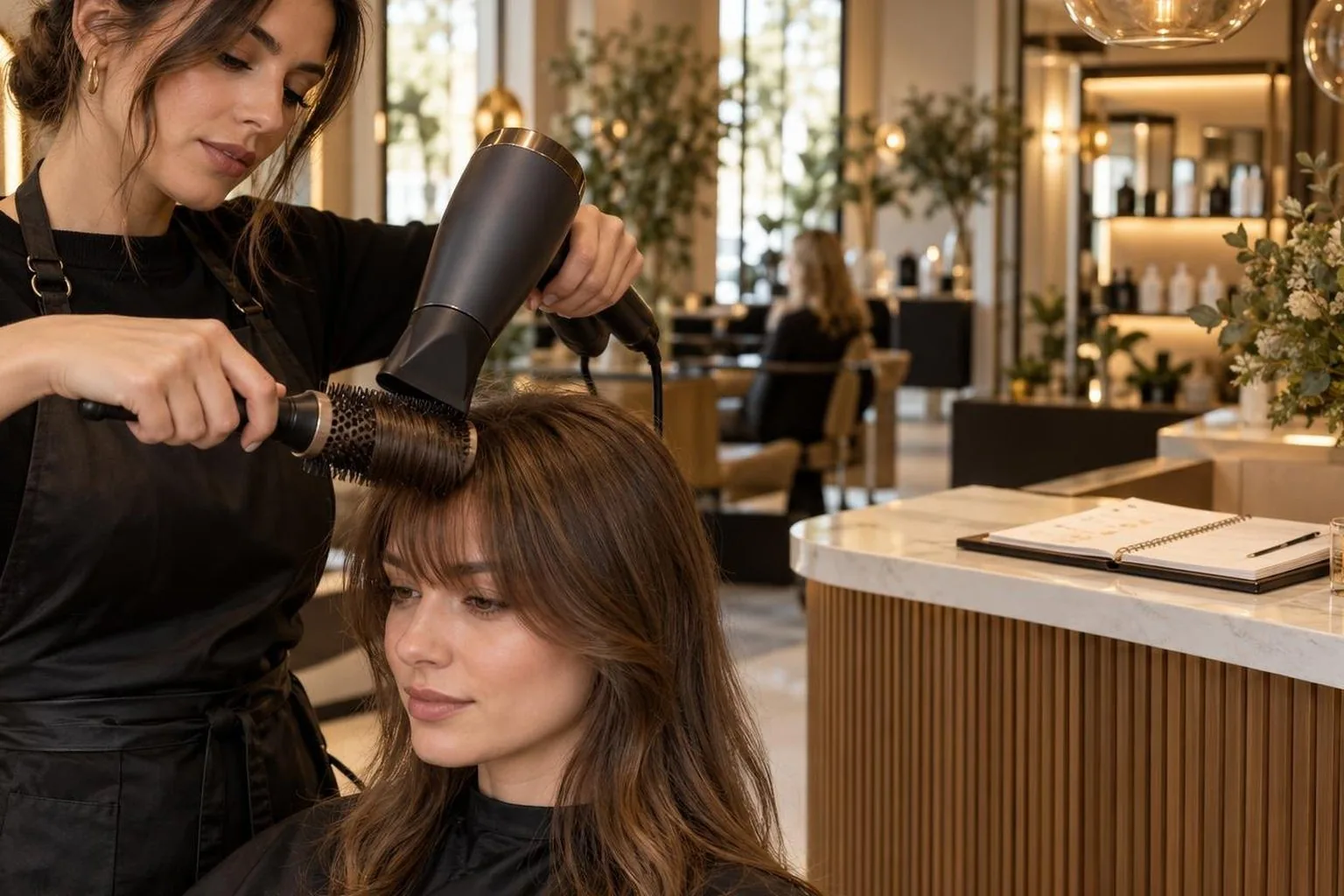
The Figures Behind It
Bangs occupy roughly 10–15% of total head surface area but demand disproportionate drying precision.
The shorter length, higher density per square centimetre, and proximity to facial oil glands make this section the most technique-sensitive zone on the entire head.
Human hair diameter ranges from 50 to 100 microns. Fringe sections typically contain 800–1,200 individual strands per square centimetre of scalp, compared to 600–900 strands in the crown region.
Temperature Thresholds
Hair protein begins to degrade at sustained exposure above 150°C (302°F). Most professional dryers output air between 80°C and 100°C at the nozzle. The critical variable is distance from nozzle to strand.
| Nozzle Distance | Approximate Hair-Surface Temperature | Risk Level |
| 2 cm | 95–110°C | High — cuticle lifting likely |
| 5 cm | 70–85°C | Moderate — acceptable for short passes |
| 10 cm | 50–65°C | Low — recommended working distance for bangs |
| 15 cm+ | 35–50°C | Minimal — slower drying, maximum safety |
Maintaining 10–15 cm between the concentrator nozzle and the fringe keeps the strand surface below the 80°C threshold where moisture loss accelerates and cuticle edges begin to lift.
Drying Time by Bang Type
Fringe style determines airflow direction, tension method, and total blow-dry duration. Thicker, longer curtain bangs require more passes than a wispy micro-fringe.
| Bang Style | Typical Length | Average Dry Time (Medium Density) | Recommended Brush Diameter |
| Micro-fringe | 2–4 cm | 60–90 seconds | 18–22 mm round |
| Classic blunt | 5–7 cm | 90–150 seconds | 25–32 mm round |
| Side-swept | 8–14 cm | 120–180 seconds | 32–43 mm round |
| Curtain bangs | 12–20 cm | 150–240 seconds | 38–53 mm round |
These figures assume a dryer operating at 1,800–2,200 watts with a narrow concentrator nozzle (width under 8 mm). Wider nozzles diffuse airflow and add 20–40% more drying time.
Section Width and Tension
Professional stylists typically sub-section bangs into 1–1.5 cm horizontal partings. Working with sections thicker than 2 cm traps moisture in the interior strands, creating frizz that becomes visible within 30–60 minutes.
- 1 cm sections — fastest smoothing, highest control, best for fine or resistant hair
- 1.5 cm sections — standard working width for most bang densities
- 2 cm+ sections — only viable on low-density, naturally straight hair
Airflow Speed
Most salon dryers offer two or three speed settings. Lower speed with higher heat is the standard approach for bangs, because excessive airflow velocity displaces short strands off the brush before the cuticle sets.
| Setting | Airflow Speed (approximate) | Best Use on Bangs |
| Low | 40–60 km/h | Smoothing, setting direction, finishing |
| Medium | 60–90 km/h | Initial moisture removal (70% dry stage) |
| High | 90–130 km/h | Not recommended for fringe work |
The cool-shot button drops output to ambient temperature, roughly 20–25°C. A 5–8 second cool blast after each section locks the hydrogen bonds into their new shape and adds measurable hold.
Brush Contact Time
Each pass of the round brush through the bang section should last 3–5 seconds. Holding heat on a stationary section longer than 7 seconds concentrates thermal energy and risks moisture damage, even at moderate dryer temperatures.
Counting passes matters. Most stylists report 4–6 full passes per sub-section to achieve a smooth, directional finish. That places total brush-contact time for an entire fringe at roughly 60–120 seconds across all partings.
Where the Difference Comes From
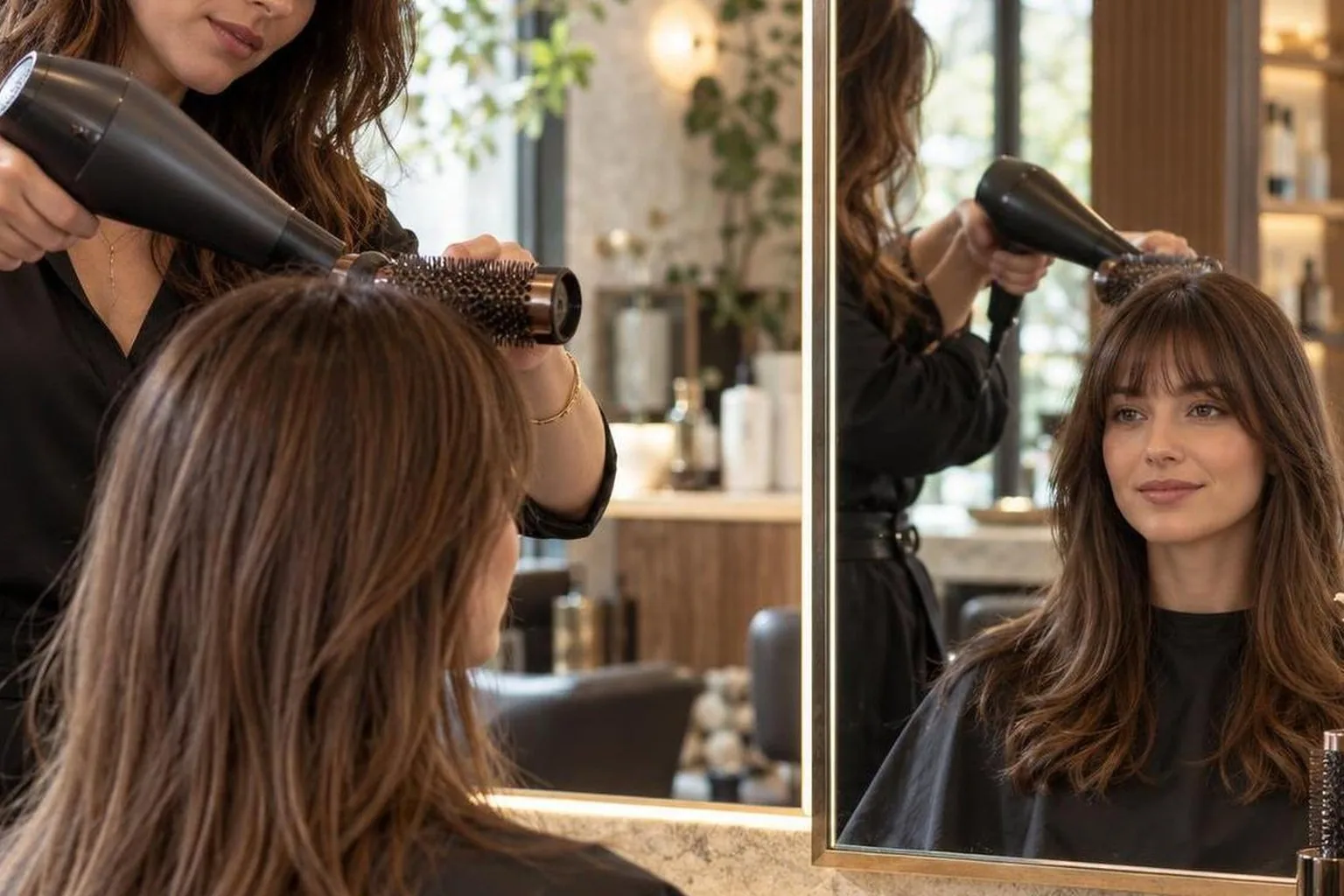
The difference between bangs that sit flat and bangs that hold shape comes down to three controllable variables: airflow direction relative to the hair shaft, tension applied during drying, and the thermal window in which hydrogen bonds reset.
Manage all three and the style holds for two to three days.
Hydrogen Bonds and the Thermal Window
Wet hair contains broken hydrogen bonds between keratin chains. These bonds reform as moisture leaves the cortex.
A blow dryer accelerates that process by raising the hair’s surface temperature to between 60 °C and 80 °C, the range where water evaporates efficiently without degrading the cuticle.
Locking bangs into a new shape requires holding them under tension until they cool below roughly 40 °C. Releasing the brush too early lets bonds reform in their natural fall pattern, undoing the work.
Airflow Direction
Pointing the nozzle downward along the shaft smooths the cuticle layer, which sits at roughly a 5° angle from the cortex. Directing air against that grain lifts individual scales, producing frizz and reducing shine.
For bangs specifically, the angle matters more than raw heat.
A concentrator nozzle narrows the airstream to approximately 8–12 mm. This lets you isolate a section of bangs without disturbing surrounding hair or the parting.
Without it, the diffused airflow hits a radius of 80–100 mm, making precision impossible on fringe sections that may be only 40–50 mm deep.
Tension and Brush Diameter
Tension stretches wet hair along the brush barrel, forcing hydrogen bonds to set in an elongated position. The barrel diameter dictates the degree of curve once the hair cools and releases.
| Brush Diameter | Result on Bangs | Best Suited For |
| 25 mm (1 in) | Tight inward curl, strong volume at root | Short, blunt-cut bangs above brow line |
| 32 mm (1.25 in) | Moderate bend, soft C-shape | Mid-length curtain bangs |
| 43 mm (1.7 in) | Gentle sweep, minimal curl | Long side-swept or Bardot-style bangs |
Using too small a barrel on longer bangs creates an over-curled, dated look. Too large a barrel on short bangs fails to generate enough bend to clear the eyebrow line.
Section Size and Drying Speed
Thinner sections dry faster, allowing bonds to set more uniformly. Most bangs benefit from being split into two horizontal layers — a lower section roughly 1 cm deep and the remaining upper section.
Dry the lower layer first, rolling it under and holding for 8–10 seconds on medium heat (approximately 70 °C at the nozzle).
Then over-direct the upper layer by lifting it 90° from the forehead and applying heat at the root for 6–8 seconds before rolling the mid-lengths and ends around the brush.
The Cool-Shot Lock
Switching to the cool-shot button drops airflow temperature to ambient (roughly 20–25 °C). Holding cool air on each section for 5–7 seconds after heat application accelerates the final bond-setting stage.
Skipping this step can reduce style longevity by up to half, according to trichology-informed styling frameworks used in professional training curricula.
Root Direction Override
Bangs tend to split along a natural growth pattern, often a cowlick or whorl near the front hairline.
Over-directing the root area — drying bangs in the opposite direction of the cowlick first, then reversing — neutralises that default parting.
This cross-directional technique requires roughly 15 seconds per direction at medium heat to override the growth pattern effectively.
How to Judge It on Real Hair
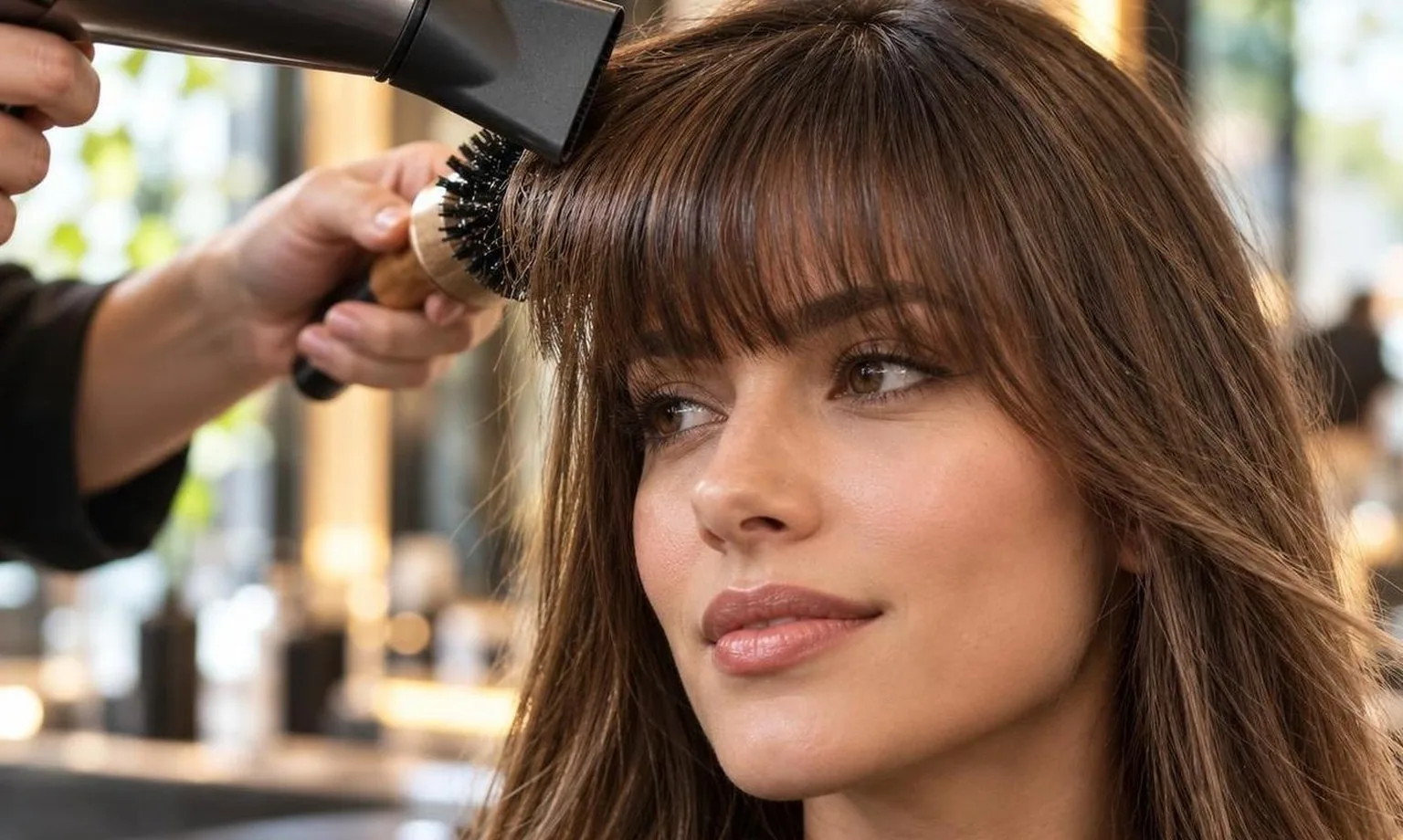
Judging a bang blowout on real hair means evaluating root lift, surface smoothness, and how the ends sit against the forehead. These three markers separate a finished result from a half-done dry.
Assess them in sequence, starting at the root and working to the tips.
Root Lift and Direction
Lift the finished bang section from underneath with a tail comb. At the root area, you should see approximately 35–45 degrees of lift from the scalp on a standard side-swept bang.
For curtain bangs, each side panel should angle away from the centre parting at roughly 30 degrees, creating a visible opening at the forehead. Flat roots signal insufficient tension during the drying phase.
Run your fingertip along the root line. Properly directed roots feel firm and spring back when pressed. Roots that collapse under light finger pressure were either dried at too low a heat or released from the brush before they cooled.
Surface Smoothness
Hold a single sheet of white paper behind the bang section under direct overhead light. This backlighting reveals flyaways, frizz halos, and any roughness in the cuticle layer that overhead salon lighting alone can miss.
A well-executed blowout shows a uniform light reflection — sometimes called a “band of shine” — running parallel to the hair strand. If reflection is patchy or scattered, the cuticle was not fully sealed during styling.
| Surface Indicator | Pass | Fail |
| Flyaways visible at 30 cm distance | Fewer than 3–4 strands | 5 or more strands |
| Shine band continuity | Unbroken across 80% of the section | Broken or absent |
| Cuticle feel (finger slide root to tip) | Smooth, no catching | Rough, snagging sensation |
End Behaviour
The ends of bangs reveal technique flaws fastest. On a blunt fringe, the cut line should sit evenly without individual strands kicking left or right. Uneven ends typically mean the round brush was rotated inconsistently during the final pass.
For side-swept bangs, the longest pieces should curve gently away from the face in a single arc.
If shorter interior layers flip outward while longer pieces bend inward, the brush diameter was likely too small — switch from a 25 mm to a 33 mm barrel.
The 10-Minute Hold Test
After finishing, leave the bangs untouched for 10 minutes without product, touching, or tucking behind the ear. This idle window reveals true hold versus temporary set.
After 10 minutes, check three things: root lift retention, end placement, and overall shape. If the bang drops more than 15 degrees from its styled position, the section was likely under-dried or released from the brush before a full cool-down.
| Assessment Point | Acceptable Range | Corrective Action |
| Root lift loss after 10 min | Less than 15 degrees | Re-dry roots with 7–8 seconds of heat, then 5 seconds cool shot |
| End shift from styled position | Less than 1 cm of drift | Re-wrap ends on brush, apply cool shot for 4–5 seconds |
| Frizz emergence | No new flyaways | Reduce dryer temperature by one setting; increase tension on brush |
Client-Facing Check
Hand the client a mirror and ask them to look straight ahead, then turn 45 degrees to each side. Bangs must read correctly from the front and at three-quarter angles.
A bang that only works head-on was styled with the nozzle aimed too directly forward.
Photograph the result from directly in front at eye level, roughly 60 cm away. This distance and angle replicate how bangs appear in everyday conversation and is the truest benchmark of a successful blowout.
What the Other Routes Give You
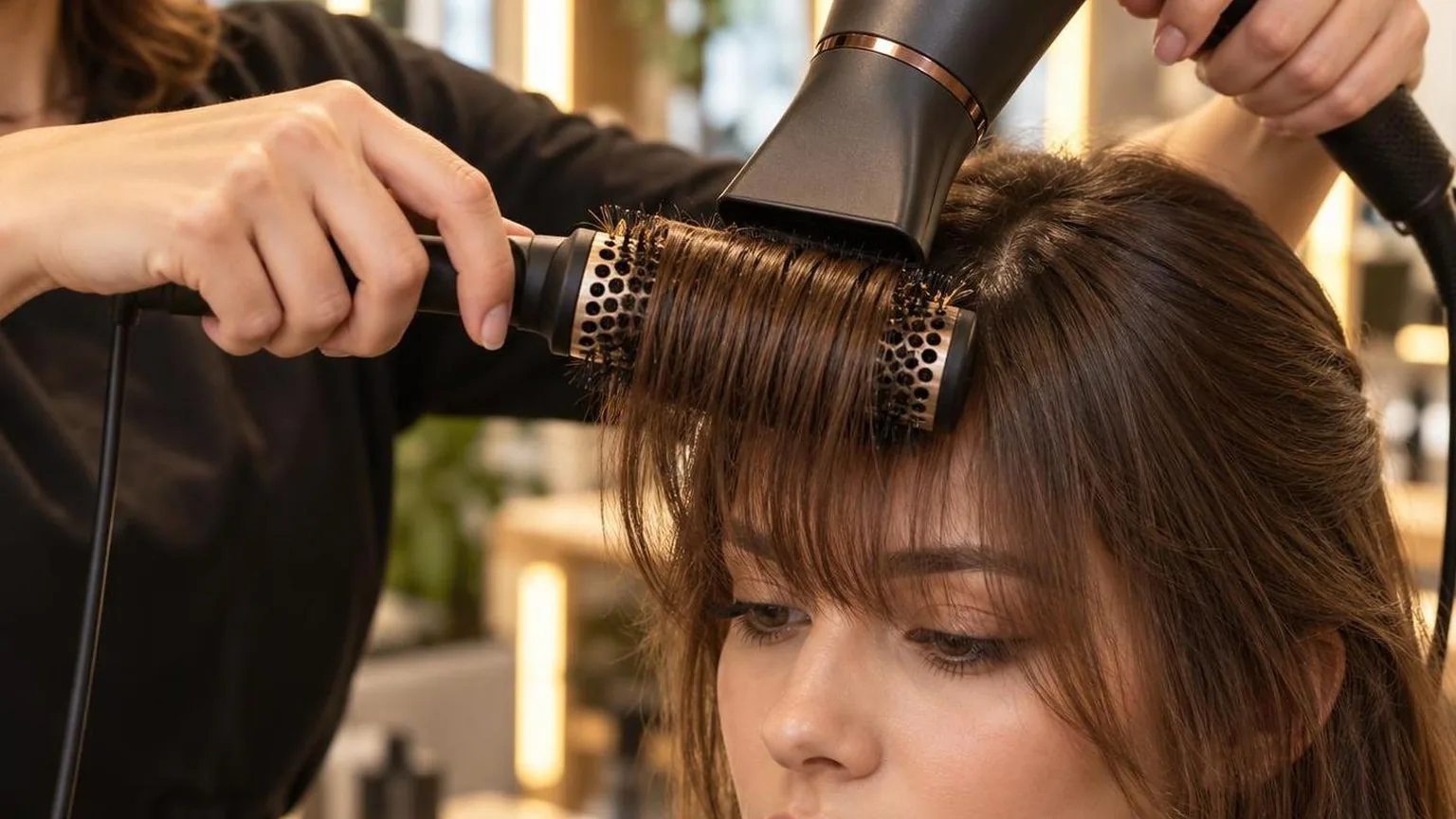
Beyond the round-brush-and-dryer method, bangs can be set with velcro rollers, flat irons, or air-drying techniques.
Each route trades off speed, volume, and hold differently, and the right pick depends on your bang type, hair texture, and how long you need the style to last.
Velcro Rollers
Rollers between 1.5 and 2 inches in diameter suit most side-swept and curtain bangs. Wrap damp bangs around the roller, secure at the root, and blast with a dryer on medium heat (roughly 150 °F at the nozzle) for 60–90 seconds per section.
Leave rollers in place for 10–15 minutes after removing heat. This cool-set phase locks the curl pattern into the cortex.
Skipping it cuts hold time by roughly half, according to repeated stylist consensus across training curricula from major professional brands.
The roller route produces soft, bouncy volume with minimal frizz. It works best on fine to medium hair.
Coarse or very thick bangs may not grip the velcro surface well enough, requiring pin-secured rollers or a light mist of working spray before wrapping.
Flat Iron
A 1-inch or 0.75-inch flat iron set between 300 °F and 350 °F can curve bangs by feeding hair through the plates with a slight wrist rotation. One slow pass at roughly 1 inch per second is the target speed to avoid heat damage.
Flat-ironed bangs tend to look sleeker and flatter than blown-dry bangs. Volume at the root is minimal unless you lift at the base before clamping.
The finish lasts well in humidity but can read heavy on fine hair if plates wider than 1 inch are used.
Always apply a heat protectant rated for the temperature you are using. Silicone-based protectants coat the cuticle and reduce friction between the plates and the hair strand, lowering the risk of surface damage from repeated passes.
Air Drying
Pin bangs in the desired direction while damp, using flat metal clips every 1.5 inches along the section. Leave clips in until hair is fully dry — typically 25–45 minutes depending on density.
Removing clips early introduces frizz and undefined movement.
Air-dried bangs produce a natural, low-volume finish. The technique suits thick, straight bangs (blunt cuts) better than layered or wispy styles, which need directed airflow to separate and shape individual pieces.
Comparison at a Glance
| Method | Active Time | Total Time | Volume Level | Hold (no product) | Best Bang Type |
| Round brush + dryer | 3–5 min | 5–7 min | High | 4–6 hrs | All types |
| Velcro rollers | 2–3 min | 15–20 min | Medium-high | 3–5 hrs | Side-swept, curtain |
| Flat iron | 2–3 min | 2–3 min | Low | 5–8 hrs | Blunt, micro bangs |
| Air dry + clips | 2 min | 25–45 min | Low | 2–4 hrs | Thick, blunt |
Key Takeaway for Stylists
Recommend the round-brush blow dry as the default for clients seeking volume and versatility. Suggest velcro rollers for clients who multitask during their morning routine. Reserve the flat iron for clients who prioritise sleekness over body.
Air drying is the lowest-damage option but offers the least control.
It works as a rest-day method between heat-styling sessions, helping clients stay within the widely recommended guideline of limiting direct heat exposure to three or fewer sessions per week.
Matching the method to the client’s bang cut, texture, and lifestyle reduces restyle requests and builds trust in your technical recommendation. The table above gives a quick reference to share during consultations.
Frequently Asked Questions
What nozzle size works best for blow drying bangs?
Use a concentrator nozzle between 60–75 mm wide. The narrow opening — typically 8–10 mm — channels airflow precisely across the fringe section without disturbing surrounding hair.
Wider nozzles scatter heat and make it harder to control direction on such a small working area.
Which direction should you aim the airflow when drying bangs?
Direct air downward at a 45-degree angle, following the hair shaft from root to tip. This closes the cuticle layer and reduces frizz.
Pointing airflow upward or straight on lifts the cuticle, creating a rough texture that makes bangs look puffy rather than smooth.
How do you prevent a centre split when blow drying bangs?
While hair is still 80% wet, overdirect the fringe to the opposite side of its natural part using a 25 mm round brush. Hold for 8–10 seconds under medium heat. Then sweep it back to the intended fall.
This neutralises the root’s growth pattern.
What temperature setting should you use for bangs?
Set the dryer between 60–70 °C (140–158 °F) on medium speed. Bangs are typically finer and shorter than the rest of the hair, so they dry faster and are more vulnerable to heat damage.
Finish with a 5-second blast of cool air to lock the shape in place.
Should bangs be blow dried first or last in a full blowout?
Dry bangs first. They contain the least moisture and begin air-drying the moment you start working on other sections.
If bangs set with an uncontrolled air-dry pattern, reshaping them requires fully re-wetting the roots, which adds 3–5 minutes to total service time.
Related Reading
- Blow drying fine hair for volume that holds
- What the cool shot button actually does
- Root volume that survives the first hour
- Blow drying thick hair faster without cutting corners
- Diffusing curls without breaking the pattern
- How to blow dry your hair at home, step by step
- Round brush diameter, by hair length
- Blow drying curly hair straight without wrecking it
- Refreshing a blowout on day three without water
- The complete guide to blow drying technique
- NIH PubMed — National Library of Medicine Search Portal
- SBA — Small Business Administration, Health and Beauty Industry Guide
- University of Southern California — Viterbi Engineering, Heat Transfer Fundamentals
- Annals of Dermatology (PubMed Central) — Hair Weathering and Cosmetic Procedures
- International Journal of Trichology (PubMed Central)
- Cosmetologists Chicago — America's Beauty Show Professional Education
- Professional Beauty Association
- Dyson — Airflow and Heat Science, Engineering Pages