
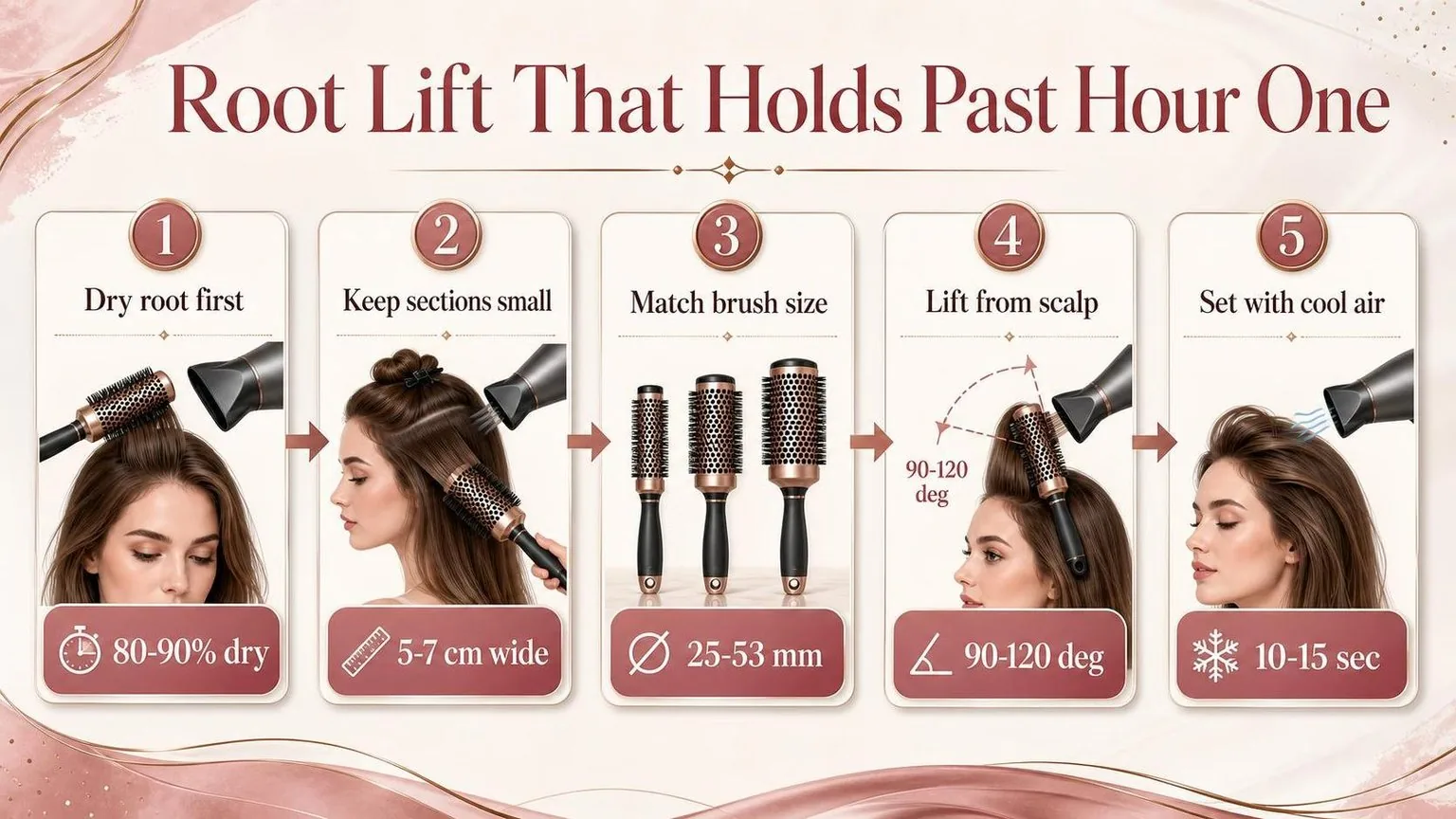
Root volume that survives the first hour comes from drying the root zone 100% dry at 90–110°C, lifting each section 90 degrees, then cooling it for 10 seconds before release.
A 25–33 mm round brush gives short layers lift without over-bending the ends.
Moist roots collapse first because hydrogen bonds reset while warm. Work in 2–3 cm sections, direct airflow against the fall, and pin the crown for 5 minutes.
The finish should feel firm at the base, mobile through the mid-lengths, and dry to the touch before brushing out.
Map Your Lift Window
Work out where your root volume collapses. Check brush size, section size and heat before you change products. The first hour usually exposes one weak point: too much moisture left, too much width at the root, or too little cooling time.
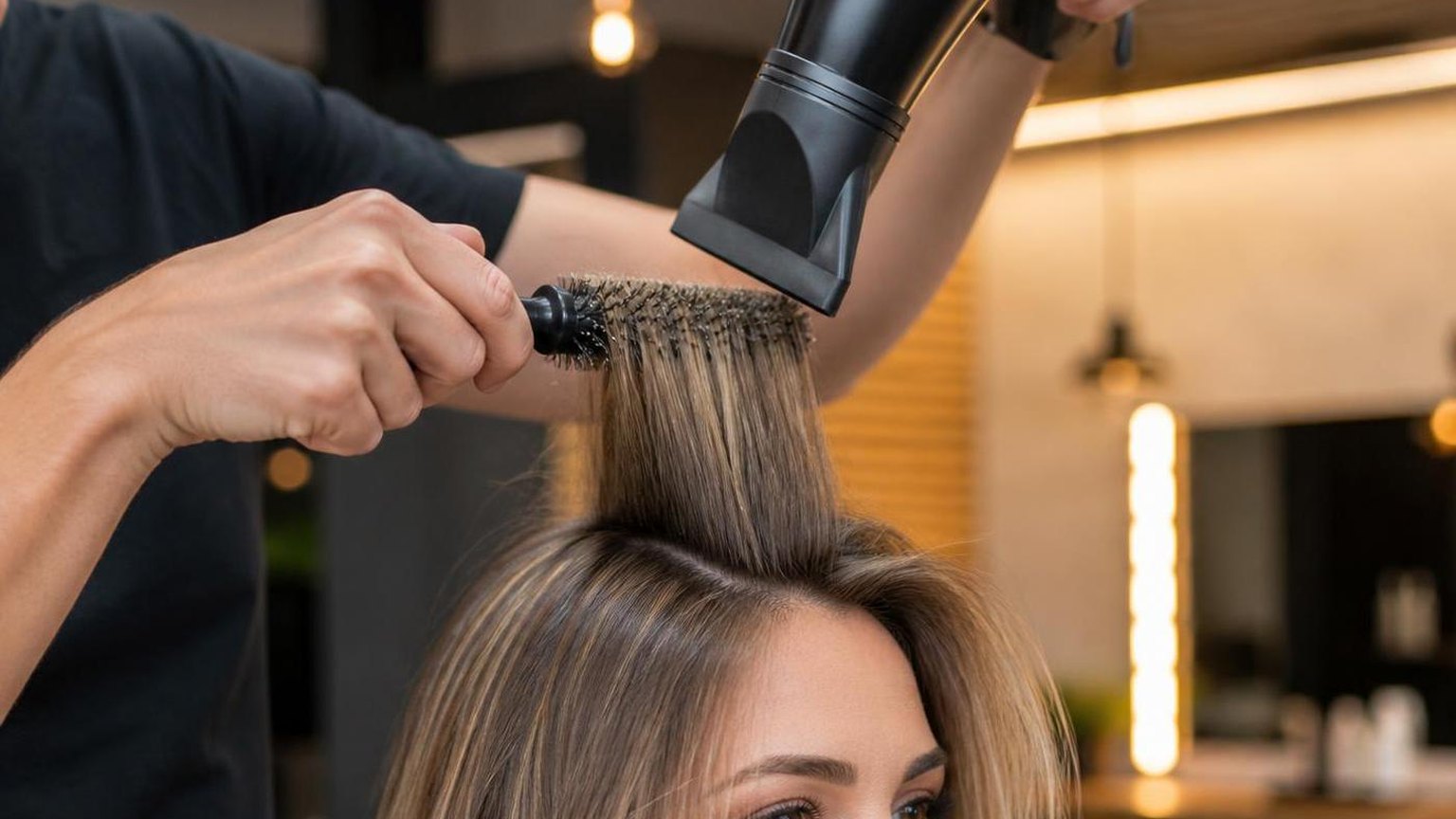
Use one front-crown section and one temple section. Each should be 5-7 cm wide and no deeper than 3 cm. Dry each to about 80-90% before the brush goes in. Then compare your own result against the table.
Now read the failure pattern. Flat root within 15 minutes usually means the section was too wet or too wide. Lift at the crown but not the hairline usually means the brush barrel was too large.
Root hold with fluffy lengths usually means airflow was high but tension was low.
Write down the exact combo that lasts 60 minutes: brush diameter, section width, heat time and cooling time. That is your starting protocol for the rest of the service.
What the Numbers Actually Say
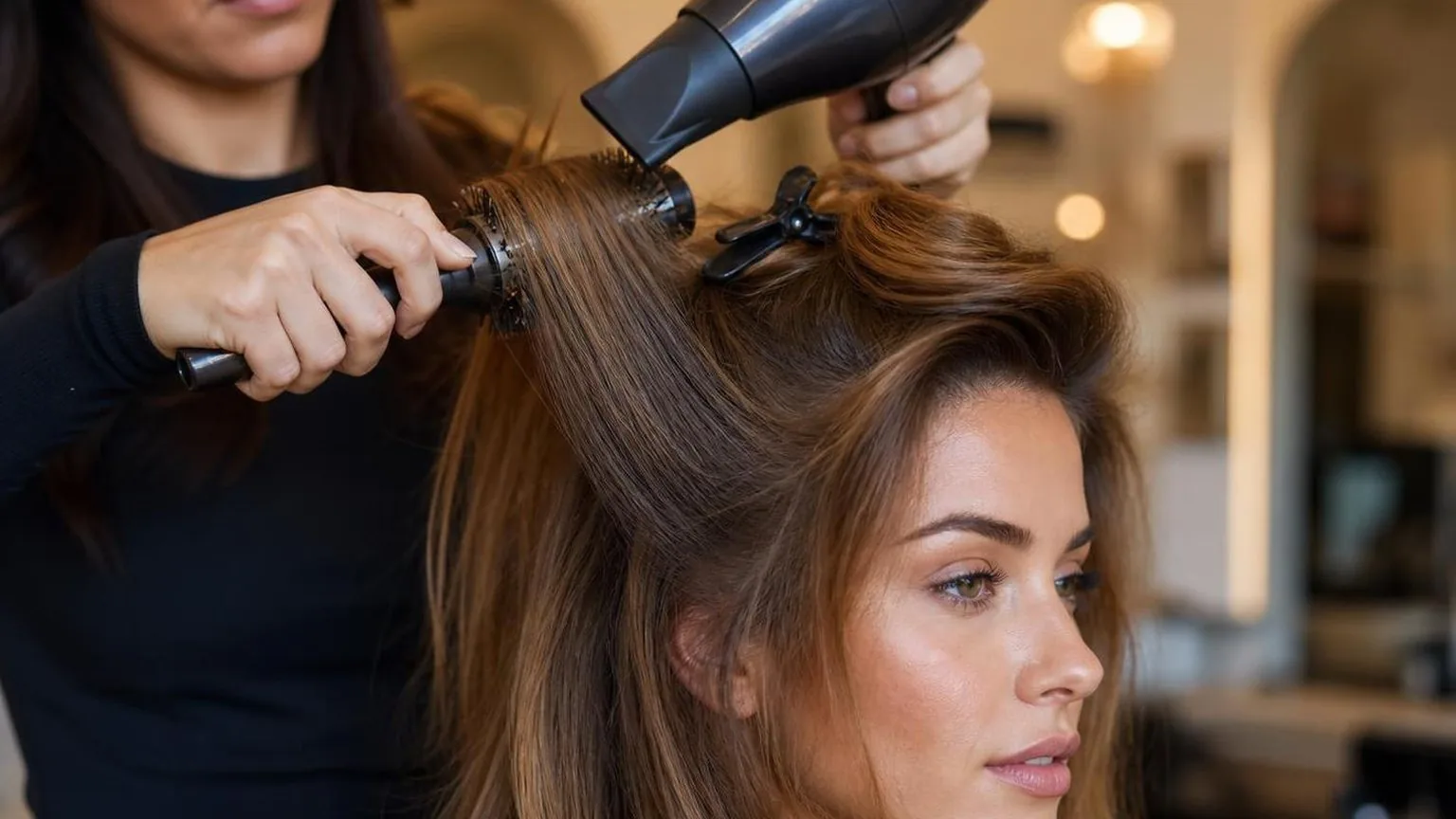
Root volume lasts when the root is dried, lifted, and cooled before ambient moisture can relax the set. In practice, the first-hour drop usually comes from too much residual water at the crown, oversized sections, or heat without a cooling phase.
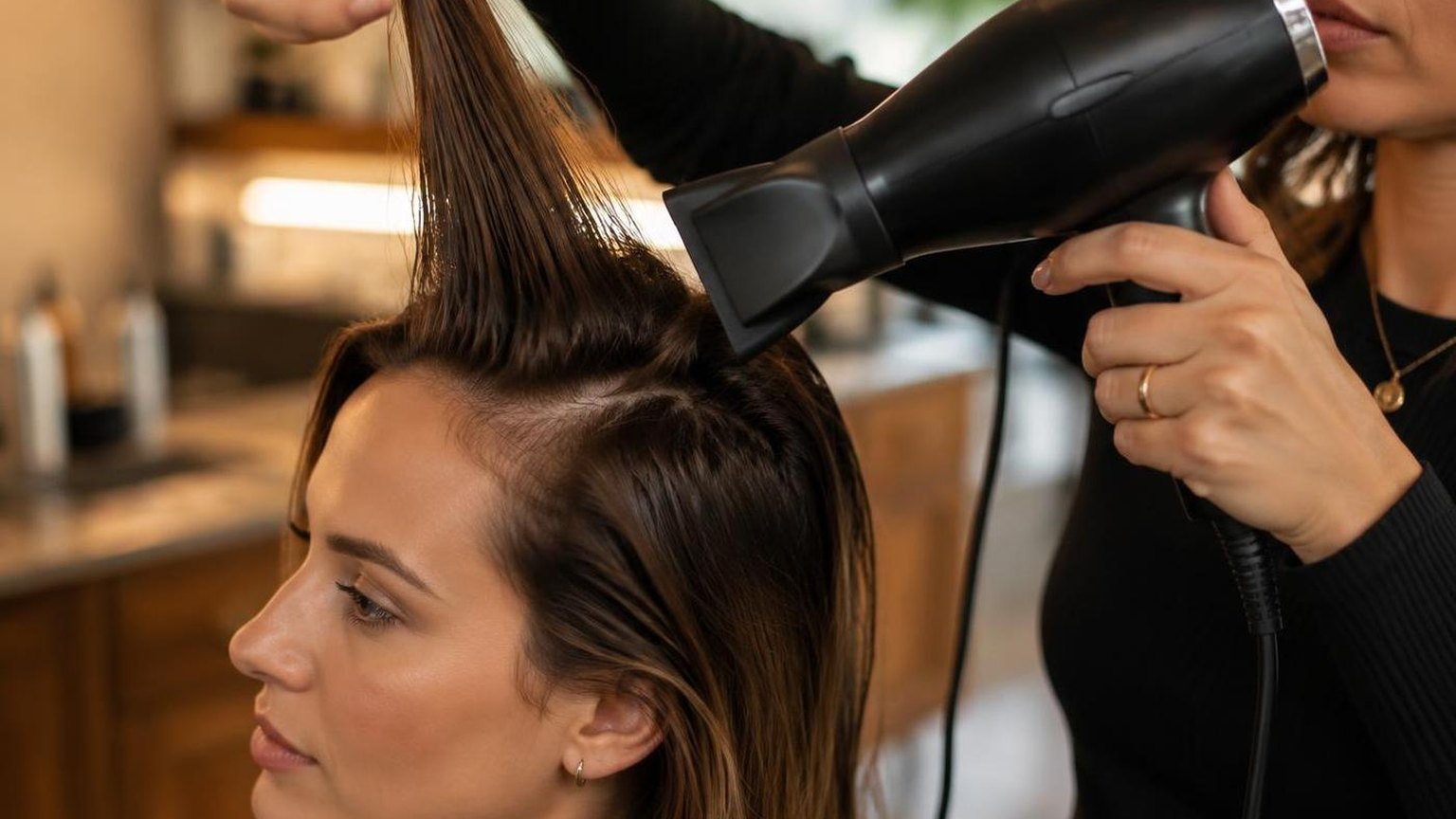
Hair shape is held largely by hydrogen bonds. Water breaks them, heat and tension help rearrange them, and cooling locks the new shape more firmly. That is why a bouncy root can collapse fast in steam, mist, or a humid salon doorway.
The key number is not maximum dryer heat. It is dryness at the root. If the crown is only partly dry when you switch from rough-drying to a round brush, the style often expands nicely for minutes, then sinks as trapped moisture finishes evaporating.
| Metric | Working number | Why it matters |
| Hair before round-brush work | About 80% to 90% dry | Leaves enough moisture for reshaping without hidden dampness at the root |
| Section width | About 1 to 2 inches | Smaller sections let air reach the base evenly |
| Round-brush barrel | 25 to 35 mm for shorter layers, 43 to 53 mm for longer hair | Smaller barrels create more lift; larger barrels stretch and smooth |
| Nozzle distance | About 1 to 2 inches from the brush | Closer airflow concentrates heat and tension at the root |
| Cool-shot time per section | 5 to 10 seconds minimum | Cooling reduces immediate post-dry drop |
| Pinning time, if used | 5 to 15 minutes | Lets the bend cool fully in a lifted position |
Section size is the fastest fix. A 3-inch section may look efficient, but it often dries on the surface first. The center and root stay damp. A 1-inch to 2-inch section gives better airflow penetration and more even tension from scalp to mid-length.
Brush diameter changes the root result. A 25 mm to 35 mm barrel lifts harder because it bends the base more sharply. A 53 mm barrel smooths and creates a looser bend, which suits long layers but usually gives less crown height.
Distance matters because air cools as it travels. Keep the concentrator about 1 to 2 inches from the brush, direct airflow from root to ends, and overdirect the section opposite its natural fall.
That builds lift at the anchor point, not only through the lengths.
The cool shot is not optional. Keratin is a poor heat conductor, so the outside can feel dry while the interior is still warm. Hold the brush in position, cool for at least 5 to 10 seconds, then release. That step is what helps the first hour hold.
- Dry the root first, not the ends first.
- Reduce section width before increasing heat.
- Use the smallest barrel that still gives polish.
- Cool each section before it drops.
The Levers You Control
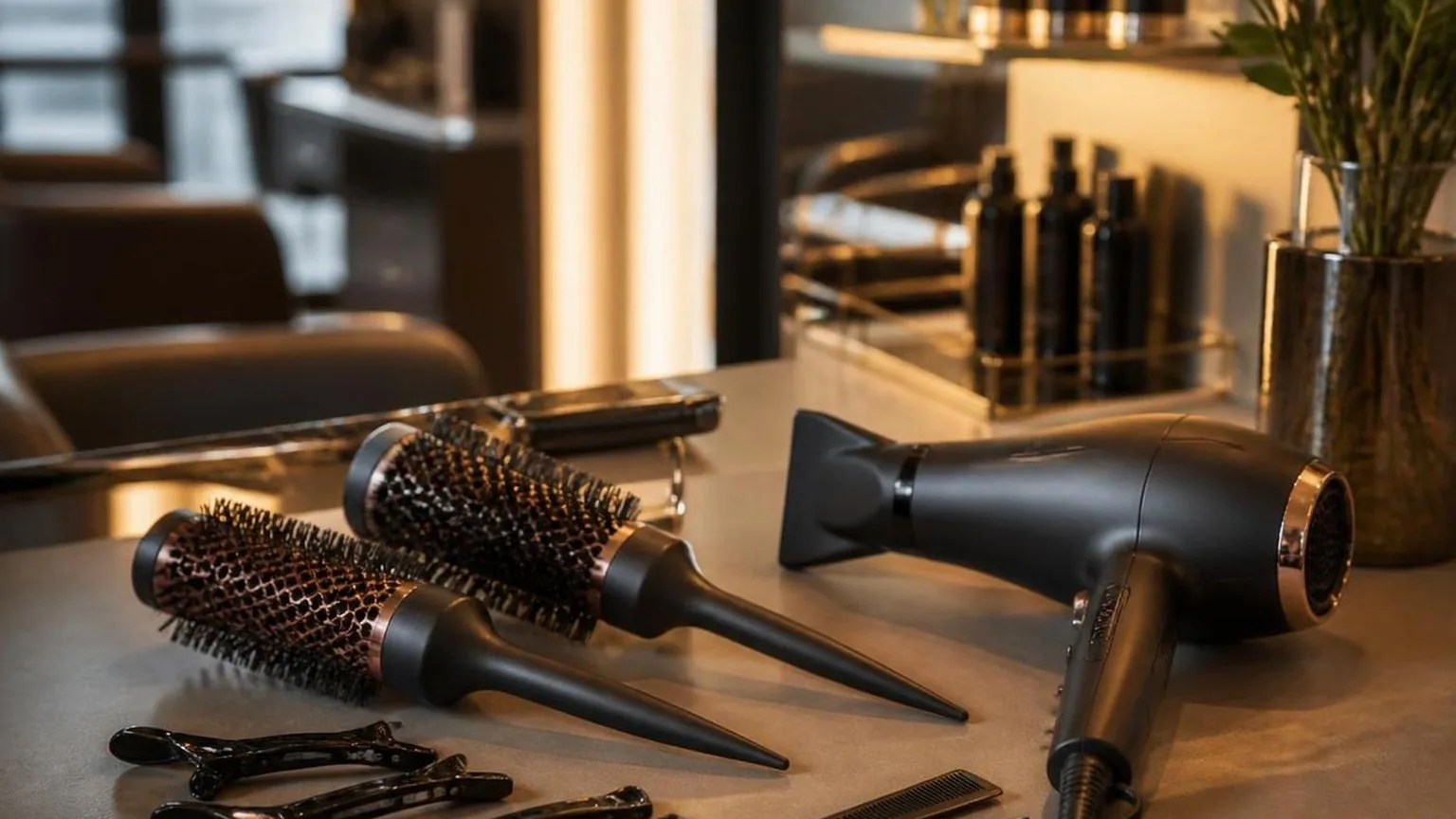
Root volume that lasts past the first hour comes from three controls: moisture, tension, and cooling. If the root is still damp, stretched flat, or released warm, lift drops fast.
Change those three variables first, then fine-tune section size and product load.
The root must reach a near-dry state before shape setting. In salon practice, the most reliable window is hair that feels about 80 to 90 percent dry before the round brush goes in at the crown.
| Variable | Working target | Why it changes hold |
| Pre-dry level | 80 to 90% dry | Too wet softens the root and delays set |
| Section width | No wider than the brush barrel | Oversized sections lose tension and heat evenly |
| Section depth | 2 to 4 cm | Deep sections trap moisture near the scalp area |
| Elevation | 90 degrees or slightly overdirected | Lift starts at the angle you dry |
| Nozzle distance | 1 to 2 cm from the brush | Close airflow concentrates heat at the root |
| Cool set | 5 to 10 seconds per section | Cooling fixes hydrogen bonds in the lifted position |
Brush size alters the shape. A 25 to 35 mm round brush gives more root bend at shorter lengths. A 43 to 55 mm brush smooths more but creates a softer rise, best on bobs and longer layers.
Section size matters as much as brush size. If the section is wider than the barrel, the edges dry without enough wrap. That leaves the root polished but flat.
Air direction changes the result within one pass. Keep the nozzle aimed from roots to ends, following the brush. Side-blasting roughs the cuticle and knocks the root away from the brush tension.
Product load is another common failure point. Heavy creams and oils at the first 5 cm can collapse lift. Use the smallest effective amount at the root, then put smoothing product from mid-lengths to ends.
- Clip each crown section up to cool fully if the hair is resistant.
- Use rollers around 50 to 60 mm on medium to long hair when you need extra memory.
- At the hairline, reduce product and section depth. Fine baby hairs overload fast.
- If the root drops first, lower moisture and increase cooling before adding more product.
The first hour exposes weak setting, not weak styling. Dry the root almost fully, lift it higher than the finished shape, then cool it before release. That sequence gives volume a better chance of surviving movement, humidity, and head turning.
What a Good Result Looks Like
Judge root volume by what stays lifted after heat, movement, and cooling, not by the first mirror check.
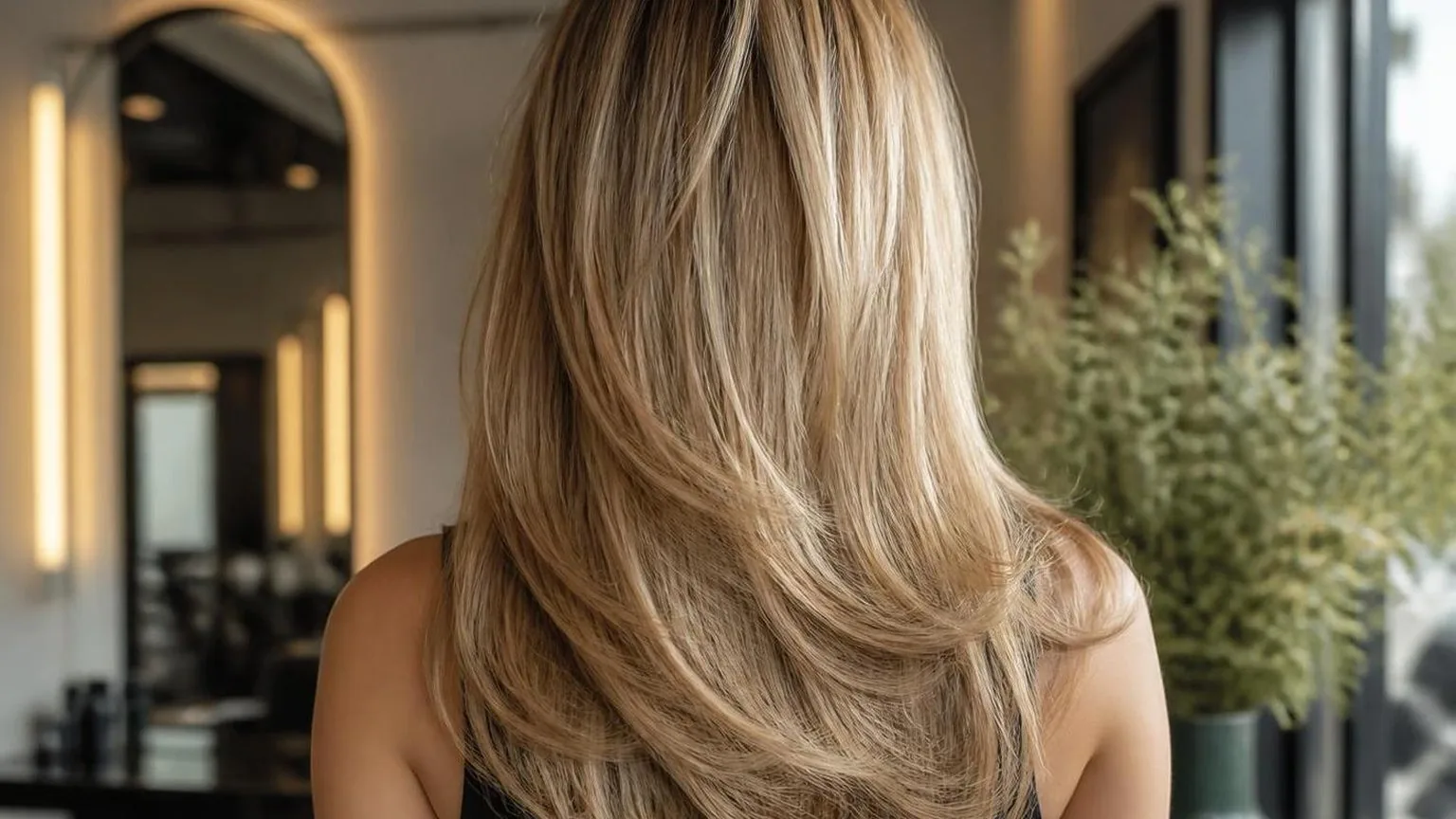
On real hair, a workable result keeps visible elevation at the crown and front hairline after 45 to 60 minutes without turning rough, sticky, or collapsed at the roots.
Start with dry hair. Residual moisture at the root softens hydrogen bonds and gives a false lift that drops fast once the client walks outside or warms up under studio lights.
Check the prep before you score the result. A root section wider than the brush barrel spreads tension too thin. For most blowouts, keep root sections at 1 to 1.5 inches wide and about 0.5 inch deep.
Tool size changes the standard. A 1.25-inch to 1.5-inch round brush usually gives the most reliable root bend on short to medium lengths. Barrels above 2 inches polish well but often reduce grip at the first inch from the scalp.
Heat matters at the root. Fine hair usually holds better with moderate airflow and plate or barrel contact around 140 to 175°F.
Medium to coarse hair often needs about 175 to 210°F, followed by a full cool shot until the section feels room temperature.
| Checkpoint | What to look for | Pass mark |
| Immediately after cooling | Root stands off scalp without spray support | About 0.5 to 1 inch visible lift at crown |
| After 15 minutes | Lift survives head turns and light finger rake | Loses less than one-third of starting height |
| After 60 minutes | Shape still reads as intentional volume | At least 0.25 to 0.5 inch lift remains |
Measure at three zones, not one. Test the front hairline, the apex, and the crown. Hair can hold at the crown yet flatten at the hairline, especially when the section was overdirected but not cooled in place.
Use touch as well as sight. Good root volume feels springy and dry. If the root feels tacky, overly soft, or crunchy, the finish may be product-heavy and less likely to survive the first hour.
- Ask the client to lower and raise the chin three times. Weak root set drops first during this movement.
- Run a wide-tooth comb through the top once. Durable volume should reopen with a light shake.
- Check both profile and straight-on views. Flatness hides from the front.
Score the result against the hair’s natural density and growth pattern. A strong cowlick or very dense root can still pass if lift remains even, controlled, and clean after one hour, rather than perfectly high at minute one.
How the Choices Stack Up
For root volume that lasts past the first hour, a directed blow-dry with lift at the base outperforms quick fixes that only roughen the surface.
It gives shape from heat-set tension, then locks it in as hair cools, which is why the crown stays higher after commuting, brushing, or pulling on a collar.
The trade-off is time and technique. Faster options can create instant fullness, but most fade sooner because they rely on friction, product residue, or temporary backcombing instead of a clean set at the root.
| Method | Typical tool size or setting | Working time | Why it holds or drops |
| Round-brush blow-dry | Medium round brush, 35-45 mm; dryer on medium to high airflow | 8-15 minutes on dry or mostly dry hair | Lift comes from tension at the root, then cooling in shape |
| Velcro rollers | 50-70 mm rollers | 10-20 minutes including cool-down | Strong at the crown if hair is warm first; drops faster in humidity |
| Hot rollers | Medium to large rollers, commonly 38-50 mm | 10-15 minutes set time | Good bend and lift, but less precise root direction than a brush |
| Root clips only | Section clips at the base | 3-10 minutes after drying | Adds elevation while cooling, but cannot create tension already missed |
| Teasing | Fine-tooth comb | 2-5 minutes | Fast height, but collapses once the cushion softens or is brushed |
| Texture powder | Light dusting at the root | Under 2 minutes | Instant grip, but often turns flat when overworked by hands |
A round-brush blowout wins on control. You can overdirect each section 90 degrees to 135 degrees from its fall, then cool it fully before moving on. That matters more than raw heat. Hair set hot but released warm drops quickly.
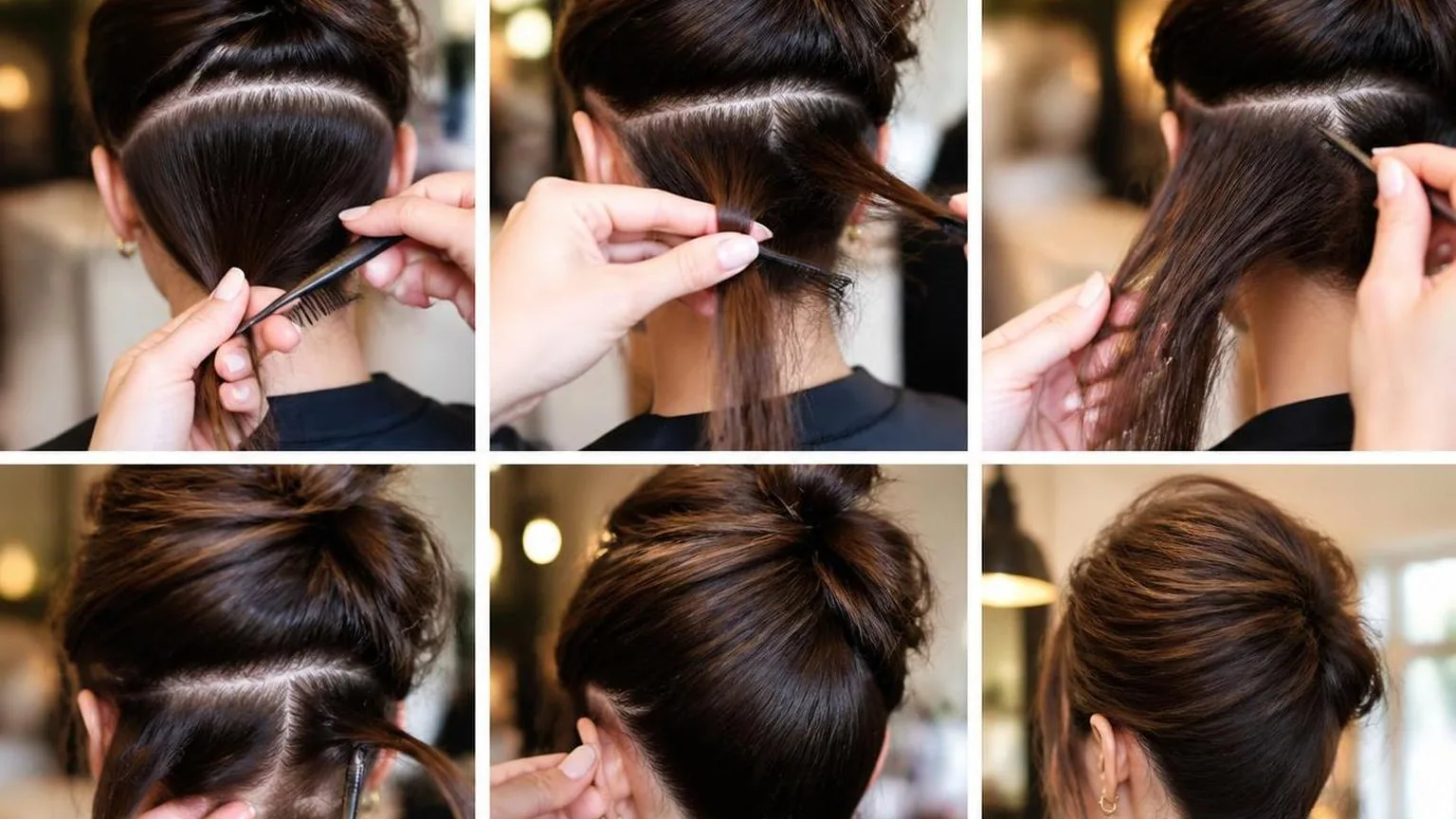
Velcro rollers come closest when speed matters in the salon. Use them on sections no wider than the roller. A 60 mm roller on a narrow mohawk panel gives cleaner lift than one oversized section wrapped loosely.
Hot rollers help on resistant hair because the heat is consistent, but they are less exact at the hairline and crown. They build bend through the mid-lengths well. They do not always place lift exactly where growth patterns fight you.
- Choose a blow-dry when the client wants movement plus polished root elevation.
- Choose rollers when the blowout is already smooth and you need extra crown height.
- Choose powder or teasing only for short-term editorial fullness or quick refresh work.
If the goal is volume that survives the first hour, the best alternative is not a different product. It is a better set: smaller sections, firmer root tension, and a full cool-down before hands touch the hair.
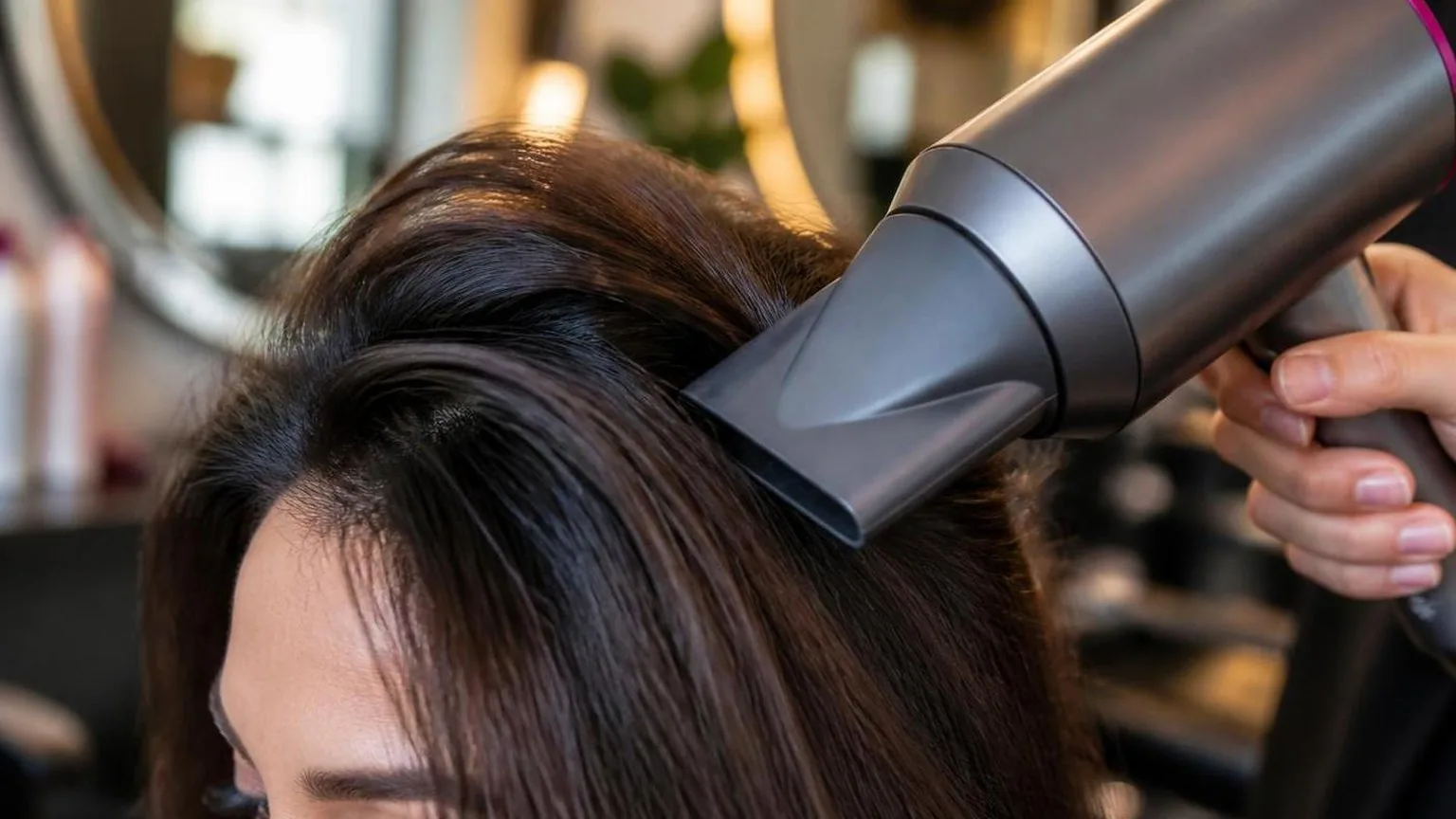
Keeping Condition Through the Dry
Root volume lasts when heat is high enough to reset hydrogen bonds, tension is firm enough to lift the base, and the hair cools in that lifted shape. Push any one too far and the root drops, the mid-lengths roughen, or the ends dry out.
Use controlled heat, short contact time, and a brush size that matches the section. The goal is lift at the first 2 to 4 cm from the scalp, not baking the entire strand.
Hydrogen bonds in hair shift with water and heat, then lock back in place as the hair cools. That is why a root needs both airflow and a cool-down. If the section is still warm when released, the lift softens fast.
Work with sections no wider than the barrel and no thicker than 2.5 cm. Smaller sections heat evenly, dry faster, and need less repeated brushing. Reworking the same root three or four times creates more surface wear than one precise pass.
| Variable | Working range | Why it helps volume last |
| Nozzle distance | 2 to 5 cm from brush | Keeps airflow concentrated at the root without blasting the section apart |
| Root elevation | 90 to 135 degrees from the head | Builds height at the base before the mid-lengths are polished |
| Brush dwell at root | 6 to 10 seconds per pass | Sets the root zone without over-drying the ends |
| Cool shot | 3 to 5 seconds | Helps the lifted shape hold after release |
| Section thickness | Up to 2.5 cm | Allows full drying and even tension |
Brush size matters. A 25 to 35 mm round brush gives more root bend and tension on short to medium lengths. A 43 to 53 mm brush smooths faster on longer hair, but it can flatten fine roots if the section is too wide.
Tension should feel steady, not aggressive. You need enough pull to keep the cuticle aligned while the nozzle tracks from roots to ends. If the bristles snag or the hair stretches visibly, reduce tension and lower the heat.
| Hair type | Tool heat target | Best brush direction |
| Fine or fragile-feeling | Low to medium, about 60 to 80 C airflow | Overdirect forward, then roll back at the root |
| Medium density | Medium, about 80 to 95 C airflow | Lift straight up, then turn half a rotation |
| Coarse or resistant | Medium-high, about 95 to 110 C airflow | Lift up and away, keep the nozzle tight to the brush |
- Dry roots to about 80 to 90 percent before round-brush work. Damp roots collapse faster.
- Keep the nozzle parallel to the hair shaft. Side-on airflow roughs the surface and weakens shine.
- Let each section cool completely before touching or backcombing. Warm hair forgets its shape.
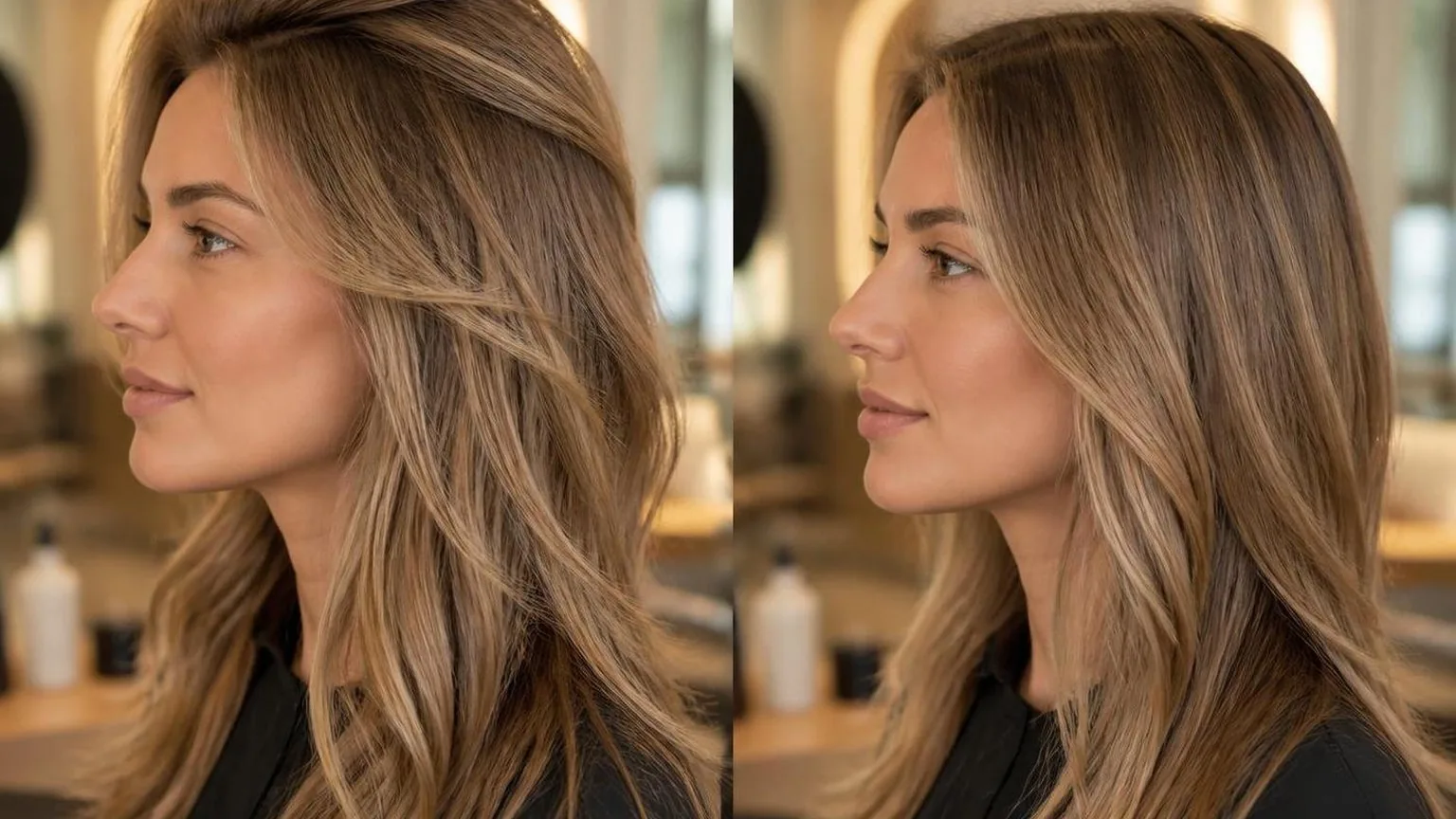
Why the Technique Works
Root volume that lasts through the first hour comes from changing heat placement, moisture level, tension, and cooling time at the root. The method does not create more hair.
It alters how the first 2 to 4 cm dries, stretches, and sets against gravity.
The root fails early when the surface smooths before the base is dry. A nozzle held 5 cm closer raises surface temperature and airflow impact at the top layer, which can seal and flatten the cuticle while moisture remains underneath.
| Variable | Less stable setting | More stable setting | Why outcome changes |
| Nozzle distance | 4 to 6 cm | 8 to 12 cm | Closer distance concentrates heat and pushes hair flat before the root fully dries |
| Section width | 7 to 10 cm | 3 to 5 cm | Smaller sections let airflow reach the base instead of drying only the outer layer |
| Root lift angle | 15 to 30 degrees | 90 to 135 degrees | Higher elevation dries the root in the lifted position rather than in its natural fall |
| Brush dwell | 1 to 2 passes | 6 to 10 seconds per subsection | Longer controlled tension stretches the base until moisture leaves the root area |
| Cool-shot time | 0 to 2 seconds | 5 to 10 seconds | Cooling fixes hydrogen bonds after shaping, reducing early drop |
Section size changes the result because roots dry slowly inside dense hair. A 3 to 5 cm subsection exposes the scalp-adjacent area to moving air. A 7 cm or wider section often dries polished on top while staying damp at the base.
Elevation changes memory. Lifting the section to 90 degrees or higher shifts the drying angle at the root. If the hair is dried at 15 to 30 degrees from the head, it keeps a flatter bend and drops faster once ambient moisture reaches it.
Tension must stay at the root, not only the mid-lengths. A round brush in the 33 to 43 mm range gives enough curvature to direct lift without forcing a tight curl. Oversized barrels can smooth well but often under-direct short root lengths.
Heat level matters because the root area is fine and dries first. Medium to high heat, followed by a 5 to 10 second cool shot, sets shape more cleanly than prolonged maximum heat. Excess heat can smooth the surface too early and collapse the base.
- Dry roots to roughly 80 to 90 percent before polishing lengths.
- Keep the concentrator parallel to the hair shaft, not pointed straight into the scalp area.
- Hold each lifted subsection until fully cool before dropping it.
- Let the last pass be airflow and tension, not extra product.
The first hour exposes weak setting fast. Any remaining root moisture, low elevation, oversized sections, or skipped cooling allows the base to relax.
The method works by drying the root completely in an elevated shape, then locking that shape in place.
Where It Usually Goes Wrong
Root lift fails in the first hour when the base is set too wet, too hot, or in the wrong direction. The common myth is that more product or more heat equals more height. In practice, clean sections, tension, and a full cool-down hold better.
Big hair starts with small sections. If the subsection is wider than the brush barrel, the root stays damp while the mid-lengths overheat. That leaves a soft base that drops fast, especially around the crown and front hairline.
| Mistake or myth | What to do instead | Why it holds longer |
| Drying roots from soaking wet | Pre-dry to about 80 to 90 percent | Less steam at the base, faster setting |
| Using the largest brush at the root | Use a 25 to 35 mm round brush for short to medium layers | Smaller barrel creates more bend at the base |
| One oversized section | Keep sections about 2 to 5 cm wide | Air reaches the root evenly |
| Maximum heat on fine hair | Use medium heat, roughly 80 to 105 C, then cool shot | Shape sets without collapsing from over-softening |
| Spraying hairspray after the style drops | Apply a light root spray before drying | Support is built into the set, not layered on top |
Another myth is that you must lift every section straight up. Overdirecting the front and crown to 90 degrees can look full for 10 minutes, then split and fall. For most blowouts, elevate the section about 45 to 90 degrees, following the head shape.
Heat misuse is the fastest route to flat roots. The nozzle should point from roots to ends, not across the cuticle. Keep the dryer about 2 to 5 cm from the brush. Parked heat at the base creates frizz and a limp reset.
Cool-down is not optional. Stylists from Sam Villa Education and ghd Education routinely teach that hair must cool in shape to hold shape. Leave each brush-set section to cool for about 10 to 20 seconds, or pin it until fully cool.
- Do not chase volume with dry shampoo before the blow-dry. It can roughen the root and reduce brush grip.
- Do not backcomb fresh blowouts at the scalp line. Cushioning the root this way often breaks the smooth set.
- Do not skip direction changes. At the crown, alternate left, right, and back for a balanced base.
The last myth is that finishing spray fixes poor prep. If the root was not dried smooth and set cool, extra spray adds stiffness, not structure. Lasting volume comes from section size, barrel choice, airflow direction, and cooling time.
Frequently Asked Questions
Why does root lift collapse within the first hour?
Roots drop fast when they dry flat, stay warm after styling, or carry too much product. Set lift at 90 degrees from the scalp, dry the first 2 inches fully, then cool each section for 10 to 15 seconds so hydrogen bonds reset in the raised shape.
What section size holds root volume best during a blowout?
Use clean sections about 2 inches wide and no deeper than the barrel diameter. On a 43 to 55 mm round brush, oversized sections stay damp at the base, so the root stretches but does not set.
Which products help roots stay up without turning sticky or heavy?
Apply a light root lift spray or mousse only at the first 1 to 2 inches of hair, then comb through once. Start small, because excess resin or oil at the base adds weight and makes volume separate within an hour.
What dryer settings keep volume at the root instead of blasting it flat?
Use medium to high airflow with moderate heat, around 60 to 80C at the hair, not the hottest setting pressed against the scalp. Aim the nozzle along the brush from roots to mid-lengths, then finish each lifted section with a cool shot.
Which brush gives the most durable root volume for short, medium, and long hair?
Match barrel size to length and tension. Use 25 to 35 mm for short hair and fringes, 35 to 45 mm for bobs and shoulder lengths, and 45 to 55 mm for longer hair, because too large a barrel cannot grip the root tightly enough to build lift.
How should I direct hair while drying for more lift at the roots?
Lift each section up and away from the scalp while drying the base first. Aim airflow at the roots, then shape the mid-lengths and ends after the root area feels dry.
Does cooling the roots help volume last longer?
Yes. Hold the lifted section in place and use the cool shot before releasing it, so the root cools in an elevated position and keeps more height.
Related Reading
- How to blow dry a finish that survives humidity
- How to make a blowout last past day two
- Blow drying curly hair straight without wrecking it
- How long a blow dry should actually take
- Sectioning: the step most people skip
- The complete guide to blow drying technique
- American Academy of Dermatology Association Hair care
- PubMed
- Occupational Safety and Health Administration Personal Protective Equipment
- U.S. Small Business Administration Salon Business Guide
- Milady
- British Beauty Council
- National Hair & Beauty Federation
- Federal Trade Commission — Business Guidance
- IRS — Small Business and Self-Employed
- National Institute of Standards and Technology
- U.S. Department of Energy