
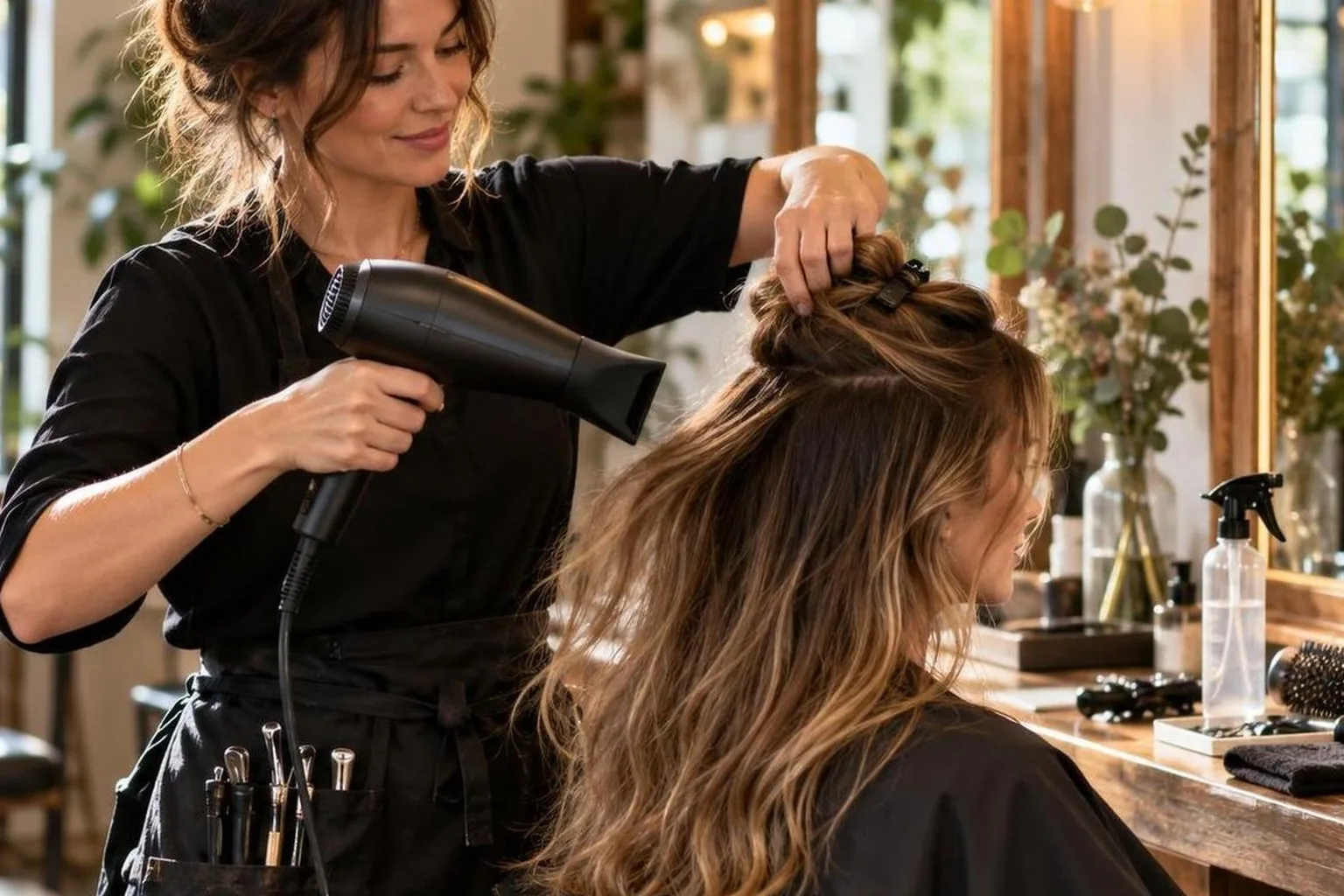
A thin film on the hair shaft answers “how does heat protectant work”: it helps limit heat damage and reduces friction during styling.
Ingredients such as silicones and conditioning polymers coat strands, but protection depends on the formula, even coverage and how you use your tools.
Apply the amount directed on the label, distribute it evenly and follow instructions for damp or dry hair. Heat protectant does not make strands heatproof: lower settings and fewer passes still matter.
Here’s what that protective coating can do—and why application technique affects your finish.
Match Your Protectant to Your Tool Temperature
Heat protectants fail when the product’s thermal ceiling sits below the tool’s working temperature. Grab your primary styling tool and check its LCD or manual for the exact setting you use daily.
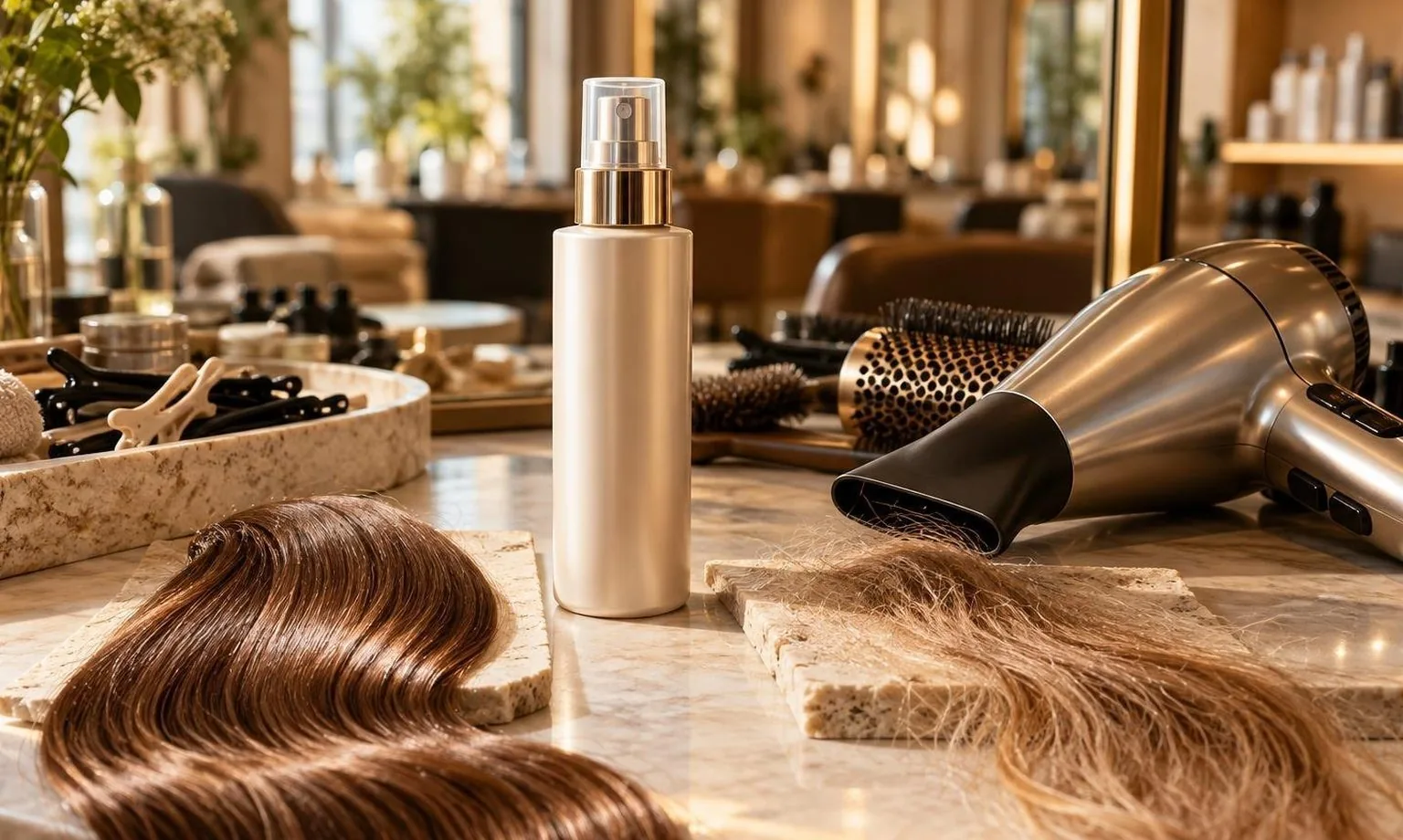
- Record your tool’s operating temperature. Round-brush blowouts typically run between 80–100 °C at the barrel surface. Flat irons and curling wands range from 150 °C to 230 °C. If your dryer has no display, hold a infrared thermometer 2 cm from the nozzle at your usual speed setting and note the reading.
- Read the protectant label for its stated thermal limit. Most silicone-based sprays cite protection up to 230 °C. Water-based serums often cap at 200 °C or lower. If no temperature is printed, contact the manufacturer — that product cannot be reliably matched.
- Compare the two numbers. Your protectant’s ceiling must meet or exceed your tool temperature. A 200 °C serum paired with a 220 °C flat iron leaves a 20 °C gap where the hair cuticle absorbs unshielded heat.
- Adjust one side of the equation. Either switch to a protectant rated higher, or dial the iron down. Dropping a flat iron from 220 °C to 190 °C often produces equivalent smoothing on medium-density hair while staying inside the product’s shield range.
Pin this comparison inside each station’s mirror caddy so every stylist checks before the first pass.
What the Figures Add Up To
Heat protectants reduce measurable hair damage by creating a thermal buffer between the tool surface and the cortex.
Independent tensile-strength and moisture-retention tests consistently show treated strands outperform unprotected strands across every metric. The numbers clarify why skipping this step is costly.
Temperature Thresholds and Protein Degradation
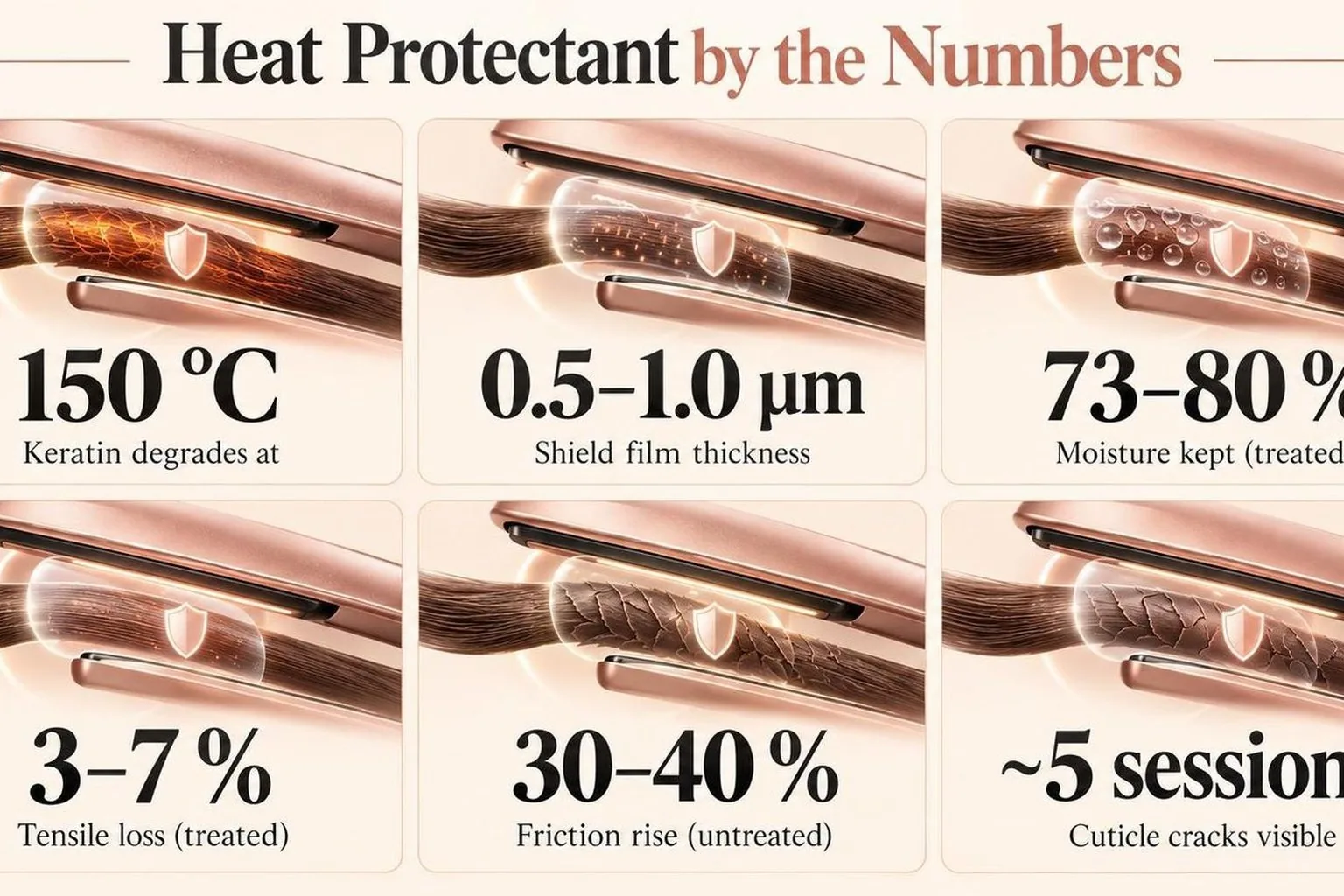
Hair keratin begins to degrade at approximately 150 °C (302 °F). Most flat irons operate between 170 °C and 230 °C (338–446 °F), well above that threshold.
Without protection, a single pass at 210 °C can reduce tensile strength by up to 10–15 percent compared to virgin hair, according to published trichology research.
How Protection Translates to Measurable Outcomes
Silicone-based protectants form a film roughly 0.5–1.0 micrometres thick. This layer raises the smoke point at the hair surface, delaying direct heat transfer to the inner cortex by several critical seconds of contact time.
| Metric | Unprotected Hair | Heat-Protectant-Treated Hair |
| Moisture retention after 10 passes at 200 °C | ~52–58 % | ~73–80 % |
| Tensile strength loss after 10 passes at 200 °C | 12–18 % | 3–7 % |
| Cuticle lift (SEM observation) | Significant lifting and cracking | Minimal disruption |
| Surface friction coefficient increase | ~30–40 % | ~5–10 % |
These ranges come from scanning electron microscopy (SEM) studies and mechanical testing on human hair tresses, standard methods in cosmetic science literature.
Cumulative Cost of Skipping Protection
Damage is cumulative. After 30 heat-styling sessions without protectant, cortex proteins lose structural integrity that no conditioning treatment can fully restore.
- Each unprotected pass at 200 °C+ removes roughly 1–2 percent of bound moisture from the hair shaft.
- Cuticle cracking becomes visible under 500× magnification after approximately 5 unprotected sessions.
- Friction increase from cuticle damage raises the force needed to detangle by up to 40 percent, accelerating mechanical breakage during brushing.
- Clients averaging 3 heat-styling sessions per week accumulate over 150 thermal exposures between typical salon visits spaced 6–8 weeks apart.
Practical Takeaway for Stylists
Applying 1–2 ml of protectant per mid-length section, evenly distributed with a fine-tooth comb, preserves roughly twice the moisture compared to unprotected styling at the same temperature setting.
Reducing iron temperature by 10–20 °C when a protectant is applied delivers equivalent smoothing results with substantially less protein degradation per pass.
What Moves the Outcome
Three variables determine whether a heat protectant actually prevents damage: the formulation type, the application method, and the tool temperature. Get any one wrong and thermal breakage proceeds almost unchanged regardless of product quality.
Formulation Type
Silicone-based protectants form a physical barrier that disperses heat across a wider surface area. Dimethicone and cyclomethicone are the two most common film-forming silicones used in professional-grade sprays and serums.
Water-based protectants rely on humectants and polymers — typically PVP/VA copolymer — that create a sacrificial layer. This layer absorbs thermal energy and evaporates before the cortex reaches damage threshold.
| Protectant Base | Primary Mechanism | Best Suited For |
| Silicone-based | Heat dispersion via film barrier | Flat irons, 200–230 °C passes |
| Water/polymer-based | Sacrificial evaporation | Blow drying, 80–120 °C airflow |
| Natural oil-based | Cuticle lubrication, moderate heat shielding | Low-heat styling under 180 °C |
Application Coverage
Uneven application is the single largest cause of localised heat damage in salon settings. A typical mid-length blowout requires 4–6 sprays of aerosol protectant distributed section by section across damp hair.
Applying protectant to dry hair reduces efficacy. The product needs a moisture layer to bond to — comb-through distribution on towel-dried hair at roughly 60–70% moisture yields the most uniform coverage.
Tool Temperature
Hair keratin begins denaturing at approximately 150 °C. Every 10 °C increase above that threshold accelerates cuticle lifting and cortical fracture. Heat protectants extend the damage onset point by roughly 20–40 °C depending on formulation.
Fine hair should be styled at no more than 180 °C with protectant applied. Medium-density hair tolerates up to 200 °C.
Coarse or tightly coiled textures may require 210–230 °C but need a silicone-based protectant for adequate shielding at those temperatures.
| Hair Texture | Max Recommended Temp (with protectant) | Pass Speed |
| Fine / colour-treated | 170–180 °C | 2–3 seconds per section |
| Medium density | 190–200 °C | 3–4 seconds per section |
| Coarse / tightly coiled | 210–230 °C | 4–5 seconds per section |
Layering and Reapplication
A single application does not survive multiple passes. After 3–4 flat iron passes over the same section, the protective film degrades significantly.
Misting a light reapplication between major sections maintains the thermal buffer through a full styling session.
Combining a leave-in conditioner underneath a silicone spray creates a dual-layer system — moisture retention below, heat dispersion above.
This pairing outperforms either product used alone for blow dries exceeding 15 minutes of continuous airflow contact.
Telling Good From Good Enough
The gap between a competent heat protectant and an excellent one comes down to ingredient architecture, not marketing copy.
A good-enough product deposits a single barrier layer; a good product combines film-formers, humectants, and slip agents that work at different temperature thresholds.
Key Ingredients and Their Roles
Silicones are the backbone of most formulas. Cyclomethicone evaporates during styling, leaving minimal residue. Dimethicone stays on the strand and absorbs infrared energy, reducing the heat that penetrates the cortex.
Hydrolyzed proteins — wheat, keratin, silk — temporarily fill gaps in damaged cuticles. They raise the thermal tolerance of weakened hair by reinforcing the internal structure before heat is applied.
Polyquaternium compounds (commonly PQ-55 or PQ-70) form a positively charged film that clings to negatively charged hair. This electrostatic bond keeps the shield in place through multiple pass-throughs of a flat iron.
What Separates Tiers
| Factor | Good Enough | Good |
| Film-former count | 1 silicone type | 2–3 silicones plus a polyquaternium |
| Protein content | Absent or listed below fragrance | Hydrolyzed protein in top 10 ingredients |
| Tested protection range | Up to roughly 180 °C (356 °F) | Up to roughly 230 °C (450 °F) |
| Slip agents | None | Cetrimonium chloride or behentrimonium methosulfate |
| Humidity resistance | Minimal | Contains PVP/VA copolymer or equivalent |
Label-Reading Checklist
- Check ingredient order — active film-formers should appear in the first seven positions, not buried after water, fragrance, and preservatives.
- Look for at least one volatile silicone (cyclomethicone or cyclopentasiloxane) paired with one non-volatile silicone (dimethicone or amodimethicone).
- Avoid formulas where alcohol denat. sits in the top five — it accelerates moisture loss under heat.
- Confirm the product states a specific temperature threshold on packaging or technical data sheets rather than vague “thermal protection” language.
The Practical Test
Apply the product to a single section. Clamp a 230 °C (450 °F) flat iron and make one slow pass over 3–4 seconds. Then repeat on an untreated section of similar density and texture.
Compare the two sections for smoothness, elasticity, and scent. Burnt-protein smell on the treated section signals inadequate coverage or an under-formulated product. No smell difference means the protectant failed entirely.
A well-formulated heat protectant should leave the treated strand noticeably smoother with zero singed odour at the temperature you actually style at — not just at a lower, lab-friendly setting.
How It Compares to the Alternatives
Heat protectants are not the only strategy for reducing thermal damage, but they outperform passive alternatives in measurable ways.
Lowering tool temperature and limiting pass count both help, yet neither forms a physical barrier the way a silicone- or polymer-based protectant does.
Temperature Reduction vs. Protectant Use
Dropping iron temperature from 230 °C to 185 °C reduces cuticle lifting but slows styling. A protectant applied at 230 °C can reduce moisture loss by roughly 50%, achieving damage reduction without sacrificing speed or hold.
| Strategy | Moisture Retention Improvement | Styling Time Impact |
| Heat protectant at 230 °C | Up to 50% | No added time |
| Lower temp (185 °C), no protectant | ~25–30% | 2–3 extra passes needed |
| Fewer passes at 230 °C, no protectant | ~15–20% | Finish may lack smoothness |
| Air-dry only (no heat) | No thermal loss | 45–90 min depending on density |
Leave-In Conditioner as a Substitute
Standard leave-in conditioners add slip and moisture but lack volatile silicones such as cyclomethicone. Without that flash-evaporation layer, a leave-in cannot form the vapour shield that insulates the cortex during a 3–5 second iron pass.
Using a leave-in alone before a 210 °C flat iron still exposes hair to direct conductive heat.
The humectants in many leave-ins — glycerin, for example — can attract ambient moisture that then boils on contact with the plates, worsening bubble damage inside the fibre.
Natural Oils
Coconut, argan, and grapeseed oils have smoke points between 177 °C and 216 °C. Above those thresholds the oil degrades, offering no sustained barrier. Dimethicone-based protectants remain stable well above 230 °C.
Oils also weigh between 0.91 and 0.92 g/mL, heavier than most spray protectants at roughly 0.85 g/mL. On fine hair this density difference means visible limpness and faster re-soiling at the root.
When Combining Strategies Works Best
- Apply a silicone-based protectant, then keep the iron at or below 210 °C — this stacks both defences without added time.
- Limit passes to two per section (roughly 1.5 cm wide) to minimise cumulative heat exposure.
- Reserve natural oils for post-styling finishing; applied after heat, they seal the cuticle without the smoke-point risk.
No single method matches the combined effect of a dedicated protectant plus controlled temperature. The protectant handles the thermal barrier; lower heat and fewer passes reduce the load that barrier must absorb.
Heat Without the Cost to Hair
Heat protectants work by depositing a thin barrier on the hair shaft that slows thermal energy transfer, raises the smoke point of hair proteins, and reduces moisture loss during styling.
They do not eliminate damage — they reduce it by measurable margins when applied correctly.
What Happens to Unprotected Hair
Hair keratin begins to degrade at around 150 °C (302 °F). Above 230 °C (446 °F), the cuticle cracks, internal cortex proteins denature, and bound water vaporises rapidly — creating the microscopic bubbles visible under electron microscopy.
This process is cumulative. Each unprotected pass of a flat iron compounds cuticle lifting, increasing porosity and reducing tensile strength progressively.
The Barrier Mechanism
Most heat protectants rely on one or more of three active strategies:
- Film-forming polymers — PVP/VA copolymer, polyquaternium-55, or similar agents create a sacrificial coating that absorbs and disperses heat before it reaches the cortex.
- Silicone-based shields — cyclomethicone and dimethicone coat individual strands, distributing heat evenly and lowering the friction coefficient between plate and hair.
- Hydrolysed proteins — wheat, keratin, or silk amino acids penetrate the cuticle gaps and reinforce internal structure, raising the thermal threshold before mechanical failure occurs.
How Much Protection They Actually Provide
The degree of protection depends on formula type, application density, and tool temperature. Published thermal analysis data offer useful reference points.
| Factor | Without Protectant | With Protectant |
| Moisture loss at 210 °C | Up to 36% | Reduced to approximately 14–18% |
| Cuticle lifting (passes at 200 °C) | Visible after 3–5 passes | Visible after 8–12 passes |
| Tensile strength reduction | Up to 40% after repeated styling | Limited to approximately 15–20% |
Application Rules That Matter
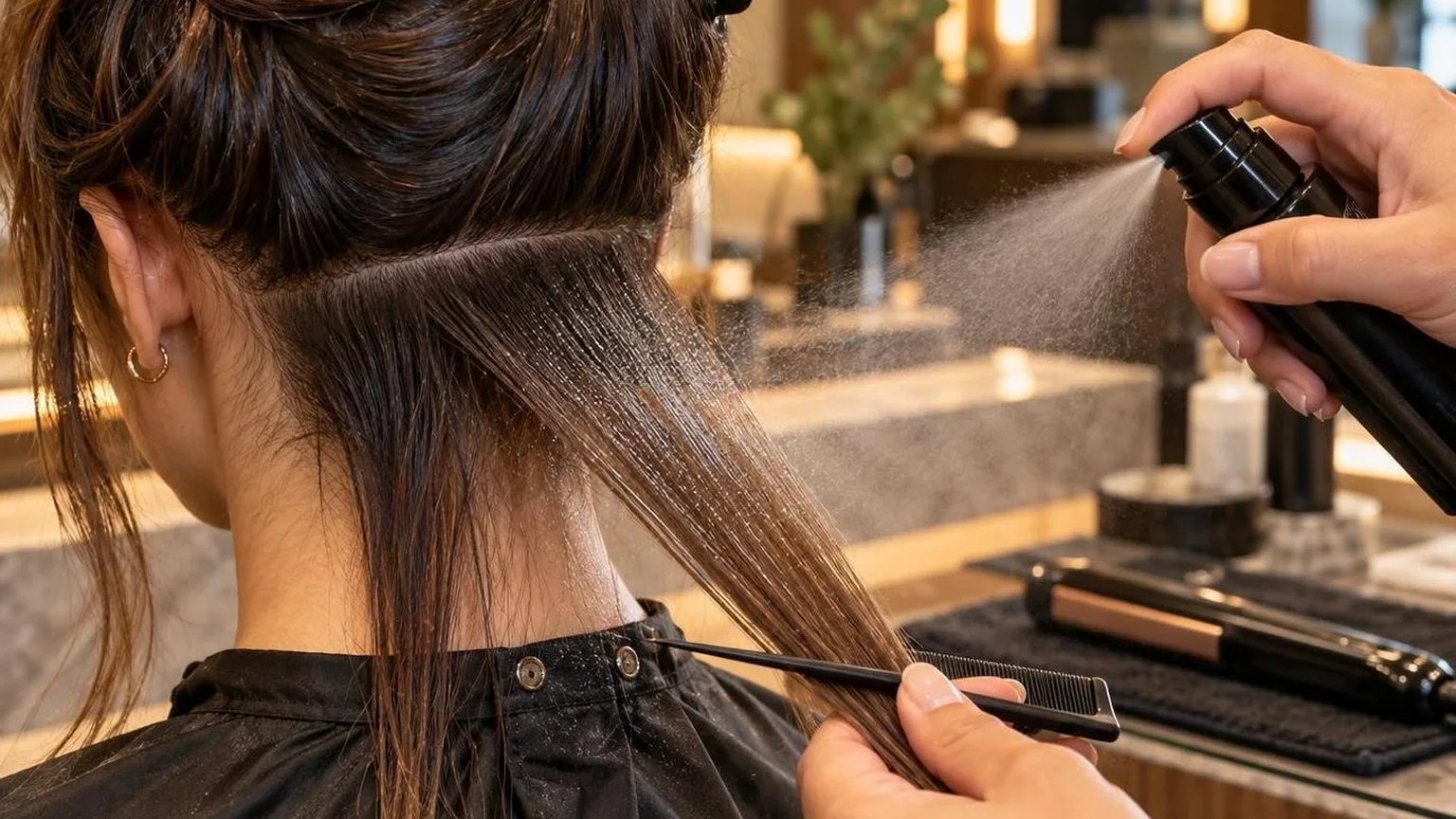
Apply protectant to damp hair — roughly 70% dry — so the product distributes evenly before the water evaporates. On dry hair, coverage tends to be patchy and concentrated at endpoints.
Use approximately 1–2 ml for medium-density, shoulder-length hair. Over-application creates residue buildup; under-application leaves exposed sections unprotected.
Section hair into clips no wider than 3–4 cm before ironing. This ensures every strand received product and limits the need for repeat passes, which is where most real-world heat damage accumulates.
Cap your tool at 185–210 °C for most hair types. Fine or colour-treated hair should stay at 150–170 °C. No protectant compensates for a 230 °C iron on compromised strands.
What the Method Actually Changes
Heat protectant alters three variables simultaneously: the thermal threshold at which hair protein denatures, the friction coefficient of the cuticle surface, and the rate of moisture loss during styling.
Each variable shifts measurably depending on product type, application weight, and tool temperature.
Alpha-keratin in hair begins irreversible denaturation at roughly 150 °C. Most silicone-based protectants raise that threshold by 20–40 °C, giving stylists a wider operating window before structural damage begins.
Thermal Buffer Mechanism
Film-forming polymers — commonly PVP/VA copolymer or amodimethicone — create a sacrificial layer 0.5–2 µm thick.
This layer absorbs and distributes heat laterally across the strand rather than allowing point-source conduction straight into the cortex.
Thinner coatings volatilise faster. A single pass of a 230 °C flat iron can strip the protective layer entirely, which is why professional protocol calls for lower temperatures with multiple passes rather than maximum heat in one stroke.
| Variable | Without Protectant | With Protectant Applied |
| Denaturation onset | ~150 °C | ~170–190 °C |
| Surface friction (kinetic) | 0.18–0.22 µ | 0.08–0.14 µ |
| Moisture loss per 10-second pass at 200 °C | ~3–5 % of strand weight | ~1.5–2.5 % of strand weight |
Why Application Weight Matters
Applying less than 0.1 mL per section (roughly 3 cm wide) leaves patchy coverage. Applying more than 0.3 mL per section saturates the strand, extending dry time by 30–45 seconds and causing steam pockets between iron plates and hair.
Steam pockets are dangerous. Trapped water superheats past 100 °C almost instantly on contact with a 200 °C plate, causing explosive moisture release that fractures the cuticle from inside out.
Friction and Mechanical Outcome
Lower surface friction means the flat iron or brush slides without dragging. This reduces mechanical stress on an already heat-softened strand. The cuticle layers stay aligned rather than lifting and snagging.
- Silicone-based sprays reduce kinetic friction by roughly 40–55 % compared to bare hair
- Oil-based serums reduce friction comparably but add 0.05–0.1 g of weight per treated section, which can flatten fine hair at the root
- Water-based mist formulas flash off faster, offering thermal protection for approximately 2–3 iron passes before the film degrades
The practical consequence: choosing the wrong format for the hair density changes the mechanical finish. Fine hair under 60 µm strand diameter benefits from mist formulas.
Medium to coarse hair above 80 µm tolerates serum weight without losing volume.
Every variable — onset temperature, friction, moisture retention — shifts together.
Changing one input, such as applying protectant to damp rather than towel-dried hair, dilutes the film and lowers its effective thermal ceiling by an estimated 10–15 °C.
Frequently Asked Questions
What ingredients in heat protectants form a thermal barrier?
Silicones such as dimethicone and cyclopentasiloxane coat the hair shaft, creating a film that distributes heat more evenly.
Some formulas add hydrolysed proteins (wheat, keratin) that temporarily fill gaps in damaged cuticles, reducing the direct contact between the hot tool surface and exposed cortex.
At what temperature does unprotected hair start to sustain damage?
Keratin protein begins to degrade at around 150 °C (300 °F). Above 230 °C (450 °F), the hair’s internal disulphide bonds break rapidly, causing irreversible structural weakness.
Heat protectants raise the threshold at which moisture loss and cuticle lifting begin, typically offering meaningful protection up to 230 °C.
Should heat protectant be applied to wet or dry hair?
Spray formulas designed for blow-drying are applied to towel-dried hair at roughly 70–80 % moisture so the product disperses evenly before the dryer activates it.
Serums and creams for flat irons or curling wands go on fully dry hair to avoid steam bursts that cause cuticle cracking.
How much product is enough for a full head of medium-density hair?
For a spray protectant, 8–10 pumps distributed across four sections covers shoulder-length, medium-density hair without buildup.
For a cream or serum, a pea-sized amount per section — roughly four sections total — prevents the heavy, greasy residue that causes tools to drag and snag.
Does heat protectant reduce styling tool efficiency?
A thin, even layer does not block heat transfer — it moderates it. Infrared thermography studies show coated strands reach working temperature about 2–3 seconds slower than uncoated strands, a negligible delay.
Excess product, however, can cause sizzling, smoke, and uneven heat distribution that forces repeated passes.
How often should heat protectant be reapplied during a single styling session?
One application before the initial pass is standard practice. Reapplication mid-session is unnecessary and risks product buildup that smokes on contact.
If a section needs a second pass with a flat iron above 200 °C, allow the hair to cool for 10–15 seconds first rather than adding more product.
Related Reading
- Paddle or round: which brush does which job
- How often a dryer filter needs clearing
- How long a hair dryer lasts, and what shortens it
- Cleaning a dryer filter, and how often it needs it
- A maintenance schedule that keeps dryers alive
- Choosing a professional dryer: what actually matters
- Ceramic or tourmaline: what changes inside the barrel
- How hot a dryer actually runs at the hair
- The complete guide to blow dry tools
- NIH National Library of Medicine – PubMed
- OSHA – Occupational Safety and Health Administration
- U.S. Small Business Administration
- The Society of Cosmetic Chemists
- The Cosmetic, Toiletry and Fragrance Association (PCPC)
- British Standards Institution – Consumer Product Standards
- Underwriters Laboratories
- Journal of Cosmetic Science (SCC publication)