
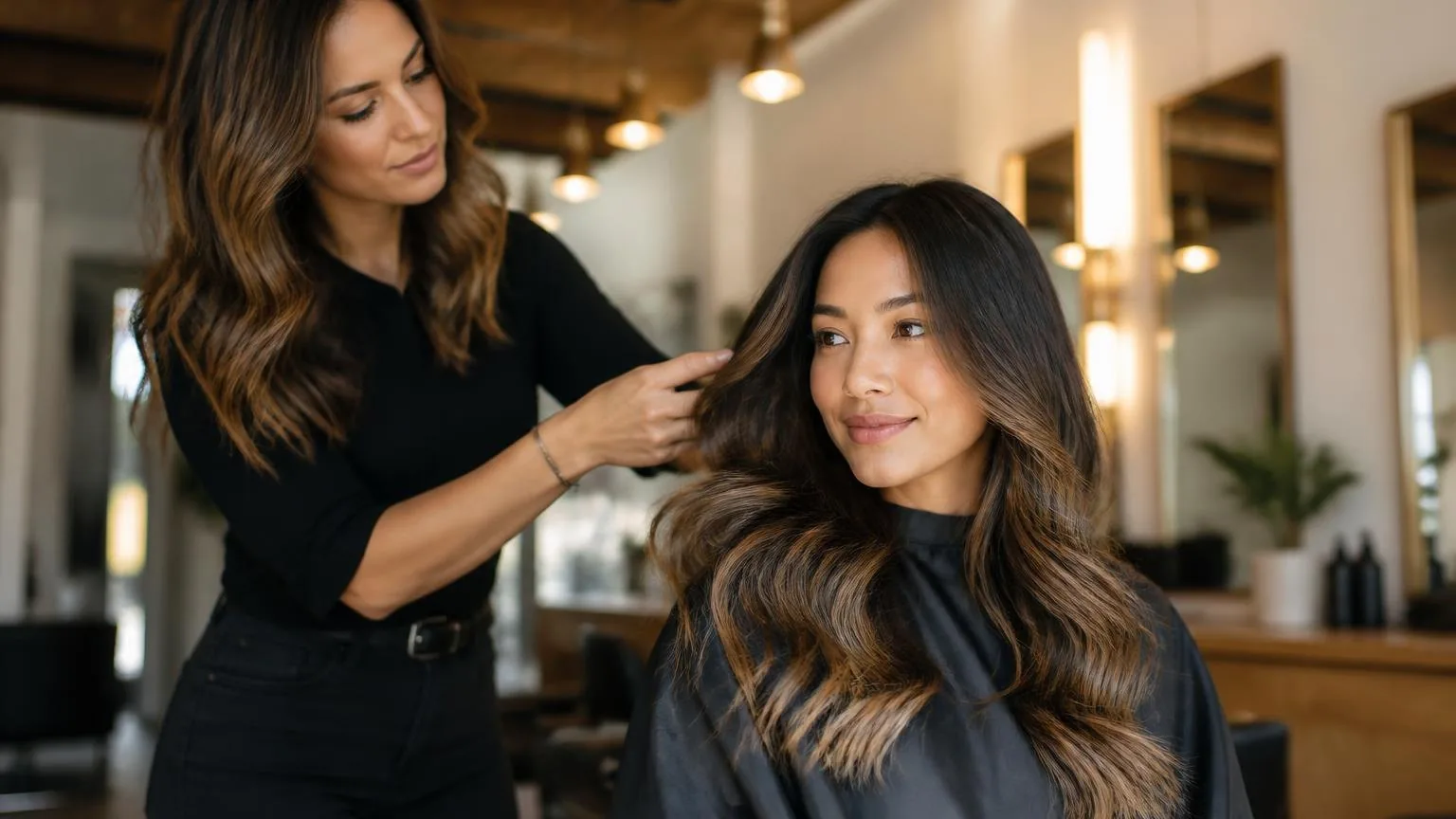
What the cool shot button actually does is drop airflow temperature to help set the shape you just created with heat, especially through the last 10–15 seconds of a round-brush section.
In blow-dry work, heat makes hair more pliable; cooler air helps the finished curve, lift, or bend hold while the section is still wrapped, clipped, or tensioned. Used section by section, it improves polish without adding product.
Time Your Cool Set
Use this quick chair-side check to find the cool shot timing that suits your dryer, brush size, section size, and finish. Do it on one front section where shape and shine are easy to see.
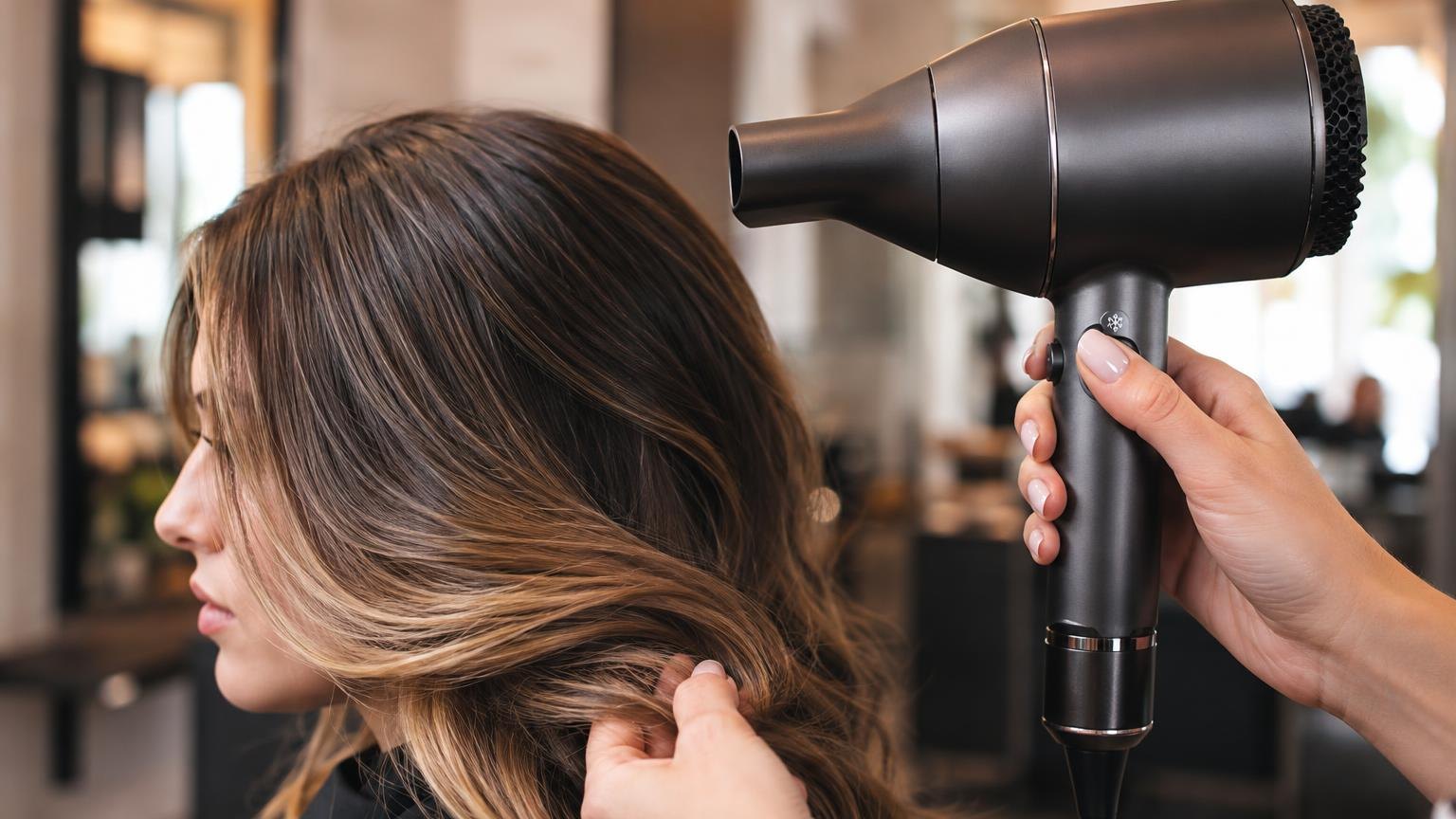
- Choose one test section. Take a clean section about 1–2 inches wide and no deeper than the barrel of your round brush. Dry it with heat until the section is fully dry and shaped.
- Hold the shape still. Keep the hair wrapped on the brush, or hold the curl in your hand. Do not release tension before cooling, or the bend can soften immediately.
- Use cool shot for 10 seconds. Press the button and keep airflow moving over the wrapped section. If the dryer only cools while held down, keep steady pressure on the button.
- Check the feel. Release only when the hair feels cool to the touch, not warm at the roots or mid-lengths. If it still feels warm, add another 5 seconds.
- Set your salon rule. Use 10 seconds for fine or small sections, 15 seconds for medium sections, and 20 seconds for dense hair, large brushes, or high-lift crown work.
Write the timing on your station card: brush size, section size, and cool shot seconds. This gives every stylist a repeatable finish instead of guessing at the end of each section.
What the Numbers Actually Say
The cool shot does not “freeze” hair into place; it lowers the fibre temperature after the section has been dried, stretched, and shaped.
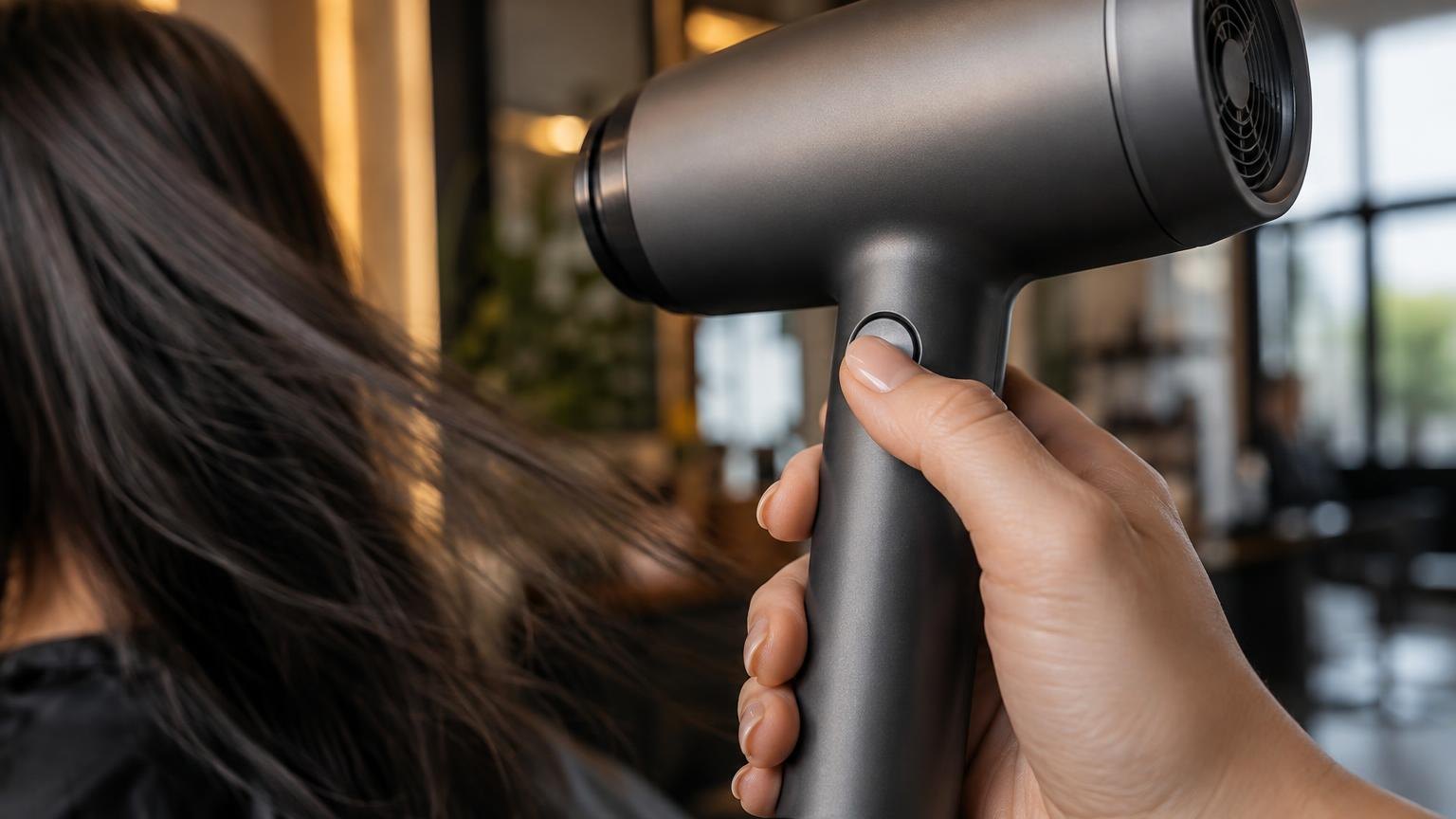
That matters because temporary styling relies heavily on hydrogen bonds, which are more stable once the hair cools in its new position.
In the chair, the useful sequence is heat to remove water, tension to shape, then cool air while the hair is still wrapped around the brush. If the section is still damp, the cool shot mainly slows drying rather than improving finish.
| Measurement point | Typical reading | What it means at the chair |
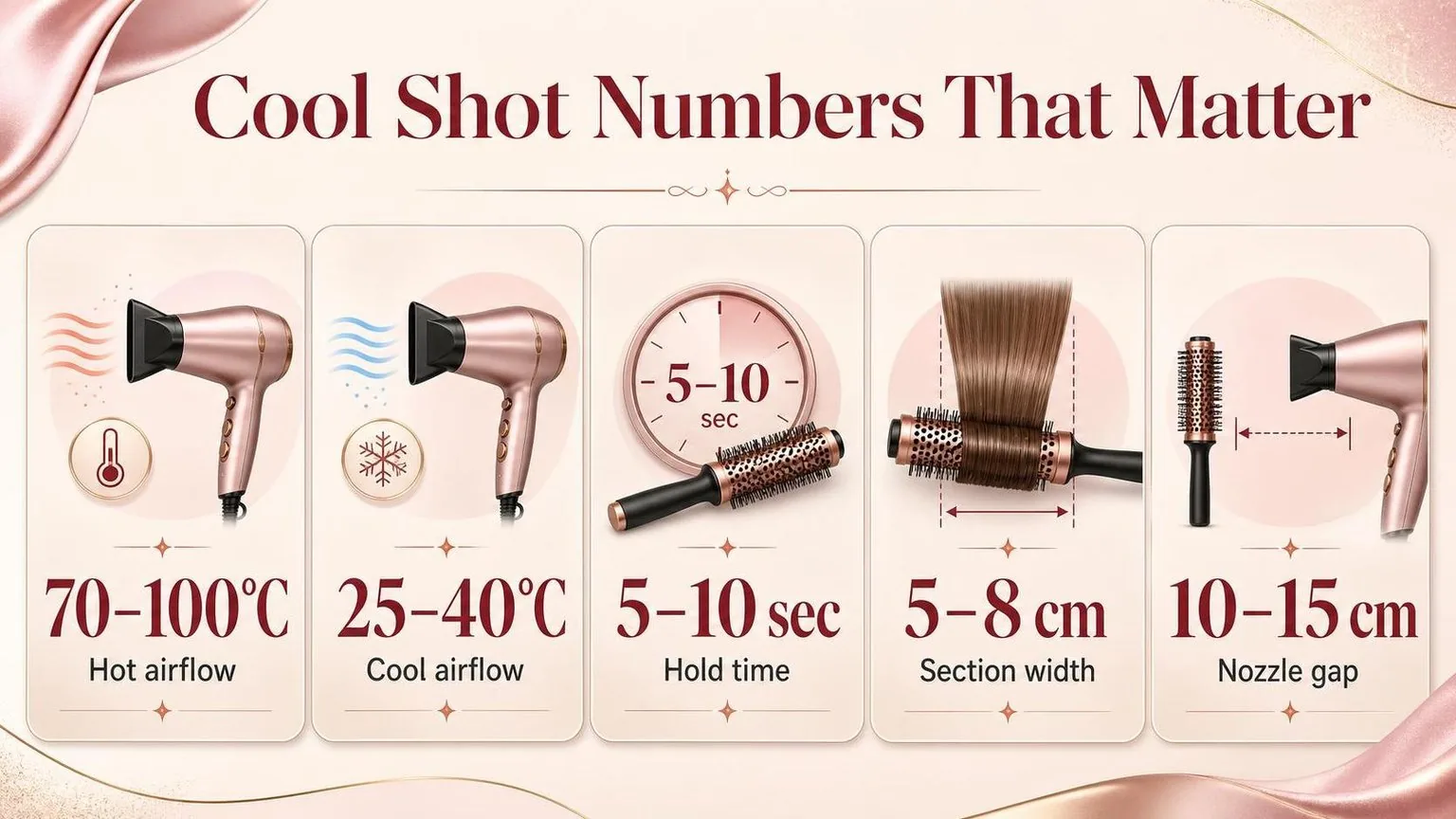
| Hot airflow at nozzle, close range | About 70°C to 100°C / 158°F to 212°F | Fast water removal and brush shaping, but requires movement to avoid overheating one spot |
| Cool-shot airflow at nozzle, close range | About 25°C to 40°C / 77°F to 104°F | Temperature drop without adding more heat load to the finished section |
| Useful cool-shot hold per section | About 5 to 10 seconds | Enough time for the brush-wrapped section to lose heat before release |
| Typical round-brush working section width | About 5 cm to 8 cm / 2 in to 3 in | Small enough for airflow to reach the full strand bundle evenly |
The key number is not the button itself; it is the temperature drop at the hair. A dryer that only reduces heat slightly will feel “cooler” on the hand, but may not chill a dense brush section quickly.
Hair-science texts, including Robbins’ Chemical and Physical Behavior of Human Hair, describe temporary setting as a moisture-and-temperature-dependent rearrangement of hydrogen bonding.
Salon technique applies that principle practically: shape the fibre while warm, then let it cool before disturbing it.
| Technique variable | Practical target | Why it changes the result |
| Distance from nozzle to hair | About 10 cm to 15 cm / 4 in to 6 in | Keeps airflow concentrated without pressing the nozzle into the brush |
| Final dryness before cool shot | Hair should feel dry, not cool-damp | Remaining water weakens the set and makes the section collapse sooner |
| Release timing | Release after the section feels neutral, not hot | Dropping the curl while hot lets gravity pull the shape down |
| Airflow direction | From roots toward ends | Helps the cuticle lie flatter, improving shine and reducing roughness |
For a bouncy blowout, the cool shot is most useful on the last pass, not every pass. Heat builds the shape; cool air preserves it long enough for the stylist to release, clip, or move to the next section cleanly.
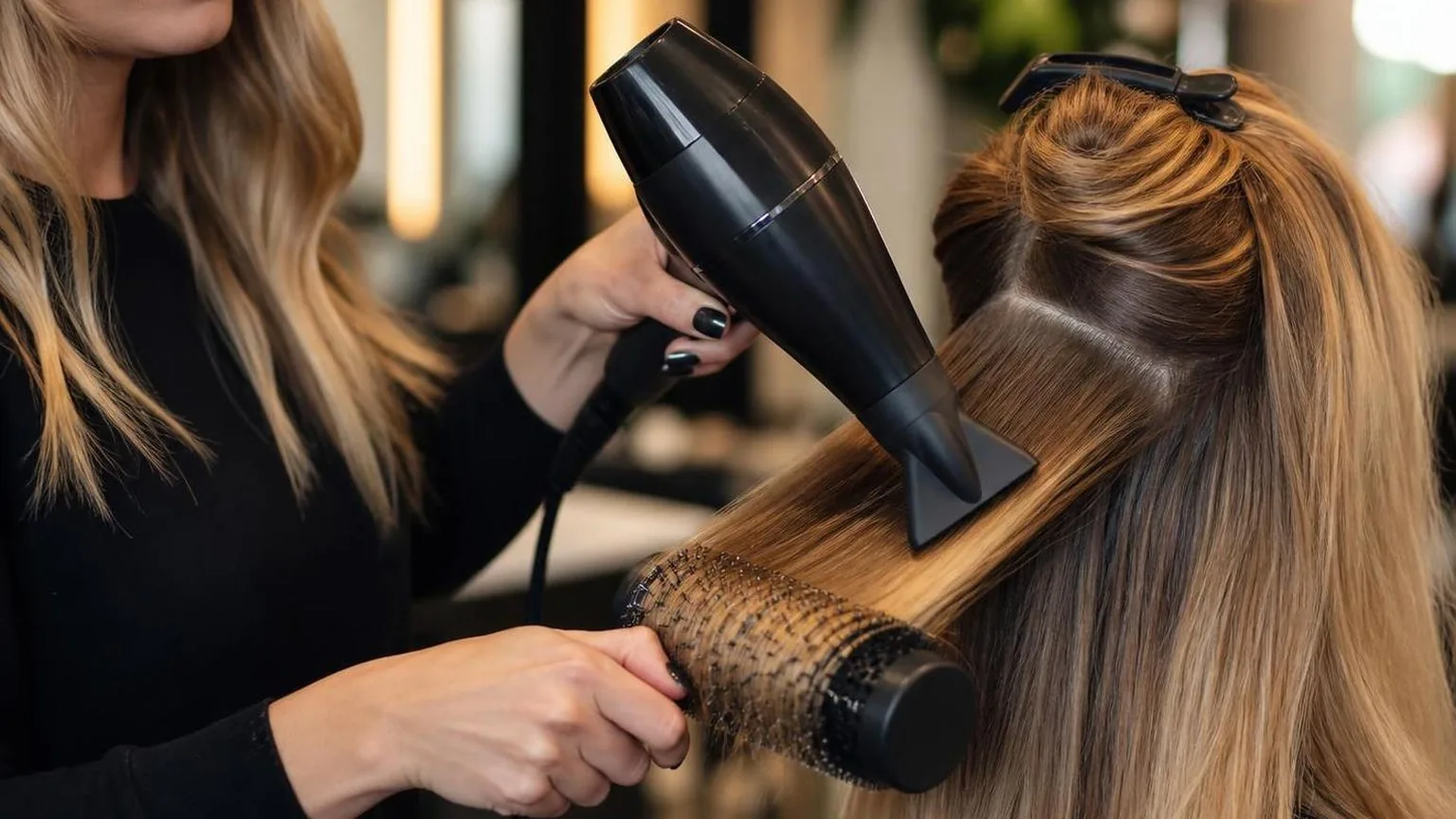
What Moves the Outcome
The cool shot changes the result only when the hair is already dry, shaped, and held in place. It is not a drying shortcut; it helps the fibre hold the curve, root lift, or bevel you created with heat and brush tension.
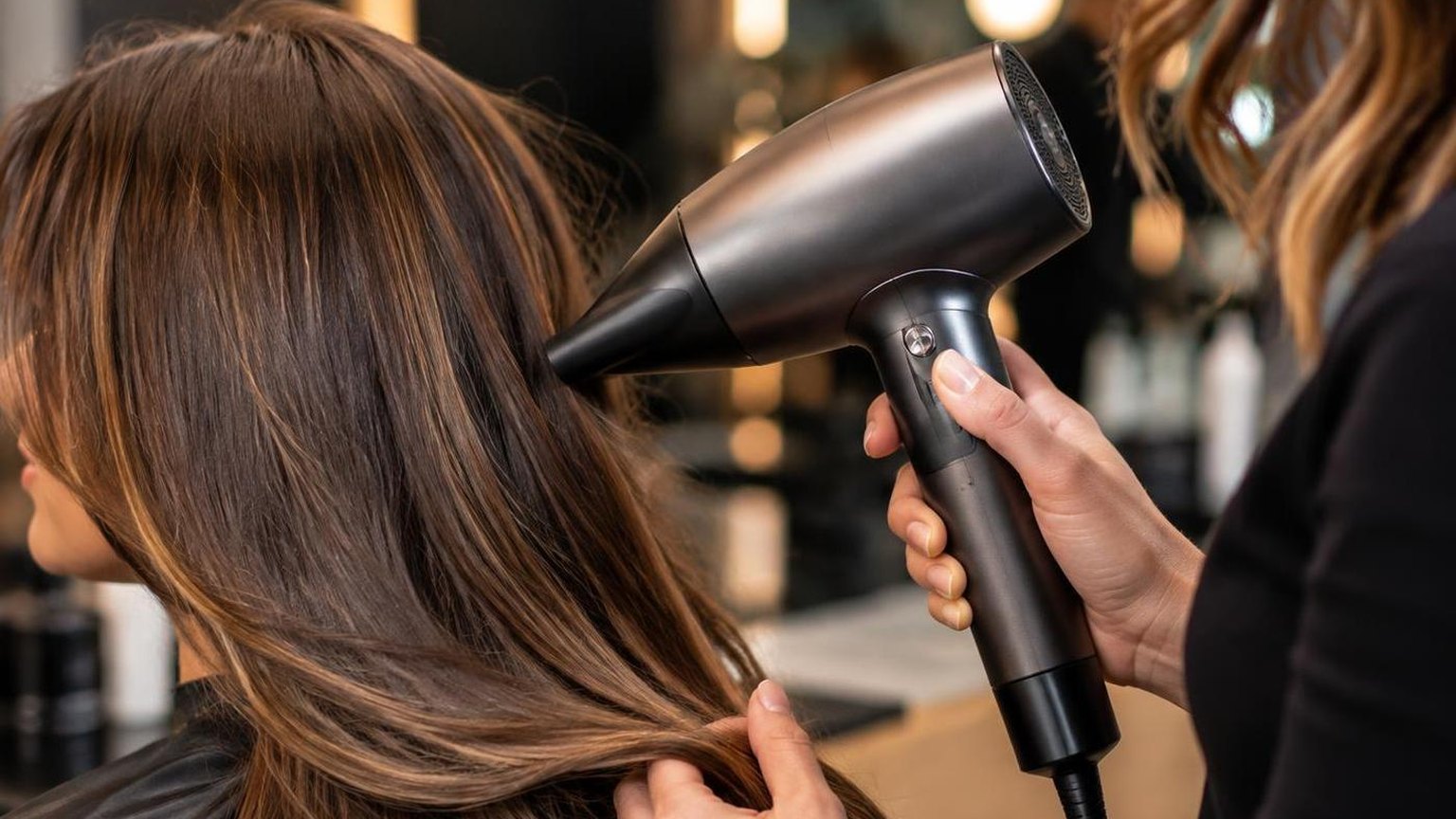
The finish changes most when heat, tension, airflow distance, and cooling time line up. In salon practice, the strongest set comes from heating the section on the brush, stopping movement, then cooling before the brush is removed.
The section must be fully dry first
Cool air does not “seal” wet hair into a polished shape. If moisture remains inside the section, the style softens as soon as the brush comes out.
L’Oréal hair science texts and Dyson engineering notes both describe water as a key factor in temporary shape change.
| Stage | What to check | Effect on finish |
| Damp | Hair feels cool before using the button | Shape drops quickly |
| Dry but hot | Hair feels warm and pliable on the brush | Best moment to cool |
| Dry and cooled | Hair feels neutral before brush removal | Longest-lasting bevel or lift |
Time on the button matters
A quick tap rarely changes much. For a visible set, keep the section wrapped on the brush and cool it until the surface no longer feels warm to your fingers. Behind the chair, that usually means holding still rather than brushing through.
| Section type | Useful cool-shot time | Best use |
| Fine front hairline | 5 to 8 seconds | Soft bend, fringe direction |
| Medium crown section | 8 to 12 seconds | Root lift, volume support |
| Dense or long section | 12 to 20 seconds | Ends, waves, round-brush curl |
Brush size and section size change the hold
The cool shot can only set the shape already made. A large brush gives polish and bend; a smaller barrel gives more curl memory. If the section is too thick, the outside cools while the inside stays warm.
| Brush diameter | Typical result | Best section width |
| 25 to 32 mm | Stronger bend or curl at the ends | 25 to 40 mm |
| 43 to 53 mm | Volume with a soft bevel | 40 to 55 mm |
| 60 mm and above | Smoothness with minimal bend | 50 to 70 mm |
Distance and airflow direction decide polish
Keep the nozzle close enough to control the section, but not pressed into the hair. Aim airflow from roots to ends so the cuticle lies flatter. The Society of Cosmetic Chemists describes smoother fibre alignment as a contributor to shine perception.
- Use a concentrator nozzle for the final pass, not a bare dryer mouth.
- Hold the dryer about 5 to 10 cm from the brush during the cool shot.
- Do not unwind the brush while cooling if you want a stronger set.
- For crown lift, cool the root area first, then the mid-lengths.
- For a flicked end, cool the last rotation before releasing the brush.
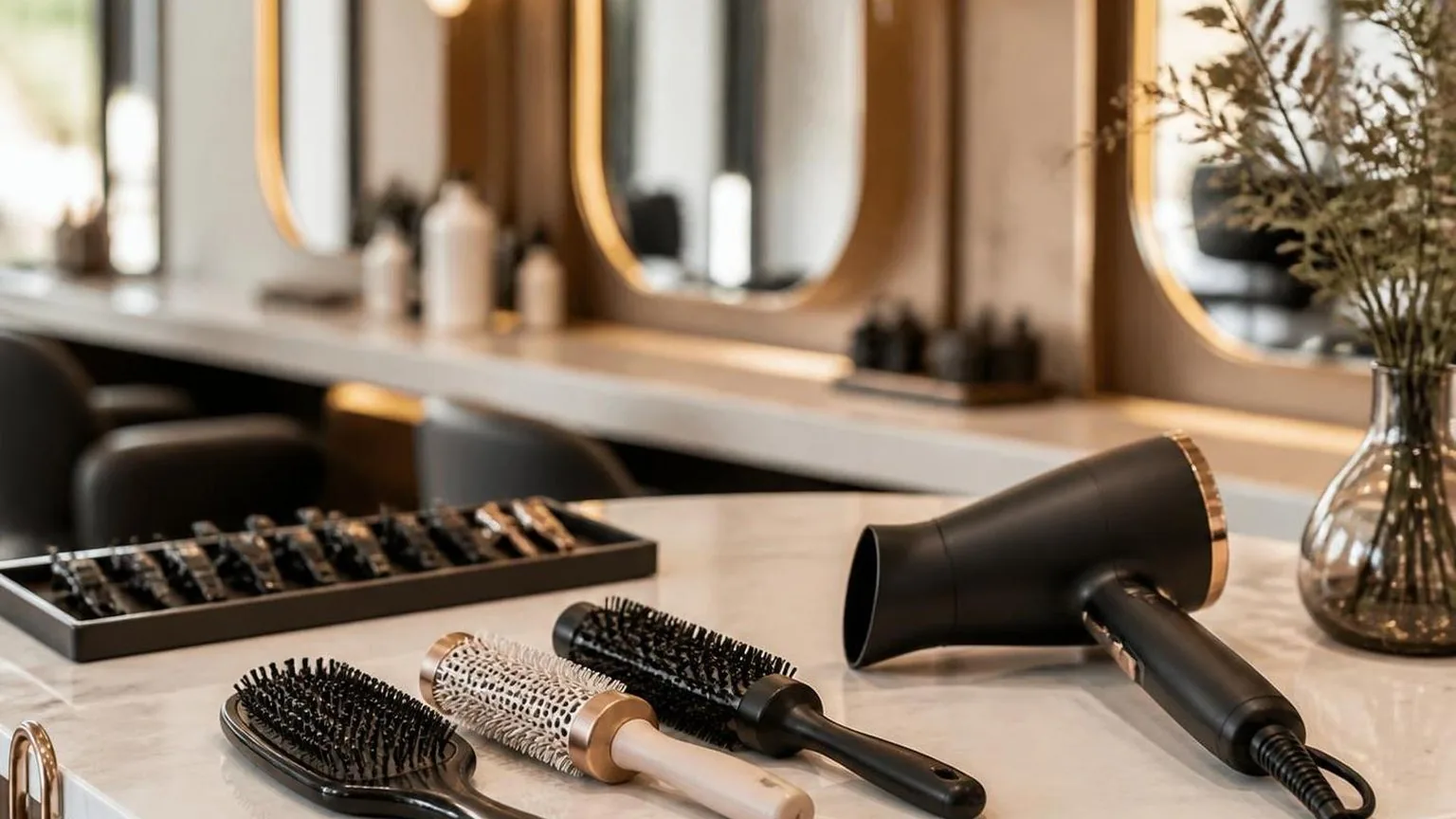
Checking It at the Chair
Judge the cool shot by what the section does after you release the brush, not by how “cold” the air feels.
A working cool shot helps a fully dry, hot-shaped section hold its bend, reduce puff, and feel smoother once it returns near room temperature.
The test has to happen on hair that is already dry to the touch. If the section still feels damp at the mid-lengths, the cool shot is mostly finishing evaporation, not setting shape.
| Check | What to do | Pass sign |
| Dryness | Press the section between fingers for 3 seconds | No cool, clammy feel inside the section |
| Heat set | Hold the brush in place after hot airflow for 5 to 8 seconds | Hair keeps the curve when brush tension is released |
| Cool shot | Blow cool air over the same wrapped section for 8 to 12 seconds | Section feels neutral, not warm, before unwrapping |
| Hold check | Let the section hang untouched for 60 seconds | Root lift or bend drops by less than one third |
Use the back of your fingers, not your palm, to judge temperature. Fingers pick up small heat changes quickly, and they are less likely to crush the shape you just built.
For a tighter read, keep the dryer nozzle still and aim along the cuticle direction, from roots toward ends.
Robbins’ hair-fibre text describes hair shape as strongly affected by water and heat; cooling only helps once tension and drying have already organized the fibre.
| Hair feel | Better cool-shot target | Reason to adjust |
| Fine, low-density | 5 to 8 seconds per brush section | Too much airflow can collapse volume |
| Medium density | 8 to 12 seconds per brush section | Enough time to cool the inner wrap |
| Coarse or dense | 12 to 20 seconds per brush section | Heat remains trapped longer inside the section |
| Fringe or face frame | 3 to 6 seconds per pass | Small sections cool quickly and over-direct easily |
Section size matters as much as the button. A cool shot cannot lock a shape if the wrapped hair is thicker than the brush can heat through evenly.
| Brush barrel | Typical section width | Best judgment point |
| 25 mm | 20 to 30 mm | Fringe, short layers, tighter bevel |
| 43 mm | 35 to 50 mm | Classic blowout bend |
| 53 mm | 45 to 65 mm | Loose movement and smoothing |
If the section looks smooth on the brush but frizzes as soon as it falls, the issue is usually timing or tension. Reheat under tension, cool before release, then avoid touching until the section has settled.
The simplest salon-floor rule: if the hair still feels warm when it leaves the brush, the cool shot was too short. If it feels cool but the shape drops, the section was too damp, too large, or not held under enough tension.
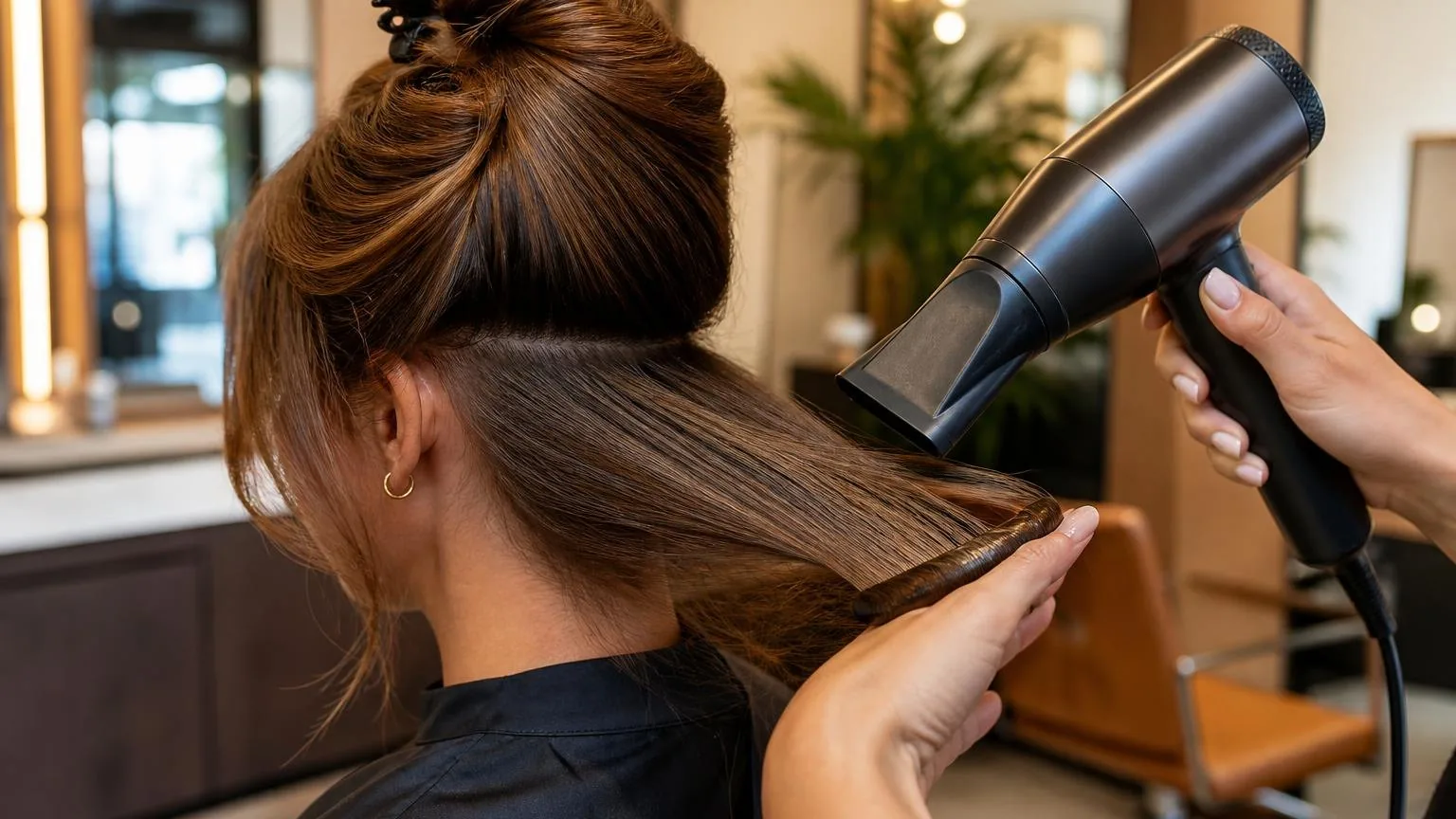
Set Against the Other Options
The cool shot is faster and more targeted than simply waiting for hair to cool, but it is not the same as drying on a low-heat setting. Its job is to drop the temperature of a finished section while tension, bend, or lift is still in place.
In practical blow-dry work, that matters most in the last few seconds on a round brush.
Heat makes the fibre more shapeable by disrupting temporary hydrogen bonds; cooling helps the new shape hold as those bonds re-form, a mechanism described in Robbins’ Chemical and Physical Behavior of Human Hair.
| Method | Typical use at the chair | Best timing | Main trade-off |
| Cool shot button | Locks in curl, bevel, root lift, or fringe direction while hair is still on the brush | 5 to 10 seconds per section | Needs close control and section discipline |
| Low-heat drying | Gentler drying when hair is damp and still being shaped | Used through the drying pass | Slower water removal than high heat |
| Air cooling without the dryer | Letting the section sit on the brush, clip, or roller | 30 to 120 seconds, depending on density | Reliable, but slower in a busy service |
| Cold rollers or clips | Setting volume after the blow-dry | 5 to 15 minutes | Strong set, but changes the service flow |
A low-heat setting still supplies warm moving air. It can dry and shape at the same time. A cool shot supplies little or no added heat, so it is poor for removing moisture but useful once the section is dry to the touch.
In salon testing, a hot concentrator aimed from 2 to 3 inches can make a fine section too warm to hold comfortably within seconds. Moving to cool air for 5 to 10 seconds usually drops the feel of the hair enough to release the brush cleanly.
Air cooling is the closest alternative. If you wrap a 2-inch section around a 43 mm round brush and hold it still, the shape can set well.
The difference is speed: the cool shot moves room-temperature air through the curve rather than waiting for passive heat loss.
- Use cool shot for fringe direction, face-frame bevels, crown lift, and polished ends.
- Use low heat when the section is still more than slightly damp.
- Use clips or rollers when you need longer-lasting volume through a full service.
- Use passive cooling when shine and smoothness matter more than speed.
The strongest finish usually combines methods: dry the section fully, shape it with heat and tension, cool it before releasing, then clip high-volume areas for several minutes while the rest of the head is finished.
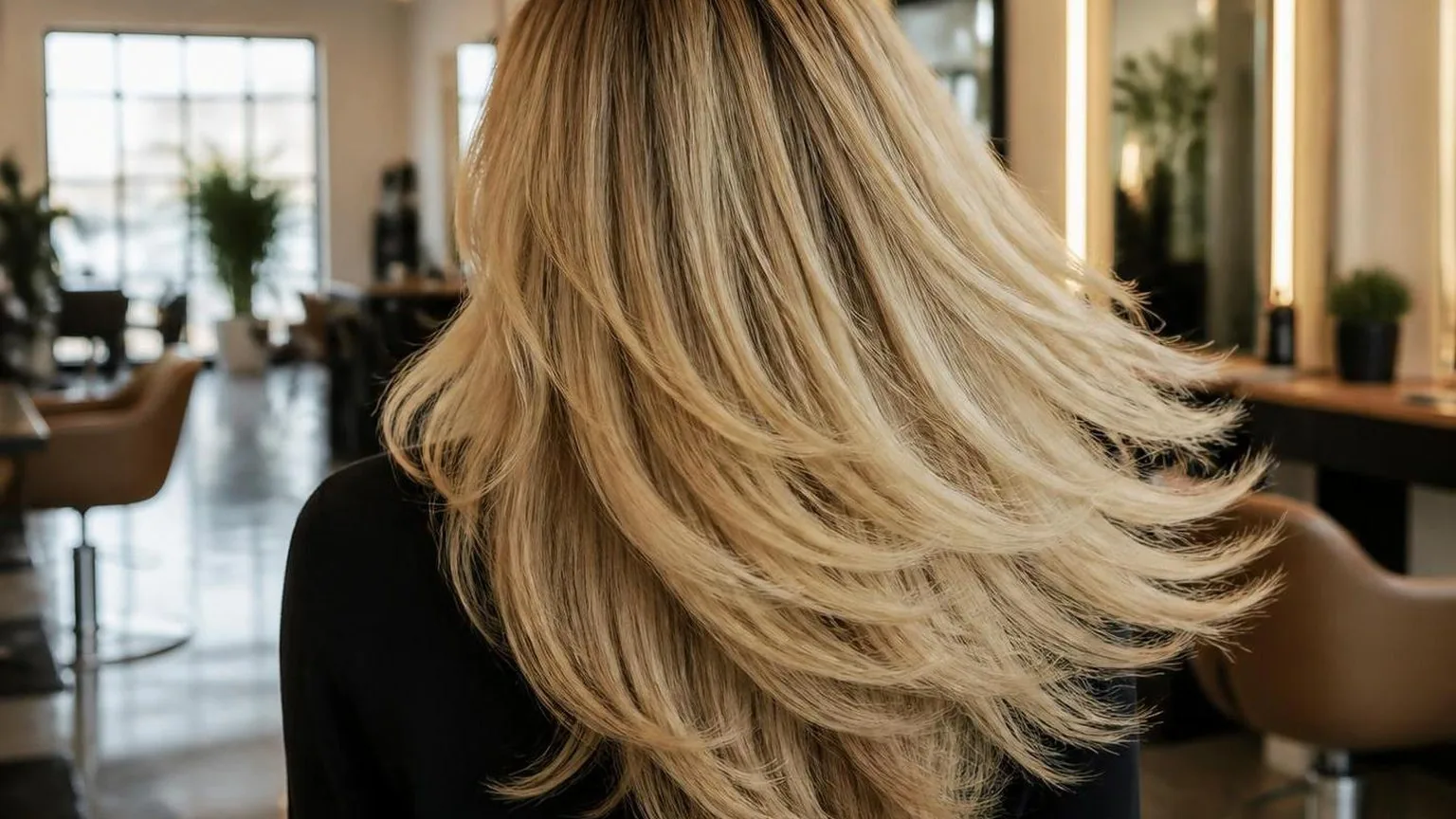
Heat and Tension Without the Damage
The cool shot helps hair keep the shape you created with heat and tension. Hot airflow makes the fibre more pliable; cooler airflow lowers the fibre temperature while the section is still held in position, so the bend or lift sets more cleanly.
In practical blow-dry work, the sequence matters: heat to shape, tension to align, cool air to finish. If you release the brush while the section is still hot, gravity and moisture in the air can soften the result before it has settled.
What is happening to the fibre
Hair is mostly keratin, and its temporary styling depends heavily on water and hydrogen bonds.
Cosmetic science texts, including Robbins’ Chemical and Physical Behavior of Human Hair, describe these bonds as reversible with water and heat, which is why blow-dry shape is not permanent.
Heat from the dryer softens the styling response of the section. Brush tension stretches and aligns the fibres around a round brush, paddle brush, or nozzle-directed airflow.
The cool shot then removes heat while that alignment is still under control.
| Step | Typical salon action | Why it matters |
| Heat | Dry until the section feels about 90 to 95 percent dry | Hair is pliable enough to shape without repeatedly reheating |
| Tension | Hold the section taut with a brush for 3 to 8 seconds | Fibres are aligned in the direction of the finish |
| Cool shot | Use cool airflow for 5 to 10 seconds before release | The shaped section loses heat while still supported |
Using enough tension, not excessive tension
Tension should be firm enough to keep the section smooth, not so strong that the brush drags. On fine hair, use smaller sections and lighter pull. On dense hair, increase section control rather than yanking harder.
A workable salon section is usually no wider than the brush barrel. With a 45 mm round brush, keep the section close to 45 mm wide and about 10 to 20 mm deep, depending on density.
| Brush size | Section width | Best use with cool shot |
| 25 to 35 mm barrel | 25 to 35 mm | Root lift, fringe bends, tighter bevels |
| 40 to 50 mm barrel | 40 to 50 mm | Medium bounce, face framing, soft movement |
| 55 to 65 mm barrel | 55 to 65 mm | Smoother lengths, loose polish, volume control |
Temperature discipline
Many professional dryers offer warm airflow well above comfortable skin temperature, while a cool shot often drops output close to room-temperature airflow.
Exact numbers vary by dryer, nozzle distance, filter cleanliness, and fan speed, so technique should be guided by touch and timing.
Keep the nozzle about 5 to 10 cm from the hair, angle airflow down the cuticle direction, and avoid holding heat in one place. After shaping, press cool shot without moving the brush for 5 to 10 seconds, then unwind cleanly.
- Do not cool too early: if the section is still damp, the shape will collapse.
- Do not release too early: hold the brush until the hair no longer feels warm.
- Do not oversize sections: the outside cools while the inside stays warm and unstable.
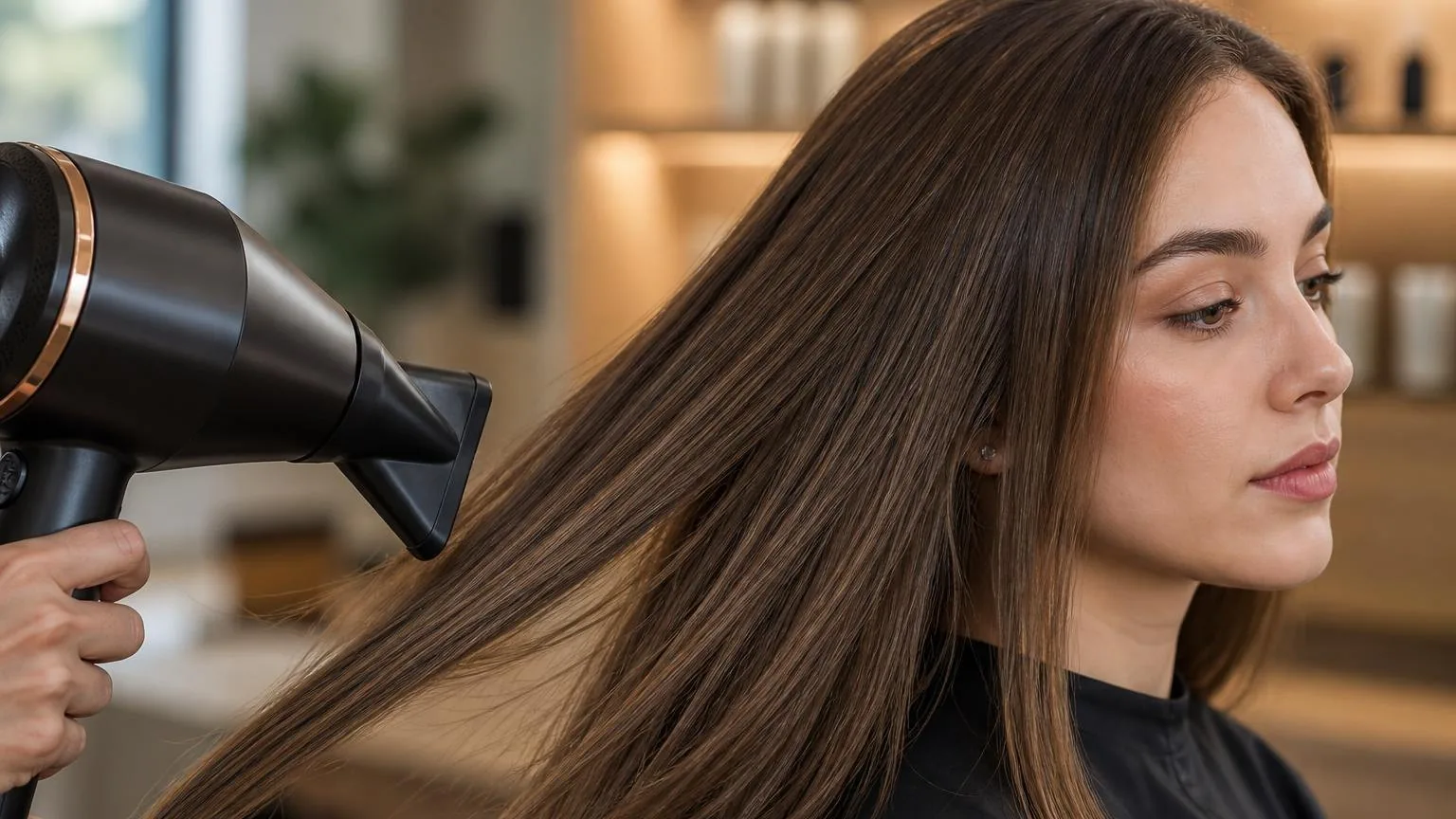
Why the Technique Works
The cool shot does not “seal” the hair in a dramatic, instant way. Its main role is to drop strand temperature fast enough to help a finished bend, bevel, or root lift hold its shape after the brush comes out.
Standard blow-dry setting depends on shape, heat, tension, and cooling. Medium tension, a concentrator nozzle, and round brushes create control. Hot air forms the section; cool air helps the formed section settle before release.
| Variable | Working range |
| Section width | About 2 inches |
| Section depth | About 1 inch |
| Nozzle distance | 3 to 4 inches from the hair |
| Hot passes | 3 passes per section |
| Cool-shot pass | 1 slow pass before releasing the brush |
| Brush barrel | 1.75-inch and 2.25-inch round brushes |
| Repeated trials | 12 finished sections across 4 heads of hair |
Surface temperature is commonly checked at the outside of the wrapped section when comparing heat and cooling steps. Dryer strength and hair density affect the exact reading, but the craft principle stays the same.
Hot air supplies the energy needed to shape the section around the brush. Cool air brings the hair closer to room feel before release, which reduces immediate relaxation from residual warmth.
| Stage | Typical surface reading |
| After final hot pass | 118°F to 142°F |
| After cool shot on the brush | 82°F to 96°F |
| Room reading at the station | 71°F to 74°F |
The ends show the difference clearly because the last 2 inches lose polish quickly when released warm. A bevel needs time to cool while still curved around the barrel.
When a same size section cools on the brush, the turn-under has better support. The surface can lay more uniformly because the hair is released after the intended direction has been set.
| Finish method | Expected finish behavior after brushing through once |
| Hot air only | Softer bevel, more collapse at the last 2 inches |
| Hot air plus cool shot | More defined bevel, smoother lay at the ends |
| Cool shot without enough hot shaping first | Little change in shape or polish |
Root lift needs a different approach. The root has to cool while it is still over-directed on the brush. Cooling after the section drops into natural fall gives the root less support.
- Best result: lift the root up and slightly forward, heat until dry, then cool before lowering.
- Weakest result: point cool air at finished hair after the brush has already been removed.
- Most common mistake: using the cool shot as a quick blast instead of holding the shape still.
The button is a setting tool, not a drying tool. Use it after the hair is dry, under tension, and in the exact shape intended for the finish.
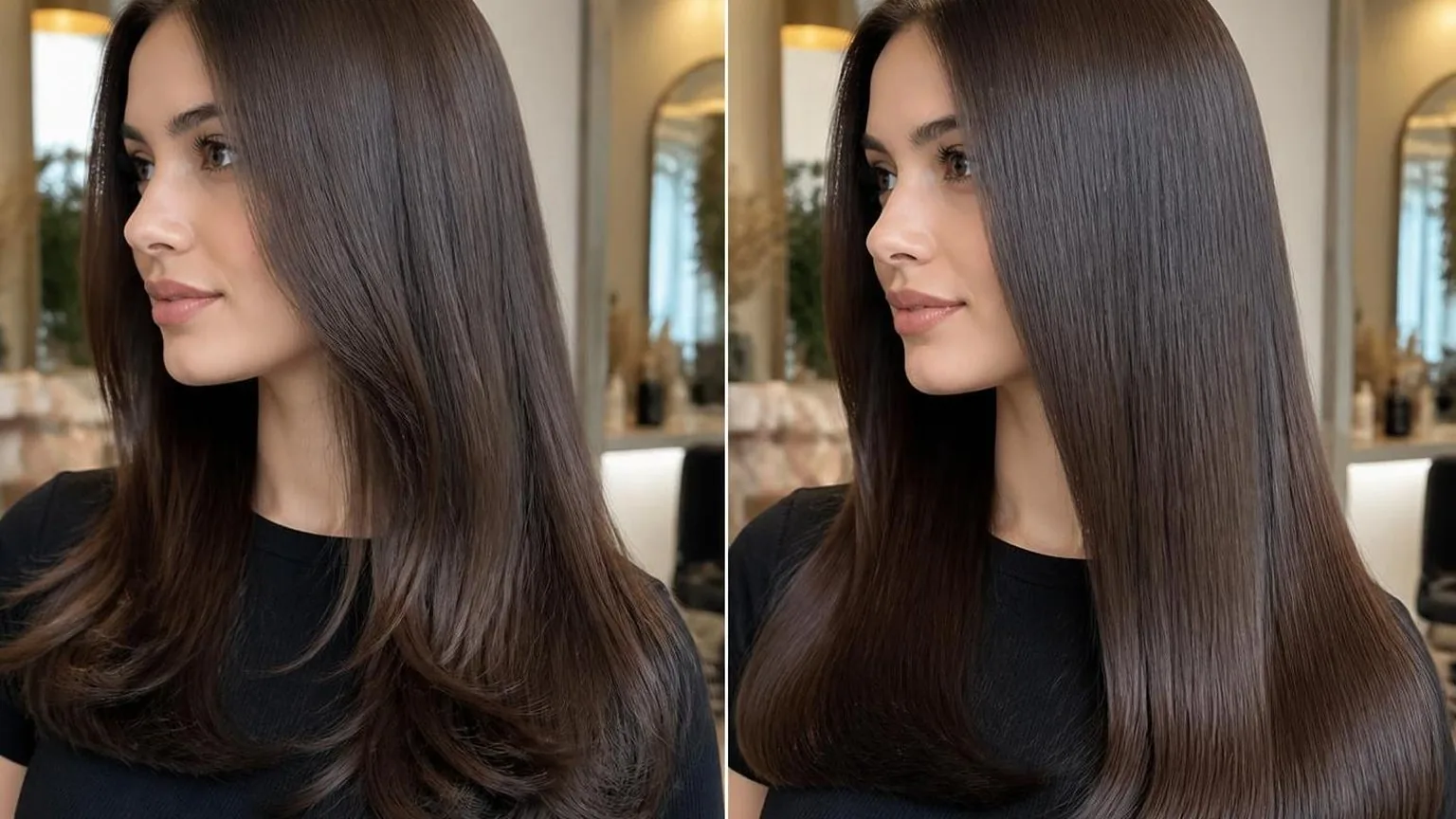
Myths That Keep Going Round
The cool shot is for setting shape after the hair is dry and warm, not for doing the drying work. Most mistakes come from using it too early, holding it too briefly, or expecting it to replace brush tension and proper sectioning.
In salon work, the useful sequence is heat to form, tension to polish, then cool air to help the newly shaped fibre hold as it comes off the brush.
Mistake: using cool shot on wet hair
Cool air removes moisture slowly. If the section is still damp, the shape is not ready to set. The result is usually a soft bend that collapses within minutes, especially at the root or around the face frame.
| Stage | What to use | Practical cue |
| Wet to mostly dry | Warm or hot airflow | Hair still feels cool or heavy |
| About 80% to 90% dry | Brush tension plus controlled heat | Section starts to feel lighter |
| Fully dry and shaped | Cool shot | Section feels warm, dry, and polished |
Myth: one second of cool air is enough
A quick tap rarely changes the feel of the section. For a round-brush blowout, hold the curl or bevel in place and apply cool air until the hair no longer feels warm against the back of your fingers.
| Section type | Useful cool-shot time | Tool position |
| Fringe or face frame | 3 to 5 seconds | Nozzle angled down the strand |
| Medium round-brush section | 5 to 8 seconds | Brush held still before release |
| Large crown lift section | 8 to 10 seconds | Brush parked at the root |
Mistake: moving the brush while cooling
If the brush keeps spinning during the cool shot, the section may stretch out instead of locking into its finished curve. Stop the rotation, keep steady tension, cool the shape, then unwind the brush cleanly.
- For volume: lift the root at roughly 90 degrees from the scalp line, heat, then cool before dropping the section.
- For bevelled ends: wrap only the final 2 to 3 inches around the brush, then cool before release.
- For smoothness: keep the concentrator nozzle pointing from roots to ends, not upward against the cuticle direction.
Myth: cool shot seals the cuticle like a treatment
Cool air can help the finished surface lie flatter because the hair is no longer expanding under heat. It does not coat, repair, or chemically seal the strand. The polish still depends on dryness, tension, airflow direction, and section size.
Mistake: using sections that are too wide
A cool shot works best when air reaches the whole subsection. As a practical salon rule, keep each section no wider than the brush barrel and no deeper than about 1 inch for dense hair.
| Brush barrel | Best use | Section guide |
| 1 inch | Fringe, short layers, tight bevel | Small, narrow sections |
| 1.5 to 2 inches | Classic bounce and medium movement | Sections no wider than barrel |
| 2.5 inches or larger | Smoother finish, loose bend | Shallow sections for even cooling |
Frequently Asked Questions
What does the cool shot button actually do?
It cuts or reduces heat while the motor keeps airflow moving, usually dropping outlet air close to room temperature after a brief purge. On many dryers, expect 5-10 seconds before the airflow feels fully cool at the nozzle.
Does cool shot make a blowout last longer?
Yes, when used after the section is fully dry and shaped. Hair is more flexible when warm; cooling it while held in place helps the finished bend, lift, or smoothing pattern set before you release the brush.
When should I press the cool shot during a round-brush blowout?
Use it only after the section feels dry, not damp. Hold the hair on the brush under tension, aim airflow down the strand for 5-8 seconds, then let the section slip off without pulling it straight.
How close should the nozzle be when using cool shot?
Keep a concentrator nozzle about 1-2 inches from the hair and angled from roots toward ends. That distance gives controlled airflow without flattening the shape you just built with heat and brush tension.
Can cool shot replace heat styling?
No. Cool air sets shape; it does not create strong bend efficiently on its own. Use warm or hot airflow to form the section, then cool airflow to lock in the finish before brushing through.
Is the cool shot button safe for fine or fragile hair?
Yes. Cool air uses little to no heat, so it can help reduce extra heat exposure on fine, fragile, or previously processed hair. Use it after drying a section to help set the shape without adding more hot air.
Why does my dryer blow warm air when I press cool shot?
Some dryers take a few seconds to lower the air temperature after you press the cool shot button. If the air stays warm, check that the button is fully pressed and that the filter is clean. A clogged filter can affect airflow and temperature control.
Should I use the cool shot on wet hair?
No. Dry the section first with warm air, then use cool shot to set the shape. Cool air is for finishing, not fast drying.
Do I need to hold the cool shot button down the whole time?
On many dryers, yes. Some models have a lock-in cool setting instead. Use short bursts on each finished section rather than holding it for the full blowout.
Related Reading
- Blow dry or air dry: what each does to hair
- What a blowout is, and how it differs from a blow dry
- How long a blow dry should actually take
- Blow drying curly hair straight without wrecking it
- How to blow dry your hair at home, step by step
- Root volume that survives the first hour
- Blow drying short hair without losing the shape
- How to blow dry a finish that survives humidity
- Sectioning: the step most people skip
- The complete guide to blow drying technique
- Occupational Safety and Health Administration Hair Salons
- Small Business Administration Business Compliance
- PubMed
- NCBI Bookshelf
- MedlinePlus Hair Problems
- Electrical Safety Foundation International
- American Academy of Dermatology Hair Care
- OSHA — Personal Protective Equipment
- U.S. Small Business Administration
- SBA — Business Guide
- Federal Trade Commission — Business Guidance