
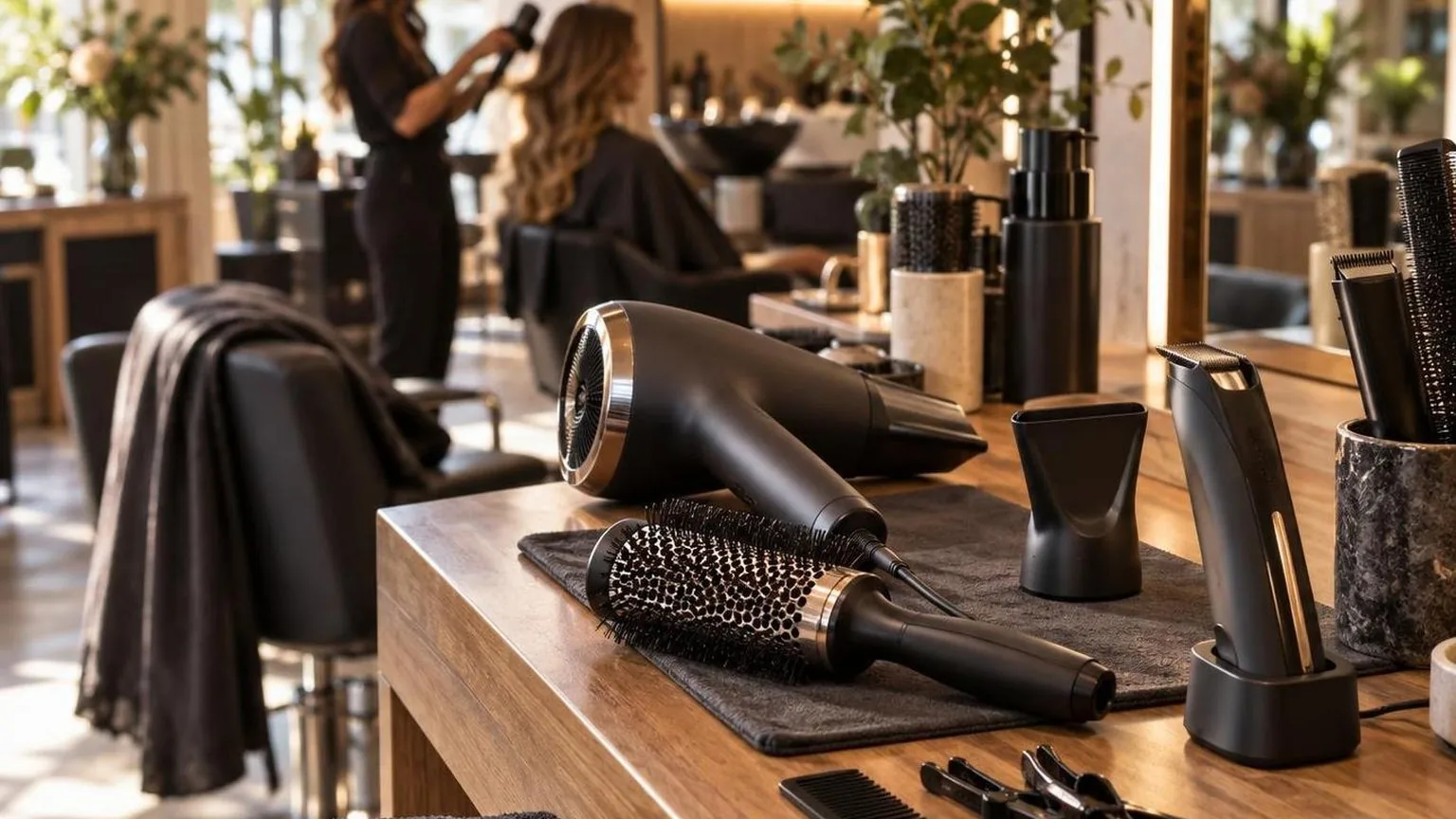
What is a brushless motor hair dryer? It uses electronically controlled magnets instead of carbon brushes to spin its motor, reducing friction and supporting high airflow at lower internal wear.
This design can deliver steadier speed, quieter operation and longer motor service than traditional brushed dryers, depending on construction.
For salon work, assess motor speed, airflow volume, heat settings and nozzle fit rather than relying on the brushless label alone.
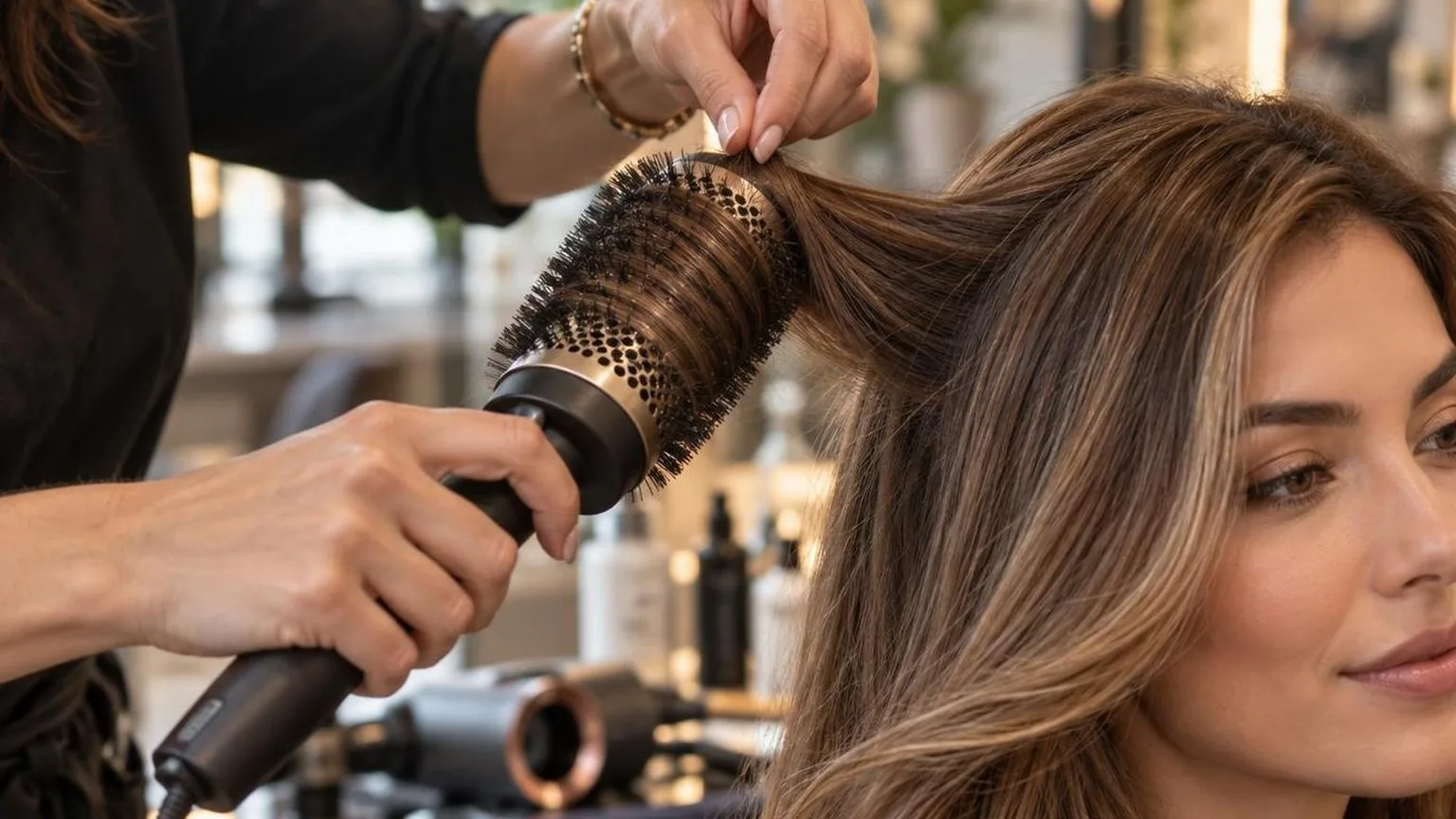
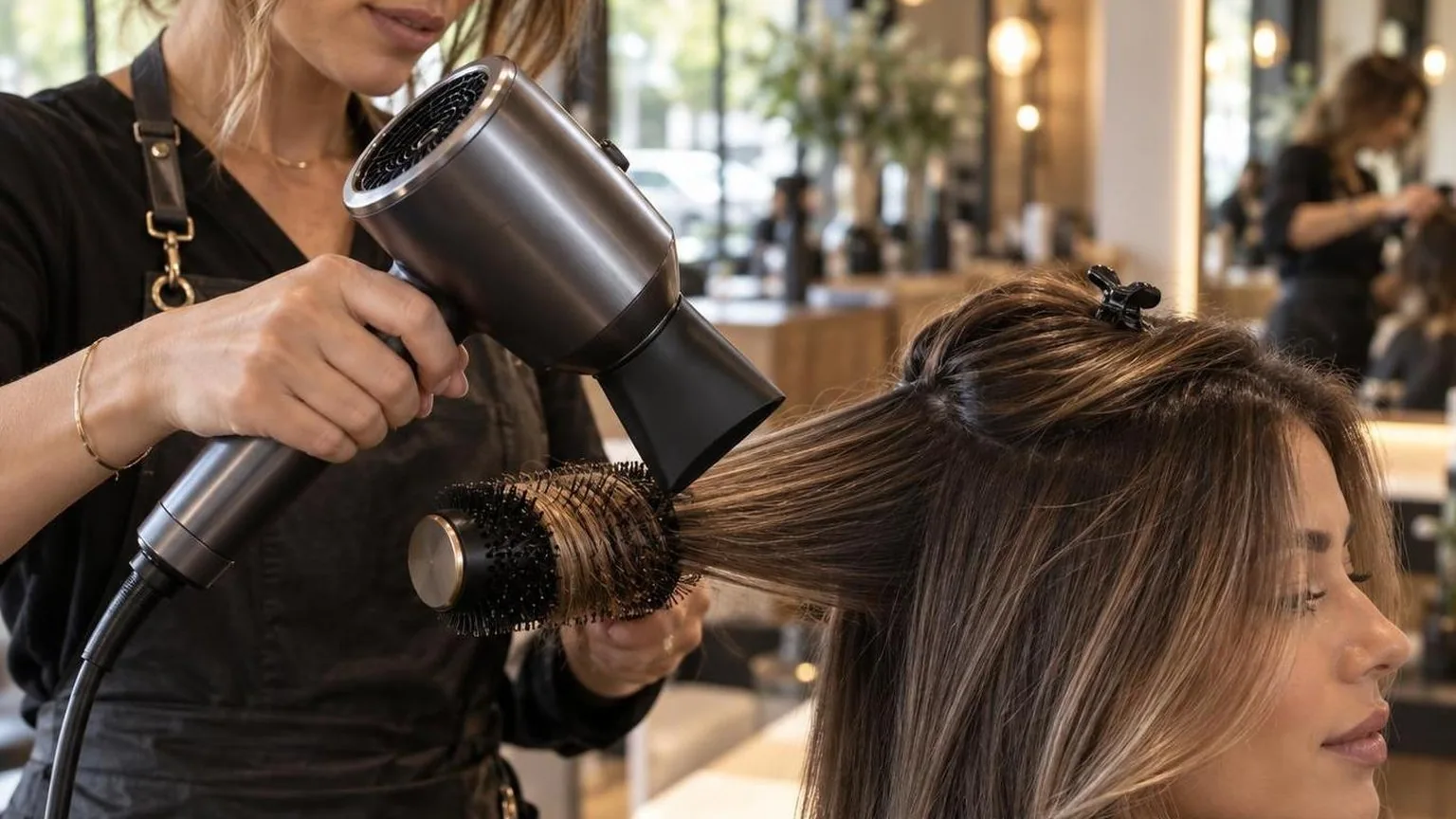
A dryer with three heat levels, two speed settings and a concentrator around 70 millimetres wide supports controlled round-brush tension and efficient section drying. Compare noise, weight and filter access.
Match a Brushless Dryer to Your Chair Time
Brushless motors vary in airflow, weight, and wattage. The right unit depends on how many clients you dry per day and how thick the hair typically is. Work through these steps before purchasing.
- Count your daily blowouts. Salons averaging 12 or more blowouts per shift need a motor rated above 100,000 hours of lifespan. Brushless motors hit that figure; brushed motors typically cap around 1,000–2,000 hours. Divide your annual operating hours by that ceiling to see when replacement hits.
- Weigh your current dryer on a kitchen scale. Most brushed-motor dryers land between 450 g and 680 g. Brushless units using the same housing often sit 50–120 g lighter because the motor assembly is more compact. If your stylists report wrist fatigue after 6 hours on the floor, that reduction matters.
- Measure your average dry time per client. Time three consecutive blowouts on medium-density hair, root to finish. Brushless motors sustain consistent RPM — often 110,000 RPM — without the torque drop that carbon-brush wear causes. If your current average exceeds 14 minutes on medium hair, the sustained airspeed of a brushless unit can shave 2–4 minutes off.
- Check your noise threshold. Brushless dryers commonly register 72–78 dB at 15 cm from the nozzle. Hold a free decibel-meter app at that distance from your current dryer and compare.
These four data points — lifespan need, weight tolerance, dry time, and noise level — give you a factual baseline before any brand comparison.
The Figures Behind It
Brushless motor hair dryers typically spin at 100,000–110,000 RPM, producing airflow velocities around 20–22 m/s at the nozzle.
That rotational speed is roughly double what conventional AC and DC brush motors achieve, translating into faster drying with less heat dependency.
The core difference is electromagnetic switching. Brushless motors use electronic commutation via a circuit board rather than physical carbon brushes scraping against a commutator ring.
This eliminates friction-generated heat and particulate wear inside the motor housing.
Brushless vs. Brushed Motor Comparison
| Specification | Brushless Motor | AC Brush Motor | DC Brush Motor |
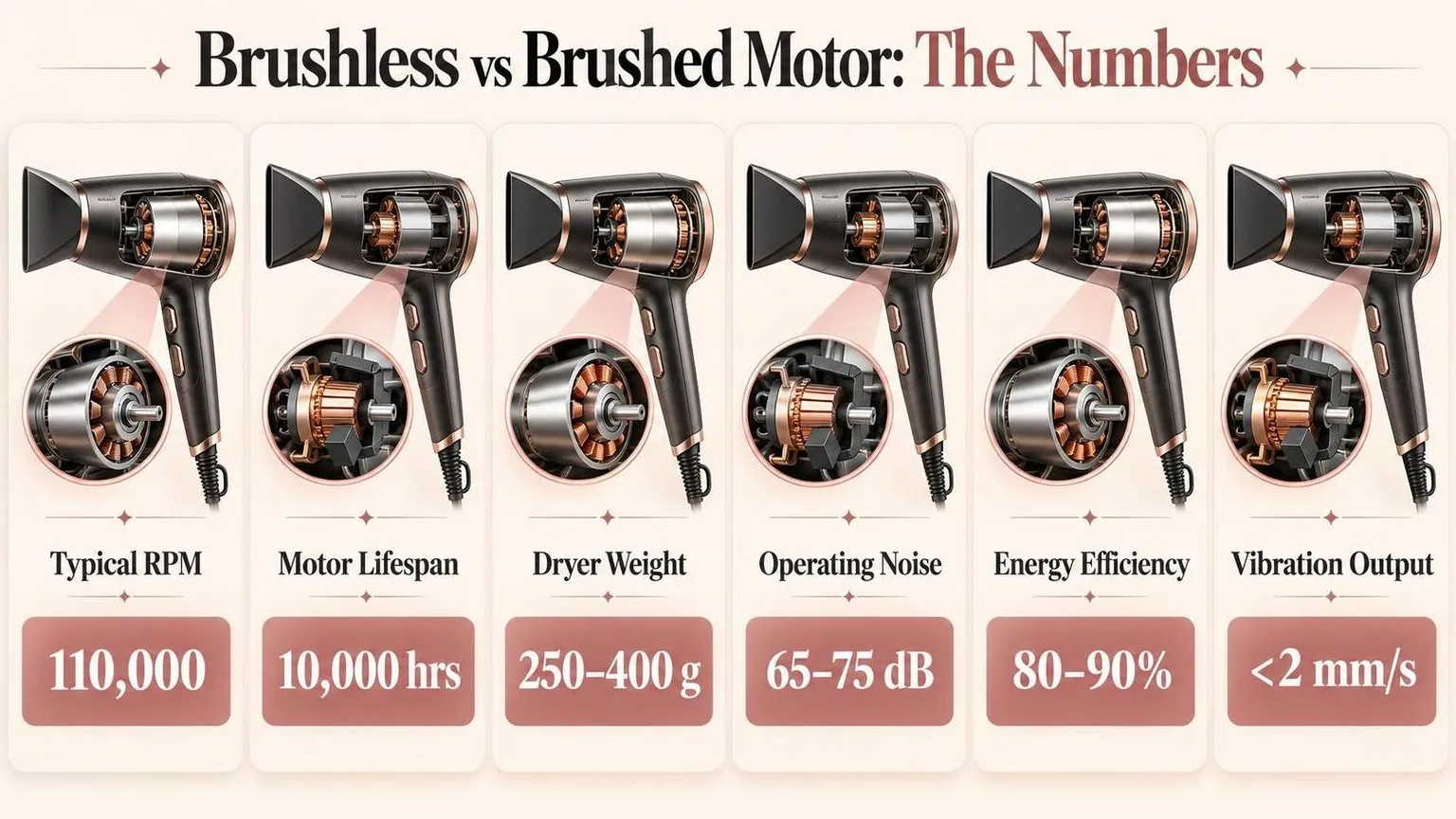
| Typical RPM | 100,000–110,000 | 20,000–30,000 | 10,000–18,000 |
| Motor lifespan (hours) | 8,000–10,000 | 1,000–2,000 | 500–1,500 |
| Typical dryer weight | 250–400 g | 500–700 g | 400–600 g |
| Operating noise | 65–75 dB | 80–90 dB | 75–85 dB |
| Energy conversion efficiency | 80–90% | 50–60% | 50–65% |
That 80–90% energy conversion efficiency means less electrical input is wasted as motor heat. In practical terms, a 1,600 W brushless dryer can match the drying performance of a 2,200 W brushed dryer running at comparable heat settings.
Weight and Ergonomics
Brushless motors weigh between 30–50 g — roughly one-third the mass of a salon AC motor. This allows manufacturers to build complete dryers under 350 g, reducing wrist fatigue during 8–10 hour service days behind the chair.
Lifespan Implications for Salons
At an average salon usage of 6 hours per day, a brushless motor rated at 10,000 hours lasts roughly 4.5 operational periods longer than an AC brush motor rated at 2,000 hours. Fewer replacements offset the higher upfront cost.
- Carbon brush replacement cycles are eliminated entirely
- No commutator sparking reduces fire risk inside the barrel
- Electronic speed control enables precise RPM adjustments in 100–200 RPM increments
- Lower vibration output — typically under 2 mm/s — reduces hand numbness during extended sessions
The airflow-to-heat ratio is the metric that matters most for stylists. Higher RPM moves water off the hair surface mechanically, allowing operators to reduce temperature by 10–20 °C without extending drying time.
The Variables That Matter
Three variables separate one brushless motor dryer from another: wattage, airflow volume, and air speed at the nozzle. These determine how fast you can complete a blowout and how much heat damage the hair absorbs during the process.
Wattage vs. Airflow
Wattage measures total electrical draw, not drying power. A 1,600 W brushless dryer with superior impeller design can outperform a 2,000 W brushed unit with a less efficient fan assembly.
Airflow volume, measured in cubic feet per minute (CFM), is the better predictor of drying speed. Higher CFM means more moisture is carried away from the hair per second.
| Metric | Typical Brushed Motor Dryer | Typical Brushless Motor Dryer |
| Wattage | 1,800–2,000 W | 1,400–1,600 W |
| Airflow volume | 35–45 CFM | 40–62 CFM |
| Air speed at nozzle | 60–80 mph | 80–110 mph |
| Motor RPM | 20,000–30,000 | 90,000–110,000 |
| Weight (body only) | 450–600 g | 300–450 g |
The RPM difference is the core advantage. A brushless motor spinning at 100,000+ RPM drives a compact impeller that accelerates air through a narrower pathway, raising velocity without requiring more heat.
Heat Settings and Control
Look for dryers offering at least three discrete heat levels. Intelligent brushless models use a thermistor near the outlet to regulate temperature 40–50 times per second, holding output within ±2 °C of the selected setting.
That precision matters. Conventional dryers without active regulation can fluctuate by 15–20 °C during a single pass, increasing the risk of cuticle damage on fine or colour-treated hair.
What to Evaluate Before Purchase
- CFM rating — prioritise airflow volume over wattage; anything above 50 CFM significantly reduces blow-dry time
- Weight distribution — a dryer under 400 g reduces wrist fatigue across a full column of 8–12 clients
- Nozzle bore diameter — narrower concentrators (around 7–9 mm opening) increase air speed for smoother tension styling
- Noise output — brushless motors typically produce 72–78 dB versus 85–90 dB for brushed equivalents
- Filter accessibility — removable rear filters prevent lint buildup that degrades airflow by up to 30% over weeks of salon use
Spec sheets rarely list CFM. If the manufacturer only provides wattage, treat it as incomplete information and request airflow data before committing to a bulk order for the salon floor.
Spotting It on the Day
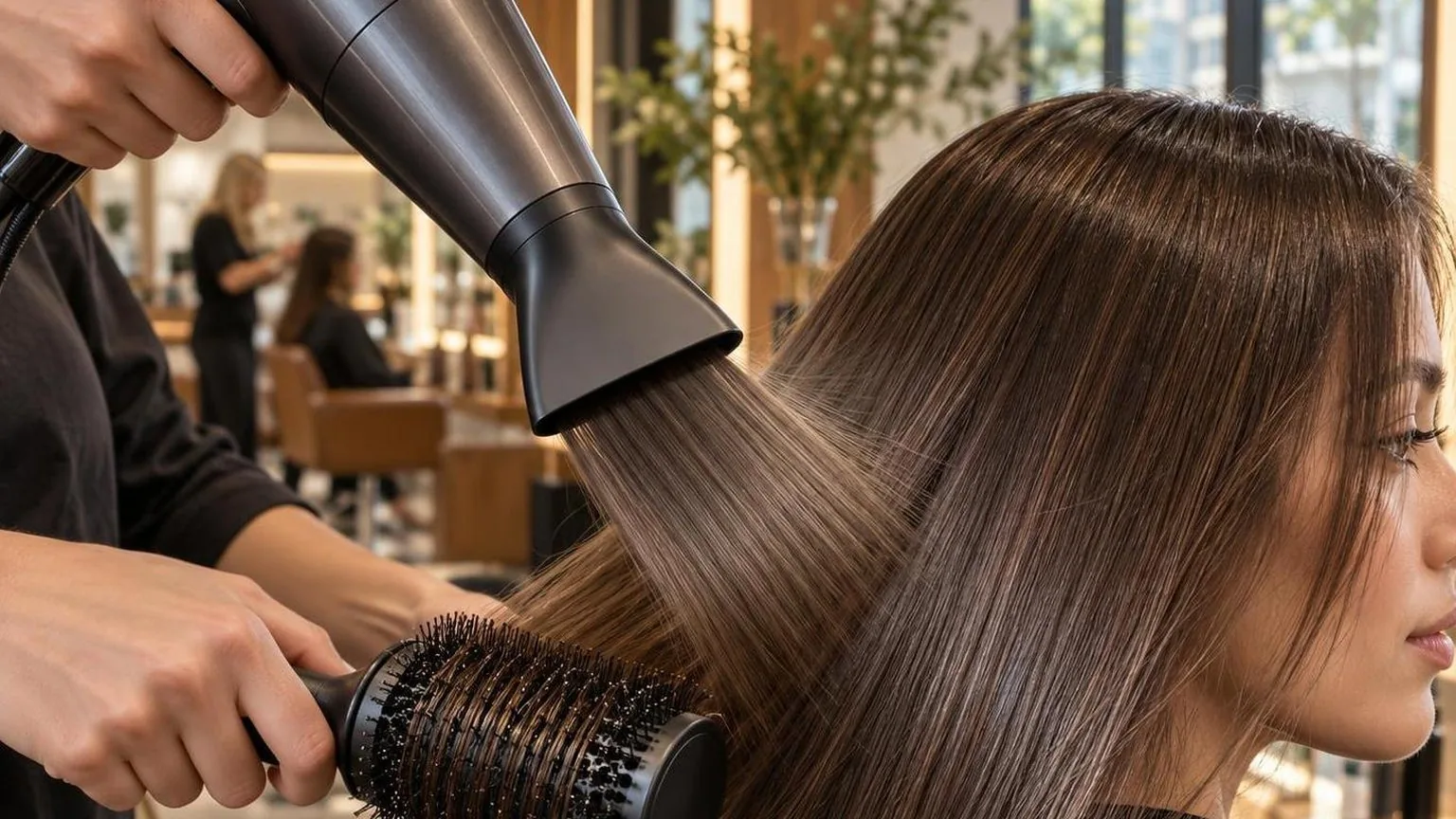
A good result from a brushless motor hair dryer is a smooth, frizz-free finish achieved faster and with less heat damage than a conventional brushed-motor dryer. The hair feels soft, retains moisture, and holds its style through a full day.
Brushless motors generate higher airflow relative to their wattage. This means the dryer relies more on concentrated air velocity and less on extreme heat to evaporate water from the hair shaft.
Benchmarks to Expect
When switching from a brushed AC or DC motor dryer to a brushless model, measurable differences should be evident across several variables.
| Metric | Brushed Motor Dryer | Brushless Motor Dryer |
| Typical airflow | 40–60 mph | 60–110 mph |
| Motor speed (RPM) | 20,000–30,000 | 80,000–110,000 |
| Average weight | 450–680 g | 300–450 g |
| Rough dry time (medium-density, shoulder-length hair) | 8–12 min | 5–8 min |
| Recommended working temperature at nozzle | 80–95 °C | 57–80 °C |
Visual and Tactile Markers
- Cuticle lies flat, producing a reflective, glass-like sheen rather than a matte or frizzy texture
- Ends feel pliable, not brittle or straw-like
- Root area has lift without excessive dryness or static
- Blowout holds its shape for 12–24 hours in moderate humidity without heavy product
What to Watch For
High airflow at lower temperatures reduces the risk of thermal fatigue, but technique still matters. Hold the nozzle 10–15 cm from the hair and angle it down the shaft at roughly 45 degrees.
Overreliance on the highest speed setting can disrupt curl pattern or blow fine hair out of the brush. Start on a medium speed, medium heat setting and adjust upward only as needed.
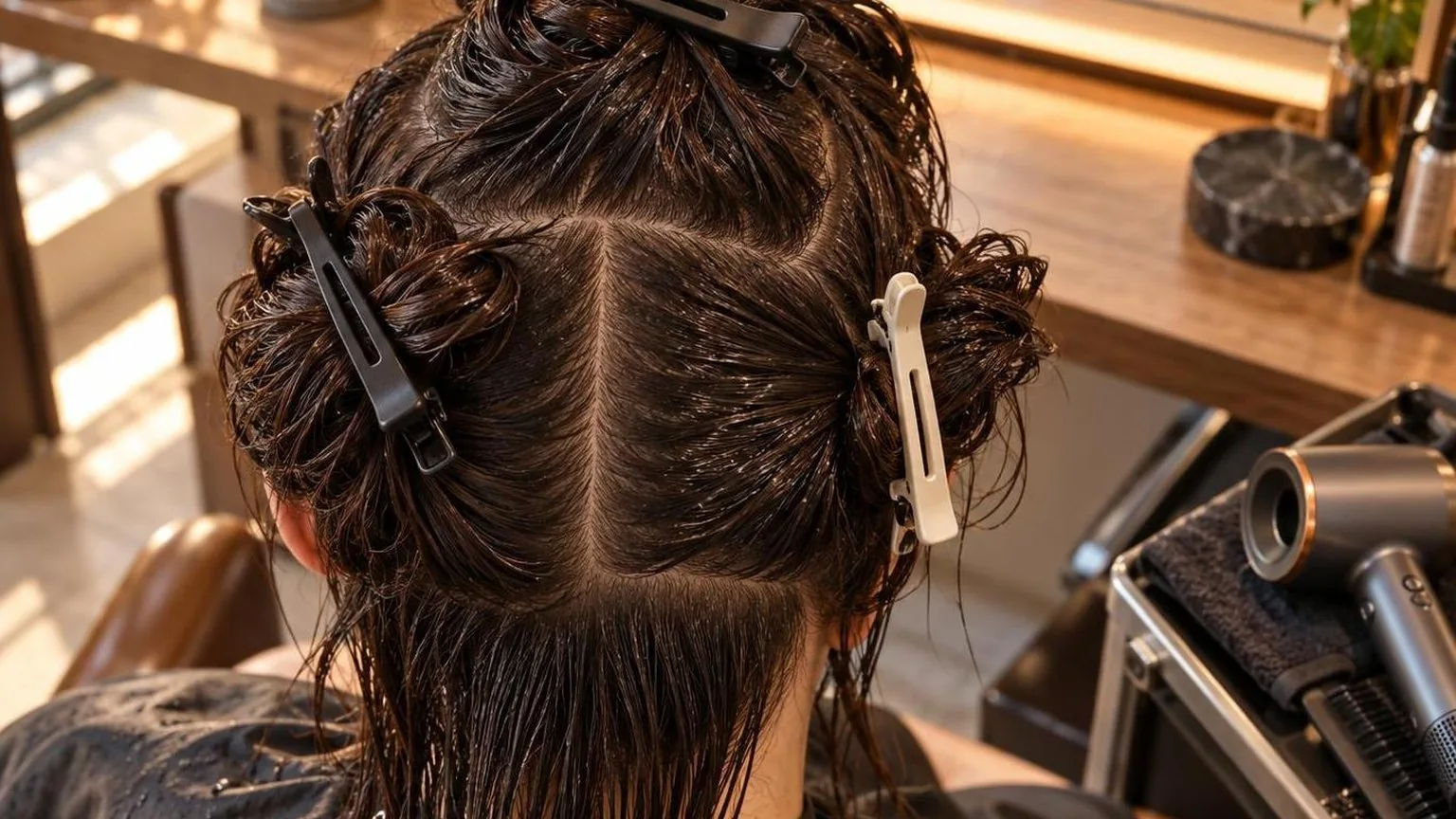
Section hair into clips no wider than 5 cm. Smaller sections dry faster and receive more even airflow, producing a consistent finish from root to tip across the entire head.
A properly executed blowout with a brushless motor dryer should leave the hair 90–100 percent dry with no residual dampness at the nape or behind the ears, where density is highest.

Weighed Against What Else Is Used
Brushless motor dryers compete primarily against two established technologies: brushed DC motors and AC (alternating current) motors.
Each type differs in airflow output, weight, lifespan, and noise level, which directly affects styling speed and client comfort in a salon setting.
Core Comparison
| Attribute | Brushless DC (BLDC) | Brushed DC | AC Motor |
| Typical motor speed | 100,000–110,000 RPM | 15,000–30,000 RPM | 8,000–12,000 RPM |
| Dryer weight range | 300–450 g | 400–550 g | 500–750 g |
| Estimated motor lifespan | 8,000–10,000 hours | 1,500–3,000 hours | 5,000–8,000 hours |
| Noise level range | 58–72 dB | 70–80 dB | 75–85 dB |
| Airflow velocity | 40–60 m/s | 15–25 m/s | 18–28 m/s |
Where AC Motors Still Hold Ground
AC motors remain standard in many professional salons. Their torque stays consistent at sustained high wattages, typically 1,800–2,200 W. Replacement parts are widely available and inexpensive, keeping long-term service costs low.
The heavier barrel of an AC dryer provides a counterbalance some stylists prefer during round-brush tension work. That weight becomes a liability during six-to-eight-hour shifts.
Where Brushed DC Falls Short
Brushed DC motors rely on carbon brushes that physically contact the commutator. This friction generates heat and particulate debris inside the motor housing, contributing to faster degradation.
Most brushed DC dryers used in travel or consumer segments draw 1,000–1,600 W. Lower wattage and slower airspeed make them unsuitable for high-volume professional blowout services.
Practical Tradeoffs to Consider
- Brushless dryers typically cost 2–4 times more at point of purchase than comparable brushed DC units.
- High-RPM brushless motors produce a higher-pitched tone that sits around 4–6 kHz, which some stylists and clients find more noticeable despite the lower decibel reading.
- Replacement of a failed brushless motor usually requires full-unit service rather than a simple brush swap.
- AC dryers with removable rear filters allow faster lint clearing between clients — a workflow step that some sealed brushless designs complicate.
Choosing between the three depends on daily client volume, shift length, and budget tolerance for upfront investment versus long-term motor replacement cycles.
Where Damage Creeps In
Brushless motor dryers deliver consistent airflow velocity throughout a session, preventing the temperature spikes that scorch cuticles.
Their electronically commutated motors maintain stable RPM under load, so heat stays where you set it rather than surging when airflow meets resistance from dense sections.
Traditional brushed motors lose torque as carbon brushes wear, forcing the heating element to compensate. Brushless designs eliminate that variable entirely by using sensor-driven electronic switching to regulate rotor speed.
Temperature Stability Comparison
| Factor | Brushed Motor Dryer | Brushless Motor Dryer |
| Typical RPM range | 18,000–22,000 | 90,000–110,000 |
| Temperature fluctuation at nozzle | ±15–20 °C | ±3–5 °C |
| Airflow velocity (approx.) | 15–20 m/s | 30–60 m/s |
| Avg. weight | 500–700 g | 300–450 g |
Higher airflow velocity matters for blowout work because it means you can dry at a lower temperature setting while achieving the same evaporation rate. Less thermal exposure per pass translates to less cuticle lifting.
Why This Matters at the Chair
Stylists doing 8–12 blowouts per shift accumulate fatigue from heavy, vibrating tools. Brushless dryers weigh roughly 30–40 % less than brushed equivalents, reducing wrist strain across a full day.
- Reduced pass count: Concentrated airspeed seals each section in 2–3 passes instead of 4–6, cutting mechanical tension on the strand.
- Lower heat dependency: Setting the dryer to 70–80 °C instead of 100+ °C achieves comparable dry times when airflow velocity exceeds 40 m/s.
- Consistent tension angle: Stable RPM means the pull you feel through the round brush stays uniform from root to end, preventing snag points that cause mid-shaft breakage.
The practical outcome is a smoother cuticle layer with fewer lifted edges. Clients notice increased shine and stylists notice less flyaway management on the finishing pass.
For salon owners evaluating new tool purchases, the relevant metric is not wattage alone. Airflow velocity at the nozzle tip, measured in metres per second, predicts drying efficiency more reliably than raw power ratings.

Step by Step Through the Change
A brushless motor dryer reshapes hair by evaporating water from the cortex while the cuticle layer is held flat by controlled airflow.
The mechanism is identical to any blow dryer — heat breaks hydrogen bonds between keratin chains, and tension from a brush resets them in a new position as hair cools.
Wet hair contains roughly 15–35% water by weight. Each strand swells by approximately 14% in diameter when fully saturated, and the hydrogen bonds that give hair its temporary shape are completely broken.
The Drying Sequence
- Surface water removal (first 2–3 minutes): Airspeed matters most here. Brushless motors producing airflow above 20 m/s strip free water from the hair surface rapidly.
- Bound water evaporation (middle phase): Heat penetrates the cortex. Temperatures at the hair surface between 60–70 °C are sufficient to drive moisture out without thermal damage.
- Bond resetting (final phase): As moisture drops below 10%, hydrogen bonds reform. The shape held by brush tension at this moment becomes the set.
Temperature Thresholds
Keratin protein begins to degrade at sustained temperatures above 150 °C. Cuticle lifting — the visible roughness that causes frizz — starts at lower thresholds, around 100 °C at the strand surface.
| Hair surface temp | Effect on strand |
| 60–70 °C | Efficient moisture removal, cuticle stays flat |
| 80–100 °C | Faster drying, early cuticle lifting possible |
| Above 150 °C | Protein degradation, irreversible cortex damage |
Brushless motors hold consistent RPM under load, typically 100,000–110,000 RPM. This steady airflow means heat distributes more evenly across the hair section being dried.
Uneven airflow from a faltering motor creates hot spots. Hot spots push localised strand temperatures above safe thresholds while neighbouring strands remain wet — the worst combination for both damage and a poor finish.
The practical result: each pass of the brush dries more uniformly, so fewer total passes are needed. Fewer passes mean less cumulative heat exposure and less mechanical friction on the cuticle.
Where It Usually Goes Wrong
Most problems with brushless motor dryers stem from mismatched expectations, not mechanical failure.
Buyers assume the motor alone guarantees faster drying or less damage, overlooking technique, wattage, and airflow design as equally critical factors.
The first pitfall is conflating motor type with wattage. A brushless motor at 1,200 W will underperform a traditional AC motor at 1,875 W in raw drying speed. Motor efficiency matters, but total power output still dictates airflow volume.
| Factor | Common Assumption | Reality |
| Airflow (CFM) | Brushless always delivers more | Ranges from 22–62 CFM depending on wattage and impeller design |
| Heat damage | Brushless motors reduce it | Heat element, not motor type, controls temperature output |
| Noise | Always quieter | Typically 10–15 dB lower than AC motors, but cheap models can still exceed 85 dB |
| Lifespan | Lasts forever | Rated around 8,000–10,000 hours vs. 1,000–2,000 hours for brushed DC motors |
Second mistake: ignoring weight distribution. Brushless motors weigh as little as 50 g, dropping total dryer weight to 300–450 g.
That lightness shifts the center of gravity toward the barrel, causing wrist fatigue during long sessions if the handle is poorly balanced.
Third, stylists often set temperature too high to compensate for lower-wattage brushless models. Running any dryer above 150 °C at the nozzle without constant movement risks cuticle lifting, regardless of motor technology.
Maintenance Blind Spots
- Brushless motors lack carbon brushes, so there is no brush dust. Stylists then skip filter cleaning, allowing lint buildup to choke intake and reduce airflow by up to 30 percent.
- Concentrator nozzles on lightweight dryers crack more easily when dropped from styling stations — replacement nozzles are not always cross-compatible between brands.
- Cord strain increases when a lighter dryer gets tugged off hooks; coiled or reinforced cords reduce this risk.
The motor is one component in a system. Wattage, heating element design, nozzle shape, and impeller diameter (typically 28–32 mm in compact brushless units) all interact.
Evaluating the dryer as a whole prevents the most common buying and usage errors.
Frequently Asked Questions
What is a brushless motor hair dryer?
A brushless motor (also called a BLDC motor) uses magnets and electronic commutation instead of carbon brushes to spin the fan. This eliminates friction-generating contact points found in traditional AC and DC motors.
The result is a lighter, quieter unit that typically operates at higher RPM — often above 100,000 RPM in premium models.
How does a brushless motor differ from a traditional AC salon dryer?
A standard AC motor weighs roughly 200–300 g and spins at around 8,000–12,000 RPM. A brushless motor can weigh under 50 g while reaching 80,000–110,000 RPM, producing concentrated high-velocity airflow.
This shifts the drying mechanism from relying primarily on heat to relying on airspeed, reducing thermal damage risk.
Do brushless motor dryers last longer than brushed models?
Brushed motors degrade as carbon brushes wear down, typically rated for 500–800 hours of use. Brushless motors have no physical contact parts subject to friction wear, so manufacturers commonly rate them for 1,000–2,000 hours.
For a busy stylist averaging 6–8 blowouts daily, that difference translates to significantly longer service life.
Are brushless motor dryers quieter during a blowout?
Most brushless dryers measure between 72 dB and 82 dB, compared to 85–95 dB for conventional AC dryers. The absence of brush-to-commutator contact removes a major source of mechanical noise.
For stylists working full chairs over 8-hour shifts, that reduction in sustained noise exposure is meaningful for hearing comfort.
What temperature and speed settings should stylists look for in a brushless dryer?
Look for at least three heat settings with a top temperature around 100–110 °C at the nozzle and a cool-shot button that drops output below 30 °C.
Variable speed control — minimum two airflow settings — lets you adjust between rough-drying at full velocity and precision finishing at lower speeds with a round brush.
Related Reading
- What a diffuser does that a concentrator cannot
- Safe heat settings for a blow dry, by hair type
- How often a dryer filter needs clearing
- What a paddle brush is actually for
- Ionic or ceramic: what the labels actually mean
- Paddle or round: which brush does which job
- How long a hair dryer lasts, and what shortens it
- Choosing a professional dryer: what actually matters
- Boar, nylon or mixed: choosing round brush bristles
- The complete guide to blow dry tools