
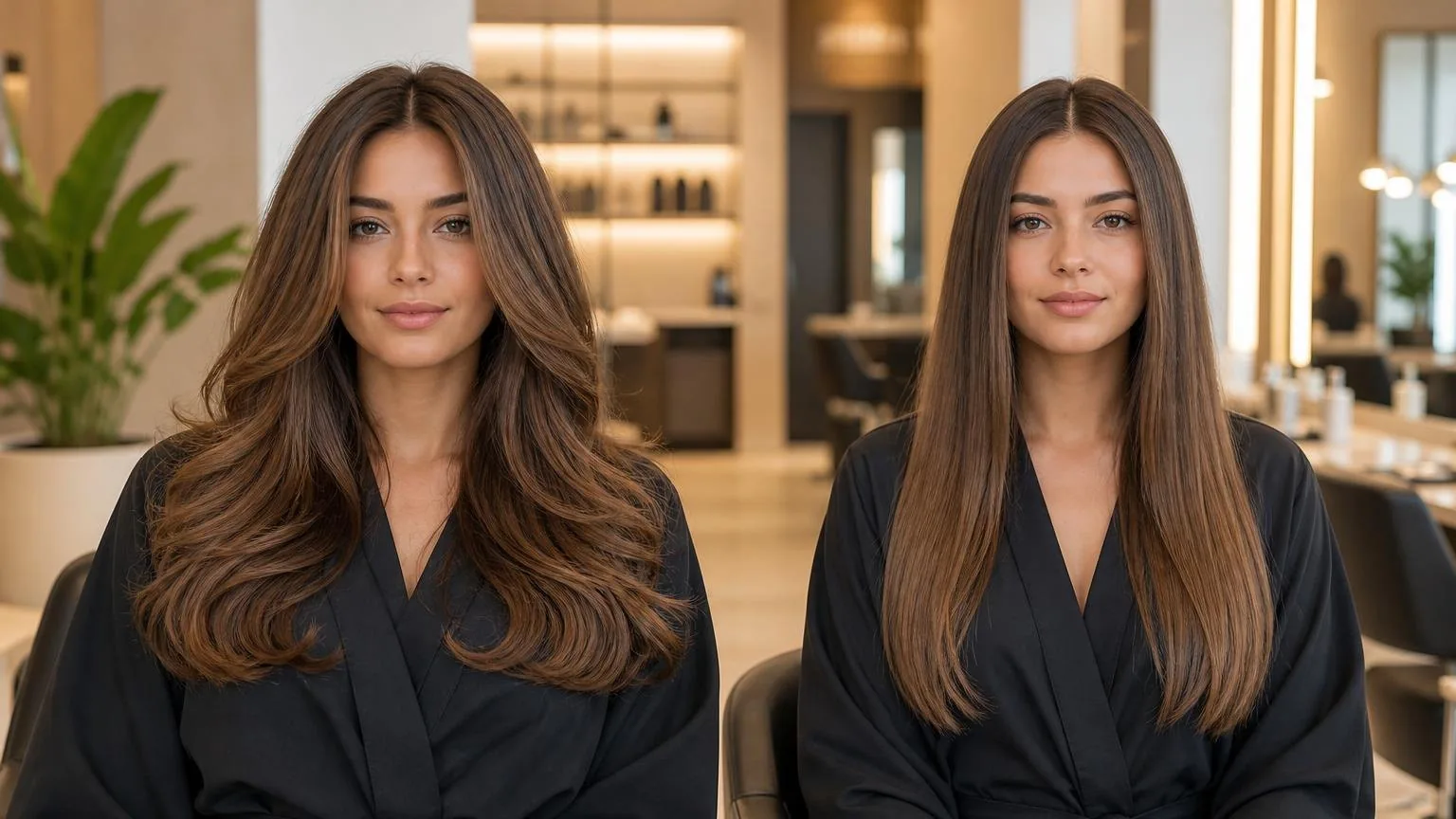
What a blowout is, and how it differs from a blow dry is this: a blowout is a styled finish built with brush tension, sectioning, airflow direction and cooling, while a blow dry simply removes moisture from the hair.
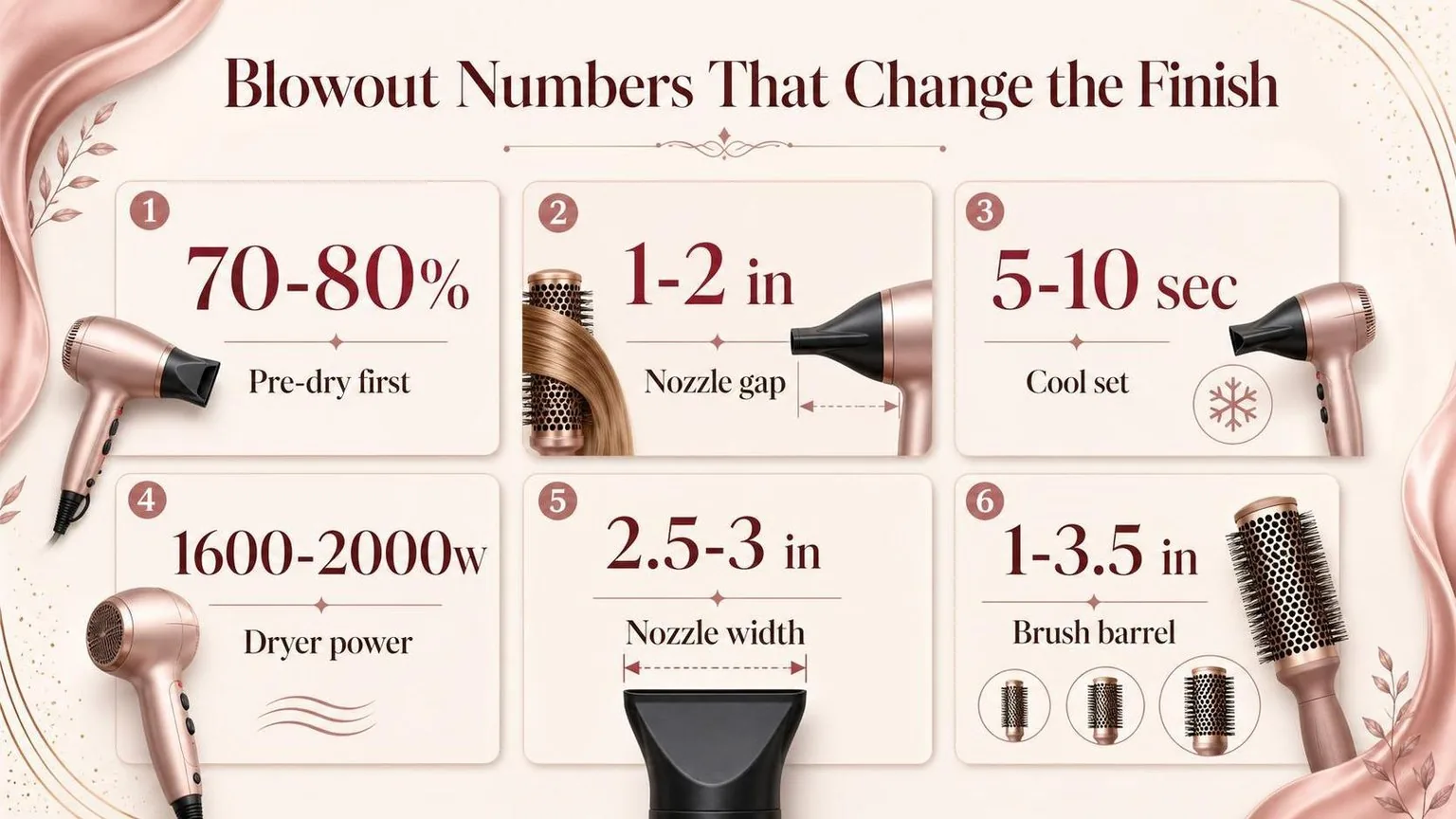
In the salon, a blowout usually starts at about 80% dry, then works in 1- to 2-inch sections using a round brush, nozzle, medium-high airflow and controlled heat around 160–200°F, depending on hair texture and tool setting.
The difference shows in the result: a blow dry can leave hair dry but unfinished; a blowout creates shape, polish, lift, bend or smoothness designed to last beyond the chair.
Map Your Blowout Finish
Use this quick chair-side check to decide whether you are doing a simple blow dry or building a true blowout. It works for home styling, a blow dry bar menu, or a stylist training checklist.
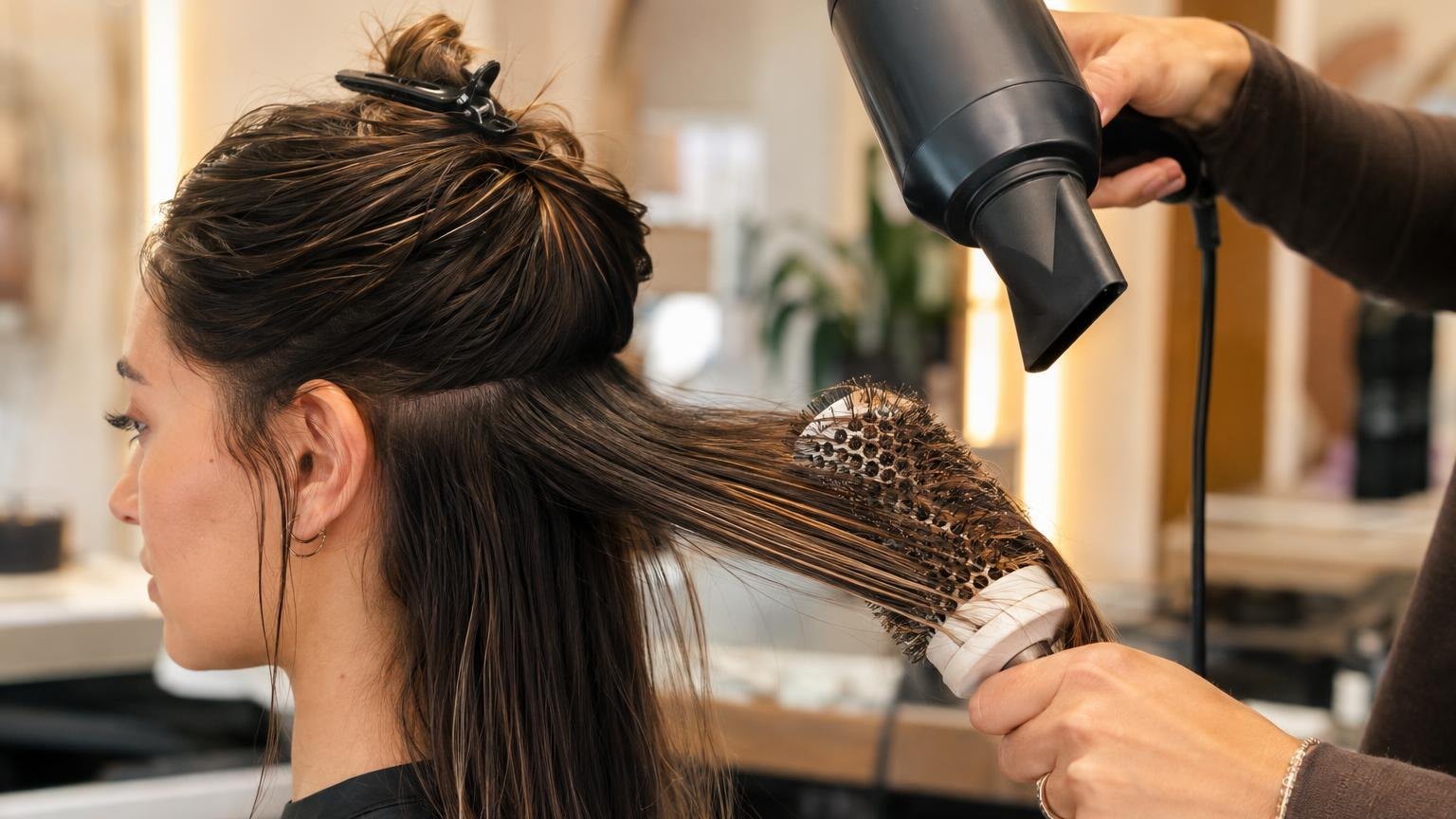
- Check the starting point. Hair should be towel-blotted, detangled, and rough dried to about 80% dry before detailed brush work starts. If you are only blasting wet hair until dry, it is a blow dry, not a blowout.
- Set your sections. Work in 1- to 2-inch sections. Use smaller sections for dense, coarse, curly, or resistant hair. If sections are too wide for the brush to control, the finish will lose polish and bend.
- Choose the brush goal. Use a round brush for lift, bounce, curve, and smoothness. Use stronger tension at the root for volume, then roll through the mids and ends for shape.
- Control heat and air. Aim the nozzle down the hair shaft with medium-high airflow and controlled heat, usually around 160–200°F depending on texture and tool setting. Keep the dryer moving; do not park heat on one spot.
- Lock the result. Cool each finished section for 5–10 seconds before dropping it. If the hair is dry but still collapsing flat, you skipped the setting step that separates a blowout from a basic dry.
If the process includes sectioning, brush tension, directional airflow, shape, and cooling, call it a blowout. If the main goal is simply removing moisture, call it a blow dry.
What the Data Shows
A blow dry is the act of drying wet hair with airflow.
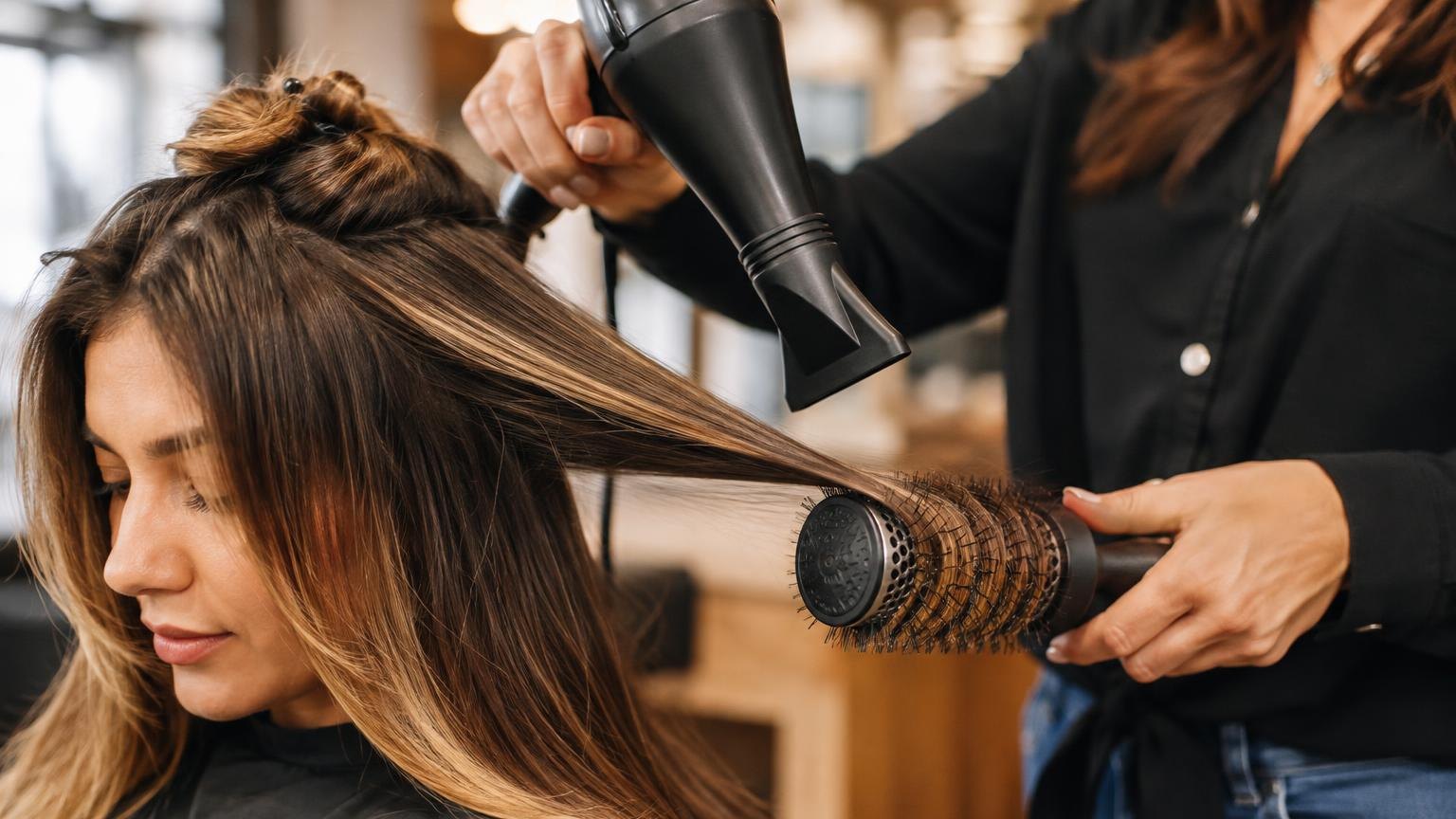
A blowout is a controlled finish: sectioning, brush tension, nozzle direction, cooling, and shape-setting are all used to create polish, volume, or movement that lasts beyond simply getting hair dry.
In salon terms, the difference shows up in time, section size, heat control, and tool handling. The numbers below reflect common professional practice, not a brand promise or a fixed service standard.
| Measure | Basic blow dry | Professional blowout |
| Typical service aim | Remove moisture and make hair presentable | Create a finished shape with volume, smoothness, bend, or bounce |
| Working sections | Larger panels, often hand-guided | Smaller controlled sections, usually around brush width |
| Brush involvement | Optional or light | Central to tension, polish, and shape |
| Cooling step | Often skipped | Used to help set the shape before releasing |
Drying starts more efficiently when excess water is removed first. Many stylists rough-dry or towel-blot until hair is damp, then begin brush work once the hair is no longer dripping.
This keeps the brush from acting like a sponge instead of a styling tool.
| Stage | Useful benchmark | Why it matters |
| Pre-dry before styling | About 70% to 80% dry | Brush work becomes faster and more controlled |
| Section width | Roughly the same as the brush barrel | Hair wraps evenly and tension stays consistent |
| Nozzle distance | About 1 to 2 inches from the hair | Directs airflow without pressing the dryer onto the strand |
| Cool shot | 5 to 10 seconds per section | Helps the section hold its set shape |
Heat is another separator. A blow dry can be done with high heat and general airflow. A blowout is more selective: the stylist changes heat and speed depending on density, porosity, and the finish requested.
| Tool or setting | Common professional range | Use case |
| Dryer wattage | 1,600 to 2,000 watts | Fast salon airflow with controlled direction |
| Concentrator nozzle width | About 2.5 to 3 inches | Focused airflow for smoothing and shaping |
| Round brush barrel | 1 to 2 inches | Tighter bend, lift, shorter layers |
| Round brush barrel | 2.5 to 3.5 inches | Loose bend, smoother finish, longer hair |
The craft difference is repeatability. In a blowout, each section is dried from roots through ends, with the nozzle following the cuticle direction.
That technique is taught by professional hairdressing educators because aligned airflow reduces frizz visually and increases shine by smoothing the surface.
- Blow dry: moisture removal first, styling second.
- Blowout: finish design first, drying method built around that finish.
- At-home takeaway: smaller sections, a nozzle, brush tension, and a cool set matter more than blasting heat.
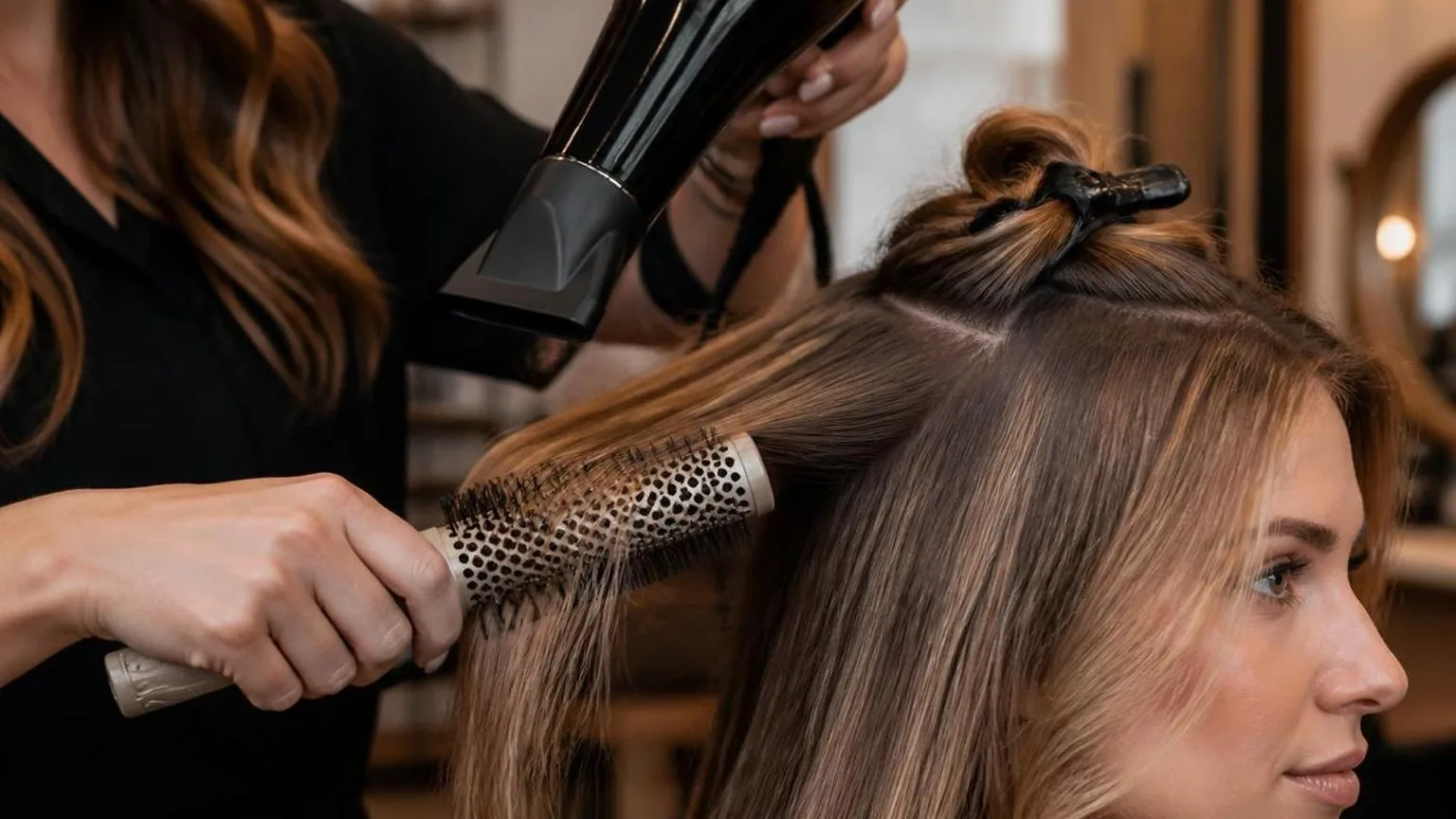
What Changes the Result
A blowout changes the result because the hair is deliberately shaped, tensioned, cooled, and finished, not just dried.
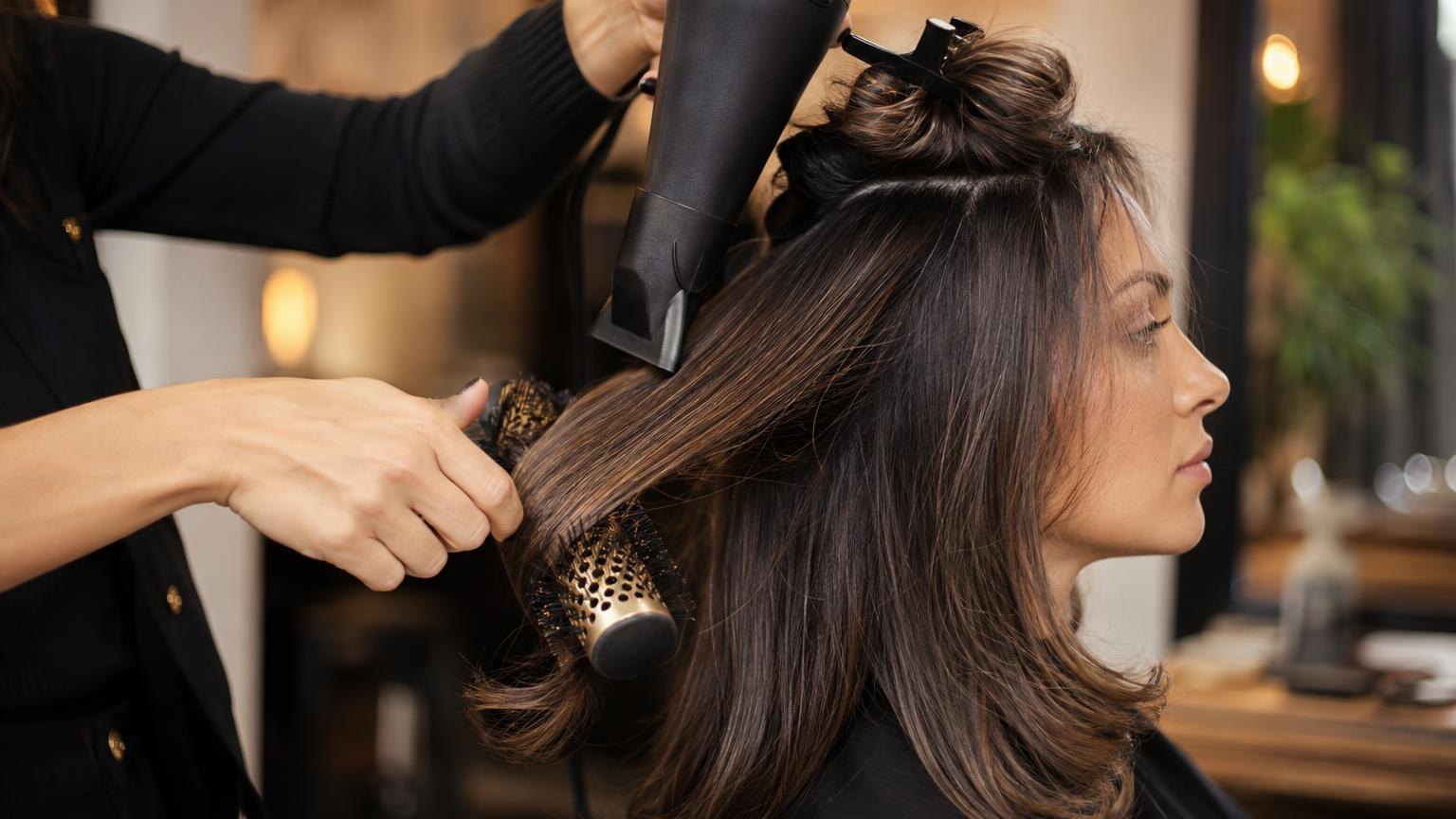
A basic blow dry removes moisture; a blowout builds direction, lift, bend, smoothness, and wear time through controlled sectioning and brush work.
The biggest difference is control. In salon practice, the finish comes from managing airflow angle, brush diameter, section size, heat exposure, and the cool shot.
Those choices decide whether hair falls flat, flips, curls under, or holds volume at the root.
| Variable | Basic blow dry | Blowout |
| Primary goal | Remove water | Shape and polish the hair |
| Typical nozzle distance | Often inconsistent | About 6 inches from the hair |
| Air direction | May blow against the cuticle | Down the hair shaft for smoothness |
| Section width | Large, loose sections | Sections close to brush width |
| Finish step | May stop when dry | Heat set, cool set, then release |
Heat, tension, and cooling
Heat makes hair more flexible while water leaves the fiber. Tension from the brush organizes the strand alignment. Cooling helps lock the temporary shape before the section is dropped, which is why rushing the release softens the result.
| Hair density or texture | Useful dryer heat range | Section thickness | Cool-shot time |
| Fine or low density | Low to medium heat | About 1 inch | 5 to 8 seconds |
| Medium density | Medium heat | 1 to 1.5 inches | 6 to 10 seconds |
| Coarse or high density | Medium to high heat | 0.5 to 1 inch | 8 to 12 seconds |
Professional stylists commonly keep the nozzle attached because it concentrates airflow. Without it, air scatters, the cuticle roughens more easily, and the brush has less authority over the section.
That is one reason a home dry can look clean but not salon-polished.
Brush size and shape
Brush diameter changes the silhouette. A smaller round brush creates more bend and root lift. A larger barrel stretches the hair smoother and gives a looser curve. Paddle brushes dry efficiently, but they do not build the same rounded shape.
| Tool | Best use | Result |
| 1-inch round brush | Fringe, short layers, tight lift | More curve and control |
| 1.5-inch round brush | Medium layers, bobs, face frame | Balanced body and bend |
| 2-inch round brush | Longer lengths | Smoother, looser movement |
| Paddle brush | Fast drying and stretching | Straighter, flatter finish |
- Root direction: Overdirecting the section upward creates lift; drying it flat to the head reduces volume.
- Moisture level: Hair should be mostly dry before detailed round-brush work, so the finish is shaped rather than boiled with excess water.
- Product load: Too much cream or oil collapses movement; too little hold can make volume fall quickly.
- Section discipline: Clean sections let heat and tension reach every strand evenly.
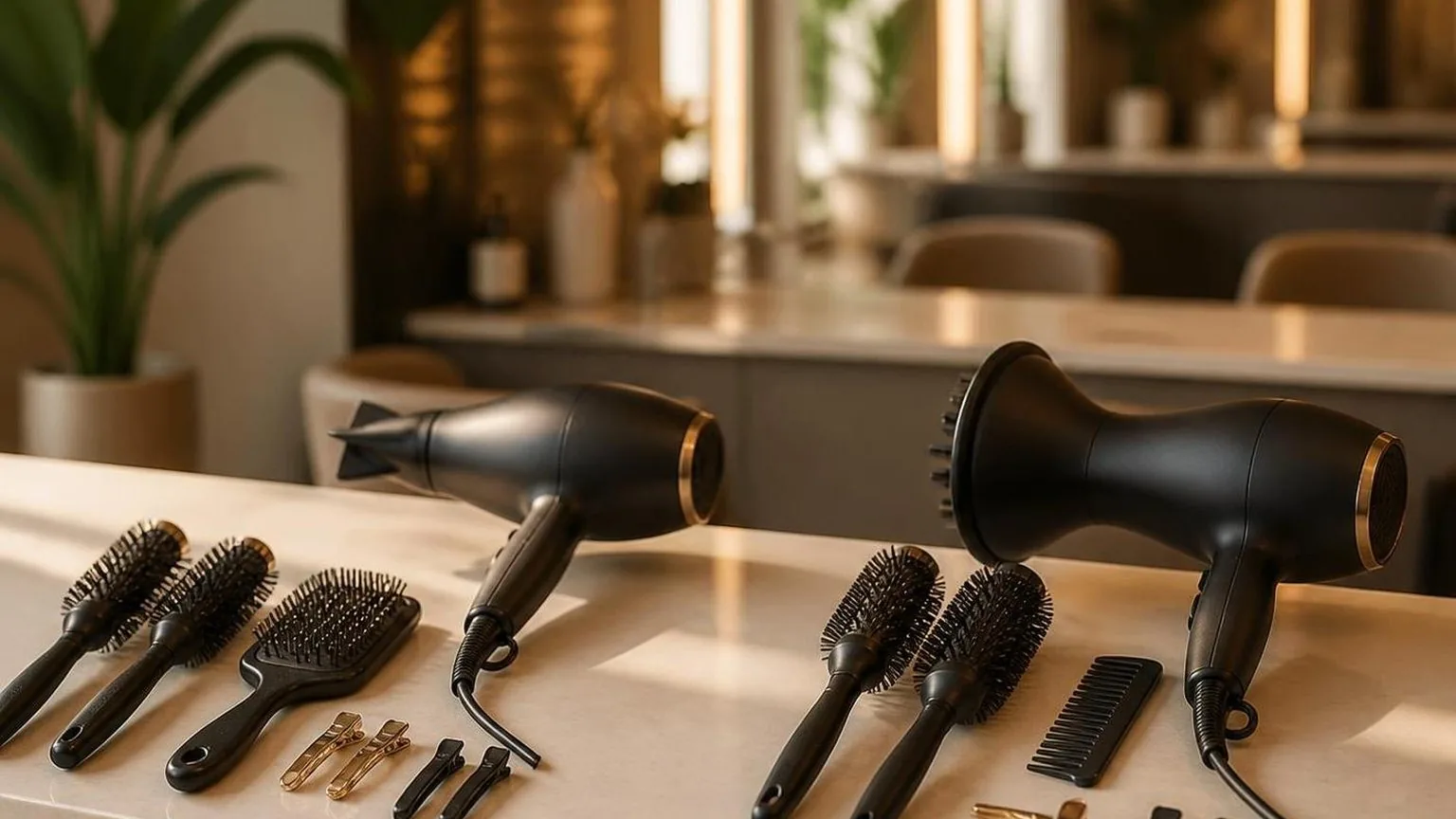
Judging It in Practice
A blow dry is judged mainly by dryness. A blowout is judged by finish: lifted roots, controlled direction, polished cuticle, shaped ends, and movement that survives brushing without collapsing.
On real hair, look less at how smooth it appears in the chair and more at how it behaves after the client turns their head, runs fingers through it, and lets it settle.
| Checkpoint | Blow dry result | Blowout result |
| Root area | Dry, but may sit flat or split at the part | Lifted in the chosen direction, with no damp shadow at the crown |
| Mid-lengths | Dry and detangled | Smooth, reflective, and stretched without looking pressed |
| Ends | Dry, sometimes flicking randomly | Bevelled under, kicked out, waved, or wrapped consistently |
| Movement | Falls wherever the cut wants to fall | Moves as a set shape, then returns without obvious gaps |
The fastest salon test is the crown check. Lift a section at the parting and feel the root with the back of your fingers. If it feels cool, dense, or heavy, it is not fully finished, even if the surface looks dry.
| Practical measure | Useful working range | Why it matters |
| Section width | 25 mm to 50 mm | Small enough for airflow to reach the root and underside |
| Round brush barrel | 25 mm to 55 mm | Smaller barrels create bend; larger barrels create volume and polish |
| Nozzle distance from hair | 15 cm to 20 cm | Close enough for control without concentrating heat on one spot |
| Air temperature at tool outlet | 60°C to 100°C | Enough heat to reshape damp hair while staying within common professional dryer ranges |
| Cool-shot hold per section | 5 seconds to 10 seconds | Helps set the bend before the brush is removed |
Watch the nozzle angle. A basic blow dry often moves air around the head to remove water quickly. A blowout keeps airflow travelling from root to end, because that direction encourages the cuticle surface to lie flatter.
Use a light test rather than a touch-only test. Under a mirror light, a true blowout shows a continuous ribbon of reflection along the mid-lengths.
Broken shine usually means rough tension, uneven moisture removal, or airflow pushed against the grain.
- At the hairline: short pieces should be deliberately placed, not frizzed away from the face.
- At the nape: hair should feel dry underneath, not just smooth on top.
- At the ends: the bend should match from section to section.
- After brushing: the style should soften, not disappear.
For clients judging at home, the clearest difference is memory. A blow dry removes moisture. A blowout builds shape into the hair while drying, then locks that shape with tension, controlled airflow, and cooling.
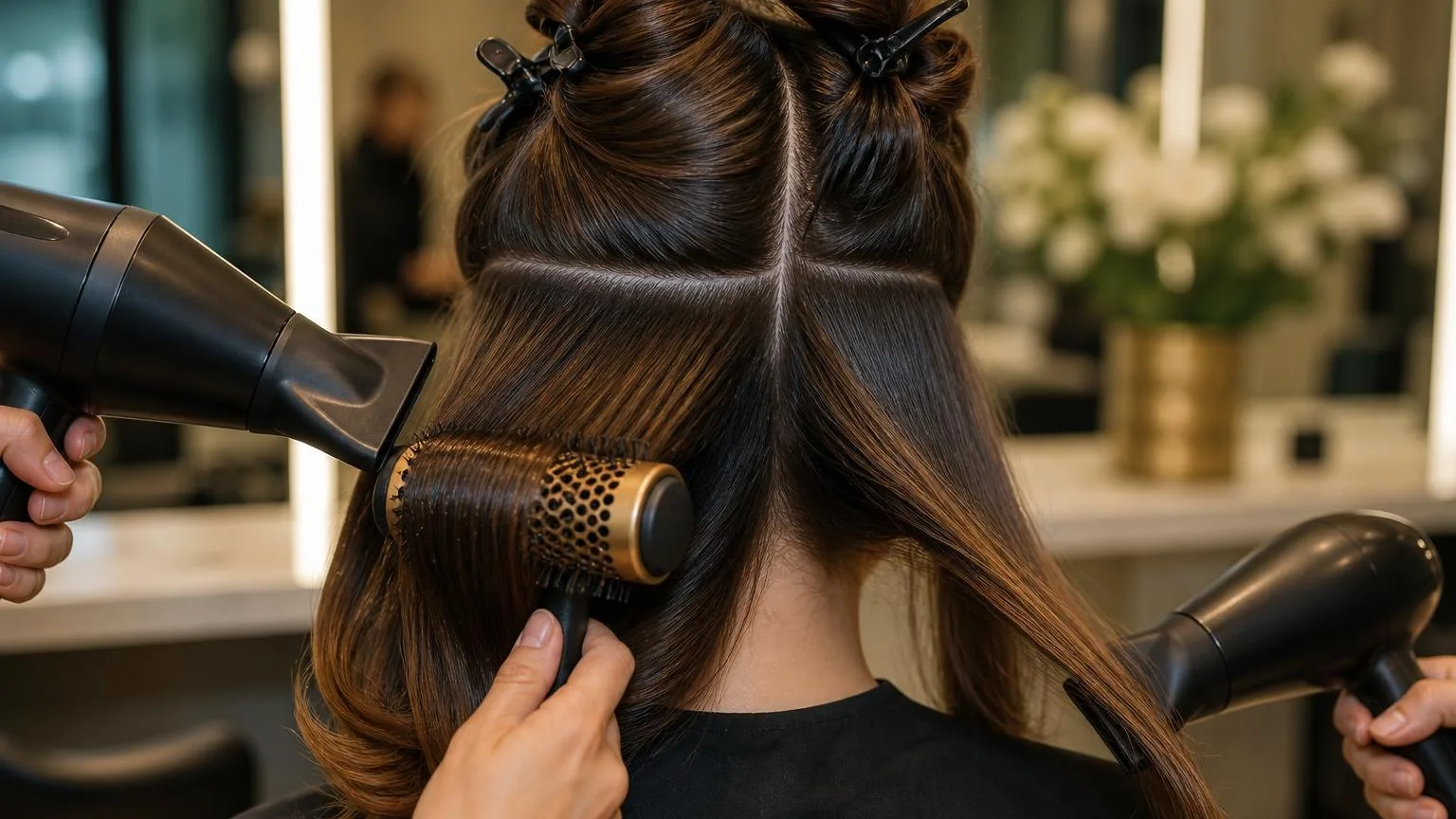
Set Against the Other Options
A blowout is a styled blow dry: the hair is dried and shaped with sectioning, brush tension, airflow direction, and a deliberate finish.
A basic blow dry removes water; a blowout builds volume, bend, smoothness, or polish that should hold beyond the chair.
In salon language, the difference is not the dryer alone. It is the sequence: towel blot, product placement, controlled drying, brush work, cooling, and finishing.
The Craft Hairdressers guidance on blow-drying technique stresses nozzle control, section discipline, and airflow from roots to ends for a smoother cuticle finish.
| Service or method | Main goal | Typical timing | Key tool action |
| Rough dry | Remove moisture fast | 5 to 15 minutes | Fingers, wide airflow, minimal shaping |
| Basic blow dry | Dry into a tidy natural shape | 15 to 30 minutes | Brush used mainly for control |
| Blowout | Dry, lift, smooth, curve, and set | 30 to 60 minutes | Sectioned round-brush or paddle-brush styling |
| Hot-tool styling | Add curl, wave, or sleekness after drying | 10 to 35 minutes | Iron or wand shapes already-dry hair |
A rough dry is the fastest alternative, but it sacrifices precision. Stylists often stop rough drying when hair is about 70% to 80% dry, then switch to brush work.
Starting brush tension too early wastes time; starting too late gives less opportunity to reshape the fibre as it dries.
A standard blow dry may use a paddle brush, vent brush, or fingers to create a clean finish. It usually has fewer sections than a blowout.
A salon blowout commonly uses horizontal sections around 1 to 2 inches deep, so the dryer can reach the full panel evenly.
Compared with flat ironing or curling, a blowout is less about pressing heat onto dry hair and more about stretching and setting damp hair with hot air.
Professional dryers commonly sit around 1,600 to 2,000 watts, but the nozzle and distance matter as much as wattage.
| Tool choice | Common working temperature or heat source | Best comparison point |
| Blow dryer with nozzle | Heated airflow, usually held 4 to 6 inches from hair | Shapes while drying |
| Round brush | Uses dryer heat plus tension | Creates lift, bend, bevel, and smoothness |
| Flat iron | Often set around 300°F to 410°F depending on hair and tool | Sleek finish after hair is fully dry |
| Curling iron or wand | Often set around 300°F to 400°F depending on hair and tool | Defined curl or wave after drying |
A blowout also differs from air drying because it controls direction. Air-dried hair follows its natural growth pattern and texture.
Blowout technique redirects the root, smooths the mid-lengths, and seals the ends with downward airflow and a cool shot.
- Choose a rough dry when speed matters more than polish.
- Choose a basic blow dry for a neat everyday finish without major reshaping.
- Choose a blowout for volume, bounce, smoothness, and longer-lasting shape.
- Choose hot tools when the hair is already dry and needs defined waves, curls, or extra sleekness.
Heat, Tension and Keeping Hair Intact
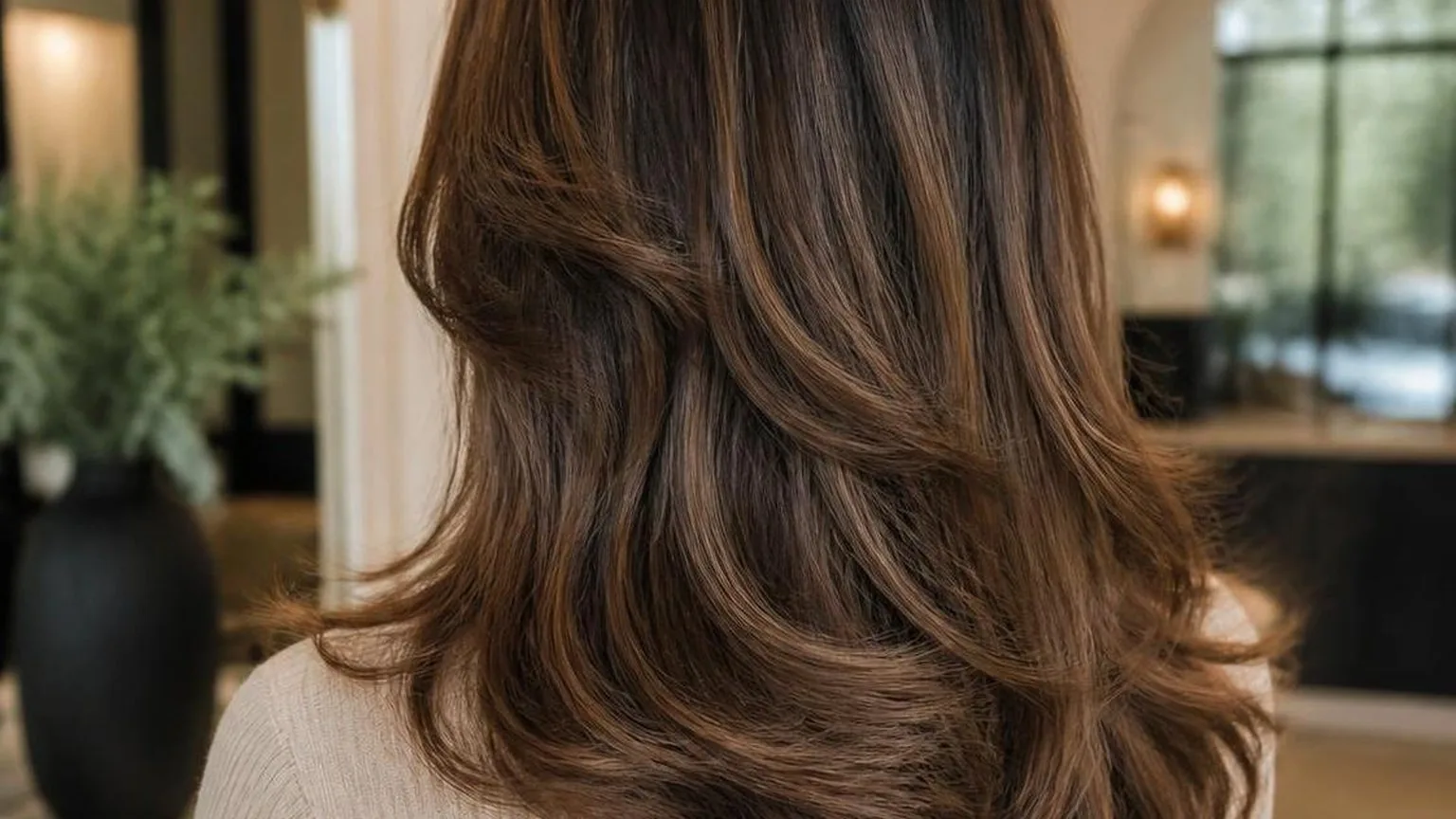
A blow dry gets hair dry; a blowout uses controlled heat, brush tension and sectioning to reshape the finish while drying.
The difference is not “more heat”, but more deliberate airflow, smoother tension and cleaner timing from wet to cool.
Hair is most vulnerable when wet because water disrupts temporary hydrogen bonds, so aggressive pulling at this stage can roughen the cuticle.
Clarence Robbins’ cosmetic science text describes hair fibres as more extensible when wet, which is why tension should rise gradually as moisture drops.
| Control point | Blow dry habit | Blowout target |
| Nozzle gap | Often touching or very close | About 2 to 5 cm from the hair |
| Air direction | Moved around the head freely | Root to end, following cuticle direction |
| Section width | As wide as the brush can catch | About the brush barrel width, usually 4 to 6 cm |
| Final pass | Stopped when hair feels dry | Heat set, then cool set before release |
For salon work, the nozzle matters. A concentrator narrows airflow so the stylist can polish the cuticle line instead of blasting the surface. Without it, hair dries, but the finish is more likely to look expanded, fuzzy or uneven at the ends.
| Heat setting | Practical use |
| Low to medium airflow | Fine hair, face-framing areas and fragile ends |
| Medium to high airflow | Dense sections, roots and early moisture removal |
| Under 150°C at the air stream where possible | Safer working range for controlled brush drying |
| Cool shot for 5 to 10 seconds | Helps the shaped section hold before the brush is removed |
Brush tension should feel firm, not forceful. In a professional blowout, the brush holds the section flat enough for airflow to smooth it, but not so tight that the stylist must tug to rotate or release it.
- Pre-dry to roughly 70 to 80 percent dry before detailed brush work on most textures.
- Keep the dryer moving; do not park heat on one spot.
- Match the section to the brush, not the brush to an overloaded section.
- Use the cool shot before dropping each finished panel.
The intact-hair principle is simple: remove water efficiently first, then shape with tension, then cool the shape before release. That sequence is what makes a blowout look intentional rather than merely dried.
The Mechanism, Step by Step
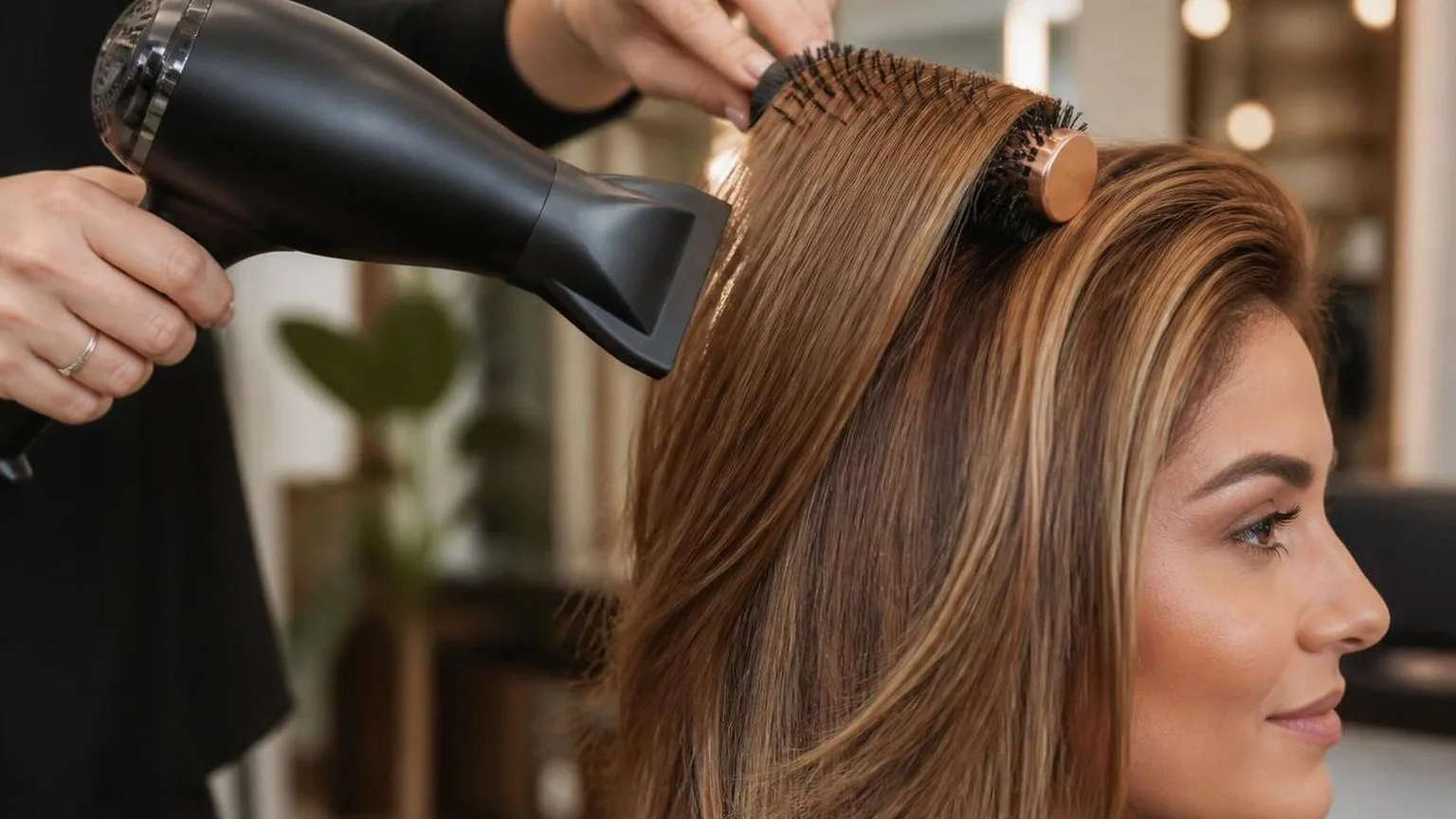
A blow dry gets hair dry and presentable. A blowout changes the finish: more root lift, smoother cuticle alignment, shaped ends, and a style that holds longer without extra hot-tool work.
The difference comes from standard craft variables: section control, brush tension, airflow direction, and cooling time. These steps affect how evenly moisture leaves the hair, how the cuticle lays, and how the finished shape sets before release.
| Variable | Basic blow dry | Blowout method |
| Section width | 3 to 4 inches | 1.5 to 2 inches |
| Section depth | 1 to 2 inches | 0.5 to 1 inch |
| Nozzle distance | 4 to 6 inches | 2 to 3 inches |
| Passes per section | 2 to 4 | 5 to 8 |
| Brush tension | Light | Firm and consistent |
| Cooling time | Usually skipped | 6 to 10 seconds per set |
Both services often start with a rough-dry to about 80% dry before styling. In a basic blow dry, hands and a paddle brush can finish the drying. In a blowout, smaller clipped sections allow more controlled shaping with a round brush.
Root lift changes because elevation and airflow set direction early. Lifting 1.5-inch sections straight up from the scalp creates height. Directing airflow along the hair shaft smooths the surface while the root cools in an elevated position.
Ends change because they need tension, rotation, and a final set. A standard blow dry can leave the last 1 inch slightly fluffy or bent in different directions.
In a blowout, wrapping the ends around the brush for two final passes creates a cleaner turn.
Cool air matters because heated hair is still movable. Holding cool air before release helps the shaped section firm up around the brush. This is why cooling time improves shape retention, especially at the crown and front hairline.
| Hair type | Best brush barrel | What changes most |
| Fine, straight hair | 1.25 to 1.75 inches | Root lift and bend at the ends |
| Medium, wavy hair | 1.75 to 2.25 inches | Smoother surface and more uniform shape |
| Dense, curly hair | 1.5 to 2 inches | Stretch, polish, and controlled volume |
Section size controls access and tension. Narrower, shallower sections expose more of the hair to the brush and nozzle. Wider sections dry faster, but interior hair may not receive the same tension, direction, or polish.
The blowout takes longer because it is built, not just dried. Smaller sections require more passes, more brush tension, and more time controlling airflow from root to end.
- For a quick blow dry, the working section is about twice as wide.
- For a blowout, the concentrator stays parallel to the hair shaft, not pointed into the section.
- The cleanest finish comes when each section is dried hot, shaped under tension, then cooled before release.
- Skipping the cool set reduces shape retention, especially at the crown and front hairline.
The practical takeaway: a blow dry is the drying step. A blowout is a controlled styling service using drying as the tool, with smaller sections, repeated brush passes, directional airflow, and deliberate cooling to lock in shape.
Where It Usually Goes Wrong
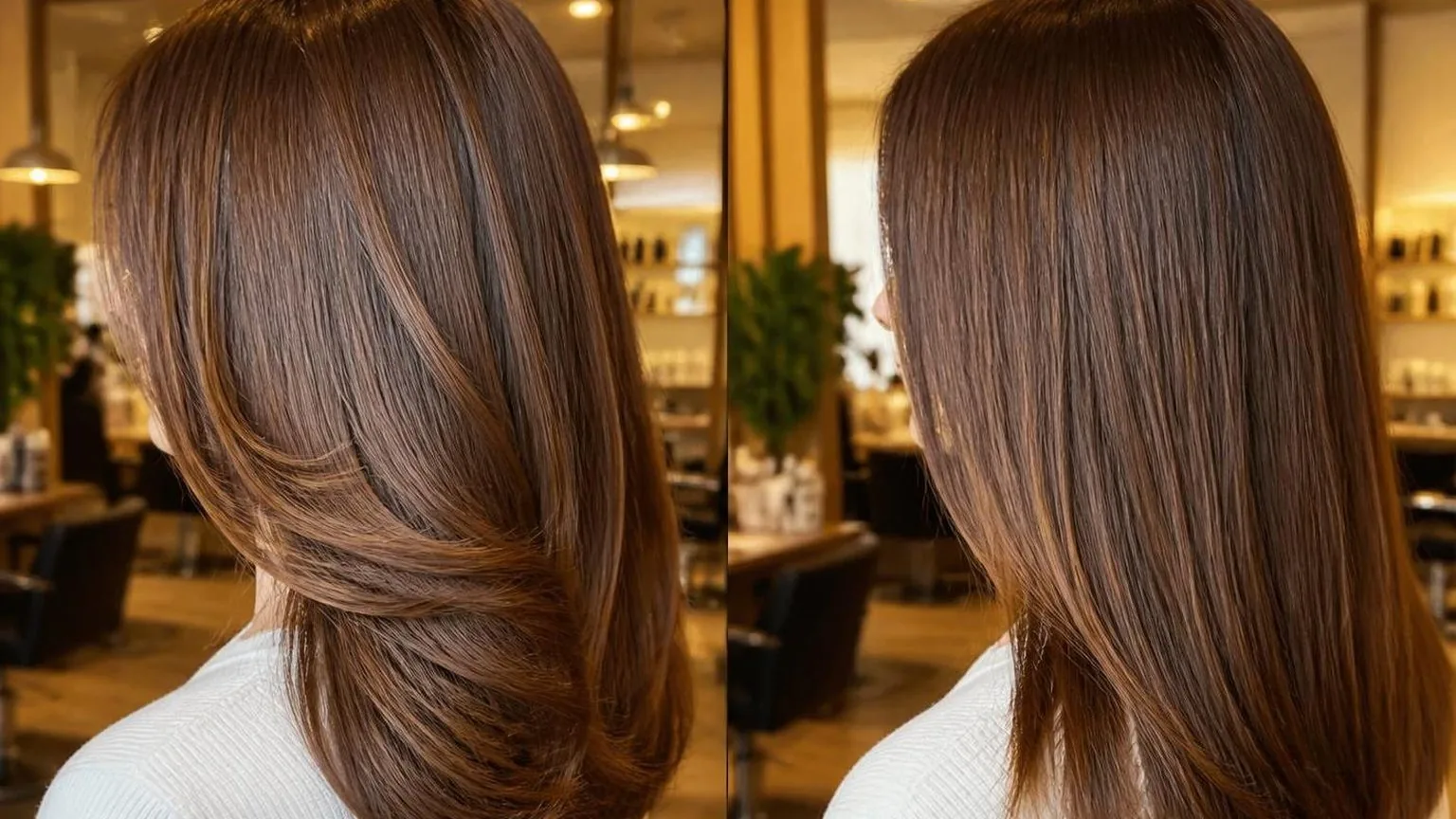
Most confusion comes from treating “blow dry” and “blowout” as identical services.
A blow dry removes water and shapes hair; a blowout is a controlled finish built with sectioning, brush tension, airflow direction, cooling, and product restraint.
The biggest myth is that hotter air creates a better result. In practice, high heat without tension roughens the finish, while moderate heat, clean sections, and a cool set give more polish and movement.
Mistake: Skipping section control
A professional blowout is not random drying with a round brush. Sections need to be narrow enough for airflow to pass through and for the brush to control the full strand from root to end.
| Hair density | Typical section width | Why it matters |
| Fine or low density | 1 to 1.5 inches | Prevents over-drying and collapse |
| Medium density | 1.5 to 2 inches | Balances speed and polish |
| Thick or high density | 0.75 to 1.25 inches | Allows heat and air to reach the inner hair |
Myth: A blowout means curls
A blowout can be smooth, bouncy, flicked, softly waved, or root-lifted. The defining feature is the method, not the final silhouette. Round brush size, angle, and cooling time decide the shape.
| Brush barrel | Likely finish | Best use |
| 1 to 1.5 inches | More bend and lift | Short layers, fringe, face frame |
| 1.75 to 2.25 inches | Soft body | Medium lengths |
| 2.5 inches and above | Smoother, looser movement | Long hair, polished ends |
Mistake: Holding the dryer too close
For control without scorching the cuticle surface, keep the nozzle about 2 to 4 inches from the brush. Direct airflow from roots toward ends. Pointing air upward lifts the cuticle edge and makes the finish look less refined.
Myth: A blow dry is always faster
A basic blow dry can be faster, but only if the goal is dry hair rather than a shaped finish. A salon blowout usually adds deliberate rough-drying, section work, brush setting, and a final cool shot.
| Step | Blow dry | Blowout |
| Rough dry | Until fully or nearly dry | To about 70 to 80 percent dry |
| Brush work | Optional | Section by section |
| Cooling | Often skipped | 5 to 10 seconds per section |
Mistake: Using too much product
More product rarely makes a blowout last longer. Start with a pea-sized amount of cream or 2 to 4 sprays of heat protectant per quadrant, then add only where the hair needs control.
- Too much root product: reduces lift and makes hair separate sooner.
- Too much serum: can flatten movement, especially on fine hair.
- Nozzle removed: spreads airflow too widely and weakens polish.
- No cool shot: leaves the section unset, so shape drops faster.
Frequently Asked Questions
What is a blowout?
A blowout is a styled salon finish using a dryer, nozzle, sectioning clips, brushes, and controlled tension. Hair is usually dried in 1–2 inch sections, then shaped for smoothness, volume, bend, or curl without hot irons.
How is a blowout different from a blow dry?
A blow dry simply means drying wet hair with airflow. A blowout is more technical: the stylist controls direction, elevation, brush size, airflow, and cooling to create a polished shape that lasts beyond basic drying.
How long does a professional blowout take?
Most salon blowouts take 35–55 minutes, depending on density, length, texture, and the finish requested. Fine shoulder-length hair may finish near 30 minutes, while long, dense hair often needs smaller sections and longer drying time.
What tools make a blowout look professional?
A concentrator nozzle, sectioning clips, and round or paddle brushes are key. Common round-brush barrels range from 1.25 inches for bend and lift to 2.5 inches for smoother, looser movement on longer hair.
What heat setting should be used for a blowout at home?
Use medium heat when possible, often around 150–180°F on adjustable dryers, with high airflow rather than maximum heat. Finish each section with a 5–10 second cool shot to help set shape and reduce collapse.
How long does a blowout usually last?
A blowout often lasts a few days, depending on hair type, weather, and how it is maintained. Keeping hair dry, using a shower cap, and avoiding heavy styling products can help preserve the shape and smoothness.
Can a blowout work on curly or textured hair?
Yes, a blowout can be done on curly or textured hair to create a smoother, stretched, or straighter finish. The stylist may use sectioning, tension, and the right brush or dryer attachment to control frizz and shape the hair.
What should you avoid after getting a blowout?
Avoid moisture, sweat, and touching the hair too much right after a blowout. It is also best to avoid heavy oils or creams, which can weigh the style down and make it lose volume faster.
Is a blowout damaging to hair?
A blowout can cause dryness or breakage if heat is too high or used too often. Use heat protectant, proper tension, and a dryer nozzle to help reduce stress on the hair.
Related Reading
- How long a blow dry should actually take
- Blow drying curly hair straight without wrecking it
- Blow dry or air dry: what each does to hair
- How to make a blowout last past day two
- How to blow dry your hair at home, step by step
- Root volume that survives the first hour
- Blow drying short hair without losing the shape
- How to blow dry a finish that survives humidity
- The complete guide to blow drying technique
- American Academy of Dermatology
- Occupational Safety and Health Administration Hair Salons
- U.S. Small Business Administration Business Guide
- National Center for Biotechnology Information Bookshelf
- PubMed
- California Board of Barbering and Cosmetology
- Electrical Safety Foundation International
- U.S. Department of Energy
- American Academy of Dermatology — Hair and Scalp Care
- UL Solutions