
How to reduce no shows in a salon: require confirmation 48 hours before the appointment and release unconfirmed bookings 24 hours before the slot. This gives clients a clear deadline while creating time to contact people on your waitlist.
Record every missed appointment, including booking channel, service, lead time and confirmation response. The pattern shows whether no shows cluster around specific services, weekdays or client groups.
Use those findings to adjust reminders rather than applying one policy to every booking.
Combine text and email reminders, request a small deposit for repeat offenders, and make rescheduling simple. Keep cancellation rules visible during booking and in every reminder.
Staff should follow the same script, document each contact and offer newly available appointments immediately.
Calculate Your Salon’s No-Show Cost
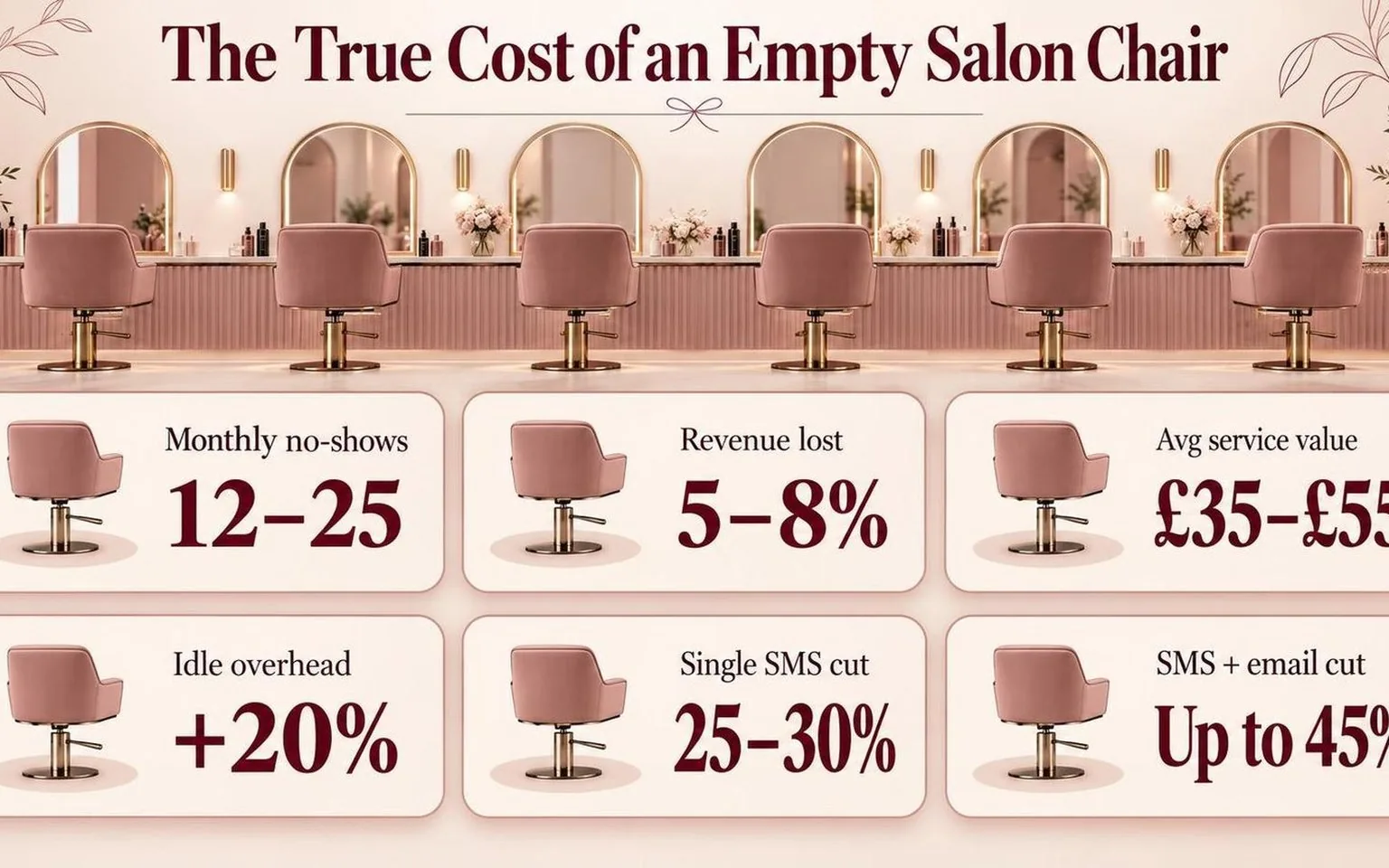
Before fixing the problem, quantify it. Most salon owners underestimate no-show losses by 30-40% because they forget to include idle-chair overhead.
- Pull your no-show count. Open your booking software and filter cancellations marked “no-show” or “late cancel” for the last 90 days. Divide by 3 to get your monthly average. A 6-chair blow dry bar typically sees 12-25 no-shows per month.
- Find your average ticket value. Total blowout revenue for the same 90 days, divided by total completed appointments. For most blow dry bars this lands between £35-£55 or $40-$65 per service.
- Multiply and add overhead. Monthly no-shows × average ticket = direct lost revenue. Then add 20% to cover fixed costs still running during that empty chair: rent per square foot, utilities, and the stylist’s hourly base if they are not commission-only. That 20% figure comes from standard salon overhead ratios published by the Professional Beauty Association.
- Set your threshold. If the total exceeds 5% of monthly gross revenue, you have a structural problem, not a minor inconvenience. Write that percentage down — it becomes the benchmark you measure every tactic in this article against.
Run this calculation on the first Monday of each month. Track whether each strategy below actually moves the number, or just feels like progress.
The Figures Behind It
No-shows cost the average salon between 5% and 8% of annual revenue according to industry benchmarks from salon management platforms.
For a salon turning over £200,000, that translates to £10,000–£16,000 in lost income — money that walked out the door without a single strand being styled.
The scale of the problem becomes clearer when you break it down per chair, per week, per appointment slot.
Revenue Impact by Salon Size
The following table illustrates projected annual losses from no-shows at a 6% average no-show rate, based on common salon revenue brackets reported by salon software providers including Phorest and Timely.
| Annual Revenue | Estimated No-Show Rate | Projected Annual Loss | Lost Appointments Per Week (avg £45 service) |
| £100,000 | 6% | £6,000 | 2.6 |
| £200,000 | 6% | £12,000 | 5.1 |
| £350,000 | 6% | £21,000 | 9.0 |
| £500,000 | 6% | £30,000 | 12.8 |
Those weekly gaps compound. A stylist sitting idle for even two 45-minute blow-dry slots per week loses roughly 104 bookable hours across a full working calendar.
When No-Shows Peak
Booking data from Zenoti and Shortcuts Software consistently shows no-show rates spike on Mondays and Fridays. Monday rates run approximately 20–30% higher than midweek averages.
Friday rates climb similarly, driven by last-minute social plan changes.
Seasonal patterns matter too. Post-holiday periods — particularly late January and mid-September — show elevated no-show behaviour as clients reassess discretionary spending.
The Reminder Effect
Automated reminders are the single most effective countermeasure, and the data on their impact is consistent across multiple salon software platforms.
| Reminder Method | Reported Reduction in No-Shows | Optimal Send Window |
| SMS (single reminder) | 25–30% | 24–48 hours before appointment |
| SMS (double reminder) | 35–40% | 48 hours + 2 hours before |
| Email only | 10–15% | 48 hours before |
| SMS + email combined | Up to 45% | Staggered 48h / 24h |
Phorest’s published platform data indicates salons using their two-step SMS confirmation system see no-show rates drop from roughly 8% to under 5%.
Deposit and Cancellation Policy Numbers
Salons that require a deposit at booking — typically 20–50% of service value — report no-show reductions of 40–55%.
A £15 deposit on a £45 blow-dry creates enough financial commitment to shift behaviour without deterring bookings.
Cancellation windows also influence outcomes. A 24-hour cancellation policy is industry standard, but data from Fresha suggests that a 48-hour window reduces same-day no-shows by an additional 12–18% compared to 24-hour policies.
Repeat Offenders
Most no-shows are not evenly distributed across your client base. Salon booking platforms consistently report that 15–20% of clients account for 70–80% of all missed appointments.
Flagging these clients in your booking system and requiring prepayment or deposits specifically for them is a targeted strategy that protects revenue without penalising reliable clients.
- Track individual no-show counts per client over rolling 6-month periods
- Set a threshold — commonly 2 or 3 missed appointments — before applying deposit requirements
- Communicate the policy clearly at booking and in confirmation messages
- Offer waitlist spots to reliable clients when flagged bookings are in the diary
The numbers point to one conclusion: no-shows are measurable, predictable, and reducible. Every percentage point you recover goes directly to the bottom line — no new marketing spend, no extra hours, no additional product cost.
What Tips It One Way
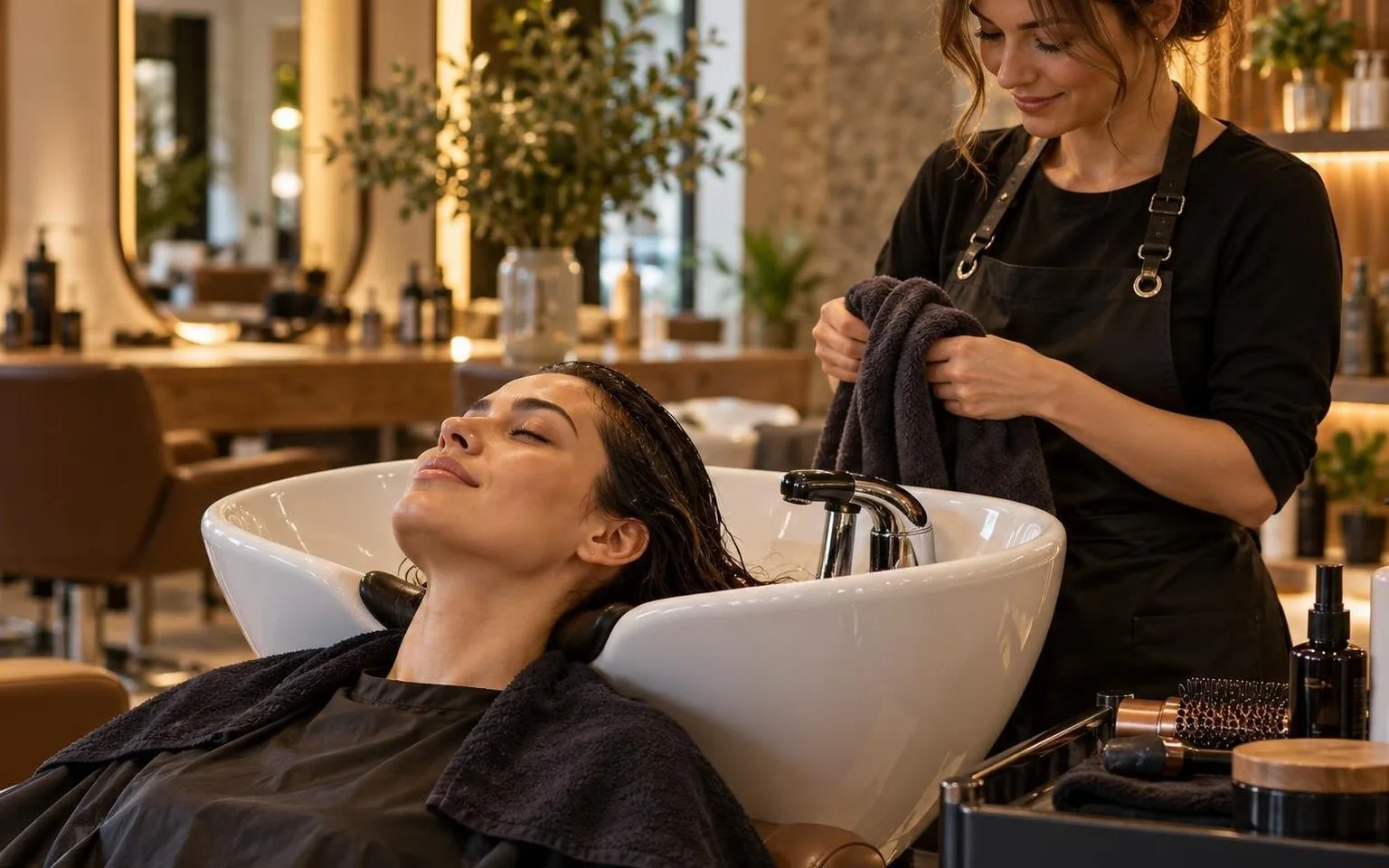
No-show rates swing on a handful of controllable variables: reminder timing, deposit policy, booking friction, and the perceived value of the appointment. Shift any one of these levers and attendance patterns change measurably.
Stack several together and salons routinely cut no-shows by 30–55%.
Reminder Timing and Channel
A single SMS reminder sent 24 hours before an appointment reduces no-shows more effectively than email alone. Text messages carry open rates near 98%, compared with roughly 20% for email.
Double-stacking reminders — one at 48 hours, another at 24 hours — outperforms a single touchpoint. The first prompt triggers mental planning; the second locks commitment.
| Reminder Method | Typical Open Rate | No-Show Reduction |
| Email only | ~20% | 5–10% |
| Single SMS at 24 hrs | ~98% | 25–30% |
| SMS at 48 hrs + SMS at 24 hrs | ~98% | 35–45% |
| SMS + calendar invite at booking | Varies | 40–55% |
Adding a reply-to-confirm step filters out uncertain bookings. Clients who actively confirm are roughly 3× more likely to attend than those who passively receive a one-way notification.
Deposits and Cancellation Fees
Requiring a card on file at booking creates financial accountability. Even a modest deposit — 20–50% of service cost — changes client behaviour by introducing a tangible cost to not showing up.
Salons that implement a clearly stated 24-hour cancellation policy alongside a deposit typically see no-show rates fall from a common baseline of 15–20% down to 5–8%.
Transparency matters. Display the cancellation policy on the booking page, in the confirmation message, and in every reminder. Clients who feel blindsided by a charge leave negative reviews; clients who understood the terms rarely dispute.
Booking Friction
Online booking systems that let clients self-schedule reduce no-shows compared with phone-only booking. The reasoning is straightforward: clients who actively chose a specific slot feel more ownership of it.
Shorter booking windows also help. Allowing appointments more than 4 weeks out increases no-show risk because the commitment feels abstract. A 2–3 week maximum window keeps urgency intact.
Perceived Value of the Appointment
Clients skip appointments they undervalue. A blowout booked casually on a whim carries less mental weight than one tied to a specific event, a loyalty reward, or a stylist they specifically requested.
Salons that assign clients to named stylists rather than “next available” report stronger attendance. The personal relationship raises the social cost of not showing up.
Waitlists reinforce scarcity. When a client knows the slot will be filled immediately, the appointment feels harder to get and therefore harder to waste.
Repeat Offender Management
Roughly 10% of a salon’s client base typically accounts for 40–60% of total no-shows. Identifying and flagging these serial offenders is high-leverage.
Effective tactics for repeat no-show clients include requiring full prepayment, limiting online booking access, or restricting them to off-peak slots where empty chairs cost less revenue.
- Flag any client with 2 or more no-shows within a 6-month period
- Require full prepayment for flagged clients on all future bookings
- Send an additional reminder at 3 hours before for flagged clients
- Track recovery: remove the flag after 4 consecutive kept appointments
Staff buy-in seals the system. Front-desk teams need a clear, written protocol so enforcement stays consistent and impersonal. The policy does the work, not an awkward conversation.
Each of these levers operates independently, but the compounding effect is what tips the balance decisively.
Salons that layer reminders, deposits, smart scheduling windows, and repeat-offender protocols together close the gap between booked chairs and filled chairs.
Judging It in Practice
Judging your no-show rate requires tracking actual appointment data, benchmarking against industry norms, and acting on patterns rather than gut feeling.
A salon running below 5% no-shows is performing well; above 10% signals a systemic problem demanding immediate process changes.
Know Your Baseline Number
Calculate your no-show rate monthly: divide missed appointments by total booked appointments, then multiply by 100. A salon booking 800 appointments per month with 56 no-shows runs a 7% rate.
Industry data from salon management platforms consistently places the average no-show rate for hair and beauty businesses between 5% and 10%. Blow dry bars often skew higher because shorter service times lower perceived commitment.
| No-Show Rate | Assessment | Typical Monthly Revenue Loss (30-chair salon) |
| Under 5% | Strong operational control | Manageable — under £1,500 |
| 5%–10% | Industry average — room to tighten | £1,500–£3,500 |
| 10%–15% | Active problem — process gaps | £3,500–£6,000 |
| Above 15% | Critical — requires immediate intervention | £6,000+ |
Revenue loss estimates assume an average blow dry ticket of £35–£45. Your figure will vary by location and service mix, so run the calculation with your own average ticket.
Track the Right Data Points
Raw no-show count alone is insufficient. Break the data down to find patterns worth acting on.
- Day of week: Mondays and Saturdays typically show the highest no-show spikes. Compare each day’s rate individually.
- Time of day: Early morning slots (before 10 a.m.) and late afternoon (after 4 p.m.) trend higher for missed appointments.
- Booking channel: Online-only bookings without confirmation steps can run 2–3× the no-show rate of phone or in-person bookings.
- Lead time: Appointments booked more than 14 days ahead no-show at roughly double the rate of those booked within 7 days.
- Repeat vs. new clients: First-time clients no-show at rates between 15% and 20% in many salons, compared with 3%–5% for returning clients.
Confirmation Timing Benchmarks
Automated SMS and email reminders are the single most effective tool for reducing no-shows. Timing matters more than wording.
| Reminder Timing | Typical No-Show Reduction |
| 48 hours before appointment | 25%–30% reduction |
| 24 hours before appointment | 30%–40% reduction |
| Double reminder (48 hrs + 2 hrs before) | Up to 50% reduction |
Platforms such as Fresha, Timely, and Boulevard all offer configurable reminder sequences. Two-touch sequences — one at 48 hours, one at 2 hours — consistently outperform single reminders across salon management case studies.
When to Introduce a Deposit or Cancellation Fee
If your rate stays above 10% after implementing double reminders for 60 days, introduce a deposit. Deposits of 20%–50% of service value are standard practice in the blow dry bar segment.
Monitor the deposit’s effect over 90 days. A well-calibrated deposit typically cuts no-shows by an additional 30%–40% on top of reminder-driven reductions.
Review Cycle
Pull no-show reports weekly but evaluate trends monthly. A single week can be skewed by weather, local events, or holidays. Monthly data across at least three consecutive periods gives you a statistically meaningful picture.
Set a quarterly review to compare your current rate against your baseline. If the rate drops below 5%, your systems are working.
If it plateaus or climbs, audit your reminder sequence, deposit policy, and booking lead times before adding further interventions.

Trade-Offs Against the Alternatives
Every no-show prevention method carries a cost — financial, operational, or relational. Deposit policies reduce empty chairs but can deter new bookings. Automated reminders are cheap but impersonal.
Waitlists fill gaps but demand real-time staff attention.
The table below compares the six most common no-show reduction strategies across cost, effectiveness, and client friction.
| Strategy | Typical Setup Cost | No-Show Reduction | Client Friction | Staff Burden |
| SMS reminders (24 h + 2 h before) | Included in most booking platforms | 25–30 % | Low | Low |
| Email reminders only | Included in most booking platforms | 10–15 % | Very low | Low |
| Non-refundable deposit (20–50 % of service) | Payment gateway fees (1.5–2.9 % per transaction) | 40–55 % | High for new clients | Medium |
| Full prepayment at booking | Payment gateway fees (1.5–2.9 % per transaction) | 50–60 % | Very high | Medium |
| Automated waitlist backfill | Software tier upgrade (~£20–£40/month) | Does not prevent no-shows; recovers 30–50 % of lost revenue | Low | Medium |
| Manual confirmation calls | Staff time (3–5 min per client) | 20–25 % | Medium | High |
Deposits vs. Reminders
Deposits outperform reminders on raw no-show reduction by roughly 15–25 percentage points. The trade-off is conversion: salons that introduce mandatory deposits for first-time clients often report a 10–20 % drop in new online bookings.
A staged approach softens the impact. Require deposits only for services above a set threshold — commonly £50 or $60 — and waive them for returning clients with clean attendance records.
SMS reminders sent at two intervals — 24 hours and 2 hours before the appointment — outperform a single reminder by roughly 8–12 percentage points in confirmation rates.
Prepayment vs. Deposit
Full prepayment virtually eliminates financial loss from no-shows but introduces refund administration. Chargebacks and refund requests increase staff workload and can cost 1.5–2.9 % per reversed transaction in gateway fees alone.
Deposits strike a middle ground: the client has skin in the game, and your refund exposure is capped at the deposit amount rather than the full ticket.
Automated Waitlists vs. Overbooking
Some salons overbook by 5–10 % to offset anticipated no-shows. This gamble backfires when all clients arrive — creating bottlenecks, extended wait times, and negative reviews.
Automated waitlists avoid that risk entirely. When a cancellation occurs, the next waitlisted client receives an instant SMS offer. The chair fills without double-booking.
The limitation: waitlists only work with sufficient booking volume. Salons averaging fewer than 15 appointments per day per stylist may not generate enough waitlist depth to reliably fill last-minute gaps.
Manual Calls vs. Automation
Confirmation calls feel personal and build rapport. At 3–5 minutes per call across 20 daily bookings, that represents 60–100 minutes of front-desk time — roughly 15–25 % of a receptionist’s shift.
For high-value services like bridal blowouts or multi-service packages, a personal call is worth the labour cost. For standard blow-dries under £40, automated SMS delivers comparable results at a fraction of the time.
Choosing the Right Stack
- Low-friction baseline: dual-interval SMS reminders for all bookings — effective, inexpensive, and universally tolerated by clients.
- Mid-tier protection: add deposits for services above your average ticket price and for clients with a prior no-show on record.
- Full coverage: layer in automated waitlist backfill to recover revenue from cancellations that still occur despite deposits and reminders.
No single method eliminates no-shows entirely. The strongest results come from combining two or three strategies matched to your booking volume, average service price, and client demographic.
Frequently Asked Questions
What percentage of salon revenue is typically lost to no-shows?
Industry benchmarks place chronic no-show rates between 10 % and 15 % of all bookings.
For a blow dry bar averaging £200–£300 per chair per day, that translates to roughly one empty chair every shift — a direct hit to daily takings that compounds across a week.
How far in advance should automated reminders be sent?
Send a first reminder 48 hours before the appointment, then a second 2–4 hours prior. Two-touch sequences reduce no-shows by roughly a third compared with single reminders, according to data published by booking platforms Fresha and Timely.
Does requiring a card on file actually deter no-shows?
Salons that hold card details at booking report no-show rates dropping to 2 %–5 %, down from double digits. The card acts as a psychological commitment device.
Make the hold policy visible during online booking so clients opt in with full awareness.
What is an appropriate no-show or late-cancellation fee?
Common practice is charging 50 % of the booked service price for cancellations under 24 hours and 100 % for complete no-shows.
State the policy clearly in booking confirmations and on signage at reception so enforcement feels consistent, not punitive.
Should salons use text, email, or phone call reminders?
SMS reminders achieve open rates above 90 %, compared with roughly 20 %–30 % for email. Phone calls suit high-value bookings but are labour-intensive. Use SMS as the default channel and reserve calls for appointments worth £50 or more.
How does a waitlist system recover revenue from last-minute cancellations?
Maintain a live waitlist inside your booking software. When a cancellation opens a slot, the system auto-notifies waitlisted clients.
Salons using automated waitlists report filling 40 %–60 % of cancelled slots within the hour, recapturing revenue that would otherwise vanish.
Do deposit requirements reduce repeat bookings?
A fixed deposit of £5–£10, rather than a percentage, lowers the friction barrier for regulars while still filtering out uncommitted bookers.
Track rebooking rates monthly after introducing deposits; most salons see less than a 5 % dip in repeat visits.
How should front-of-house staff handle a first-time no-show?
Contact the client within 30 minutes of the missed appointment via text, not a call — it feels less confrontational. Offer to rebook once.
Flag the client record so that future bookings automatically require a card hold or deposit before confirmation.
Can overbooking offset no-show losses without creating wait times?
Overbooking by 5 %–10 % of capacity works only when your historic no-show data supports it. Track no-show frequency per day of the week and per time slot for at least 90 days before adjusting.
Saturday mornings and Monday lunches typically show the highest variance.
What booking-window length helps minimise no-shows?
Appointments booked more than two weeks out carry higher no-show risk because client commitment fades with time. Limit online self-booking to a 14-day window.
For slots beyond that, require phone or in-person booking, which adds a personal commitment layer.
Related Reading
- Insuring a stylist's hands: what cover exists
- What a blow dry bar is, and how the model works
- What a booth renter actually takes home
- EPLI for salons: when it starts to matter
- How blow dry stylists are paid: the three structures
- How salon memberships work, and when they backfire
- Chair renters and insurance: who covers what
- The blow dry bar business model, explained
- The complete guide to the blow dry bar business