

For microfibre towel vs regular towel hair, choose smooth microfibre and blot rather than rub: the gentler technique limits friction and helps preserve your styling pattern.
A regular cotton towel can still work, but avoid scrubbing lengths or twisting them tightly into a heavy wrap.
The useful distinction is fabric texture, not the label alone: microfibre describes the fibre, while cotton towels come in different weaves. Press small sections until water stops dripping, then detangle gently.
This guide compares handling, absorbency and practicality so you can choose a towel for your blow-dry routine.
Match Your Towel to Your Hair Density
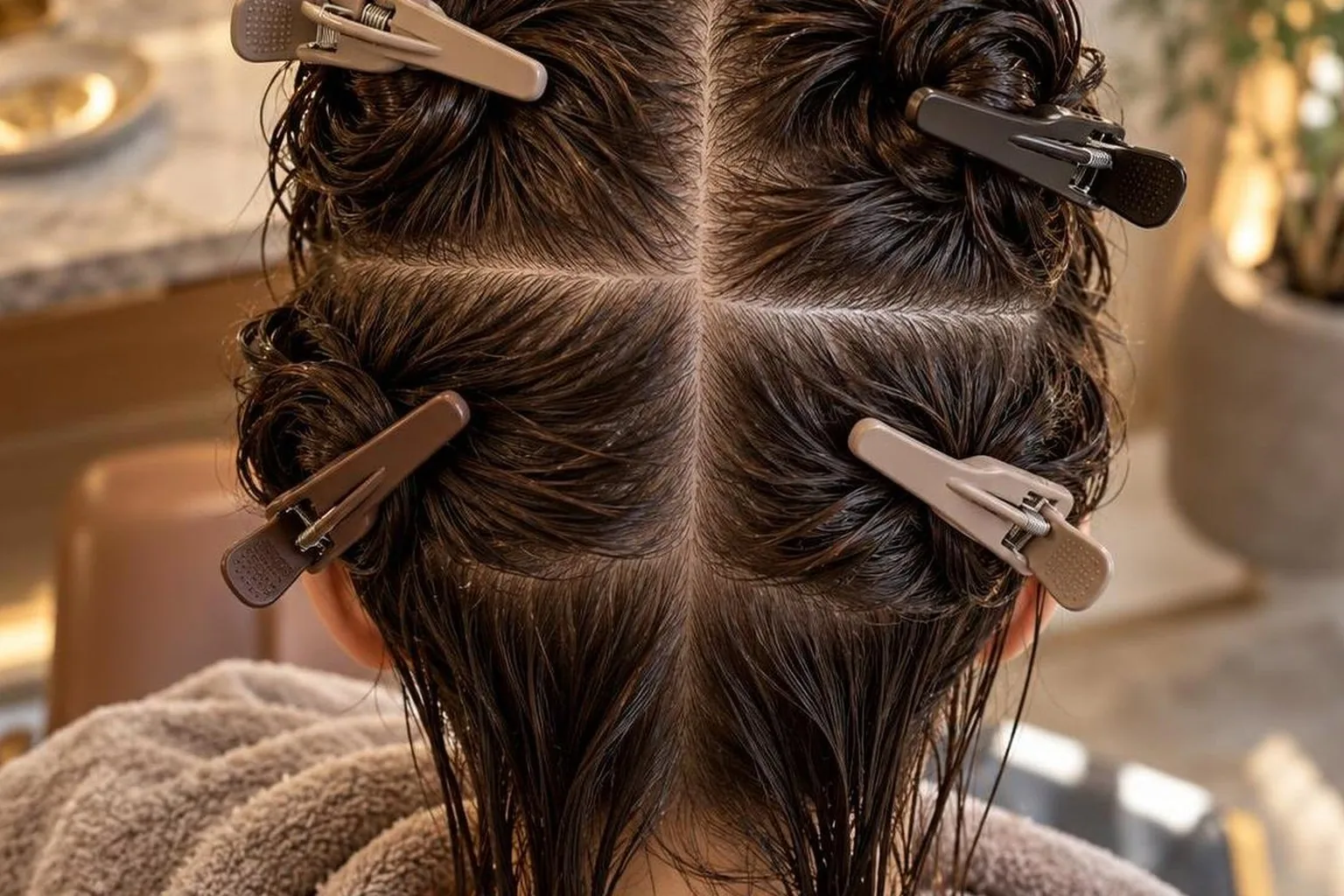
Grab a single strand from your brush. Roll it between your thumb and index finger. If you cannot feel it, you have fine hair. If it feels like a thread, you have coarse hair. This determines which towel fabric actually cuts your drying time.
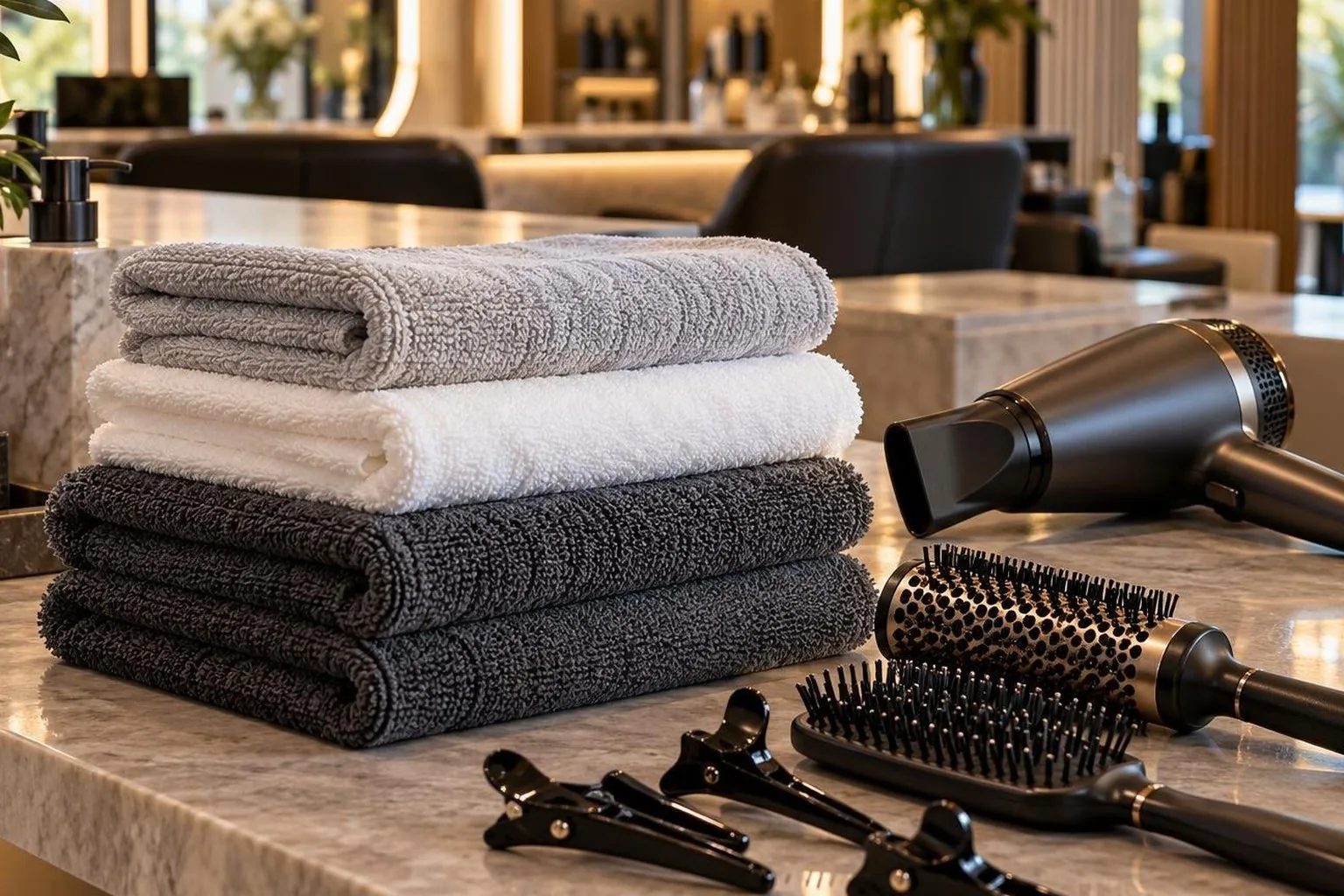
- Measure your current dry time. After washing, wrap hair in your regular cotton towel for 5 minutes. Remove it, then rough-dry with a dryer on medium heat (around 80 °C / 175 °F). Time how long the dryer runs before hair is 90% dry. Write that number down.
- Repeat with a microfibre towel. Use a 300-gsm (grams per square metre) microfibre towel, minimum 40 × 70 cm for above-shoulder hair or 65 × 100 cm for mid-back length. Same 5-minute wrap, same dryer setting. Record the new time.
- Calculate the gap. Subtract the microfibre time from the cotton time. A difference below 2 minutes means your hair type gains little from the switch. A difference of 4 minutes or more signals a meaningful reduction in heat exposure per client.
- Multiply across your column. If you run 8 blowouts per stylist per day, multiply your per-client time saving by 8. That total tells you whether re-towelling the salon pays back in chair turnover.
Record results for at least three different hair densities — fine, medium, coarse — before committing to a bulk order. Towel performance shifts significantly between types.
What the Numbers Actually Say
Microfibre towels absorb water faster per gram of fabric weight than cotton terry, reduce friction on the cuticle layer, and cut passive drying time before blow-dry by roughly 30–50 percent.
Those gains come from fibre diameter, weave density, and surface area — not marketing.
Fibre Diameter and Surface Area
A single microfibre filament measures approximately 0.5–1.0 denier — about one-hundredth the diameter of a human hair. Standard cotton terry fibres sit around 1.5–2.2 denier.
That difference in diameter dramatically increases total surface area per square centimetre of towel fabric.
More surface area means more contact points to wick moisture from the hair shaft through capillary action, without requiring pressure or rubbing that disrupts the cuticle.
Absorption Capacity Compared
| Property | Microfibre Towel | Cotton Terry Towel |
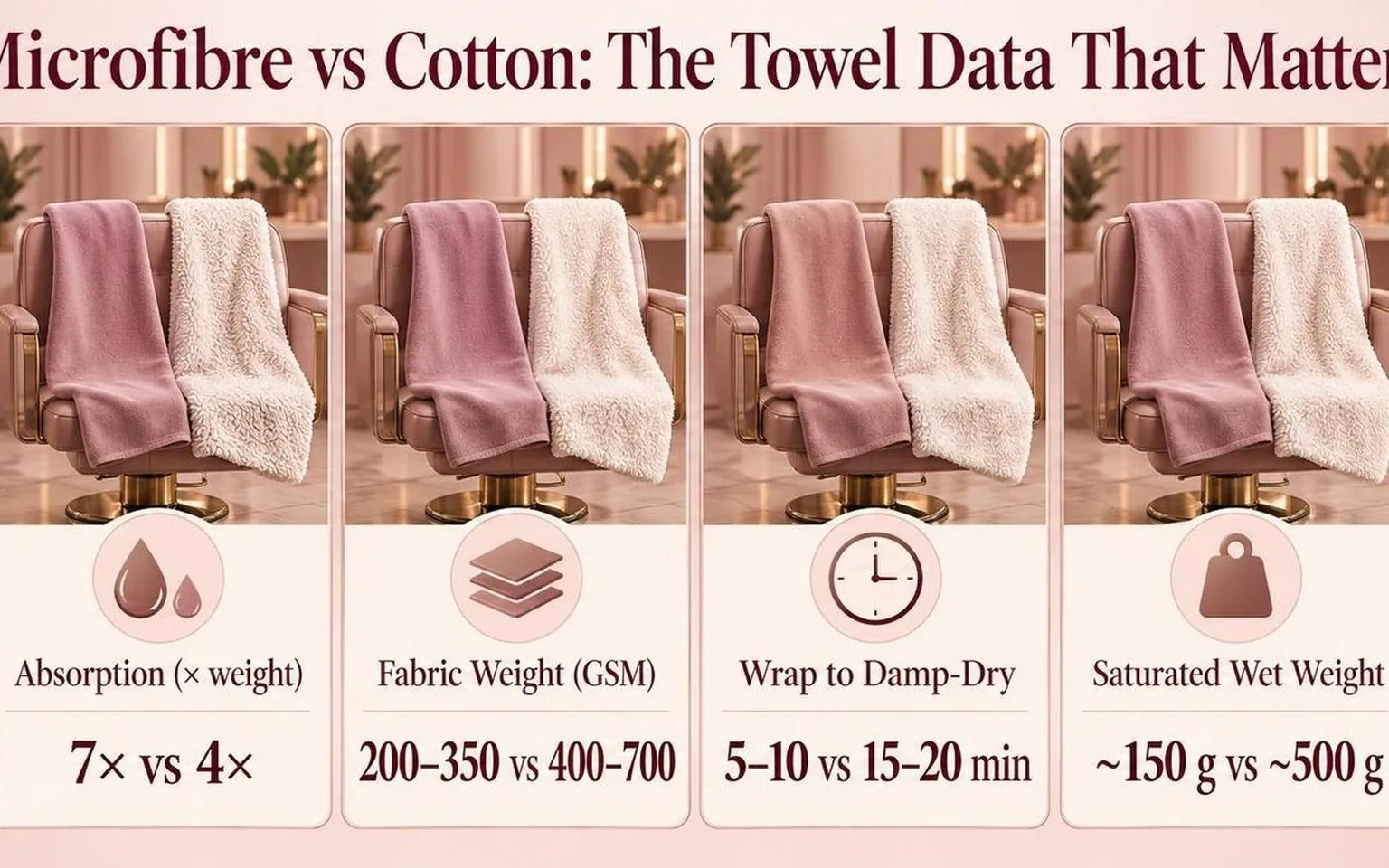
| Typical fabric weight | 200–350 GSM | 400–700 GSM |
| Water absorption (× own weight) | Up to 7× | Up to 4× |
| Approximate dry time to damp-dry | 5–10 minutes (wrap method) | 15–20 minutes (wrap method) |
| Wet weight when saturated | ~120–180 g (standard hair towel) | ~350–600 g (standard bath towel) |
| Fibre denier | 0.5–1.0 | 1.5–2.2 |
The GSM gap matters practically. A 300 GSM microfibre hair towel weighs roughly 80–100 g dry and stays light when wet. A 600 GSM cotton bath towel can exceed 500 g when saturated, pulling on roots during a turban wrap.
Friction and Cuticle Impact
Cotton terry loops create more drag against the hair surface during rubbing. Microfibre’s flat-split weave — typically a blend of 80 percent polyester and 20 percent polyamide — glides with less resistance across each strand.
Reduced friction matters most for colour-treated, chemically straightened, and fine hair types where the cuticle is already compromised. Less mechanical disruption preserves smoothness and reduces frizz at the blowout stage.
What This Means for Blow-Dry Time
Starting a blow-dry on hair that is 60–70 percent dry rather than 80–90 percent wet shortens total dryer time. For a medium-density, shoulder-length blowout, that can translate to 8–12 fewer minutes under heat.
Less heat exposure per session accumulates over weeks. A client visiting a blow-dry bar twice weekly could reduce monthly thermal contact by 60–90 minutes simply by switching the prep towel.
Durability and Lifecycle
| Factor | Microfibre | Cotton Terry |
| Typical wash cycles before performance drop | 200–500 washes | 50–80 washes |
| Lint shedding | Minimal after first 2–3 washes | Ongoing throughout lifespan |
| Recommended wash temperature | 30–40 °C (no fabric softener) | 40–60 °C |
Fabric softener coats microfibre filaments and blocks capillary channels. Washing microfibre towels with liquid softener or dryer sheets can cut absorption performance by up to 50 percent within 10 wash cycles.
Cotton terry tolerates higher wash temperatures and bleach, making sanitation easier in high-turnover salon environments. That is its main operational advantage.
Where Cotton Still Wins
- Higher heat tolerance for autoclave or high-temperature laundry sanitation
- Biodegradable at end of life — microfibre is synthetic and sheds microplastics during washing
- Lower per-unit cost for bulk salon purchasing
- More absorbent in total volume when size is unrestricted (full bath towel vs. small hair wrap)
The environmental trade-off is real. Each microfibre wash cycle can release an estimated 700,000–12,000,000 microplastic fibres into wastewater, depending on fabric age, machine type, and load size.
A mesh filter bag rated at 50 microns or smaller can capture a significant portion of shed fibres.
For blow-dry prep specifically, the performance data favours microfibre on speed, weight, and friction. For salon operations, cotton’s sanitation resilience and lower replacement cost still hold weight.
The right choice depends on which metric — drying speed or operational simplicity — ranks highest in your workflow.
What Moves the Outcome
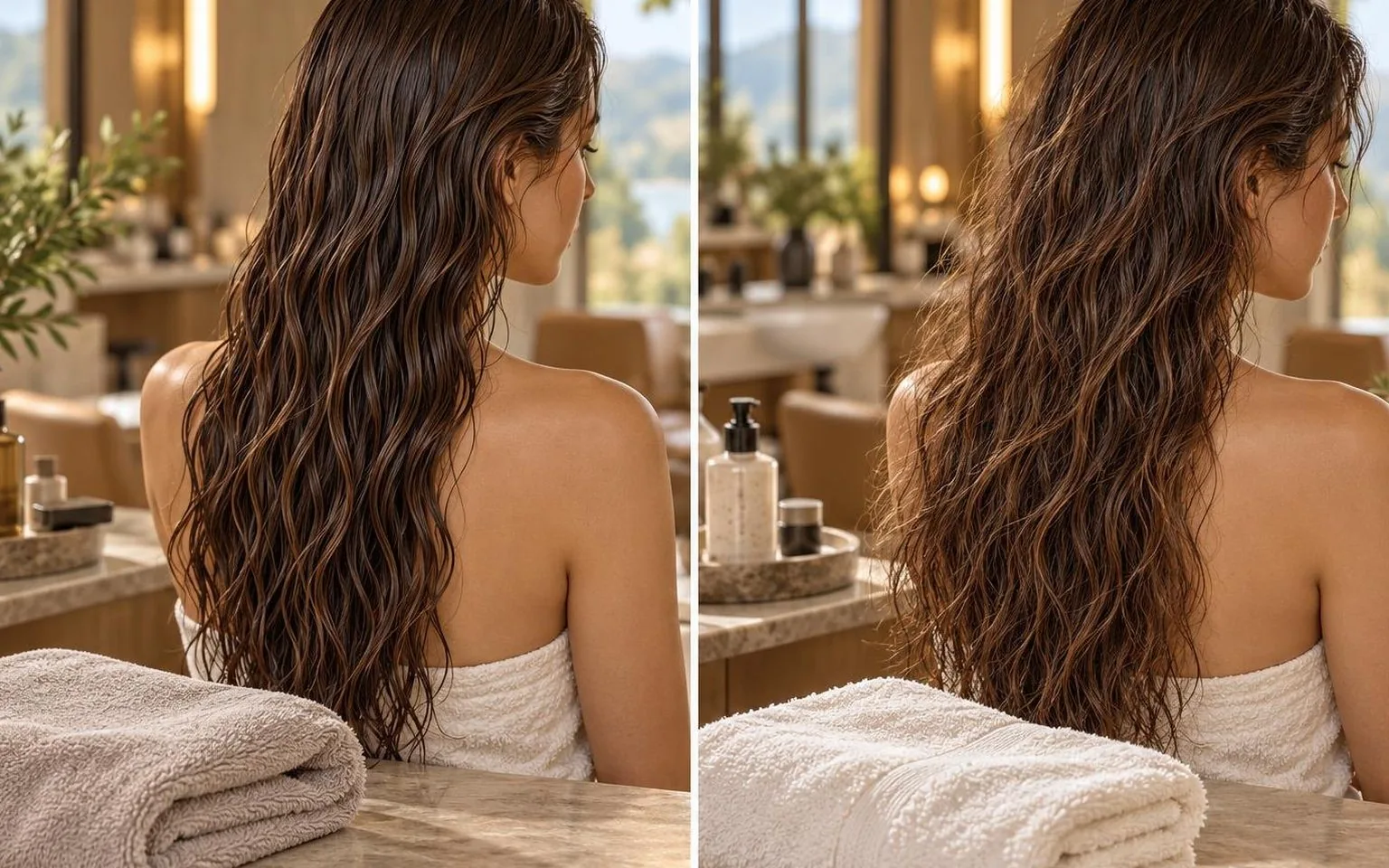
Three variables determine whether a towel helps or harms the cuticle during drying: fibre diameter, surface area per gram of fabric, and the friction coefficient against wet hair.
Microfibre alters all three in measurable ways that change moisture removal speed and mechanical stress.
Fibre Diameter and Capillary Action
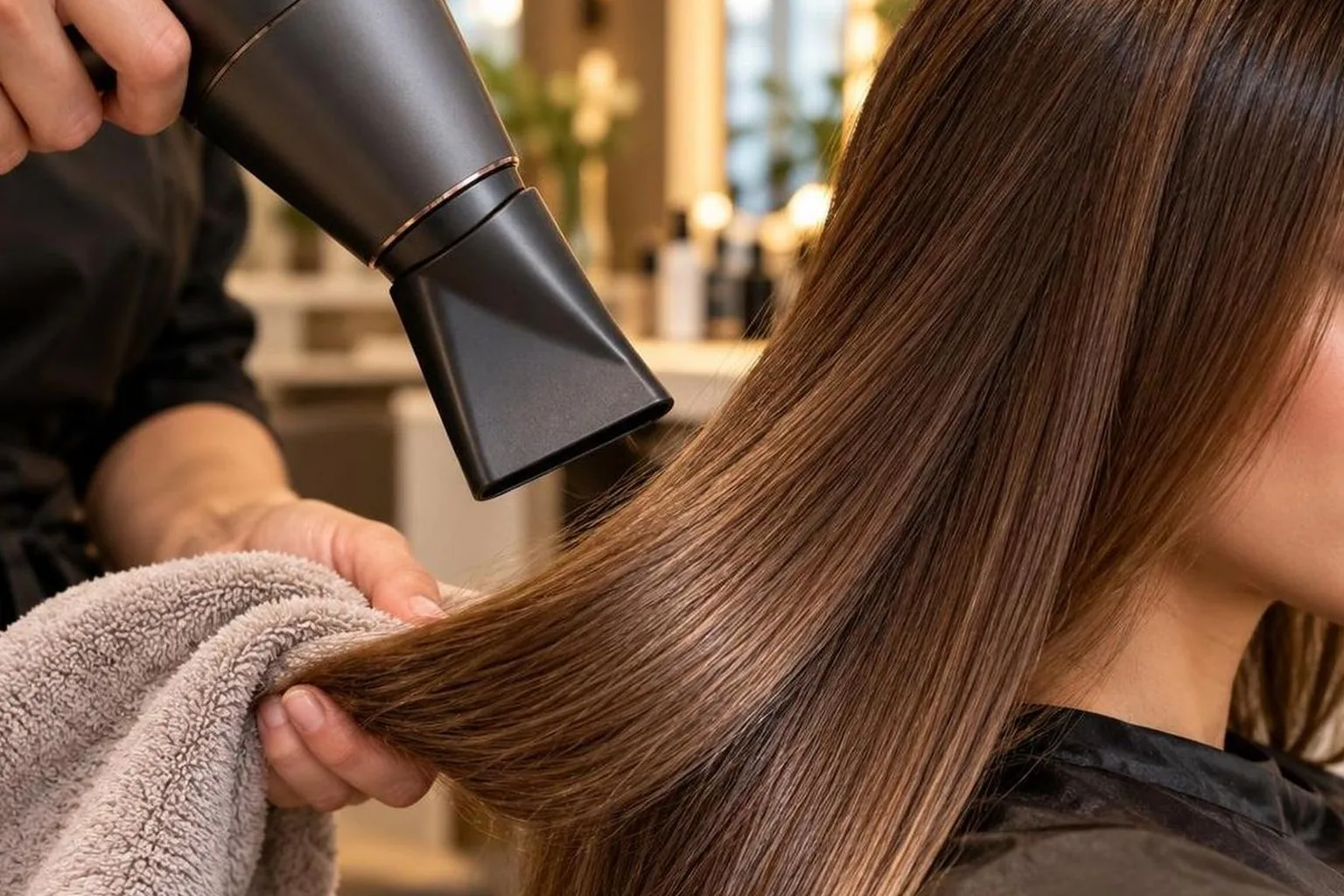
Standard cotton terry towels use fibres roughly 12–25 micrometres in diameter.
Microfibre towels use split polyester-polyamide filaments typically 0.5–1.0 micrometres in diameter — approximately 1/16 the width of a human hair strand.
Thinner fibres create narrower channels between strands. Capillary pressure is inversely proportional to channel width, so microfibre generates stronger wicking force per unit of fabric surface area.
This means microfibre pulls water away from the hair shaft through absorption rather than requiring the vigorous rubbing motion most people default to with cotton terry.
Absorbency by Weight
The absorptive capacity of each fabric type differs significantly relative to its own dry weight. Below is a comparison of typical performance ranges reported by textile manufacturers.
| Property | Cotton Terry | Microfibre (80/20 Poly/Polyamide) |
| Typical fabric weight | 400–600 GSM | 200–350 GSM |
| Water absorbed (× own weight) | Up to 7× | Up to 8× |
| Approximate dry time on hair (wrap method) | 25–40 min | 10–20 min |
| Typical towel dimensions (hair-specific) | 65 × 130 cm | 25 × 65 cm or 40 × 80 cm |
Microfibre achieves comparable or slightly higher absorption in a lighter, thinner fabric. This reduces the total weight sitting on the head during a turban wrap, lowering tension on wet roots.
Friction and Cuticle Disruption
Wet hair swells roughly 15–18% in diameter as water penetrates the cortex. In this swollen state the cuticle scales lift and become vulnerable to mechanical damage from friction.
Cotton terry loops catch and snag raised cuticle edges. The looped pile structure creates more contact points per square centimetre against the hair surface than a flat-weave microfibre.
Microfibre’s flat, dense weave presents a smoother contact plane. Stylists who blot rather than rub with microfibre report less visible frizz at the mid-lengths after blow-drying, consistent with reduced cuticle roughening.
What Actually Matters in Practice
- Technique overrides material. A cotton towel used with a gentle press-and-squeeze method causes less damage than a microfibre towel used with aggressive back-and-forth rubbing.
- GSM matters within microfibre. Budget microfibre towels below 200 GSM feel thin, absorb less, and require more passes over the hair. Target 280 GSM or above for salon-grade performance.
- Blend ratio affects grip. An 80/20 polyester-to-polyamide split is the most common blend for hair towels. Higher polyamide content (e.g., 70/30) increases softness and absorption but raises cost per unit.
- Towel size changes drying physics. Smaller microfibre wraps (25 × 65 cm) suit fine or short hair. Thicker or longer hair needs at least 40 × 80 cm to maintain adequate fabric-to-hair contact for effective wicking.
- Laundering degrades microfibre faster. Fabric softener coats the split fibres and reduces capillary performance. Wash microfibre towels at 40°C or below, without softener, to maintain absorption across roughly 200–300 wash cycles.
The Bottom Line for Blow-Dry Prep
Microfibre removes more water in less time with less friction. That means the hair arrives at the stylist’s chair 30–50% drier, reducing blow-dry duration by several minutes per client.
Fewer minutes under heat means less thermal stress. For a salon processing 15–20 blow-dry clients daily, cutting 3–4 minutes per appointment recovers meaningful chair time across a full schedule.
What a Good Result Looks Like
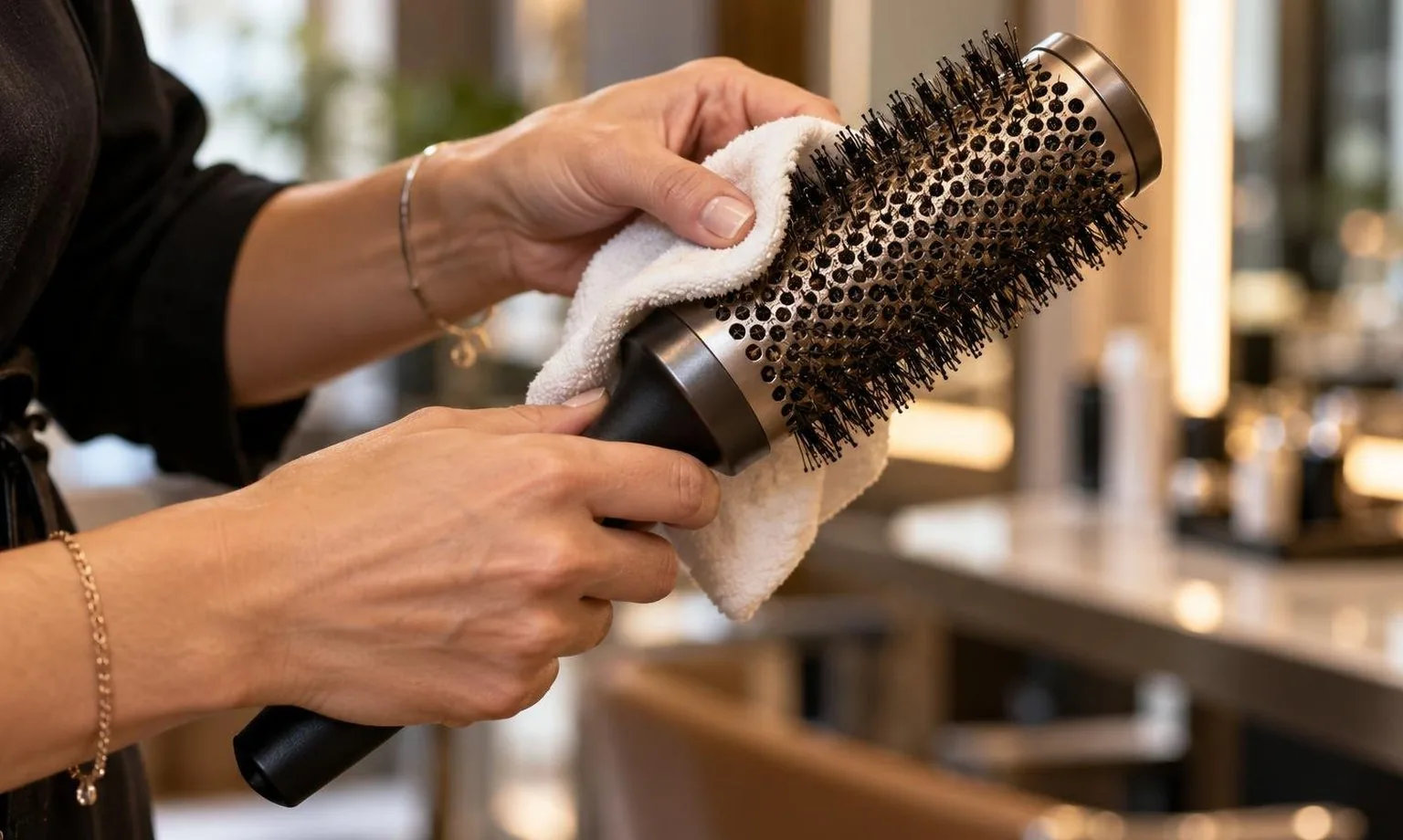
A good result means hair that reaches 80% dryness in roughly 15–20 minutes of passive towel-wrapping, with minimal frizz, no visible roughing of the cuticle layer, and reduced blow-dry time by approximately one-third.
The towel itself should feel damp but not dripping when removed.
Drying-Time Benchmarks by Towel Type
The table below compares passive wrap-drying performance on medium-density, shoulder-length hair (approximately 12 inches) without any blow-dryer assistance.
| Metric | Microfibre Towel | Regular Cotton Terry Towel |
| Weight (dry) | 90–120 g | 400–600 g |
| Water absorption capacity | Up to 7× its own weight | Approximately 3–4× its own weight |
| Time to 80% dryness (wrap only) | 15–20 minutes | 30–45 minutes |
| Typical fibre diameter | Under 10 micrometres | 12–20 micrometres |
| Surface friction on hair | Lower | Higher |
| Wet weight on head | 200–350 g | 700–1,200 g |
What You Should See in the Mirror
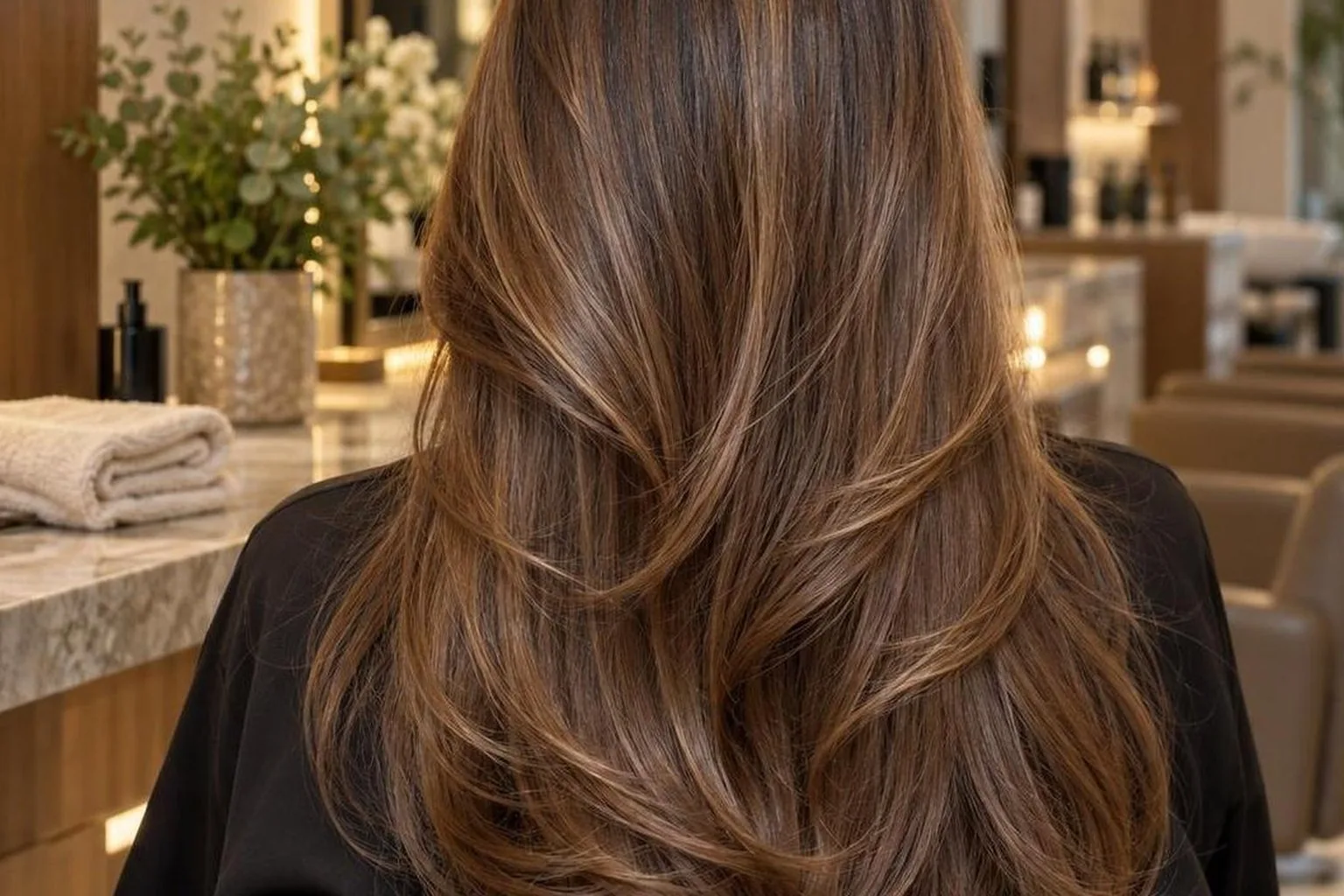
After removing a microfibre wrap, the hair shaft should look smooth under normal bathroom lighting. Flyaways along the hairline and crown should be noticeably fewer than after a terry-cloth rub-dry.
Cuticle disruption from rough towel friction shows up as a matte, straw-like texture. A good microfibre result preserves a subtle sheen even before any product or heat styling.
Part the hair at mid-shaft. Individual strands should feel cool and slightly damp, not wet-cold. If water beads still form when you squeeze a section, the towel needs more time or a second pass.
What You Should Feel
- Hair moves freely through fingers without snagging — a sign cuticle scales are lying flat.
- No heavy, waterlogged weight pulling at the root area.
- Scalp feels damp but not saturated; excess moisture has transferred into the towel fibres.
- Tangles limited to the lower 2–3 inches at most, detangling with a wide-tooth comb in under 30 seconds per section.
Blow-Dry Follow-Up Comparison
The real payoff shows during the blow-dry stage. Stylists working a standard round-brush blowout on pre-dried hair can compare total dryer time directly.
| Pre-Dry Method | Approximate Blow-Dry Time (Shoulder Length) | Heat Passes per Section |
| Microfibre wrap, 20 min | 12–18 minutes | 3–4 |
| Cotton terry wrap, 20 min | 22–30 minutes | 5–7 |
| Cotton terry rub-dry, 5 min | 20–28 minutes | 5–7, plus frizz correction |
Fewer heat passes translate to less thermal damage per service. For a stylist running 8–10 blowout appointments in a shift, saving 8–12 minutes per client is operationally significant.
Red Flags: When the Result Is Not Right
- Hair still dripping after 20 minutes of wrapping — the towel may be oversaturated or too small for the hair volume. Standard microfibre hair towels measure approximately 65 cm × 25 cm; thicker or longer hair needs a larger format, around 110 cm × 40 cm.
- Frizz concentrated at the crown and hairline — the wrap was too tight or the towel was rubbed back and forth instead of scrunched.
- Static after removal — common in very dry environments below 30% humidity. A light leave-in mist before wrapping helps.
- Musty odour from the towel itself — microfibre requires washing every 3–4 uses in water no hotter than 40 °C, without fabric softener, which clogs the fine fibres and reduces absorption.
The Bottom Line for Professionals
A properly executed microfibre pre-dry should leave hair at a state stylists call “towel-dry ready” — 70–80% dry, smooth, and workable.
That baseline cuts blow-dry chair time and reduces cumulative heat exposure across every appointment.
Weighed Against What Else Is Used
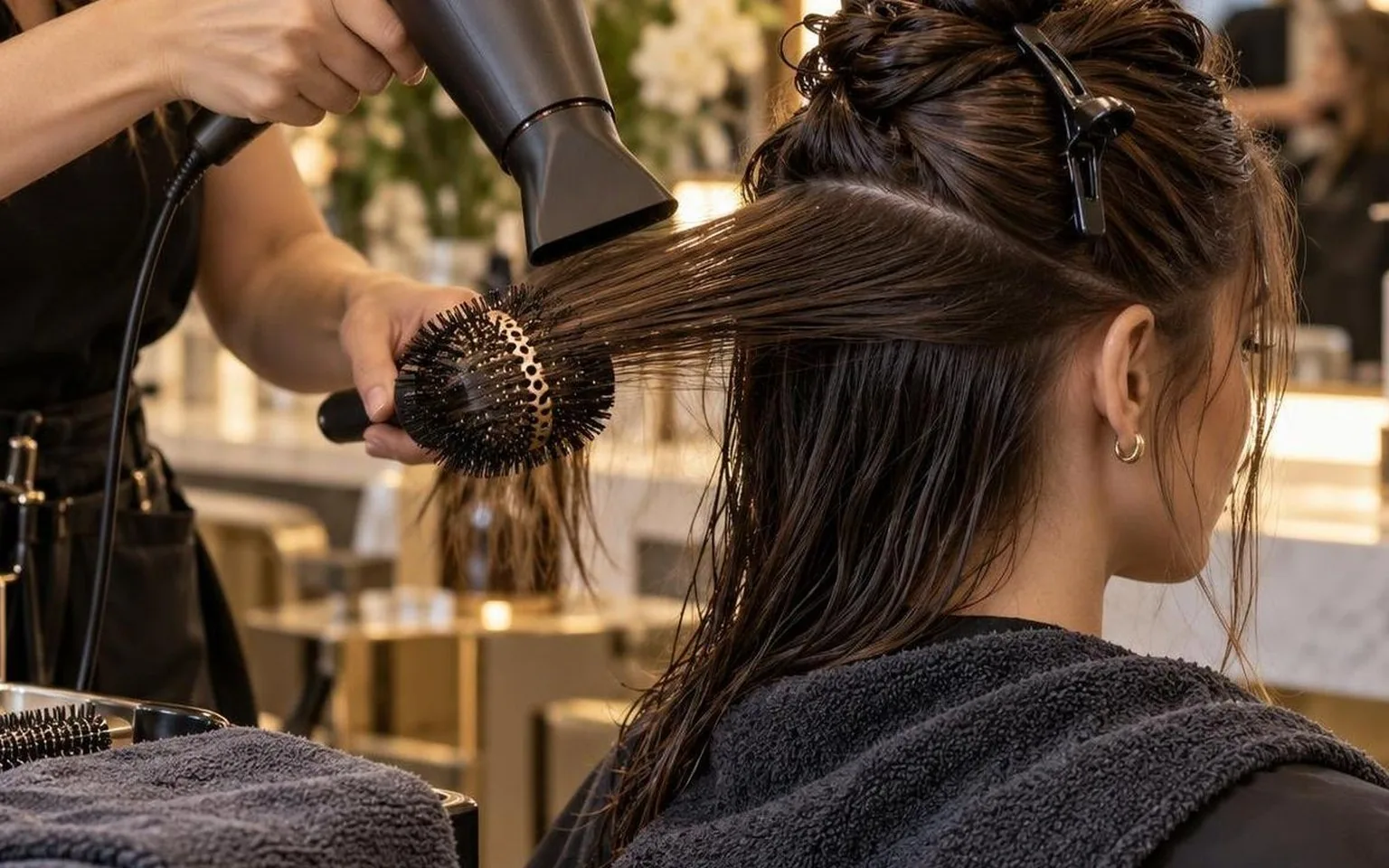
Microfibre towels, standard cotton terry towels, and T-shirt cotton each interact with wet hair differently. The comparison hinges on three measurable factors: fibre diameter, water absorption rate, and surface friction against the cuticle layer.
Microfibre filaments measure roughly 0.5–1.0 denier, compared with 1.5–2.5 denier for standard cotton terry.
That smaller diameter means more individual fibres per square centimetre of fabric, creating greater capillary action to draw water away from the hair shaft.
Fibre and Fabric Comparison
| Property | Microfibre | Cotton Terry | T-Shirt Cotton (Jersey Knit) |
| Typical fibre diameter | 0.5–1.0 denier | 1.5–2.5 denier | 1.0–1.5 denier |
| Water absorption (× own weight) | Up to 7× | Up to 4× | Up to 3× |
| Surface texture | Smooth, flat weave or plush | Looped pile | Flat, single knit |
| Typical towel weight | 80–120 g | 300–600 g | Varies (repurposed garment) |
| Drying time (air, room temp ~21 °C) | ~1–2 hours | ~4–8 hours | ~2–3 hours |
Cotton terry’s looped pile structure is the core problem. Wet hair cuticles are raised and open. Loops snag those lifted cuticle edges, generating friction that roughens the hair surface and increases tangles.
Microfibre’s flat or split-weave construction reduces that snagging. The fabric contacts the hair shaft over a broader, smoother plane, distributing pressure more evenly during the blotting and scrunching stages of drying.
The T-Shirt Method
Many stylists recommend an old cotton T-shirt as a low-cost alternative to microfibre. Jersey knit has no loops, which eliminates the snag issue associated with terry cloth.
However, T-shirt cotton absorbs significantly less water — roughly 3× its own weight versus microfibre’s 7×. That means longer contact time on the hair or more passes to reach the same moisture reduction before blow drying.
For salon throughput, that difference matters. An extra 2–3 minutes of towel-drying per client across a full column of 8–12 appointments adds 16–36 minutes of non-billable time per stylist per day.
Friction and Cuticle Impact
Rubbing any towel vigorously against wet hair causes mechanical damage. The technique matters as much as the fabric.
Blotting or gently scrunching — rather than back-and-forth rubbing — minimises cuticle disruption regardless of towel type.
That said, the coefficient of friction differs between materials. Microfibre’s split fibres grip water rather than hair, whereas cotton terry’s loops grip both. This distinction makes microfibre more forgiving when technique is imperfect.
Practical Salon Considerations
- Laundering: Microfibre should be washed at 40 °C or below with no fabric softener, which clogs the split fibres and reduces absorbency. Cotton terry tolerates 60 °C and standard detergents.
- Lifespan: Microfibre towels maintain performance for approximately 200–500 wash cycles. Quality cotton terry lasts a similar number of cycles but loses pile density and absorbency sooner.
- Weight on the head: A wet microfibre hair towel weighs roughly 150–200 g total when saturated. A saturated cotton terry towel can exceed 700 g, adding neck strain during a turban wrap lasting 5–10 minutes.
- Lint transfer: New cotton terry sheds lint onto freshly washed hair. Microfibre produces virtually zero lint after the first wash.
Which Towel for Which Hair Texture
Fine, straight hair benefits most from microfibre because it reaches a blow-dry-ready moisture level — around 60–70% dry — faster, typically in 3–5 minutes of gentle scrunching.
Coily and tightly curled textures (Type 4a–4c) also benefit from microfibre’s reduced friction, but may need two towels or a longer wrap time of 8–12 minutes to achieve similar moisture reduction before diffusing.
Cotton terry remains adequate for thick, coarse hair that tolerates more mechanical handling, provided the stylist blots rather than rubs. It is not the optimal choice, but the damage differential narrows with correct technique.
Frequently Asked Questions
What fibre diameter makes microfibre towels less abrasive to hair cuticles?
Microfibre strands measure roughly 1/100th the diameter of a human hair, typically under 10 micrometres. This finer contact surface creates less friction against the cuticle layer during blotting.
Regular cotton terry loops are approximately 12–15 micrometres, generating more mechanical drag on wet, vulnerable strands.
How much faster does microfibre absorb water compared to cotton terry?
Microfibre can absorb up to seven times its weight in water, while standard cotton terry absorbs roughly 25–27 times its own weight but releases moisture far more slowly.
The capillary action between split microfibres wicks water away from the hair shaft faster, reducing the total time hair stays saturated.
Does towel choice affect frizz levels during a blowout?
Friction lifts the cuticle, which scatters light and creates frizz. Microfibre’s smooth, densely packed weave causes less cuticle disruption than looped cotton terry.
Stylists who pre-dry with microfibre report noticeably smoother results before the round brush even touches the hair, cutting rough-dry time by roughly 2–3 minutes.
What GSM weight should a salon look for in a microfibre hair towel?
A GSM between 300 and 400 balances absorbency with manageable bulk. Below 250 GSM the towel saturates too quickly on thick, long hair.
Above 400 GSM the towel becomes heavy when wet and harder to turban-wrap securely, adding unnecessary weight and tension at the roots.
How should microfibre hair towels be laundered to preserve performance?
Wash at 40 °C or below with a small dose of liquid detergent. Skip fabric softener entirely — it coats the split fibres and kills absorbency. Tumble dry on low heat or air dry.
Most salon-grade microfibre towels maintain peak performance for 200–300 wash cycles under these conditions.
Can a regular cotton towel cause mechanical breakage on wet hair?
Wet hair loses roughly 30% of its tensile strength. Vigorous rubbing with a cotton terry towel creates torsional stress that snaps weakened strands, particularly at mid-lengths.
A scrunching or blotting technique with any towel reduces this risk, but microfibre’s lower friction surface provides a wider margin for error.
What towel wrap technique minimises tension at the hairline?
Flip hair forward, lay the towel flat across the nape, roll both sides inward toward the crown, then twist once and tuck the tail at the forehead. Keep the wrap loose enough to slide two fingers underneath at the temples.
Microfibre’s grip holds this wrap without needing a tight twist.
Are waffle-weave microfibre towels better than flat-weave for blowout prep?
Waffle-weave microfibre creates small air pockets that boost evaporation speed, making it slightly more efficient for thick or high-density hair. Flat-weave is thinner, lighter, and better suited for fine hair that needs less moisture removal.
Both outperform cotton terry on friction reduction.
How long should hair stay wrapped in a towel before blow drying?
With microfibre, 5–10 minutes of wrapping typically removes enough excess water to begin rough-drying efficiently. Cotton terry takes closer to 10–15 minutes to reach the same dampness level.
Over-wrapping beyond 15 minutes in either fabric can cause hygral fatigue from prolonged moisture contact.
Is there a measurable difference in drying time when switching from cotton to microfibre pre-dry?
Salon tests consistently show a 20–30% reduction in total blow-dry time when microfibre replaces cotton terry in the pre-dry step.
On medium-density, shoulder-length hair, that translates to roughly 3–5 fewer minutes under heat, which reduces cumulative thermal exposure across a full day of client bookings.
Related Reading
- How long a hair dryer lasts, and what shortens it
- Diffuser or concentrator: which nozzle when
- Boar, nylon or mixed: choosing round brush bristles
- What heat protectant does, and what it cannot do
- When a round brush is worn out, and how to tell
- Paddle or round: which brush does which job
- How long a dryer can run before it needs a rest
- What a diffuser does that a concentrator cannot
- Hair dryer wattage, and why more is not better
- The complete guide to blow dry tools