

salon employee vs contractor is decided by control: the business sets hours, prices, and methods for an employee, while a contractor controls those choices.
The label alone does not settle classification; daily practice, written terms, payment structure, and independence matter when assessing the arrangement.
For owners, the decision affects scheduling, supervision, payroll handling, records, and the way services are presented to clients.
For stylists, it affects autonomy, predictable income, equipment, workspace, and responsibility for business costs. Comparing both models prevents a contract from disguising an employee-style relationship.
This guide breaks down practical tests, salon-floor examples, and questions to document before signing. Use the comparison to review who directs each service, who bears financial risk, and whether the working arrangement matches its paperwork.
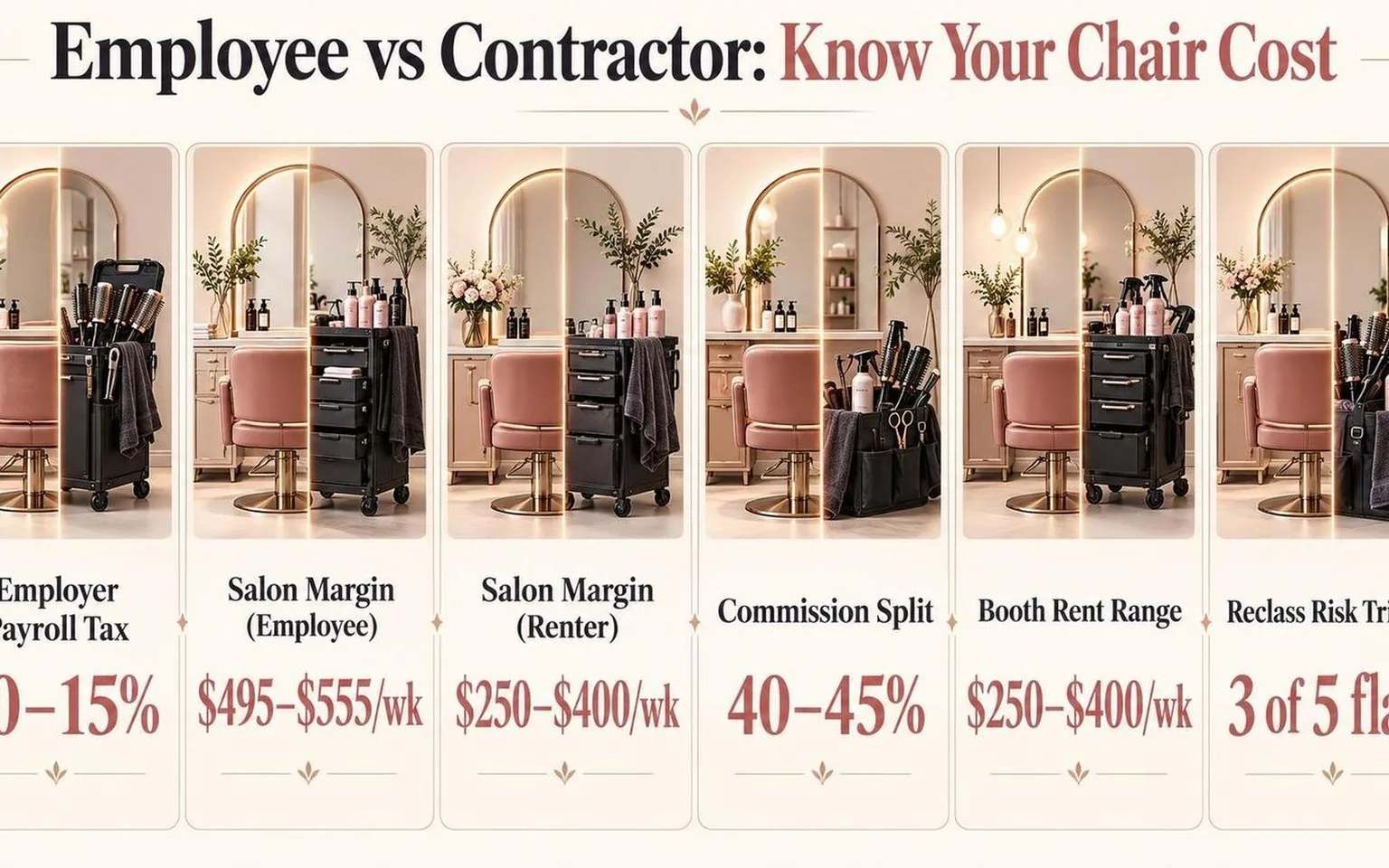
Score Your Setup Right Now
Before reading further, run through this five-point checklist to see where your current arrangement actually falls on the employee-versus-contractor spectrum.

- Schedule control. Open your booking system. If you set the stylist’s hours — even a flexible window like 9 AM–5 PM, three days a week — that weighs toward employee status. If the stylist books their own clients with zero input from you, that leans contractor.
- Tool ownership. Count the dryers, brushes, and chairs the stylist personally owns and brings in. A contractor typically supplies their own primary tools — a full kit worth £/$800 or more. If your salon provides everything down to the Denman D3 brush, that signals employment.
- Client list. Check who holds the client contact details. If all bookings funnel through your front desk or your salon software, the relationship looks employer-employee. A genuine contractor maintains and markets their own list.
- Payment structure. Pull the last four pay records. Flat hourly rates (e.g., $18/hr) indicate employment. Commission-only or booth rent at a fixed weekly rate ($250–$400/week) tilts toward contractor.
- Substitution rights. Ask one question: can the stylist send a qualified replacement without your approval? If no, that is an employee marker under both IRS and HMRC guidance.
Tally the items that lean “employee.” Three or more out of five means reclassification risk is real — read on.

The Figures Behind It
Classifying a stylist as an employee rather than an independent contractor changes the cost of that chair by roughly 20–30 percent once taxes, insurance, and benefits are factored in.
The gap widens or narrows depending on state, revenue per ticket, and whether you offer benefits.
The employer’s share of federal payroll obligations sets the baseline. These are non-negotiable costs that disappear entirely under a contractor model.
| Tax or Contribution | Employer Rate (Employee Model) | Contractor Model |
| Social Security (FICA) | 6.2% of wages up to the taxable wage base | 0% — worker pays full 12.4% |
| Medicare | 1.45% of all wages | 0% — worker pays full 2.9% |
| Federal Unemployment (FUTA) | 6.0% on first $7,000 per worker (before credit) | 0% |
| State Unemployment (SUTA) | Varies; new-employer rates typically 1.0–5.4% | 0% |
| Workers’ Compensation Insurance | Required in nearly all states; beauty-sector premiums often $0.50–$2.00 per $100 of payroll | 0% |
Combined, the mandatory employer-side burden runs approximately 10–15 percent of gross wages before any voluntary benefits are added.
Commission vs. Booth Rent: A Side-by-Side Scenario
Consider a stylist generating $1,200 per week in blowout and styling services. The table below models take-home and salon cost under each structure.
| Line Item | Employee (Commission) | Booth Renter (Contractor) |
| Gross service revenue | $1,200 | $1,200 |
| Stylist’s share | $480–$540 (40–45% commission) | $1,200 minus rent |
| Weekly booth rent paid to salon | N/A | $250–$400 typical range |
| Salon revenue after stylist pay | $660–$720 | $250–$400 (rent only) |
| Employer payroll taxes (~7.65% FICA + FUTA/SUTA) | $48–$59 | $0 |
| Workers’ comp estimate | $5–$11 | $0 |
| Product cost borne by salon | $60–$96 (5–8% of revenue) | $0 — contractor supplies own |
| Net salon margin per stylist per week | ~$495–$555 | $250–$400 |
The employee model delivers a higher gross margin per stylist when the chair stays busy. The contractor model delivers a fixed, predictable income regardless of no-shows or slow days.
Hidden Cost Multipliers on the Employee Side
- Paid time off: Offering two weeks of PTO adds roughly 3.8% to annual labor cost.
- Health insurance contribution: The average employer contribution toward a single-coverage plan runs approximately $7,000–$8,000 annually per the Kaiser Family Foundation Employer Health Benefits Survey.
- Training hours: Onboarding a junior stylist typically absorbs 40–80 hours of supervised floor time, paid at base wage with zero direct revenue.
- Payroll processing: Third-party payroll services charge $4–$8 per employee per pay period on average.
The Contractor Cost That Does Not Appear on Your Books
Contractors set their own schedules under IRS guidelines. That means you cannot mandate Saturday coverage, require attendance at 9 a.m. team meetings, or dictate which products touch the client’s hair.
Loss of scheduling control hits blow dry bars hard. Peak demand clusters between Thursday 4 p.m. and Saturday 2 p.m. A contractor who opts out of Friday evening leaves a chair empty during a salon’s highest-yield hours.
Misclassification penalties are severe. The IRS can assess 100 percent of the employee-side FICA that should have been withheld, plus the employer share, plus penalties and interest.
State labor departments may add back-owed unemployment insurance and workers’ compensation premiums independently.
The numbers make the choice situational, not obvious. High-volume blow dry bars with predictable traffic usually recoup the employee overhead through scheduling control and brand consistency.
Lower-volume or single-chair studios often find the contractor model leaner and simpler to administer.

Where the Difference Comes From
The distinction originates in federal tax law, specifically IRS common-law rules codified under IRC Section 3121(d). The IRS uses a behavioral control, financial control, and relationship-type framework to classify workers.
State labor departments layer additional tests on top of that federal baseline.
The IRS framework has three prongs. Each one examines a different dimension of the working relationship between salon owner and stylist.
Behavioral Control
This prong asks whether the salon directs how, when, and where the work is performed. Dictating shift schedules, mandating specific blowout techniques, or requiring attendance at training sessions all point toward employee status.
A contractor, by contrast, controls the method.
If a stylist chooses her own round-brush diameter — 43 mm versus 53 mm — sets her own booking calendar, and declines appointments without penalty, those facts support independent contractor classification.
Financial Control
This prong examines who bears the economic risk and who controls the business side of the arrangement. Five factors matter here.
| Factor | Points to Employee | Points to Contractor |
| Investment in equipment | Salon supplies all dryers, brushes, product | Stylist owns her own Dyson Supersonic, brush kit, finishing products |
| Unreimbursed expenses | Salon covers all costs | Stylist absorbs cost of replacement nozzles, continuing-education fees |
| Opportunity for profit or loss | Fixed hourly wage (e.g., $16–$22/hr) | Sets own prices, earns per client, risks empty chairs |
| Services available to the market | Works exclusively at one location | Serves clients at multiple salons or on-location |
| Method of payment | Regular payroll with W-2 | Invoices salon, receives 1099-NEC for payments of $600 or more |
Relationship Type
Written contracts matter but are not decisive on their own. The IRS looks past the label to the substance. A contract titled “Independent Contractor Agreement” will not override behavioral and financial facts pointing to employment.
Permanency weighs heavily. An indefinite, full-time arrangement suggests employment. A stylist booked for a 6-week bridal-season pop-up suggests a contractor relationship.
Benefits provision is another indicator. Offering paid vacation, health insurance, or retirement contributions signals an employer-employee relationship under IRS guidelines.
The State Layer
Federal classification is only the floor. Many states apply the stricter ABC test, which presumes a worker is an employee unless all three conditions are met.
- A: The worker is free from control and direction in performing the service.
- B: The service is performed outside the usual course of the hiring entity’s business.
- C: The worker is customarily engaged in an independently established trade or occupation of the same nature.
Prong B is the critical obstacle for blow dry bars. A stylist performing blowouts is clearly working within the salon’s usual course of business, making contractor classification extremely difficult under the ABC test.
California, New Jersey, Illinois, and Massachusetts all enforce versions of the ABC test. In those states, most in-chair stylists will default to employee status regardless of what the contract states.
Texas and Florida, by contrast, still rely primarily on the IRS common-law test, giving salon owners more flexibility in structuring contractor arrangements — provided the actual working conditions support that classification.
Why Misclassification Carries Weight
The IRS reports that misclassified workers cost the federal government billions in unpaid employment taxes annually.
Penalties for a salon caught misclassifying include 1.5% of wages for failure to withhold income tax plus 20% of the employee’s share of FICA taxes.
State-level penalties stack on top. Unpaid unemployment insurance, workers’ compensation premiums, and back wages with interest can accumulate rapidly. Several states also impose per-worker, per-day fines that escalate with repeat violations.
The distinction is not cosmetic. It is structural, rooted in statutory frameworks that regulate tax obligations, liability, and worker protections at both federal and state levels.

What a Good Result Looks Like
A good result is a workforce structure where classification matches reality, labor costs are predictable, and the salon faces zero misclassification liability.
The owner retains the talent pipeline needed to deliver consistent blowout quality while staying compliant with IRS and state labor rules.
Financial Benchmarks for a Healthy Model
Labor cost as a percentage of revenue is the single most important metric. The target range differs by classification model.
| Metric | Employee Model | Contractor (Booth Rent) Model |
| Labor cost as % of service revenue | 40–50% | N/A (rent replaces payroll) |
| Typical commission split | 40–55% to stylist | 100% to stylist (minus rent) |
| Booth rent range (weekly) | N/A | $150–$400 depending on market |
| Employer payroll tax burden (FICA, FUTA, SUTA) | 7.65–10% of gross wages | 0% |
| Workers’ comp insurance | Required in most states | Not required for ICs |
| Profit margin target (pre-tax) | 10–18% | 15–25% |
Booth-rent models show higher owner margins on paper, but the owner controls neither service quality nor scheduling — a serious problem for blow dry bars built on consistency.
Operational Indicators of Correct Classification
An IRS audit does not care what you call the worker. It cares what the worker actually does. A good result means the daily reality matches the contract.
- Employees: Owner sets hours, supplies all tools (dryers, brushes, product), trains staff on house technique, sets pricing, and handles booking.
- Contractors: Stylist chooses own hours, brings own tools, sets own prices, markets independently, and serves their own client list.
If a stylist labeled “contractor” must follow a set schedule, use salon-provided Dyson Supersonic dryers, and charge the salon’s posted prices, the classification is wrong — regardless of what the 1099 says.
Retention and Culture Metrics
Employee-model salons that classify correctly tend to see annual stylist turnover between 30–40%, which is considered manageable in the beauty industry.
Contractor-model turnover often exceeds 50% because no non-compete or loyalty structure exists.
A good result on retention looks like this:
| Indicator | Good Result (Employee) | Good Result (Contractor) |
| Average stylist tenure | 18–36 months | 12–18 months |
| Client rebooking rate | 55–70% | 40–55% |
| Schedule fill rate (weekly) | 75–85% | 60–75% |
| Online review consistency (4+ stars) | High (owner controls quality) | Variable |
Compliance Checkpoints
A properly structured salon can pass three tests without scrambling:
- IRS 20-Factor Test: Evaluates behavioral control, financial control, and relationship type between salon and worker.
- ABC Test (used in California, New Jersey, Massachusetts, and other states): Presumes worker is an employee unless the hiring entity proves all three prongs — freedom from control, work outside usual business, and independently established trade.
- State unemployment audits: Triggered when a former worker files for unemployment benefits. Misclassified contractors discovered here generate back-tax assessments averaging 3–5 figures per worker.
The Bottom Line for Blow Dry Bars
Most blow dry bars need tight quality control, standardized timing (typically 30–45 minutes per blowout), and consistent pricing. That operational reality points strongly toward the employee model for front-line stylists.
A good result is not simply cheaper labor. It is the structure where your classification, your contracts, your daily operations, and your tax filings all tell the same story — with no gap an auditor can exploit.

How It Compares to the Alternatives
The employee-versus-contractor decision sits alongside other staffing models: booth rental, salon suites, and hybrid commission-plus-rental arrangements.
Each structure shifts tax burden, scheduling control, and product cost responsibility in different directions, directly affecting a blow dry bar’s margins and culture.
Core Structural Differences
| Factor | W-2 Employee | 1099 Contractor | Booth Renter | Suite Renter |
| Employer payroll tax burden | 7.65% FICA match | None | None | None |
| Workers’ comp required | Yes, in most states | Varies by state | No | No |
| Owner sets schedule | Yes | No | No | No |
| Owner supplies tools/product | Typically yes | No (IRS guideline) | No | No |
| Owner controls pricing | Yes | Risky to enforce | No | No |
| Client belongs to | Salon | Gray area | Stylist | Stylist |
Tax and Cost Implications
Hiring a W-2 employee costs roughly 20–30% above gross wages once you factor in the employer FICA match, federal unemployment tax (FUTA) at 6% on the first $7,000 of wages, state unemployment, and workers’ compensation premiums.
A 1099 contractor eliminates those costs but restricts how much operational control you can exercise. The IRS uses a three-category test — behavioral control, financial control, and relationship type — to determine classification.
Booth renters pay a fixed weekly or monthly fee, commonly ranging from $100 to $400 per week depending on metro area and foot traffic. The salon owner collects predictable rent but loses influence over service quality and brand consistency.
Suite renters operate essentially as independent businesses. They lease a private room, typically 100–200 square feet, set their own hours, and build their own clientele with no revenue share to the building owner beyond rent.
Where Blow Dry Bars Differ from Traditional Salons
Blow dry bars depend on speed, brand uniformity, and high daily client volume. A single styling station in a busy location may turn over 8–12 clients per day during peak periods. That throughput model demands scheduling authority.
Contractor and booth-rental arrangements legally prohibit the owner from mandating shift times, dress codes, or specific technique sequences. For a blow dry bar selling a consistent 45-minute service at a set price, this restriction creates friction.
Employee status allows owners to enforce standardized blowout menus, require attendance at technique training.
And mandate the use of specific dryers and brushes — a 53 mm round brush for volume sets versus a paddle brush for sleek finishes, for instance.
The Hybrid Model
Some salons use a commission-to-rental graduation path. Stylists begin as W-2 employees earning 40–50% commission, then transition to booth rental once they build a client base above a set weekly threshold.
This model hedges risk for the owner during a stylist’s ramp-up period while offering a clear incentive structure. It also reduces misclassification exposure because the employment phase is documented with proper payroll records.
Misclassification Risk
- The IRS can impose a penalty equal to 100% of the unpaid employer FICA taxes for willful misclassification.
- Many states, including California under AB 5’s ABC test, presume worker status is employee unless the hiring entity proves otherwise across all three prongs.
- Back-owed unemployment insurance, interest, and state penalties compound quickly — audits often cover multiple prior filing periods.
The safest path for high-volume blow dry bars is the W-2 model. It costs more per head but preserves the scheduling control, brand standards, and technique consistency the format requires.
Booth rental and suite rental suit established stylists with loyal followings. They rarely fit the fast-paced, menu-driven structure that defines blow dry bar operations.

Heat and Tension Without the Damage
The employee-vs-contractor distinction is not about styling technique — it is about legal classification, tax liability, and how much control an owner exercises over the person holding the dryer.
Getting it wrong exposes a salon to back-tax penalties, lawsuits, and loss of workers’ compensation coverage.
The IRS uses a three-category framework — behavioral control, financial control, and relationship type — to determine worker status. No single factor is decisive; the agency weighs the totality of the arrangement.
Behavioral Control
If the salon dictates when a stylist works, which products to use, and how to perform a blowout, that stylist is almost certainly an employee under IRS guidelines.
Contractors set their own schedules, choose their own tools, and decide their own methods. The salon can specify the end result but not the process.
| Factor | Employee Indicator | Contractor Indicator |
| Schedule | Salon assigns shifts | Stylist sets own hours |
| Training | Salon requires specific technique training | Stylist brings existing skill set |
| Tools and products | Salon supplies dryers, brushes, products | Stylist provides own equipment |
| Client assignment | Salon routes clients to stylist | Stylist builds and owns client book |
| Dress code | Salon enforces uniform or appearance standard | No appearance mandate |
Financial Control
Employees receive a guaranteed hourly wage or salary. The salon bears the economic risk — slow days still cost payroll dollars.
Contractors invoice for services, can negotiate rates, and absorb their own business expenses. They have a genuine opportunity for profit or loss independent of the salon’s revenue.
| Financial Factor | Employee | Contractor |
| Payment structure | W-2 wages, withheld taxes | 1099-NEC, no withholding |
| Expense reimbursement | Salon covers supplies | Stylist covers own costs |
| Investment in equipment | Minimal personal investment | Significant personal investment |
| Ability to work for competitors | Often restricted | Free to serve multiple salons |
Tax and Penalty Exposure
Misclassifying an employee as a contractor triggers the employer’s share of FICA taxes — 7.65% of wages — plus penalties. The IRS can assess a penalty equal to 1.5% of wages for failure to withhold income tax.
State-level consequences vary. California’s AB 5 applies a strict “ABC test,” and violations can result in fines of $5,000 to $25,000 per violation under the state Labor Code.
Massachusetts presumes every worker is an employee unless all three prongs of its own ABC test are met. The burden of proof falls on the salon owner.
Practical Steps for Salon Owners
- File IRS Form SS-8 to request an official worker-status determination if classification is unclear.
- Draft written agreements that specify the relationship, payment terms, and scope of work — but remember that a contract alone does not override actual working conditions.
- Audit current arrangements against the behavioral and financial control factors at least once per fiscal quarter.
- Keep booth-rental agreements separate from any service-level requirements that imply employer control.
- Consult a labor attorney licensed in your state before converting employees to contractors or vice versa.
Why It Matters at the Chair
A stylist classified as an employee gains access to unemployment insurance, overtime protections, and employer-contributed benefits. A contractor gains autonomy but shoulders self-employment tax of 15.3% on net earnings.
Neither model is inherently better. The correct classification depends on the actual working relationship, not the label either party prefers.
Structure the arrangement honestly, document it thoroughly, and revisit it whenever the day-to-day reality shifts.

Frequently Asked Questions
What is the key legal distinction between a salon employee and an independent contractor?
An employee works under the salon’s control regarding schedule, pricing, and methods. A contractor sets their own hours, supplies their own tools, and determines service pricing.
The IRS uses a behavioral-control, financial-control, and relationship-type framework to classify workers.
Who pays for tools and products — the salon or the stylist?
Employees typically use salon-provided dryers, brushes, and backbar products. Contractors supply their own equipment, from their 75 mm round brush to their preferred finishing spray.
If the salon furnishes all tools, that weighs toward an employment classification under most state tests.
How does chair rental pricing typically work for contractors?
Booth renters pay a fixed weekly or monthly fee for station access, utilities, and sometimes reception services. Rates vary significantly by city and foot traffic.
The contractor keeps all remaining revenue after rent, but handles their own taxes, insurance, and product purchasing independently.
What tax obligations differ between the two classifications?
Salons withhold income tax, Social Security (6.2%), and Medicare (1.45%) for employees. Contractors receive a 1099-NEC and pay self-employment tax of 15.3% themselves.
Misclassifying an employee as a contractor exposes the salon to back taxes, penalties, and interest from the IRS and state agencies.
Can a salon set a contractor’s working hours or dress code?
Dictating specific shift times, mandatory dress codes, or requiring attendance at staff meetings signals an employment relationship. Contractors choose when and how they work.
Imposing these controls while classifying someone as a contractor is the single most common trigger for misclassification audits.
Which model offers better staff retention for a blow dry bar?
Employment models give owners control over service standards, consistent scheduling, and team training — critical for maintaining blowout quality across 30-minute appointment slots.
Contractor models reduce payroll overhead but increase turnover. Most multi-chair blow dry bars favor W-2 employment to protect brand consistency and client experience.
Related Reading
- The blow dry bar business model, explained
- EPLI for salons: when it starts to matter
- Insuring a stylist's hands: what cover exists
- Pricing a blowout: the four inputs that set the number
- The types of salon insurance, and what each covers
- What a booth renter actually takes home
- Chair renters and insurance: who covers what
- The complete guide to the blow dry bar business
- IRS — Independent Contractor vs. Employee
- SBA — Hiring and Managing Employees
- U.S. Small Business Administration — Business Taxes
- Professional Beauty Association
- IRS — Forms and Instructions for 1099
- IRS — Employer's Tax Guide (Publication 15)
- IRS — SS-8 Determination of Worker Status
- Cornell Law Institute — Employee Definition (FLSA)